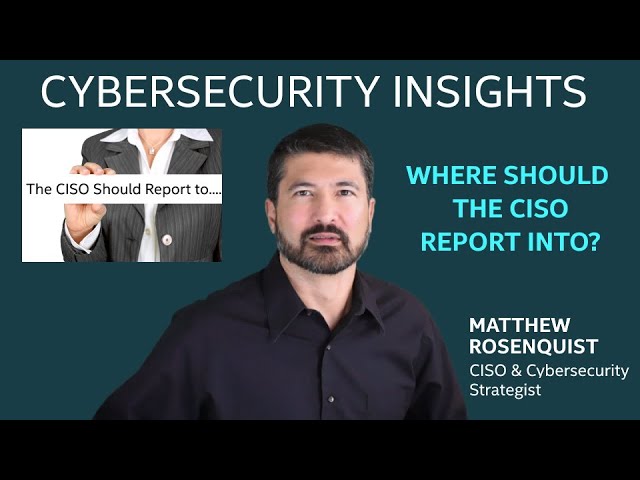
A CISO reporting to IT, HR, or finance inherits that function's priorities, misaligning security with actual risk. The speaker argues CISOs should report directly to the CEO with board access for independence and budget authority, though regulatory needs or uptime demands may require reporting to legal or IT instead.
Chapters
Where should a CISO report into? The CIO? Into IT? Uh, CTO? Into the legal department? Maybe to the CEO? I hear these conversations often, and the answer is likely not what you might expect. So let's break down some of the factors. First off, we have to understand that there can absolutely be competing priorities when it comes to cybersecurity. So take for example the IT department, right? The executive that leads the IT department, in their mind, in most cases, their priority is about keeping the infrastructure up and running, or the availability of the infrastructure. It might be the website, it might be the network, it might be the database, whatever, But that's really kind of how they're gauged from a success criteria. Make sure it's up and running. Make sure it's functional. Okay, but if you look at, let's say, HR, and you ask them, well, what's important to you for cybersecurity? They'll probably— they're still worried about availability, but that's probably lower on the list. What would top their list more likely would be the confidentiality of the data that they possess. We don't want our HR records out. The development team, right, who has the IP or trade secrets, they would probably say the same thing. You know, we don't want, you know, our trade secrets to be exposed, or our intellectual property. We need to keep that confidential. We would be willing to have a day or a couple of days downtime, but just don't expose that. If you were to talk to the finance people, they would have a different aspect. Yes, confidentiality is important and availability probably less so, but what's most important to them? Integrity. And what I mean by that is they want to make sure that the transactions, the numbers in their spreadsheets, don't get altered without their knowledge. Nobody should be moving around a decimal point on a paycheck or a PO check that's getting cut, right? So the integrity of the data that is most important. Now, if you're a CISO and you're reporting into IT or, or HR or, you know, finance or whatever, whatever that executive's priorities will be, they'll be the priorities of the CISO just kind of by default. And they will put pressure on programs and spending that don't align with their priorities. So again, you've got these competing perspectives on what the goals of cybersecurity should be and how they should be delivered. So we have to take that into account. And for most organizations, there's a combination of all those risks. But if you look at the primary threats that are attacking the organization, that can lead to what the goals really should be. And again, it could be more than one. In fact, in almost all cases, it's all of those— the confidentiality, availability, and integrity. However, you know, how far they sit, the disparity between them, and from a priority sense can vary greatly. As an example, if you're in a highly regulated organization, a company, and your biggest concern by far, by the executives in the board, is you don't want to violate some regulation, let's say it's healthcare HIPAA or privacy regulation, and that is your biggest concern, and the threats that are coming after you are the ones looking to expose that data or, or do something that would push you beyond the bounds of what's allowed from a regulatory perspective, then yeah, maybe putting the CISO under that organization— it could be legal, for example, that might actually be okay. If on the other hand, you're part of a company that, you know, let's say you're manufacturing widgets, bolts, right? You're not really worried about confidentiality, but you're a manufacturer, which means you really need uptime. If your factory goes down, you go out of business. Putting them, the CISO, under the IT organization, that would make a lot of sense. So it really kind of depends when you look at the priorities and the risks and threats and really what you want to do overall. Now, there's another kind of aspect here, and again, I would support putting the CISO wherever that right alignment is for the organization. And personally, I like, uh, CISOs to be further up in the chain, right, close to the CEO. I actually report into the president of my company, which I think is a great position for it. I've got great access to the CEO and so forth. But I've seen in some companies where the CEO is not a security champion themselves, and having a CISO report into the CEO really creates friction. And the CISO has to justify everything, and they tend to get very little because the CEO just doesn't understand the value of it. And in those same organizations, sometimes within that CEO staff there is a member that is a security champion, and it can be a CTO or CIO or whatnot. And sliding in the CISO under that person, at least temporarily, until the CISO becomes more informed of the value proposition, that can be a good buffer. And I've seen where CTOs and CIOs will actually allocate more of their budget to security to secure the entire organization than the CEO would, uh, if the CISO reported directly to that person. So that could be a better overall situation. Now, for any organization, there's probably more wrong answers of where a CISO should report to than acceptable ones. And again, personally, in general, I like the CISO reporting into the CEO or president, and And they also need to have direct ties to the board. They should be presenting to the board on a periodic basis, at least once a year. And in doing so, in that position, there's some really good benefits. And again, it shouldn't be that way for every organization, but on average, right, some of the benefits include it allows that CISO to better address that conflict we talked about, that conflict of interest among the C-suite peers. It also gives them more accountability for the overall arching security of the organization, and it typically comes with an independent budget so they can determine how best to allocate that budget to meet those goals, uh, for the betterment again of the overall organization. And being at that C-suite themselves and working peer-to-peer with the CTO and the CIO and you know, those people at that level, it really facilitates peer cooperation among the C-suite community. Because keep in mind, the CISO doesn't actually do everything themselves. They have to work through their partners in the C-suite to implement policy and security controls and work issues and manage risk. So they're not independent. They have to work as part of a cooperative team. So that cooperation is needed. Um, the last thing is the fact that the CISO at that level reporting to the CEO can also be leveraged to help the organization pursue competitive business opportunities related to cybersecurity. So think of security features being added into a product, or improving the brand strength or trust of customers because of security and a security reputation, or some type of competitive differentiation in the marketplace to give, again, a business advantage. Because cybersecurity should not only be enabling the business, it should be facilitating those opportunities to push ahead. And drive success. But again, one size does not fit all. And like many complex situations, where the CISO should report, well, it all depends. And I know nobody likes that answer, but tell me what you think, where you think the CISO should report to and why. Also, please hit the like button if you like this. Subscribe for more cybersecurity insights as well.