The LinkedIn Content System I Teach My Coaching Clients (Full Workshop)
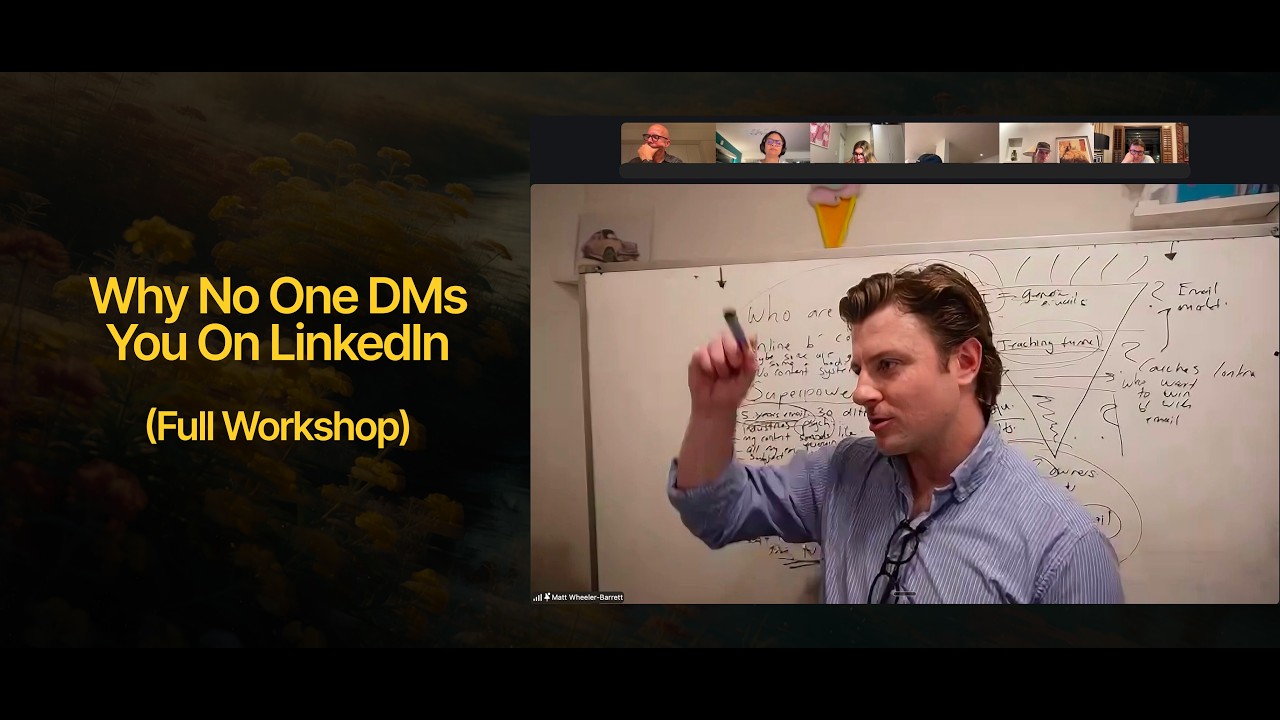
Matthew Wheeler-Barrett teaches his LinkedIn content system using three pillars (who you are, your superpower, your offering) mapped to a funnel. He covers identifying a content enemy, writing hero stories with the PAS framework, recycling posts with new hooks, and building swipe files from client calls and case studies.
Chapters
recording afterwards to help out with that for you guys too. All right. So what we'll cover today is we're just going to give you a bit of a brief background on me. I know there's lots of familiar faces here, but I will be sure that probably I'm going to tell you one or two things that you don't know about me just to give context to why I've landed up where I am today. We're going to go over a bit of quick terminology around the content and how I use certain levers to teach people their content practice. And then we're going to have a fun whiteboard session. So I've got an example going for you guys on if I was an email consultant and business owner, online coach, I'm going to show you how I will build, how I would essentially build out my whole content strategy and just teaching you more so how to use that funnel system to book in more calls for yourself and also learning how to write better in the language of your customer. It's so important and so many people underrate this one. Because because we're chasing vanity metrics the whole time, and why is it not post getting those impressions? We actually at times forget who we're writing for. Now I guarantee you that all of us on this call are business owners. We're not trying to be brand influencers. So it's all about really showing we understand our customers' world and that our solution is the pain to to their problems. At the end, I'll also leave twenty minutes open to Q&A, so you guys can literally let rip ask me any questions about content positioning and LinkedIn just to ensure that you get. further value out of this call. Cool, guys. So just to dive into a bit of my story, I think I'm going to start when I graduated from university. And one of my first loves and passions was fashion. My dad gave my, my mom— oh, he gave me, sorry, a jacket that he used to wear when he, when he saw my mom. And I was like, this is amazing. This is such a cool jacket. There must be so much value in people's closets. And that essentially ignited my, my love for, for business. Unfortunately, it didn't ignite my love for certain parts of business because I learned lots about failing forward, picking the wrong business partners. But in general, that took— like, taught me a lot in terms of storytelling, how you need to show up and actually build a brand, whether you have a product, whether you have a consulting offer. Being able to tell the better story will allow you to attract more customers. Someone can be less talented than you, their product can be much weaker than yours. But if they show up more consistently and on a more regular basis, they're going to slowly start stealing that pipeline away from you. During COVID then, you know, things got a bit rough. So went over to the UK. For context, originally from there. So it was easy for me to hop over from South Africa. And I was lucky enough to, for 2 and a half years, work for my uncle's mate Sam. And he owned a full house B2B agency. So it was awesome. In lockdown, I literally got to be this guy's right-hand man, learning all about agency scaling. And that's essentially what then led me onto— not by choice— onto Unify. So unfortunately, you know, flew back to South Africa, worked remote here, and I was like, can't go back to England. The war in Russia started and I was like, flip, like, I don't want to go back. So unfortunately, I did get retrenched. Never took it personally. It was more so a business decision. But that then ignited my fuel to start Unify. And just to show you guys, 3 years ago, that's what my profile used to look like. So, you know, I just had the odd connection on my profile, do something great in the banner, and that was it really. So didn't really use it at all as a strategic tool. And then Unify was born. Now, just for context, where we are now, 3 and a half years, a full-time team of 6 and working with some, some consultants. And some awesome clients around the world from real estate to automation, packaging and machinery, and really learned a lot there with the team just in terms of also helping other people tell their stories. While I was building Unify, I was lucky enough to get approached firstly by another Matt, just to add another one to the mix. Matt is one of the biggest online coaches for sales on LinkedIn in Australia, and he was like, dude, come work in my community, come coach, take on the coaching calls for content. I was super ecstatic that this dude wanted me to be on his community out of everyone to help him coach, and I said yes without even looking at the time. Turned out for a year and a half I was getting up at midnight till 1:30 AM coaching his community. Tried everything to have energy for it, but whatever, got through it and it led me to where I am today. So super pumped. And I guess, you know, at the start, and just like some of you perhaps on this call, if you are perhaps struggling with your story and just getting it going at the start, it does take a bit of sacrifice and commitment. But if you build it on the right systems, the right strategies, and also around you, the unique human that you are, it's a lot easier to create a system that keeps you going down, down the line. So that's where today actually we are now, landed here where we are today, scaled the brand, coached multiple people, and really just learned the most important part of digital copywriting building your personal brand with this world of AI, with all these gurus, how can you show genuinely that you are human? And that's unfortunately by sitting down and doing a bit of thinking, looking inwards, and actually really asking yourself, who am I? What stories have I gone through that allows me to be unique to others? Now, just a quick example before we get into the terminology. You know, if I'm Matt, We all know there's tons of other Matts out there as well. Thanks, Mom. With these, with these Matts, if there's 5 of them doing LinkedIn personal branding, you know, and someone's deciding, you know, which Matt should I go for? If I'm not telling personal stories or showing my interests outside of work that I love my mountain biking and whatnot, by telling those stories, you naturally make yourself more memorable. And at the end of the day, you know, my uncle always taught me, 2 things. Firstly, Matt, always be polite to everyone. You never know who's going to be your boss one day. And always remember that someone knows something that you don't know. And I've always carried those through my life. And also at the same time, why I love doing what, what we do, we get to learn from our clients' industries as well. So super pumped to just get further into this with you guys and help you where I can. So just before we, we get into things, we're going to use Dan the Man as the example. Dan actually is on this call right now too. So Dan, shout out for believing in us and telling your story with our help. So, you know, when Dan came to me, he literally— when he joined our Slack, he literally said, Matt, like, my LinkedIn's dead. And I was like, flip, you're making me a bit nervous here. Like, I really do hope I can help you. Got into it. And, you know, as we can see over here on the right, this is when Dan started working with me and we just got that engagement up now. At the end of the day, not selling you fancy tactics. But what I will tell you is the sooner you learn how to lean into your stories, to use the funnel strategy, which we're going to go into on the whiteboard behind me, you'll really start to learn that there's certain ways that you can tell stories to grab more people's attention and being authentic at the same time, which is really, really important. We're not going to try to, you know, fake tactics to go viral for the sake of just getting loads of impressions. Because at the end of the day, if someone can't see themselves in your story and they're actually never going to use your product or service, what is the point of trying to get those people on your account? So we're going to keep diving further and further into that. So yeah, Dan really just leaned into who he was and we did actually this whole system that Dan went over and I think I stand corrected. Dan can jump in and correct me if I'm wrong. But we started implementing the system and he's posted around his birthday. He thought, you know, how can I write a bit more to my audience and make other people be seen? He managed to get 1,700 people to his profile with one post. So that just shows you when you are looking at positioning yourself correctly and hit the drawing board a few times and actually strategically think, you know, what should I be saying? What are the pain points of my customer? That allows you then to tailor stories a bit more actually around what's going to help you get that needed business. So when we start thinking about your content strategy, guys, I want you to use the analogy of a big fishing boat out in the ocean. So you're going to pretend you're a fisherman, fisher, fishing woman, all of that. You're going to pretend you're on that boat out in the middle of nowhere. Okay, now you're going to throw that net super wide into the ocean. You're going to grab some fish, and as you pull it towards the boat, yes, some fish will escape the net, but slowly but surely the net will come to the boat and you'll have some fish on the boat. This is exactly how we need to start thinking about our content, and more specifically on LinkedIn, because yes, we want to grow our audience, but at the same time too, we want to ensure that with our middle of funnel content and our bottom of funnel content We're showing people why we are fit for the job, why our solution is the pain point to what people essentially are struggling with in theory. So coming here, we're then going to dive into your, your content pillars. So just to give you a brief explanation of them now. So you know who you are. For me, online business coach. You could be a solo entrepreneur. You could be an entrepreneur with a team. That's who you are, more so your top-level title. What is your superpower? This purely is what unique characteristics or traits or skill sets do you possess that perhaps other people or your other competitors don't have? So for example, one of our community members, Philippe, he's in the EV mobility space. He had some fantastic consulting experience beforehand. And for context, he ghostwrites for EV and mobility CXOs and CEOs. Now with that, because he was in consulting in the EV and mobility space, he really got to know the buyers in terms of also how they think, how does their psychology behave. Then on top of that, Philippe also went to university and got a degree in psychology. Now we all know that really good marketers and storytellers also understand psychology. That's how they're able to write content in a way that jerks a reaction out of the reader. And, you know, let's reach out to this person, let's go work with Philippe because he really understands our industry. So your superpower, you need to think of it and take a few notes now if anything comes to the top of your mind. But think of something that really is just you, unique. Now, one that works really well, if any of you have been in an industry before or your current industry but once were your ideal customer, that's a great way also to remind people, you know, I once was you. I understand the psychology behind things better than another ghostwriter. So at the end of the day, if I was going up against Philippe, you know, hands down, I would want him to take the job because I don't understand that industry as well as he does. And this is exactly why it's so important to really think, what is my superpower? And I love to just label it like that. You know, don't know if any of us have elastic arms or anything like that, like The Incredibles. But you know what I mean? You will find those superpowers that stand out to your ideal client. Now, when we come to your content enemy, this is another concept that I really like you guys to lock into. Now, the people that become memorable online are people that are willing to stand up against something. Now, not saying you have to throw hate at people and get really angry online and whatnot. There are also obviously levels of respect for everyone, but it's more so what is the old way versus the new way of doing things. So this is all about thinking if you see something online and I'll use myself as an example. So ghostwriter, LinkedIn coach, you know, I grew from, from small following, got bigger, but I'm still nowhere near the level, let's say, of like the gurus with 100,000 to 300,000 followers. And I still see some of those same gurus saying, here's what I do for an hour on my LinkedIn a day. And I'm like, okay, but most people have 2,500 to 5,000 followers. How are they going to get the same benefit of a 300,000 audience versus someone that's got 2,500 to 5,000? So sometimes, you know, I'm like, that doesn't work because if they're not on the same level as you or they're not showing you that they once were in the trenches, Why do you think I may believe that you are the one to get me out of it? And once again, coming back to your superpower, if you can show you once were them and you figured it out yourself, built new systems, put yourself out there, worked your ass off to make sure that you did good things for your clients, those are the stories you also want to remind people about because it makes you naturally more memorable and also separates you essentially from, from the pack. So with that content enemy, anything also in your industry that really annoys you. Another one which I'm sure loads of people get annoyed by on this call is the heavy use of AI automation, the DMs where flip, they barely even get to ask you what your name is before they pitch slap you in the DMs, or that content that all just looks the same, same, same. So that would be my content enemy. And if I were to write a piece of content about that, I'd be like, you know, You tell people you don't have the budget perhaps, or the time for someone else to do your LinkedIn because you just throw it in AI. Meanwhile, you sound exactly like everyone else. So how do you expect to close any leads or get anyone reaching out to you when you just blend into the noise? So that's how I would phrase it against, let's say, my content enemy. So it's always good to remind people that, you know what, Matt might be actually right. I'm tired of using this automation. I'm tired of my content just seeming so vanilla. Like, how can I add a bit of flair and my own, like, my own stories to it that makes me an unfair competitive advantage? Because remember, if you've had a really cool story, how is someone else supposed to compete with that? I coached a guy, Scott, awesome guy, on a lovely woman's community called Emily Dunlop. And Scott was like, yeah, I'm perhaps not sure exactly here and there what to post about. But then I asked him a few questions and we did a session on, on her community with him. And one thing he told me, Matt, when I was younger, I launched Red Bull in Glasgow when also Irn-Bru was like the cult following for drinks overseas. I was like, no ways, that's insane. He's like, yeah, even when I did the selling, I did door-to-door knocking and I got told to fuck off a few times. I was like, hectic. Okay, now if you wanted to write a top of funnel post with that Red Bull, Irn-Bru, Glasgow, selling. That story now can relate to perhaps anyone that may be interested in selling more specifically, or door-to-door selling, or Red Bull or Irn-Bru. So it naturally draws more eyes in, and that's us spreading the net wider. And we'll get into a few more of those on, on the board in a sec. So it's all about just understanding, you know, with me, what is the new way of doing things and how can I also prove that with the results? That I've achieved for my clients already. So just before we get into the whiteboard session, I just want to really just make sure you guys are on the same page with, with the funnels because I'm going to draw it all out on, on the board. So we know top of funnel and we're going to now throw that net into the ocean. So our top of funnel content usually has something to do with the content enemy. As I said, what do you see in your industry where people keep falling flat on their faces? Your personal stories. Now, I like to call these hero stories. And if I was every single one of you tomorrow or later on in the week after this call, we'll also send the recording if you want to watch this part again. But with your hero stories, whether it's personal, whether it's business related, think of all the stories like Scott launching Red Bull when he was younger in Glasgow. Think of all the stories that made you who you are today and taught you those lessons and helped you create this mindset that you have today. Now, naturally, when you tell those different stories, you're going to get different people that are interested in those stories because maybe I am really interested in like selling and Red Bull. Maybe I really do like mountain biking and the creative headspace it gives me. I like to call my mountain biking forced meditation. I don't have time to think because I'll fall off the mountain. So things like that, like telling your audience about that, that naturally draws you in on a human level to different people. And that's why it's so important to tell those stories. And more specifically, no one now can go scrape AI and be like, rewrite this and add my like words and sprinkle me in it. Like, people can smell that from a mile away. So when you tell your hero stories from your life and showing people that you have come a long way and people can appreciate the journey or relate to you at one point of the journey, naturally they're going to start paying attention to you. And as we get now into our middle of funnel content, that's when we really start figuring out, you know, who are the right people, who are the people that keep looking at my LinkedIn profile, and how do I know that those are perhaps the people now we're going to go after. And we're not going to go after them as in pitch slap them in the DMs. We're going to go after them as in write valuable outward-inward messaging To really show that we understand their world. I always say this, when someone can see themselves in your story, there's naturally just more trust in how you can help them with theirs. Because if anything in you reminds them of them or their current situation or past situation, they're going to want to work with you because naturally you're going to give them more trust that you are that person. Remember, if I can't see you were once upon a time in the place where I was, And now I'm stuck in the trenches. Would you rather want someone to help you that's just been successful and squeaky clean all the time? Would you rather want that person that's admitted, yeah, I stuffed up a few times, but hey, I kept going, I kept innovating, and I am where I am today, and I can show you the stepping stones to get out of that trench yourself as well? So that's how you really want to think about your middle of funnel content. So to help with this, there's, there's a few tips here of how you can get better at it. So Always transcribe your sales discovery calls and your client calls. When you get a new member coming on, I know one of our clients, Ritvik, is on this call and shout out to him doing an incredible job over there in New York for financial wealth advisors. But with Ritvik, he has a survey and he actually gets people to pinpoint what the content did in terms of playing a role for the final sale. And loads of the people say, yeah, the content did. It impacted how, you know, I saw us potentially working together. And, you know, he's had his best month last month, all because he's just getting better and better at speaking the language of his ideal customer. And it's so important. And at the same time, I think, remember, guys, this is where I'm challenging you on the mindset. You're going to be like, oh, I posted that, but it only got 15 likes. Like, I can't post that again. Like, you can, because all we're posting is for your actual customer. We're not trying to get a brand endorsement by Apple or GoPro. Like, we're literally trying to win more clients in our pipeline. And from doing that, it's getting ruthlessly obsessed with writing in the language of your customer. Another option, if you were, for example, a Google Ads agency owner, you could go look on Glassdoor, Trustpilot, go look at all the bad reviews, see what people are getting irritated about, see what pains they're sharing on these review platforms. That is absolute gold for you to go look and be like, you know what, these 2 pains, we absolutely solve it for the system. So I'm going to speak about this pain in my hook line, and then I'm going to share in my outward-inward messaging literally how that works. Boom, there's your content for your ideal customer. So it's all about showing I see you, I get you, and I have the solution to remove all your pain. So you always want to see your solution in your messaging as that painkiller. They pop and the pain's gone the next morning. In terms of our bottom of funnel content, I like to follow a framework called the PAS framework. And what that is, is the framework in terms of how we write downwards in the post. So the PAS standing for pain, agitate, and solution. So once again, you know, perhaps you are a consultant that is struggling to write content. So I could write my hook. You know, you've been sitting on your 12 Notion drafts for the last week and still haven't posted a post. Meanwhile, your competitor just posted an epic story. You know, how does that make you feel? But then I can also show you that my client Jack, who's also like you, he invested in the coaching with me and look, we created the system for him and he's just got 4 inbound leads off his latest post. That's like the power of showing up. So all you're doing with your bottom of funnel, we've got the good results. Now we're going to just show people the proof's in the pudding. We've gone out to achieve these results for people, but at the same time, I'm going to grab my ICP's attention by really showing that in the first few lines, I get you. And like, I'm here to essentially help you with bettering that further option. Before I jump into the next section, I wouldn't mind actually just giving a quick 5 minutes if anyone potentially wants to put up their hand and ask a question, if they have any questions. So far, all good, everyone? Okay, sweet. We will move on to the next section. Just so you guys remember, I will leave 20 minutes at the end to go over your content. All right, so quickly, before we dive into the whiteboard session, I promise you I will keep this short. But just so you do know, we are going to drop a link in the chat now where there will be a Calendly to my Calendly landing page. In these sessions, what we're doing is 30 minutes to see more so what we are doing in our offer, to see also potentially, you know, how can I also give some value away, make sure that we get your positioning right, see what's going on with your messaging. And then you can decide after this, after that call, potentially there's a fit there for you. So it's just going through our whole process of potentially how we are helping people scale their stories and also treating LinkedIn like an ecosystem. So I'll keep that one there for a bit, but keep it short. And now we are going to have some fun on the whiteboard. So if anyone has any questions off the back of this invitation, you're more than welcome to send me a DM and I will get back to you tomorrow. Sweet, guys. All right. So I just want to confirm once again with hands, can everyone see my screen, my whiteboard now? Okay, awesome. Perfect. Cool, guys. So for, for this whole content system we're going to go over now, I want you guys to take down a few notes of when you're going through it in your own head of what essentially your content is going to look like. And we're going to go through a funnel system. We're going to go through those pillars, and I'm going to bring in all that terminology that I mentioned on the call. Okay, but to make it a bit easier, I have come up with an example just to bring a bit of structure to it. So in terms of the person we're going to go for, I'm going to write the pillars down here for you guys. So once again, you'd go, who are you? Then you go your superpower. And then you would go What is your business? Okay, so I'm gonna go for the the purpose of this session. I'm gonna go with an online business coach in terms of the superpower, and we'll just put email here because this person's an email business online coach to help people with with their emails. In terms of— we're going to call, we're going to call this person Sally. So Sally's an online business coach and she specializes in email. So that's who she is in terms of Sally's superpower. She has 5+ years in, in email. She's written for 30 different industries. And she has a degree also in psychology. Okay, so that's her superpowers in terms of what her business is. That is email. And then for context for everyone, done, done with you. So more so blended coaching approach. So she's an online business coach who specializes in email. Her superpower, she's written for 5 years in email. She's written for 30 different industries. So she really understands like business messaging and she also studied psychology. So she really understands human behavior as well. In terms of her business, then she does done-with-you services for coaching other founders on how to get really good at doing their own emails. Right now on the right-hand side here, We're gonna get our our funnel again. I'm just gonna put here tofu, tofu, tofu. Okay, so we're gonna first start off with this. So you guys will do it yourselves. You'll identify who you are. You'll then think right. What are my superpowers? You'll then be cool. Email done with you. Okay, then over here we've got now top MOFU, BOFU. So we know, like I told you with the top content enemy, personal stories, observations in your industry, middle of funnel. That's essentially— you got to see this as your teaching funnel. So I want you to always think this is where we're going to spend most of our time, teaching funnel, because We need to show people we really understand our trade and we really know how to solve these people's pain points and their problems. Now, what we're going to do now is with our funnel and with our pillars, we're going to work on these in a second. But firstly, I'm just going to zoom a bit out of this funnel because over here we need to think, what does that person look like? What does that person look like? And what does the person at the bottom look like. So if I was to niche down and let's say now Sally is targeting a specific niche, let's just go with that. Her ICP would essentially be 6-figure business owners. Just make sure I get this right for you guys. Yeah, there you go. Who want to book more calls with email. So this over here is Sally's absolute dream client. So she wants to find more 6-figure business owners who want to book more calls with email. So like, that is her absolute dream client. Now, if we look at the funnel, though, not everyone is going to be in her dream client section. So we need to think, right, well, if we go outwards and start looking, yes, the fish are going to start coming into our net over here every time we, we push out our top of funnel content. But now we need to think, right, how do we know what we need to write here? Like, I'm confused. Like, I'm busy with work and stuff. I've got no plan. What must I say? So this is where we now start going back to here. And this is all about now really understanding your customer to ensure that we actually start writing messaging that they actually need to hear based on like their frustrations. And this part over here usually ties to your superpower and usually, yeah, what your business does. So these are the 2 main pillars that you'll be having fun with in middle of funnel content. And then bottom of funnel would tie to those 2 just with obviously That's with the results. So that would be with your, your results. Now, with when we go, who are you? Correct. Cool. I'm an online business coach with, with email. So now you can think, you know, what do other perhaps people similar to that have? So you already start perhaps attracting more people similar to you. So, you know, maybe some months are good. Some are bad. Okay. Then perhaps, you know, for, you know, I know perhaps I should have a content system, but I don't. So like no content system. Then in terms of the superpower, that would be— and now you want to think here. This is how you think about the pains here. With your superpower, think if someone went with someone else that didn't hold my skills or they tried to do it themselves, what perhaps pain points would they do? We know Sally has 5 years experience in email, so she must be able to write one wicked subject line. She knows how to write for 30 different industries. So flip, like she can write almost, you know, for a robot or some microbiome product. Like she's got all those skill sets. Now, if I go here, perhaps one of the pains would be like my content sounds like everyone else. So that's really just showing people, you know, like, oh, it just sounds the same. I don't have that skill set to write outward inward, right? Because then they're not going to actually get their ideal customer to reach out to them. So essentially, you could say here too, you know, all my emails look like templates or my subject lines sound generic. Okay. So like you just think with your superpowers, If someone didn't possess your experience or your skills, where are they going to essentially come stuck? So you really want to essentially think about that and really like double down on that. That will really help you make sure that you just are a bit more strategic. Then in terms of email done with you, the reason why Sally is doing this offer is because she knows people capture emails and sit there. But perhaps, you know, they're sitting on 20K subscribers, but they're not doing anything with it, like complete like waste of audience, right? So the pain could be, you know, I've, I've got a huge list but never make the time for it. So with— I won't, I won't continue there because I could go on forever. But with these now, you've got to think, right, what are the pain points? So with, with your email, those pain points more specifically are what pain points will they experience if they perhaps don't use my offer, my system, my business that allows me to do better? So right now you're now coming to your Wednesday in your week and you're like, oh, I'm overwhelmed. Like Sally did well. She signed another 2 clients. She's stuck in writing these emails and she's like, I need to get another piece of content out, but I don't know what to post for tomorrow. So then she'd go to her content plan and she'd be like, okay, cool. I've got a huge list but never have time for it. I wonder why they don't have time. So that for me would go straight to middle of funnel content. We're going to teach— we're going to teach them. So now Sally can write a post that when she works with her Done With You clients, because she really has strong systems of documenting ideas, learning how to approach subject lines better and also perhaps create strategic swipe files and also learn how to write in the messaging of her ICP, she can then now teach that and show that she's able to erase the I don't have time for it. Better systems equals more time that you can do your emails and Sally can still make sure that her new 3 clients are happy. Right. So if you go here, My content sounds like everyone else. Ah, okay. Well, I'm then also going to teach you that it's so important that the more you understand your ideal customer, the more you write in their language, the more they feel seen and trust you. And that leads to more people reaching out to you or replying to your emails. Because if I can help you understand the psychology, I know that I'm able to write messaging that actually jerks a reaction out of someone to reach out or reply to that email. Now, in top of funnel content, I could be like, you know, AI equals, let's say, generic emails, right? So everyone knows that AI is the big topic. So your hook line could literally be like, you know, Most people will tell you to automate your emails with Claude. I'll tell you the complete opposite, and the opposite meaning you need to sound like a human. You can say like in Substack now, people know that like there's AI that actually tells you if it's written with AI or written by a human. So if you're not able to articulate and write your human thoughts in an email, you're going to lose trust. Or Sally's going to tell a story at the top here that how perhaps in her 5 years of email, she worked perhaps for a big agency overseas, like, let us say, McCann, and in McCann, she used to get grilled perhaps by her manager because she did not spend enough time writing subject lines. And from that personal experience, many other people can perhaps relate to managers getting upset. Many other people perhaps can relate to also subject lines. Because when we look to zoom out of this funnel, we have our really, really big— like, sorry, defined niche at the bottom of who Sally's ideal customer is. But then when we get to middle of funnel, these people will look like coaches, coaches, or let's say online business owners who want to win business with email marketing, right? Then as we zoom further out, top of funnel is anyone that's interested in email marketing. But as you can see here, we've, we've dropped the 6-figure, we've dropped online business owner, and we've dropped email specifically over here for Sally's Dream Client. But as she moves out of it, She first needs to build trust and nurture people with people that are just interested in converting more through, through email and better written content. Then at the top here, anyone who's interested in email, it doesn't matter what industry, she can speak about subject lines, she can speak about lockups in the emails. It can be a broad observation of what she sees works. Let's say, for example, HubSpot launches a new statistic. Or some controversy around some results they've found. You know, I read one the other day, and by the way, guys, if anyone wants to know what the emoji that grabs the most attention apparently is, an octopus. So just a fun fact there from HubSpot. So that's how you— this is how you zoom out. So for your content system, when you're always a bit all over the place and you're like, what the heck must I post? This already just starts— allows you to go back to a bit more of a strategic drawing board. It allows you to think, right, I've just had this awesome client meeting, or I've just had a client perhaps kick off about something on a potential sales call that they're really getting annoyed about from a past agency. Ah, okay. They're getting annoyed because they felt this— once again, their subject lines weren't good enough, or they felt when that agency wrote content, they really didn't understand the language of my customer. Well, that's why Sally keeps telling us stories that she studies psychology. She's written for those industries, that she's probably the better person to write for you because she gets it. She's got the experience, and that is her superpower that allows her to stand out from essentially the rest of the crowd. In terms of this, to help you also fuel your, your content system, it's super important for you guys that you also create swipe files. So Any pieces of content you see that work really well for other people that perhaps could be replicated into your industry. So what I mean by that is, let's say on, on Twitter, lots of people like using screenshots of certain things. Content Enemy, for example, you can use that. I use one, for example, where Elon Musk hates on LinkedIn. He calls it cringent. But I'm like, hey guys, like What, who cares what a billionaire thinks? Like, he doesn't need to like put food on the table for his family. So if you're a small business owner, like, it's time to wake up. It's a good platform to win business. Or another one could be, let's say I'm a fitness coach, and perhaps, you know, before I got inspired to really invest in my fitness, you know, maybe I was overdrinking, overeating, and things like that. You can use things like drinking too much or common patterns in society, burnout, etc., and that a wider audience can also relate to. So when you think top of funnel, it always is advisable that is there a way for me to somehow link it back to me? So, you know, for me, for example, I could do a post perhaps to attract a younger audience and mention, guys, you know what, I got retrenched, but I built up my personal brand. I built a team at the agency and started building a coaching business. Why can't you do the same? Like, I literally did it. I was also in the, in the retrenchment trenches, and I can help you get out of that. So anything that's broad on a topic level of your industry, so think about that. But then every now and then also, your hero stories are so important because if you guys are coaches, consultants, advisors, or like small business owners, that you are a lot more important than a logo. Because you're not as established, and that's fine. It's like if I don't go so niche down, and let's say I start playing in a bigger pond— so I could say I help, um, entrepreneurs grow their personal brands— why would someone listen to me about personal branding and entrepreneurship versus Stephen Bartlett? Because I— that's too much of a big pond that I'm operating in. Like, I need to niche down a bit so I become more of an authority with something very specific. So that's just a thought with you guys to have with your content too. It's so important to, to factor that in. But with those hero stories, you guys need to keep recycling them because people can relate to you on a human level. People also like, you know, I've never heard that story before, now I remember that person, because perhaps something you told them in your story reminded them of a football game they went to with their granddad, something that just resonated with them. And I think we underestimate how many people actually relate to lots of the same things. And that's why it's so important to, to put that out there. Now, if you are looking to— I'm just going to try to rub a little space out here.
Yeah.
So if now we've got our pillars, we kind of just also want to start thinking about— sorry, that's not very clear, but all I'm going to do is I'm going to put Tofu, Tofu, mofu, tofu, bofu. So what most people forget to do, and I forget to do it at times myself as well, when we start planning out this content strategy, a simple way to do it— I'm sure some of you have Notion or a content calendar— definitely plan it out so you can visually see it. But what you want to do, tofu, mofu, bofu, I would want to label those in different colors so I know which one's which. Then you need to start striking a balance. So let's say, fine, let's say you've thrown your net out a few times now. You've got a larger following now on your LinkedIn, and now you're like, right, I've seen a lot more of my ICP coming on my profile. Now I need to post more MOFU because I need to convert more of those people and get them deeper into my funnel. Right. So you guys can test this yourself. It's all dependent on where you are. But if I was posting 3 times a week and I was posting in a 2-week sprint, I would do something like tofu, bofu, mofu. Then the following week perhaps would be mofu, mofu, tofu, because I appreciate with everyone, myself included, with your bofu content, you don't get that as often because you have to wait till you get your client results, etc. But I will teach you a trick on that. If anyone's thinking, well, I've got 2 clients, you know, perhaps I haven't won one in a while. How do I recycle that content that allows me to use the same case study? You can think when, when Sally came to me or sorry, when I went to Sally and I was having 4 real big frustrations with my email marketing, right? Because I invested in Sally's Done With You offer, I really, really got huge benefit out of it. I wrote better emails. I wrote in the language of my customers. Everyone was talking about it at the family braai, like I was crushing it, right? Sally's super proud now. She's really helped Matt achieve good results. Now, if Sally wanted to repurpose that, we could just use the different pain points in the hook. So Matt was struggling with subject lines. You know, his open rate went up by 40% within a period of 6 weeks. Oh, that's interesting. How do I get that for myself? Or Matt really struggled to write in the language of his customers, like, so when he did, he got more responses because people saw themselves in his emails and trusted him more. Oh, that's interesting. Okay, so you can also really recycle them as much as you can by being strategic with the content pillars essentially that you, you use. So this then, all in all, allows you to build that strategic content strategy that actually you're being a bit more scientific and strategic with your content. The worst thing you unfortunately can do is we get busy, we get lazy, so we perhaps throw something in AI. We perhaps just, you know, repeat this, this quick story that we heard from a friend because it's just easy, you know, and we're like, it still feels productive though because I've got a post live. But you might as well just slow it down for a bit and build up a bit of a system. Because I can tell you guys now, with my best performing posts that are on like Content Enemy, Elon Musk, etc., I've recycled like that Elon Musk post now, I think like 7 times. Spread that net wider, it's literally gone viral every single time because all I'm doing is I'm perhaps changing up the hook, testing a different visual hook or different image, and just keeping the same core message there. So with your hero stories I've got another one, Super Naughty in School, and I tell that like how I was a rebel, etc., because I actually then start getting lots of guys, more guys actually messaging me being like, yeah, we also didn't listen in high school. So I'm like, cool, like now you can also, you know, even though you didn't listen in high school, you can build a personal brand and build some digital products. So it's all about just recycling those stories to make sure you become memorable. You also need to remember, as your audience grows, those people perhaps don't know those stories. So I know lots of you perhaps have done it. The reintroduction posts are always a great one. It's always really just good to show who you are as a person and just how can I relate to you more as a human? I think it's, it's so important and everyone is saying, yeah, there's so much competition, Matt, like LinkedIn's so saturated. I'm like, yeah, fair. It's saturated though with AI and a load of rubbish. Now, if you're willing just to be a bit more vulnerable, I like to call it, let's say, strategic vulnerability. But there's certain levels and you can just share more stories that show genuinely you are a lot different. You are more memorable. You have these superpowers that I am actually the right fit for essentially your, your company. So I think with this, I'm keen to dive into some questions now. I know we've gone a bit faster than anticipated, but I'm here for the next 35 minutes still. So if anyone has any questions on their own content pillars, their own situation, even their DMs, their LinkedIn strategy. Like, I'd love to just hear if anyone has any specific questions. Come on, guys, someone's going to have to put up their hand, otherwise I'm going to have to call someone out. There we go. Hey, Matt, thank you. My question is regarding the outward Inward writing or messaging? I'm not sure I quite got that. So could you just rephrase that to see if I got the right understanding, please? Yes, sure. I'll first explain inward-outward messaging and then we'll go into outward-inward messaging. Let's just use— where they mostly get this wrong is like SaaS companies, apps, and things like that. You know, I build this amazing app. I'm like, awesome, we've got these features. Our app does this, it does this. Look at this flashy thing. Amazing. Like, download our app. Like, why has no one downloaded our app? Well, because they can't see themselves in it. You know, flip it outward-inward. It's all about making it about them. So when you're speaking inward-outward, it's I, me, myself. When it's outward-inward, it's you, your, your situation. Like, what are you doing? You're making it about the reader, you. So instead of perhaps speaking about the features of the app, you can speak about the outcome the features help it do. So if you use my app, you'll be able to get 3 hours back of your time because it'll be able— this app will be able to idea generate 30 ideas a day for you. So you no longer have to create a swipe file or, you know, my, my app will also ensure that it's getting you the right data so that you can make more strategic results, which equals more money for you. Anything that's a pain-saving, time-saving frustration, if someone can't see themselves in front of it, just like when I say, you know, you're a consultant and you need to post stories, but you're— you for the last 2 weeks have had 12 drafts sitting in your Notion and they've just sat there. If someone has struggled to write with their content and they have 12 drafts sitting in their Notion, they're going to feel that burn when they read that. So you want to show a bit more, I get your world. I understand that these certain things frustrate you, but I'm showing you that my solution erases those. Does that help? Yeah, it does.
Thank you.
On that last example that you're mentioning, for example, you've been sitting on your 12 Notion pages waiting to post. So would you recommend to, to write from you instead of starting with your own story? So, you know, like you're having the same issue, I tried to post 3 times per week, but it didn't work, and then turn it into them, like mention the you, or would you recommend start right away with you? So with top of funnel, I would use sometimes more I because you're telling stories actually around you that shape you as a person and like show people who you are. But when you come to your teaching, I would use outward-inward. So making it all about them and you and your. Awesome.
Thank you.
Perfect. Kita.
Hey, Matt. Great session. Good to see you. Yeah, good to see you. I have a question regarding recycling. So I did it the first time, I think actually yesterday. So I did the post about my parents and the house. Do you do like just the change of the hook or do you do also like, you know, like the same visual but you add more pictures? Like, how do you do that and how often you do that? Like, is it once a month or what do you suggest?
So in terms of timelines, I recycle my posts every 2 months. So just giving them some time to sit there and then recycle them after that, that's always seemed to have worked really nicely for me. In terms of the recycling around the other elements of your post, always good to test a different visual because I do know I've, I've tested where I've actually copy and pasted and just pasted my same post. Absolutely flopped, like completely. There's no proof of it, but I guarantee you LinkedIn probably does know this exact same piece existed once upon a time on the feed. People don't need to perhaps see it again. So In terms of the hook, go look through the comments of your previous post. That's always a fantastic place where you can perhaps see what people are saying, how you can learn from them when it comes to that, and you can build that into the hook. Then in terms of the visual, I always try to use different visuals. You could use a plain visual, you could have text overlay over your visual with another hook line, so then you kind of have 3 chances, right? You've got the written hook, you've got your visual, and you've got a hook over the visual. So you've perhaps got 3 chances now to stop someone scrolling. Okay. So I think with those, that's the main element there in terms of the actual post. The part that looks probably the same for me is usually just the core message in the body of my post. So I fairly keep that the same, but I'll always perhaps try to change the pain point or angle, but it still ties into the same overall core message. So If you go look on my profile, I did a screenshot of two of the same posts, and you can. I can't remember how I did it. I'll just send it to you on LinkedIn, actually. But I did a video literally explaining how I recycled the exact same post. So hopefully that can also help you.
Yeah, absolutely. Because I see that there's for this particular topic, it seems to you know like people get touched by that, and a lot of people actually reach out and comment and kind of like. there's not too many impressions. I would say like on the mid-end, but the amount of engagement is crazy, right? And I thought like, okay, I'll recycle it after a month and it seems that it still works, right? So it's a great way to kind of, yeah, get more people into your DMs.
I think in what you've said, there's a good lesson for everyone too and even for myself, but You know, I told you it worked after 2 months for me. You just told me it worked well after a month. And that's the whole thing too with personal branding. There's no one-size-fits-all. We all also have different audiences as well. So I would rather encourage you guys to experiment, use the principles, let's say for example, I've taught here today, but then also still always be a bit nimble and on your feet and thinking, you know, how can I change it up? How can I be a bit more more strategic because there's literally no one-size-fits-all writing course for LinkedIn. And that's why I get annoyed when everyone buys the same course because you're going to all sound the same, right? Like most people, you'll slowly start to sound more like them if you fully just focus on them. So also focus on your own experimenting. It's also the way you're going to actually see if your audience wants to see something new or something different. So, you know, yes, it's important to follow the strategy, But every now and then, if you've got a really cool idea and something that's just a bit different, like, go for it. Like, you also are allowed to have fun with it. Every now and then, I like to post stories about how my dad made me clean his rims with a toothbrush and like our love for cars. Yeah, it doesn't have too much of a lesson in it, but like, I just also like writing that. I enjoy content. So also having 1 or 2 pieces that you enjoy, it helps on those days where perhaps, you know, you're only feeling 3% and you're not feeling that full 100% energy to rock up and inspire everyone with an awesome story. Does anyone else have any specific questions, perhaps around their positioning, their pillars? If perhaps something stood out to them here, I'd love just to hear from anyone else specifically. John, how do you think it perhaps sounded based on our conversation last week? I see he's finally there.
Yeah, so, uh, for the benefit of everybody else on the call, I've got 3 different businesses. So my challenge is, you know, how do I position my content when I'm going out to the market on like which business do I like focus on? Like obviously it's like a personal brand, right? So we can talk about my pain points and, you know, my findings and stuff, but I think really drilling down into the ICP I'm finding tough with 3 different businesses and 3 different brands. So what would your advice be on that? I know we spoke briefly about it at the weekend, but yeah.
And just to perhaps give context for everyone quickly on the 3 businesses.
Yep. So I've got 2 recruitment businesses, both focusing on different ICPs. So one is, um, private equity-backed businesses in the UK and Europe. One is, uh, forward-deployed engineers and solutions engineers into the AI space. And the other one is offshore solutions for international businesses in South Africa. So if they want to hire Ops, marketing, finance, IT, they can offshore those people to South Africa.
Yeah.
So totally different. Like, 2 are in the recruitment space, one is not recruitment but offshoring.
Yeah. And in terms of the offshoring though, do you feel like there are any crossovers with the 2 other recruitment businesses?
Yeah, there's some recruitment. So part of that solution is I will provide recruitment for those companies. I'll like source the talent, but The majority is I provide employment, I'll provide the office, I'll provide the IT laptops and stuff for them to be able to operate internationally.
And in terms of those 3 businesses, which one is the one where you find is right now the easiest to generate more cash flow?
Well, one, so the finance recruitment business has been going for 14 years. That's been the enabler for me to live in South Africa and focus on other stuff. I'm less excited about that business, I think, probably because it's a saturated market in Europe. The one I'm— the one I'm really excited about is the tech one, because I can see the volume, like the need there is huge, but it's the biggest risk for me to kind of say goodbye to the business that's paid for the house and, you know, the food on the table. And then the South African offshoring, there's a much longer sales cycle with that, like that's like 3 to 6 months, so make a proposition to a client, It goes to the board, they agree it, we've then got to find an office, we've got to source the people, blah, blah, blah. So it's like 6 months to actually generating an income at all for the slightly bigger clients. So the biggest risk for me personally is the tech recruitment bit, but that's probably going to be the biggest gain. So I know we talked about it at the weekend, and I was like, Matt, shit, this is a big thing, because I can kind of turn my back on what's what's kind of fed me through for the last 14 years.
Yeah.
Like, what do I do, basically? And from a content perspective, I've gone from, like, getting 35,000, 40,000 impressions on a single post, which is decent from 6 months of doing it, to now getting, like, 80,000 or 90,000 on a single post, which has been a bit of a shock.
Yeah, the algorithm definitely has not been playing fair ball lately, that's for sure. I think the algorithm has got a lot more intuitive in terms of how it distributes certain content now to people. It is fixable. I mean, as I showed you at the start here, I think Dan was experiencing something a bit similar with his content to lean into more strategically positioning certain personal stories. And that's why also, you know, why this balance of the funnels is also so important because what I've seen on my LinkedIn, I'm sure perhaps some other people have, is those hero stories sometimes help, you know, spark that profile the next time middle of funnel. So slowly but surely, it's slowly going up and getting stronger. In terms of my advice for you, in terms of all the businesses you've said, you know, the one that allows you to live in South Africa, etc., I would lean into the bulk of that for now in just terms of top level of the recruitment and what you've done there and achieved. And think about all the amazing past stories and placements and success you've had in the recruitment space, then I would start, you know, honestly start DMing people, start perhaps creating 1 or 2 landing pages where you start capturing specific email addresses, perhaps more so for the tech side of things where you can rather use more so of your email marketing to start testing things. Or every now and then, you know, you can say, You know, I've got all these amazing stories in the recruitment and whatnot, but I'm also like testing something in the tech space now. I'm dabbling here, like I'm going to host perhaps like a certain webinar or do one-on-one calls where you're able to perhaps like find out more. So leveraging more so your success and slowly transitioning into that based on what the results are saying.
How, how personal do you get on these LinkedIn? Like, obviously this is my personal LinkedIn page, so how personal can you get on that? Like you talk about Like the real stories, it's your story, not anybody else's. So like, is your advice basically just to go personal? Because if you're then thinking about your ICP, which might be private equity funds or whatever, like, are they going to be that bothered about kind of your personal story where you might have, you know, been bullied as a kid or whatever? You know, I'm just picking something out of the hat, but—
Yeah, yeah, sure, sure. So I think with this, there's, there's different altitudes and levels to, to the personal stories. I think, as I've said before, it kind of does have to have a main link to a main core message or agenda around actually like how it shaped you and like made you of who you are today. You also got to think of certain personal stories of also just spreading the net and attracting more people because of that story. Now, the example I gave you with the fitness coach, for example, um, I was speaking to, to the coach this, this morning on a call, and he said his post where he spoke about like, you know, perhaps he was drinking a bit too much and all of this, and he wasn't feeling right. He was living for the weekends and not living for everyday sort of thing. He said it did really well in terms of spreading that net wider, but not— he'd say probably only 20% were his ICP. And that's fine. That's the whole point also of top of funnel. There's no ways you can do a top of funnel post and every single one of them is your ICP. So every now and then it is important to spread that net and then identify certain people now that have either connected or landing on your profile And then as we go more narrow, what perhaps personal stories or, you know, with you, I know when I first, first spoke with you, you were still in the UK and then you moved to South Africa. And then you've mentioned now perhaps you may be also moving again. Just also like explain to people like what that was like, the lessons you learned around building the business, but at the same time still placing people in the roles. I'd have to dig a bit deeper with it with you. But there are all sorts of angles you can tie yourself to, to make you more approachable to people. I think one of the lessons that most people don't take on is that they make us memorable, these personal stories, but you also naturally start attracting people through something else. Meanwhile, you don't know that actually one day they probably would also become your dream client. So let's say, for example, I love old BMWs. Let's say I'm posting about them. I got chatting to a guy on Instagram. He hops on a call with me, wanted to like get coaching from me, but the personal relationship just started because he also like, he sent me a photo of his old BMW. So like when people just see perhaps a bit more of yourself, themselves in you, they're more inclined to follow you or at least pay more attention to you. So like you'd have, you'd almost want to map it out like from when you built your first business up until now. What are all perhaps the ups and downs, certain learnings you found that also perhaps, you know, have identified a new way of doing recruitment? Like all these people just place people into a business, but they don't even see if they're a cultural fit. Maybe that's one of the unique superpowers you have, like the approach of how you integrate people into company culture.
Yeah.
But we'll, um, we'll chat more on that for sure. I'll definitely reach out to you. Thanks, man. Awesome.
Yeah, just wanted to confirm that this actually works because I've been posting from different angles, like, uh, that I'm, for example, from a village of 2,000 people, and a lot of people told me that, hey, like, I'm also from, like, very small town, whatever, and some of them right away turned into customers. So kind of, uh, I, I— it doesn't have to be, like, really directly tied to what you're doing. It's more about people buy from people, right? And I had the same thing with, you know, like when I was talking to my parents and some of, you know, people reached out like, hey, like I see that you care about your parents. I also want them to succeed, blah, blah, blah. And also another sale. So it's kind of like connecting on a personal level. I think my best clients were actually the ones that came through this kind of funnel because they straight away perceive you on a different level, right? So absolutely like— Good advice, and I would definitely encourage to try it out.
Yeah, I love that. I love that. I think, let's say, the way perhaps you tie yourself to that, to you, perhaps, you know, like, let's say, you know, your father and mother brought you up to love and care for your family, and now that helps instill the values that you have as well. You don't have to then say, you know, the family taught me now how to treat my clients better and buy them pizza on Friday, like things like that. But like, you can still share that. So I really do like that addition. Really appreciate that. Does anyone else have any other questions they'd like to pop through? Appreciate it's getting late for you guys, so I just want to be conscious of your time too. Right guys, if there are no more questions, I will leave it to you guys. If there is anything else you'd like to hear from us, any other information you'd like to get from me, as I mentioned, we have that Calendly link. So I'd love to just— the more to speak to, the better. Always here to help and see how we can potentially be a fit for you guys. But really did enjoy the session. If perhaps there are any other learnings you'd like to hear about, we are going to start doing future webinars as well. So yeah, always really keen to bring an awesome group of people on a call together and we all learn from each other and keep growing our businesses.
Thank you.
Awesome, guys.
Thanks, man.
Appreciate it. Lovely to see so many familiar faces. Appreciate you all being here. Hope you have a lovely evening further, and we'll chat soon. All right, cheers, guys.
Bye-bye.
More from Matthew

RAW TALKS! with Matt Wheeler-Barrett & Mr. Raw - The Power of Authentic Storytelling