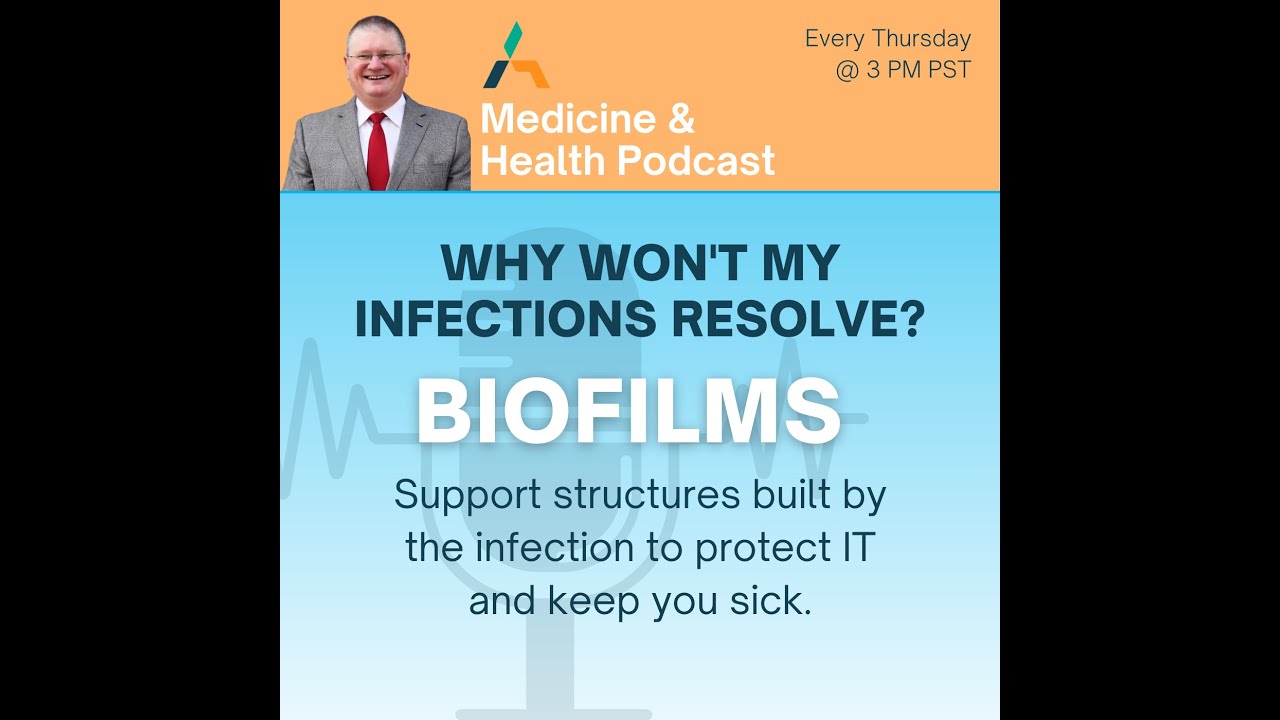
In this episode of Medicine Health, Dr. Paul Anderson explains how biofilms—protective microbial communities that naturally exist in wet environments and the human gut—can become pathological contributors to chronic infections. He defines biofilms, distinguishes normal, low‑level biofilms from phase‑1 (moderate) and phase‑2 (severe) pathological forms, and outlines why they form: co‑infections, antibiotic pressure, immune disruption, and stressors that push microbes to embed deeper. The host’s diet, especially plant‑derived chemicals found in traditional herbs and spices, can help keep early‑stage biofilms in check, but these natural compounds are less effective against advanced biofilms. Dr. Anderson notes the difficulty of testing for gut biofilms, emphasizes that long‑standing illness, heavy antibiotic use, or immunosuppression likely indicate significant biofilm burden, and recommends working with a practitioner to trial anti‑biofilm strategies alongside broader anti‑infective support. The talk frames biofilms as one of many overlapping reasons chronic infections persist, highlighting the need for targeted, multi‑modal treatment.
Chapters
Welcome to Medicine Health with Dr. Paul Anderson. I'm Dr. Paul, and today we're talking about different reasons that your chronic infections just won't resolve. And there's, there's as many reasons as we can think of, but we're breaking it up into different underlying problems that should at least be looked at. And this particular segment, we want to talk about another common, but I think early in the learning curve part of chronic illness, and that is the idea of biofilms. So a biofilm is something that is natural to many microbes, and they are ubiquitous in waterborne environments. So you hear a lot about biofilms in the study of oceanography and even water plant systems, anything to do with wet areas. Okay. Well, what the basic idea of a biofilm, so bio, life, film, and goo, right? It is a protective mechanism by certain microbial families that will build them as, you could think of them as a shelter for them where they can replicate and they can do what they do. and be protected from potentially your immune system, even drugs and other things. Now, in humans, because we're talking about health and chronic health problems here, one of the reasons that you can bang away on infections and they won't respond to the treatments they should respond to is you're killing the available weak part of the infection, But the resident and core part of the infection is protected inside of a biofilm structure. The other thing, if you get to that point and look at one of the other modules here that we talked about, is other infections— co-infection, superinfection, stuff like that. One of the reasons that those raise their ugly heads during a chronic infectious disease flare or treatment, etc., is that the biofilm might be built by one type of microorganism, but then other microorganisms will go in and join it. And so a biofilm now, the higher-level biofilms, are actually kind of considered their own infectious disease agent, and it's really a whole bunch of families. And you could literally have virus, parasite, bacteria, fungus, everybody living in there, and they'll even trade genetics with each other sometimes, making them stronger. So what will happen then is the biofilm will become this, you know, go from this natural thing that's just sort of part of humans and other animals and every wetland and ocean and everything. to a higher level that becomes pathogenic. And this is a common issue that other healthcare providers will bring up. And that is, well, biofilms are normal inside of people. The first biofilms in human that were really talked about about 300 years ago were in your teeth. And we know that the biofilm formation in around the teeth is one of the reasons that dental caries, all of that can, go on, kind of get crazy is because you got all this bacteria and stuff that's protected. But it's really from your mouth all the way through your GI tract where most of your biofilms are. So what we have to do is delineate between a normal biofilm, which we all have, all humans have, and then pathogenic biofilms, meaning biofilms that have gone beyond what nature intended and have grown to the point that they're protecting way too many bugs. Now, why would this happen? Okay, this is another one of these, you know, medical, microbiological, philosophical crossover discussions. If this is a natural process that can be symbiotic, meaning, you know, mutually agreeable between certain bugs and the human body, and we might grow natural, normal biofilms inside of our gut, Why would they get pathological? Why would they be diseased? Why would they grow and become disease-causing? Well, the reason is that the natural processes that keep them in balance have been overwhelmed by something. So that could be the presence of other infectious organisms, and those will trigger more biofilm formation. So it's not natural for you to have certain infectious organisms in higher amounts, and so that would support the biofilm formation. Also, the use of, say, antibiotics or other anti-infective drugs that can cause some of these biofilm-forming organisms to go hide deeper. So it's like a protection. So if you're not assaulting the Bug, and they're relatively happy. They might make a little biofilm that's kind of weak and normal in your body. But if they start to get assaulted, and you're throwing you know anti-infective things at them, they can become biologically triggered to make their biofilms bigger. Then there's the fact that let's say a normal biofilm is gonna. be in every human pretty much, but then maybe they get other stressors, the stressors like the drugs that throw off your immune system or other things, or the biofilm is there and it becomes a home for other microbes to move in and share some genetics. And those genetics sometimes are resistance genetics, so they resist your immune system, they resist the normal treatments that would kill those bugs. So the biofilm develops in a non-natural pathological way. So the way I like to think about it is you've got, you know, think of it going from your left hand to your right hand on a spectrum. At your left hand, you got your normal, natural, everybody's got them, regular old biofilms, no big deal. Then you stress the body, you do all these other things, and then the body will make a little stronger biofilm. Call those usually a phase 1 biofilm. And if you keep stressing the body and keep throwing things off and keep having, you know, maybe an improper balance of treatments and other stuff, and then the bugs get together and share some genomics, you get a phase to a deeper biofilm, something that's harder. Now, another thing you might think of is, well, throughout history, humans have probably had biofilms, and why weren't they pathologically a problem before now? Now, some of that is a bigger discussion, such as how come chronic illness is so common in modern times, which we don't need to get into right here because what I'm enough time for that, but the other part about it is that one of the things that is preventive against the biofilm— now, keep this in mind, preventive treatments often don't work when you get into the world of pathology. So if I'm looking at just the left-hand side of that scale where I got my normal natural biofilms that everyone else has, what— one of the things that prevents them from from becoming problematic is the constant movement through my diet, because most of these are in your digestive tract. So constant movement through my diet of the right type of plant chemicals to keep those biofilms happy and not growing. Okay? Now, those chemicals might help early pathology like a phase 1 biofilm, but they don't do much for the phase 2, the really bad biofilms. But those chemicals— so you think, well, chemicals, geez, people, you know, 100 years ago or 1,000 years ago didn't have chemicals. Now these are things we eat every— if you look at the plant chemicals that keep the biofilms in check and keep your immune system in your gut happy and all this other business, they tend to come from the spices and herbs and a lot of the adjunctive things that we do with our cooking. Yeah. And the cool thing is that as I have looked at what those chemicals are and what plants or seeds or herbs or spices, etc., they come from, is that they come in the flavorings and the cooking procedures from every endogenous, indigenous diet I've ever looked at. So you don't have to have the same herbs and spices. So for example, if you look at the Nordic and northwestern Russian and Nordic areas, you go back 100 or 1,000 years, the stuff that they would use to prepare and store their food and cook their food and all that, full of these antibiofilm chemicals. You look over in Asia, different foods but the same idea. You look in India, you look in Africa, you look anywhere else in the world, and in North America too. Now, All right, so if it's part of the, you know, indigenous eating, how come they happen? Well, most people don't eat like they used to, and most people aren't using a lot of those sort of natural chemicals in, you know, what they're eating and preparing. Now, the other thing is that once we get sick— so we're sicker than we used to be— once we take a bunch of antibiotics, we do other stuff, the biofilms grow. In spite of maybe all of the spices that we eat and stuff like that. The other thing is this idea of early lower biofilm versus later big biofilm. So if the normal natural one that we all have is sort of like a little pup tent that the bugs live in, so a little tiny thin tent, then a phase 1 is sort of like a house and then a phase 2 is like a skyscraper. So the longer you've been sick, the deeper and bigger your biofilms get and the more bugs go in them. the more immune dysfunction that you're going to have. So biofilms are another area. It's real similar to what I was saying in regard to the mold toxins, mycotoxins, and how over time we become more aware of these things. We've become more aware of treating them. We're more aware of how these things work in our chronically ill people. They've always been there. It's just that we healthcare providers are becoming more aware of how all of that works. So biofilms are a little interesting in that there's a couple of laboratories that kind of can test for them, but there's not really great tests that are accessible to, you know, the average healthcare provider or patient. And a lot of that is because a lot of these biofilms are inside your digestive tract. So one of the ways to know that they're there is if you've been sick for more than a few months you've got some pathologic biofilms. If you've been sick for a long time and/or on immune suppressive drugs or a lot of antibiotics or other stuff, you've probably got some big biofilms to deal with. And in that case, it's just like the mold toxins or other stuff. You have to work with a practitioner who's gonna help you, uh, to do some treatment trials with biofilms and then to add in some other anti-infective support and see if we can break that down. So To put a point on all this, while there's never one reason why chronic illness is chronic, in chronic infection care, if things aren't getting better, we've talked about many, many reasons. Biofilms, and especially pathological biofilms, become a big part of what's wrong there. This is Medicine Health with Dr. Paul Anderson, and we are all done for today. I want to thank you for listening, and we'll see you all on the radio next week. Thank you.