Building Camper Vans with Brett Hinker and Architect Cheryl Ciecko
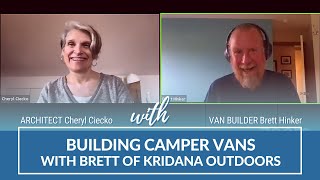
Brett Hinker of Kradana Outdoors walks through converting a cargo van into a two-person camper. He uses a diesel heater that burns less than a liter of fuel per hour, sprays polyurethane foam for insulation, and sizes battery banks around 500 amp-hours. Key trade-off: prioritize counter space over a built-in stove and go portable instead.
Questions this video answers
Lake Stevens, north of Seattle (near Everett).
kradanaoutdoors.com (Kradana Outdoors).
Two‑part polyurethane spray foam, minimum 1 inch installed, quoted as ~R‑7 per inch.
An aftermarket diesel cabin heater that draws fuel from the vehicle's diesel tank and burns less than a liter of fuel per hour; electrical draw once running is a couple of amps for the fan.
He bought a 1998 Ford cargo van with an International 7.3 turbo diesel; it had ~230,000 miles when purchased and Brett described this engine as durable (examples cited up to 500K–1M miles).
Chapters
They did and how they think you should do it. But sorting through all that and saying, okay, what am I really going to do? Is very challenging. And then there's certain aspects of it that are just beyond people's capabilities. I think a lot of people can, you know, maybe they've done a little woodworking and building a bed in the back or something as well within their capabilities, and they want to do that, but the electrical scares the bejeezes out of them.
Right.
That's a common one that I see, where people just go, wow, it's so overwhelming. There's so much. And, gosh, if I get this wrong, I might burn my camper to the ground and maybe hurt myself.
You know, there is that potential. We are actually also live on Facebook, on my Facebook page right now. So I want to kind of go back to tell people who, like, your name is Brett Hinker. Is that how you say your last name?
Like thinker without the T? You're one of the first people to ever pronounce that correctly the first time. Thank you, Cheryl.
That's a good one to rhyme to. So here we have today, I'm interviewing Brett Hinker. And Brett works on camper vans, and he's has an electrical background. He's just been talking about all those things and how he. How he came to do that. But, Brett, what is your company that you. Did you start a company? So I did ran across Brett's page somehow. I don't know why. Maybe I do a lot of research, and things pop up that are things that I should know about or people I should talk to. And so your company came up, and I thought, oh, this is really interesting.
Yeah.
Reach out and see if you'd like to have a conversation. And here we are.
Sure. Yeah. That's great.
Where are you located?
So I'm located just north of Seattle. So it's a little town called Lake. Yeah, Little town called Lake Stevens. People are more familiar with Everett, where Boeing's located. So I'm just a little northeast of where Boeing is, which is kind of a landmark for people.
And you're. You're. What you're doing is you're helping people. And I saw you primarily help people with electrical that are renovating their own vans.
That's exactly right.
Started was just helping with that piece and then moving into. I could do the whole thing.
Yeah, well, I really started the opposite. I built the whole van of my van, you know, myself, for myself, and figured out a lot of stuff. You know, there's. There's a lot of details to figure out when you do that. And I've always, always thought that working for myself would be a lot of fun and something I've wanted to do. And I just hadn't made that jump in my life. And circumstances presented themselves a few months ago where, you know, I kind of was at a crossroads. And I said, hey, I'm. Now's the time. No time like the present. You know, let's go do something I want to do. And, you know, I have the skills to do this. My wife's always, you know, I kind of tend to discount myself. You know, I figured it out. It's easy, you know, and she's like, hey, a lot of people can't figure that out. And they could really use help doing that. So I put it out there. It was actually Facebook, since we're live on Facebook. I just did a post. I didn't even have my company formed yet, and I just threw it out there. You know, hey, if someone's needing help with their van building it, I could help. You know, I have a mechanical engineering background and, you know, I've been a wrench all my life. And what do you need help with? And I. From one post, I had multiple people contact me and a couple electrical jobs come my way. A really sweet lady living in her van full time. She was a newer Dodge Promaster, and she had done her own electrical off the Internet. Found some guy with a webpage and she put it probably 80% together. And then it kind of scared her a little bit. You know, she was afraid to plug it in. She wasn't sure. She didn't know how to test it. She wasn't sure things were working right. She didn't blah, blah, blah. Right. And so that's a very. That's a situation I think a fair amount of people find themselves in. And it's really hard to find an electrical shop or an electrical contractor willing to even look at that. You know, that's already half built. It's kind of all or nothing. And I said, kind of raised my hand. She reached out to me on Facebook and said, hey, would you be willing to look at this? She sure, what the heck? And so that was actually my first job. She came. She came to my shop here, just at my house, and, you know, opened up the van and I scratched my head for a couple hours looking at it, and then it clicked. And I understood what she was trying to do. And in one day, I was able to put her whole electrical system together and plug it all in and it all works. Yeah. You know, and having, I'll tell you what, that was really meaningful to me. You know, I shared with you, I worked, I've been working in aerospace for a couple of decades and you know, you know, it was good for making a paycheck and I did do some very interesting things with robotics and automation and very technical things that I enjoy quite a bit. But that impact to another person kind of wasn't there. I was working with a big, largely faceless, you know, large aerospace companies. There just wasn't a lot of personal reward in what I was doing. And I'll tell you what, when she pulled up and she took a look at her van and she almost, almost broke into tears and said, oh my gosh, that looks so good. Does it really all work? And then she gets in and she's flicking all the switches and plugging in her phone to charge in every outlet and the thing and it all works. And she was just beside herself. And that was so rewarding. I was like, man, there you go. I think I'm on the right track, you know. And so, yeah, so that was just, you know, I mean, honestly, I'm really just, I'm like a month in to really going for it, you know, and.
Just, I can tell you there's a big market out there of a lot of things related. So whether it's people just getting back to nature and finding out ways they can travel around and kind of be on their own space, which is what I do a lot of, and, and then people who, who because of their home environments, what, you know, toxins, oftentimes they have to get out of their house, they have nowhere else to go. And, and it can take time to figure out an alternative. And so trying to find somewhere to at least sleep, that you can be safe and you can get a good night's sleep and that you cannot be exposed to bad things. Now we have to be careful in trailers. And I don't know if you're just getting started, you may not be aware of all the things that can off gas and you know all these.
Yeah, from my engineering background, yeah, from my engineering background I understand that it's like that new car smell everyone loves. You're breathing in massive lungfuls of toxic chemicals. Basically that is your new car smell, right?
Yeah, yeah. And so people that are already sensitized to mold and hyper reactive to mold are often really sensitive to smells. And so it's a challenge for people to try to figure these out. And in My, I did this class recently as we were talking before I went live and on trailers and people living who doing RVs. And I have a number of people that are trying to do. What you're talking about is like trying to do their van or an RV or a school bus and put all the pieces together. And I'm always looking for people that, you know, do it. I do, I do houses and buildings. So I understand the basics are all the same, except it's on wheels, which means you're a hurricane and an earthquake all at the same time.
Exactly.
Addition to your structure. I do like the idea of a van being that it's already kind of designed to be at least watertight in most cases. And then we have thermal bridging that we have to worry about and we have to worry about condensation on metal.
Yep, that's exactly right.
So you said you did your first full one. Is that that's the first one you've done entirely from beginning to the end?
Absolutely, yeah.
And it's for two people.
Yep. Yep. Two people. Yeah. Set up for my wife and I to be out there. Queen size bed in the back. If you look on my website, there's actually several pictures of it in there. It's. It's. Because it's small, it's hard to get really good, really good pictures, you know, and I'm not a great photographer, but I think it kind of tells the story when you look at it. And some of the interesting features I, I put in it. And like we talked before, what did.
You put into it that was interesting? What are your favorite things that you kind of figured out?
Well, I'll start with my wife's favorite. So, you know, a comfortable place to sleep is number, number one. Followed. Followed closely by warmth. We're up here in the Pacific Northwest and we do camp year round. So we just got back a couple weeks ago from a five day trip down the Oregon coast. The Oregon coast in February is stunningly beautiful and exceedingly cold. So it was wonderful. So I have a. Basically I use one of the cheaper versions, kind of a kind of a Chinese knockoff, but they have like a Webasco or there's a couple of different. Very nice. My van's a diesel, so it actually runs off the diesel fuel off the tank. And it's like your house. You have a thermostat on the wall. There's no condensation issues because you're not burning fuel inside. You don't have to worry about carbon monoxide or anything like that the combustion all happens outside the van. So it's fantastic.
Does it work? You're actually running your engine?
No, no, it pulls fuel from the fuel tank and it's a separate little heater that actually burns fuel from the diesel tank. And they have them gasoline as well. And it's a little heat exchanger, basically.
Oh, really? But your car isn't running.
Nope. And it pulls a very, very small amount of electricity. Once it's up and running, it's just basically running a little fan and it's. It has a little combustion chamber and it runs maximum, a couple of amps, which is very doable. You know, you mentioned the difference between structures and vans. Power, Power consumption and power availability is one of the big issues as well, right?
If so, yeah, I was wondering about that because, like, so we have a little trailer and when it's cold, we have solar. But when it's cold and rainy, for instance, and there's sun, we don't have any solar giving us any energy. And we use it to recharge the battery. And so we can only go six hours on our battery to do the fan for the heat that's running off propane.
Yeah, yeah, exactly. And so that's one of the first things I do, aside from understanding how my customer is intending to use the van. And you know, matter of fact, on my checklist for things today, as I'm developing a spreadsheet that helps kind of do that quicker to go in and say, what are you going to be using? And then I do the calculations with my engineering background to say, okay, what's the power consumption? What kind of batteries do we, we need? You know what, what kind of battery reserve, energy reserve do we need to satisfy what they want to do? And sometimes I have to tell them, yeah, that's, you know, your van's just going to be a giant battery if that's what you want to do. So we can't, you know, that's not practical.
No air conditioning if you don't have electric hookup.
Yeah, yeah. People say, oh, I want an electrical system, but I'd like to run a little space heater. And you're like, not off a battery that just doesn't work.
Right, right. So your heater can. And so how many hours can you get off of it without.
Days and days. Yeah, it burns on high. It burns less than a liter of fuel an hour. And I have a 35 gallon.
I don't have a battery to run the fan.
I don't know.
You leave the interior Light on in your car for the weekend and your battery's dead.
Yeah, not with my systems. So the way I design my systems is I have a house much like your trailer. So let's. You're familiar with your trailer, so I'll use that as an example. Right. I'm basically building an integrated trailer to the van. Right. So it has all of its own systems in the back, including a house battery system. And so it disconnects from the, from the, from the engine battery, from the starter battery automatically. So you can't. Even if, even if you turned everything on and left it on and ran the batteries down to zero, your vehicle's still going to start because those systems are isolated. But then once you fire the van up, in my most basic systems, the way you would charge the battery in the back is off the van though, because that's the most. It's already there.
Right.
You don't have to add a bunch of expensive components. Your alternator's there, so it automatically connects and charges while you're running and automatically disconnects when you're not. To make sure you don't run it down and make sure it's charging. You don't have to remember to flick a switch or anything. It just charges when you're driving.
Yeah.
So that's kind of where I start.
And then we tried charging our phones off of a car battery once, and that also drained the battery.
So I have, you know, in my van again, this is part of the calculations I do based on what it is you're trying to do. Every. If I've learned anything so far is that every single customer is different. Every single customer's needs are different. Right. So some people can get away with one little battery and that's plenty for what it is they're doing. Other people need a big Battery bank and 500amp hours, you know, minimum, just to kind of get them through the night. The first company I talked about, she used our company. First customer I talked about, she had a regular 110 volt, fairly large refrigerator. It didn't have a huge amp draw, but it had to run through an inverter, which is kind of inefficient. And so you run all the numbers on that. She, she had a pretty good sized battery bank. To be able to run all that isn't the way I would have designed it. I didn't design the system, but we got it working and it, you know, it worked in the end, even though it wasn't the way I would have done it.
So in your trailer that you did for yourself, what are you. We were talking about what the features are that you like. What. What are you really? What's one of your most exciting, you know, you're like, I'm so glad I got that to work. That's so cool.
Yeah, yeah. So the heaters. The heater's number one by far.
Number one, you said? Yeah, we're talking about it being comfortable.
Comfortable. Comfortable, Yep, exactly. I have a nice little refrigerator, a little RV fridge. It's a small, just kind of dometics refrigerator, but from all the years of four wheel driving with a cooler. I heard somebody else. I'll steal it from them. They called it cooler soup. You know, you go drive around and, you know, you make some food and you end up in, you know, Ziplocs half the time. What else do you have when you're camping, right? You throw it in your cooler and then it ends up in the bottom of the cooler and half full of water. And it's basically you waste. I mean, I can't think of a camping trip I came back from with a cooler that I could actually take things from the cooler and put it back in the fridge. You throw away $50 worth of food after every weekend. Right? Which always kind of bothered me. The fridge eliminates that. The fridge is really, really nice. You don't have that water and, you know, it's just a little fridge. So that's fantastic.
Running.
Also a 12 volt. It runs off of electricity off the battery in the back.
And so how long can the refrigerator run without?
Days and days. I can go about three days running. The heater and the heater and the refrigerator. I do have solar on mine, so that's not even really including the solar that's just running. You know, if I was, you know, if I was out somewhere in the end, I was parked in a cave, I could still go several days, you know, without it. And then you add in.
I can't do that, so. And if you go driving, it'll recharge.
Yeah. The minute I drive or the minute the sun comes out. Because I have solar on mine.
Right. So why. So I have a pope. We put around our refrigerator and propane. I don't know why I can't run.
Yeah.
It must be a different kind of refrigerator then. Is that what.
And. Or a different kind of battery? Oh, yeah. Oh, yeah.
Lithium battery. Is it like a really.
It depends. You gotta just look at how large the capacity of the battery more than the chemistry of the battery for calculating that so the. So that you just told me you have a propane fridge.
Yeah. So you have propane or electric? It goes either way. But we obviously don't run the electric unless we're plugged into electricity.
So those are horribly inefficient from electrical standpoint, really. So I have a. I have a. My little fridge is what's called a compressor fridge. So what the electricity is running is a little pump and it compresses the refrigerant and then it expands, and that's how the cycle works to actually cool the fridge. So I'm just running a little electric motor with mine. You're actually running a heater element with yours. And it either heats from the propane or from the electricity. Typically when you're heating on the electricity, it's just a really inefficient way to do it. It takes a lot of power. So I usually, like. I didn't put a propane system in my van. That was one of the first questions I asked myself. Do I want on board gas? You know, and I kind of looked at it. I said, you know what? I'm just going to go all electric, you know, and just eliminate a system.
Can you?
I don't. You can. There's some inductive stoves. That's another one, though. That takes a lot of power. So if somebody wants to do that, you know, we can run the numbers and see if it's practical. I've seen people do inductive, you know, inductive top stove top type of stuff. I use a portable little stove in mine. I, you know, like I said, I backpack, you know, I don't mind being a propane stove.
Like a little canister.
Yep, little canister outside.
So we do. We have remote, but even though we have it in our trailer, we prefer to cook outside because. Yes, when you use a higher btu, a piece of equipment then is really safe outside. And then, yes, you had a view and there's more room to move around. And if there's grease, battering or oil or just dropping things or whatever, it's just much better to have that all. Yeah.
So I have a little, tiny, cheapy little butane one that I bought from, you know, big five or something. It was like under $30, I think. And it's a little single burner, and that's what I use inside the van. You get up in the morning, it's super cold out. You're not ready to climb out of the nice, toasty, warm van yet. But you want a cup of coffee. That's what I use to make my coffee or make my wife a cup of tea or cook. You know, you can cook with just. It's just a one burner little thing, but it doesn't take much space. So I can put it on my countertop and there's still room to put other things on the countertop. I have a big two burner Coleman, you know, kind of a traditional Coleman stove that I set a little table up outside. If, you know, if it's time to cook dinner, we're gonna cook a full blown dinner. Then we, I set up outside. I have an awning off the side. So even if it's raining or something, I can get in out of the rain and cook outside. Yeah. So that for me that's what works. And I didn't want to take up that valuable counter space with a stove. You know what do you use the stove? Let's go crazy and say an hour a day. So 1 24th of the day you're gonna be using this thing, yet you're gonna take up 80% of your counter space with a stove.
Yeah.
It didn't make any sense.
Mine has a lid on the stove. And we, honestly, to your point, I think it's, I mean I can think in three years of using it and we, you know, six to eight weeks a year and I can think of a handful of times that we've actually used it. So.
That's exactly right.
One time in a windstorm we heated something up quickly, which you probably could have done. And another time was, I think most water or something that we were warming up. Again, bad weather, really bad weather. But ordinarily the other bad weather is let's go out to eat. We're going to go out.
Yeah, yeah.
And we don't do, we just don't cook. But you're right, it's, it's very, it's. I think that you're right. The counter space would be more valuable.
Yeah. I mean, how big is your trailer?
It's only 18ft.
Yeah. So that's a pretty small.
It's like a teardrop that pops up.
Yeah, yeah.
Mine is out of Quebec.
Yeah. So you know how valuable counter space is. Right. It's at a premium and it instantly fills up the minute you stop.
Right. Cluttered and you haven't done anything yet.
Yeah, exactly right.
Can you brush your teeth in there?
Yes, yes. So I also opted, again, I have the ability to do water systems if somebody wants that. I grew up dry camping out in the desert. So I'm very water conscious. I decided not to do a water system number one, because I use my van for so many different things. I didn't want to take up a bunch of my storage space. With a water tank that much like the stove, how often do you really need 20 gallons of water? For me, the answer is never. So why would I use a bunch of my storage space to house a water tank? And frankly, in a water. A built in water tank, I'm always a little leery of actually using that for drinking or anything. You know, it's just.
Yeah, we don't drink ours, but we do brush our teeth.
Yeah, you can brush your teeth with a water bottle though, too. You know what I mean? That's when I looked at it.
That's because you can't. You've done camping without, you know, tent camping. Those of us who've done that. Yeah, you get the water bottle, you put it on the toothbrush, brush, spit on the ground, you know, rinse the tooth thing off, take a swig, spit on the ground. But a lot of people haven't done that there. I have people who are like, how can you live without air conditioning?
Yeah, right. Yeah. That's not really the client base I'm looking at.
Funny, because I grew up without air conditioning. I'm like, there's actually those of us that, like, for many years in our life, I feel really old, but probably till I was around 10, nine or 10, that you go to bed in your underwear and you have all the windows open and you got fans running. You get used to it.
Exactly, exactly. Well, to answer your question, though, so what I ended up doing is I just put a little sink in there with a drain that I don't even have a gray water tank. It just drains to the outside. But it's a little place. So my wife, first contacts and like, Mindy, I can kind of go a week and just pull my hair back and, you know, pull it into it and I'm fine.
Right.
I'm not too hurt. She likes to wash her face at night and do some things that maybe, you know, I'd venture to say, you know, a lot of ladies would like that convenience to be able to do that, and then many guys as well. So I put a little sink in there and it. And it lets her not have to climb out in the cold and the dark to go wash her hands. She can wash her hands, set up a little just portable mirror. She can put a little mirror up and get her contacts out, and you can Brush your teeth and spit. You know, you don't have to, you know, already be in your jammies already have your shoes off and then have to go climb outside, you know, so you can do it all from inside the van, which is really nice. So that's. So the heater, the fridge, the little sink is fantastic. And for water, all I do, you know, when you go to the store and you buy the two and a half gallon thing with a little spout on the bottom, I just set that right by this, right at the sink and you can just open the spout, wash your hands under that water. You can refill it if you need to. If you're not near a store. I carry water on the outside of the van, so I custom built a back bumper for it that carries my spare tire and then has a. It's actually a. It looks like a jerry can for fuel, but it has a little spigot on the bottom. So it's five gallons of water outside the van that's potable. So I'll use. Yeah. In addition to the two and a half gallons in there. And then I normally buy a couple little 1 gallon things from the store. Just again, I dry can. I used to dry camp a lot, so I'm a little, very conscious of water. But yeah, that's, you know, that gives me plenty of water. You know, when you have five gallons on the back and I actually have room for. I have another jug. So I can carry like 15 gallons of water on the back of the van if I want to.
Oh, wow.
Yeah.
Water key for life. So that's a good thing that we don't want to. Not.
Right, right.
What about toilet? Do you have a toilet or is that an outdoor event for you guys?
So that, that is a funny, funny story actually. So I bought the van and the very first thing my wife says is it needs to have some sort of toilet facility in it. I hadn't even brought the van home yet and I had a porta potty sitting in the box. That was the very first thing I bought. And I literally built the cabinet around the porta potty. That's what like drove the design of the cabinet so it would have a place to fit. And yeah, it's just a little tiny porta Potty. It's. It's nothing, you know, it's not built in. It's just one of those little cassette.
Or something or some sort of a. Yep.
You can go to Camper World or any of those things. And there's a variety of Them, you know, we typically are out for about a week or so. So even if I need to, you know, find a pit toilet at a campground and dump it once during the trip or something like that, it's. It's fine. It's, you know, it is right there in the middle of the van. There's no closet or anything. I mean, we tuck it away when you're not using it. So you know, it's not, not like that. But you know, when you use it, you basically pull it out to the middle of the van, you know, and use it right there. So it's, you know.
So my experience that's mostly a middle of the night thing. Usually places where there is some sort of facilities. Yes, generally is my goal. And cleaner the better, otherwise we don't stay very long. But yeah, it's generally the middle of the night thing that's hard to manage. And I think less problems with stepping outside and stepping back inside very quickly.
So that's usually what happens with us. It's the pull off to the side of the road. Cause we've been drinking coffee all morning and I go find a tree and she uses the porta Potty in the van and we're both really happy. Or you know, you gas station and you know, I mean when you're traveling, sometimes they're very nice and sometimes they're not nice at all. And, and a lot of the times, you know, pull around the back so you have a little, there's tin windows on the van you can't really see in. And she find her a little private spot off to the side of the road or behind the gas station or whatever. And, and she can use it when she needs to and she's very comfortable with that. So.
Yeah. Do you have a table in there?
I do, I do.
Your doors like, do your front seats turn around so that you.
They do.
So that's a special thing you have to buy or did you buy. So what did you buy? You bought a shell of a trailer or you bought a trailer. That was something. And you took it apart.
So when I, so when I bought mine, it was a work van. So it had like shelves in it and the divider between the, the passenger compartment in the back that you could lock because you might have, you know, tools and stuff in the back. So it was, it was a full blown work van when I bought it. You could, you can see on the side where it used to have the DOT numbers where it was a businessman.
Oh, windows or no windows?
No, no. What has A window on the sliding door on the side. But then the backs of cargo van. So there's. There's no windows? Well, there is on the very back. I mean, it depends. There's some windows, but it's not like a passenger van. But there's windows all down the side. Like the driver. The driver's side has the driver's door window and that's it on the side.
Okay, so what else, what did you do? Did you put in the, like, did you change the seats so that they were RV seats that are. I know, I've seen them. Camping World has catalogs and I'm like, yeah, yeah. I'm like, oh, look, you can buy this. You can buy, you can, you can buy the couch for the. And so.
Yeah.
What did you keep of this, of this cargo trailer? And what did you not keep your thing?
I didn't keep anything. I kept.
Yeah, I tore.
Yeah, I mean I ended up using stock seats in it, but I bought new seats because when I bought the van, it had 230,000 miles on it and been a work van. It's a diesel. So this is the particular. And this goes into the vehicle much more than the camper. But why I chose this particular vehicle, it's a 1998 Ford, has an International 7.3 turbo diesel in it which are well known to go half million to a million miles between rebuilds. So it sounds like a lot of miles, but for this particular engine, it's really not. And the fact that it was a fleet vehicle means it was maintained. It might not have been loved because it was a fleet vehicle, but it was maintained. Right. So I'm a mechanic as well. I mean, I used to work as a mechanic and so I checked it all out. I replaced all the stuff that's gonna stick you on the side of the road, the pulleys and the altern. I just spent like, I don't know, a thousand bucks right out of the gate. Just replaced everything that would stick you on the side of the road. And then I mentioned earlier, I'm converting it to four wheel drive. Well, when I do that, I'm essentially replacing everything but the engine. I'm replacing the axles, the steering system, the suspension, everything. So for that reason, I wasn't that worried about those things being worn out because I'm gonna replace them anyway. Now granted, I've driven at 60,000 miles on this old stuff since I bought it. All over the place. I've been down to Arizon, out to Montana and you know, down to California a couple of weeks ago. So, I mean, I take this thing on 3000 mile road trips regularly, as is with the old stuff in it.
But wow. So can you help people buy the base vehicle or is it. Yes, that could be part of your. Because I'm thinking for me, I was like, okay, so say. Because I have in the back of my mind that I would like to have a trail. We have the trailer, but especially in the winter, if you want to go somewhere that's not realistic. And I wouldn't mind having a tray. A van that we could, you know, just drive sleep, drive sleep, drive sleep, drive sleep. And also maybe stop some places, but a little bit different situation than the trailer situation. Yep, yep. And so I wouldn't know where to start. So my followers probably don't know where to start either. So.
Yeah, yeah.
So say we are into mechanics and we're not an electrician. And how do we know. Is that a service you can offer to help? Like at least virtually screen like, okay, this 1998 looks good. This one doesn't. This, yeah, this looks like it could be good one to look at. And don't even bother with this one because it's going to.
Absolutely, yes. So I do that informally. I typically don't do that as a service because I, you know, especially if you're buying an older van, it is an older vehicle. Right. So there's a lot, there's a lot that goes into that. I'm actually helping a customer right now that found a nice high top so you can stand up in it. So it's the same. Yeah, they're. They're looking to buy it. And so I did exactly what you're saying. They called me up and said, hey, we don't know that much about vehicles, but we saw this thing with a high top. The idea of being able to stand up in it is fantastic. You know, what do you think? And so I walked through it with them and looked at it and told them some of my concerns and some of, you know, and you know, you know, I always recommend you take it to a qualified mechanic and make sure. I have toyed with the idea of buying a van and then, and then turning it into a camper and then selling the van. I'm a little concerned about that because if it is an older used van, it is an older used van. You know, no matter how you cut it, that's what it is, you know, so unless you want to just put a rebuilt transmission in it and just spend a bunch of money on it at the beginning there's kind of no guarantees necessarily that it's going to be super reliable. The good news is that with a lot of these old vans like my Ford that I got, it's way overbuilt. It's a one ton Ford. I mean this thing is built like a commercial truck and it's been driving around with 1,000 pounds in the back, which is like 2% of it, not 2%, but it's been driving around with a very low load on it. So it's really overbuilt for what it is. So it's just built so sturdy. And then being a mechanic myself, you know, if something goes wrong a thousand miles from home, it's not the end of the world for me. You know, I had to pull a wheel and replace the brakes. Yeah, seriously. I pulled into a friend's house, I just drove down to California back a 3,000 mile road trip and I was having some brake problems and I pulled into my, my wife's cousin's carport in his apartment and tore the front end apart, replaced the brakes and put it all back together and then spent six more days driving through the desert after that and it didn't bother me. So it depends on the person, you know.
Yeah, you're definitely the right person for that. I can see that and I'm proud. Can people buy a new. Would you recommend getting a new trailer or newish trailer that is, or the cargo van. Do they sell them like unfinished or.
They do, they do. So there's a lot of debate online like which ones are the best. So the Dodge Promaster is one that a lot of people go for, especially here in the States. The Mercedes Sprinter vans are really nice. I just did some work on one of those. Do an electrical system and a heater actually in a Sprinter van. A little more challenge finding service for those if you're out and about is what I've heard. I don't own one myself but that's a concern people have. Ford makes their Ford Transit as well. So if you're not mechanically inclined and you are going to be driving all over the place, far from home, buying a new or a few year old one of those, a Sprinter, a Dodge Promaster or a Ford Transit. That's absolute, you know, obviously now you're not buying a $5,000, you know, van to begin with, now you're spending 30 or 40, you know. So it depends on what, what the person's budget is and how they're going to use it.
Yeah, yeah, no and there's. But there are people that want to do that within, you know, a lot of people. And then. So. Okay. The other big thing that comes up with my population, because it's mold focused and air quality focused is condensation.
Yep.
And if it doesn't come up with them, then I'm usually bringing it up.
Yeah, yeah, yeah, yeah, yeah.
It's the way moisture moves that turns into bulk water from water vapor that people just, it just isn't obvious. And it's often behind surfaces that we can't see. And we're thinking, well, where did it come from? And as a camper yourself, even in the 10th, and you will sure agree with me that it comes from our breath. You know, you can be sleeping out in the cold in, you know, 40 degrees in your sleeping bag. It's really cold. And it's like, why the tent is all wet inside.
Yeah. You roll over and you bump the tent, it rains on you.
There's a reason we have the vent at the top and the rainfly and stuff is to let that moisture out. But we had that, we had a tent trailer. So you sleep on these things that sit out. And we had slept with every single window open.
Yeah.
And we still were getting rained on.
Yeah, exactly.
Because it just, it's just the air is heavy outside. It's very cold outside. It doesn't hold a lot of moisture and our breath is very warm.
Yep, exactly.
Right. And so what do you do about that? In. And what, what did you consider in that? As an engineer? I think this is really. That's one engineer. Because as an architect, you have a strong engineering background, but it's an analytical thinking that's a, that's really, I think, really fun. So.
Yeah, yeah.
Condensation in your van. What do you do?
So for me, what I did is I used a two part poly polyurethane foam. So like, you know that great stuff you can buy at Home Depot, it's like a can and you spray it and it expands. I use that throughout my van. So it seals everything and it seals right up to the. Right up to the metal. So you don't have that bare exposed metal. That's where it's going to condensate. Right. You can have the cold metal, the warm air, you do the stoichiometry and that's what's going to happen. Right. It condenses right on that cold metal. I got rid of all the cold metal. Basically.
It's.
It's. I have. It's R7 per inch and I have minimum one inch throughout my van. So I've had some people express like online I share. Someone else was asking this question on one of the forums and I said yeah, here's what I did and I showed what I did and someone else was concerned with the outgassing of that. And you know, the bottom line is anything's gonna, gonna have some of that. Right. I mean there's, there's nothing that, nothing that isn't.
That's true that some of the best materials you can use do off gas and it's question how long are they off gas for?
Right, right.
And if it's gonna be years then you probably don't want it. Right. It's gonna be two days.
Right.
You open your windows and you let it off gas and then it's gone.
Yep, exactly. So I don't get any smells or anything. And I really specific to this because it is really a concern, you know, for you and your fan base. But I didn't do a ton of research on it. I did it largely it was economical. It is a two part urethane. So it's not an ambient cure. You know, it's not like a regular glue that you put it out and then the off gassing is what cures it. It's a two part, you mix it and it and it's a catalyst and a reactor and it reacts and then it's more or less inert after that. So when you're spraying it you got to wear a respirator and all that stuff because as it's mixing and it's doing its thing and the chemical reactions happening, it's letting off, it's letting off gases. But afterwards I haven't had any adverse smells or anything. And my wife I mentioned is she's had mold issues, mold toxicity. She's hypersensitive to many, many things and she's never had any sort of a reaction, you know, in the van whatsoever. It doesn't bother her at all. So I actually have it on my list of things to do after that comment this gentleman made about a week ago on the concerns about that. And you know, being a two part I'm less, less concerned about it. But I'm going to do a little more research on that to find out more that I didn't consider frankly when I, when I first built it.
Yeah, There are situations where if the mix isn't just right.
Yeah.
It will off gas forever and toxic. So that's one thing that happens because it is chemical interaction and if you. It's like baking a cake, you don't do it exactly right, then the cake doesn't.
Right, right, right.
Same thing. If it's not exactly right, then the chemicals can be. At least that happens in buildings. The other concern that I have on it that I just don't know would be just that like we talked about. About that. It's. You know, anything in a van is like you have a hurricane and an earthquake going on at the same time. Driving down the road.
Yeah.
Does any movement cause the. The foam to debond from where it's connected to. To where there could be tiny air gaps. That vapor, which is much, much smaller than water droplets, could actually be driven and end up condensing. And typically in that case, you know, and that's where you might see sometimes where there's rusting happening in steel or something or. Yeah, it was. But somehow water got in there was through a window frame or you know, condensation or wherever. We don't know. I have seen. Just for your research, I have seen recently when I was researching the trailer class, I did sheep's wool, that there were some people doing vans out of sheep's foot wool. And they were just kind of sticking it all over. The goal for that being air entrained. So you don't want to squish it.
Yeah.
It needs to be fluffy. But fluffy. And I thought this. So it's kind of like a sweater, I think through all.
Yeah.
Actually can dry if it gets wet. The question, you know, I don't know. I think, I don't know that the trailer companies have completely figured it out, so.
Exactly. Yeah. And I don't know with the loose insulation like that, to me you have. There's still the cold wall. You know, the. The outside wall right there. I mean, I would, I don't know, I haven't done any testing or anything on it, but I would imagine you'd still get condensation on the wall. And now you're kind of soaking the wool. I don't know.
This one had like two layers and they were able to put the insulation behind it. But what you're talking about is called a thermal bridge or which is not thermal. It's actually cold that we're worried about. But it's basically just like the handle of our pot. And if it's not an insulated handle, then you grab because it's transmitting the temperature. Well, cold will do the same thing. So to your point and the people listening here that the outside is cold or it could be the inside is cold because you have air conditioning going because you are connected to electric. And either way, if you have warm moist air outside and the inside is cold, you open the door and then this flood of humid air goes in and touches the cold surface. Like your glass of ice water or the opposite is that the outside is transmitting the cold and then your condensation breath hits that cold surface and again warm, warm hitting a cold surface. And then we hit the dew point oftentimes and that causes bulk water to exactly at that surface. So it is a conundrum to say that it is.
It is.
I try to stay in my lane on the building piece, but I'm always curious. I mean it's something that we just have to. We try things and live and learn. And I mean the same thing with tiny houses, people trying to figure those out. And that's the same conditions and you got to allow for some movement. I like the idea of a van though, because I think it's. At least you got. The frame has been designed for what you're trying to use it for as opposed to building the entire enclosure. You know, it's got a little aerodynamics to it. So did you add windows too? Since you said it was a cargo and it had a window in the door. Do you have fresh air in there?
Yeah. So I added pop out windows on the back. So being a cargo van, they were just fixed glass windows on the back and I added the pop out, you know, so you can get a little ventilation. I also added a vent in the top just with an electric fan on it so you can turn that on and ventilate for whatever cooking smells or you know, condensation or whatever. To your point on the condensation though, I'll tell you what, the inside of the windshield certainly gets wet when you sleep in it all night. I have my, you know, and I. And I have my little blind up there. You pull that thing down and you got to get a towel and wipe the window down. So, you know, I mean, I don't know. I don't have a great solution for it. Exactly right.
And we have it in our trailer too. We get to a certain temperature and. And I debate, you know, I try different things. I always run my fan usually. I think that's helpful to keep air moving.
Yeah.
At some point the glass is really cold and your breath is really warm.
And it is exactly right.
You don't have to be riding an exercise bike or doing. It's just breathing while you're sleeping.
Yep.
I actually showed a picture of the breath turned to frost on the inside. And glass is really, really cold. It's not going to be. If it's too heavy, if it's insulated glass, there's probably not really any kind of.
No, no, it's not. I mean, I'm talking about the windshield, right? So it's just whatever, whatever safety windshield is. Can I share of a picture? Is that possible?
Yeah, let me give you the. Let me show you. Make it so you can share your screen and you can share your screen. Okay.
No problem.
Be able to see it.
Let me see if I can actually scare up a couple.
Pick this window that you want to share and it should end up with like a green screen.
Okay. Give me. It'll take me a minute so we can kind of keep chatting while I'm fooling with this, but I'll see if I can scare up just a picture of it with all the, with all the foam.
So, so, and so what else is in there? Anything else is in there besides. So the.
So the swivel seat was. Oh, for the, for the insulation.
Well, are those the only two windows? Did you add or did you have any others that you can. Did you put screens on the passenger windows? Is there other ways to.
Yeah, yeah. So there's a screen on the vent and the vent works fantastic. It's actually called a fantastic fan, but.
Which is I think the similar. And I was amazed. That was one of my biggest concerns was would we get enough ventilation in what seemed to be really a small number of windows coming from a tent trailer. Yeah, it opens up completely. But what we found with the fan was very powerful and that we can run for many, many days. And it just sucks the air right in through the window. And you can lay there and be. It's a breeze.
Yeah. And so that's what I do. I crack. Usually I crack the passenger window and then one of the back pop out windows and then you have the vent. I normally just leave it open. I don't normally leave the fan actually on. I'll turn it on periodically if you want to, you know, and then you can just feel the breeze. I mean it really pulls the air in. I've done a couple of screens and literally just use house screen with some magnets and just kind of put it up. I never worried Pacific Northwest here, we don't have that many mosquitoes and stuff like that. But I'll tell you what, we went out to Glacier National Park, I believe it was last summer and I didn't know if it was hummingbirds or mosquitoes, but I'm telling you, man, these things were like, I mean, no joke. These things were unbelievable. And so that was like, okay, it's hot. You have to crack the windows, but I am not sucking these guys in here, you know? So, yeah, I did the screen thing and then I just cut a piece of screen that's kind of oversized and I literally crack the window and then hold the screen up and slam it in the door. And the door holds the screen in place over the window. It works great. Works really good.
You know, the other thing that works actually, ours uses Velcro.
Yeah, I thought about that.
They just. We just, we have like. Ours is attached, I think, but you can lift it up because it's our escape window. And.
Yeah.
Just got velcro around the whole thing. And so you lift it up to operate the window and then you just kind of smooth it down and then it's totally. It's on there. And it seemed like such a cheap solution. Really.
Yeah, yeah.
Velcro. So done. Okay. You can, you know, that's not hard.
Exactly.
I did see some accessories for passenger windows that had little. That you kind of can put in your window opening.
I saw some of those online.
And stuff for the door where you could leave the door open. And there's things I saw people have that, whether they're magnets or something, that's some sort of a screen that you can open your sliding door.
And actually I have seen that. Yeah, some of the real high end stuff. Those $150,000 ones I was telling you, have some like retractable screens. Kind of like those nice ones you can buy for your house. I've seen those as well. Typically security, just like, you know, like for me, that's why I cracked the window. I mean, I boondock camp a lot. I'm just kind of camping out in the middle of nowhere. There's, you know, I've had very few situations where that's actually been an issue. But I'll tell you what, when it kind of is like having that sense of security, like I have a locked door. If someone's trying to get in, that's gonna at least buy me a little time to do something as opposed to a screen.
You could have a bear. We had. We were in so true. Some mountains in southern Wyoming. And in the middle of the night, or it was like 11 o', clock, we go to bed. At nine, we were camping. At 11 o', clock, this car alarm is going off somewhere and we're thinking, you know, that's really rude. Who's doing that? Who's just going and going and going, you know, camping in a very rustic campground. Can't see people. Well, we found out the next day from the ranger was a bear got in the car. Wow. They didn't lock car doors. And there's a bear in that area that knows how to open car doors because it's very lucrative.
Right.
People have food in their cars.
Yeah.
And they also get their car ripped to shreds.
Yes.
But that's what happened. So I can imagine in a trailer that you wouldn't sleep with that. I think I'm thinking more it's a place with flies or mosquitoes and, you know, you just need to get out of the wind or, you know. And it's getting hot in here. Yeah.
I mean, typically what we do, you know, we'll have the. The slider door ends up open a lot because that's how you're getting in and out while it's in RV configuration. Right. So it just kind of is. Even if you had a screen, it would be open so often, I don't know how effective it would really be. I mean, that's just my opinion on it. You know, usually what we do is while you're cooking dinner and doing your stuff during the evening, it's just open, you know, it just is. And then when we get in at night, usually I turn on one light and let them all. Let all the bugs get around the light and then kill the bugs on the light. And then we go to bed.
He's like, got up, turn off all the lights and he stands there and he's. Ceiling ends up. Needs to be washed because he's got.
Exactly.
But you have to be careful. If you come to the Midwest or Wisconsin, Minnesota, Florida, anywhere this direction, there are places where screens are really, really nice to have and that.
Yeah.
Spend the whole night going, okay, I hear one. I hear one.
Oh, I hate that you're laying in bed.
You know, it's here. It's taunting me. You gotta find it. We had in Montana, we got bats.
Yes. Oh, really? I've seen lots of bats, but I haven't. I haven't ever had one in the van or anything like that.
But this is in a tent trailer and they. They found a little spot and my husband. Right. Flew over my husband somehow. I don't know if they were on my husband or what, but woke up just about slugging me. So there was a bat in there. Oh, my gosh ended up catching it, but can you imagine? So did you find a picture to share that?
Yeah, I'm having trouble doing it. I'm going to email them to myself and then I'll fire it up. Here you go. I found a bunch of grape. I know where they are. I just was having trouble getting them to my. I have that icloud thing and it takes so long to like download. It's ridiculous.
What is your website? Do you have a website?
Yeah, I sure do. It's a Kradana K R I D A N A outdoors dot com.
What does that stand for?
So kajana is Sanskrit for play is one of the interpretations. So it's play outdoors, basically.
Kradana.com. did you say?
Yep.com. yeah. Okay, here you go.
Well, name. So I will get online and write that It's K R I-A N A.com Cardana Outdoors. All one word, outdoors. So I don't know what's@thatoutdoors.com.
So let's see here. Sorry, this is taking a minute. I wasn't. Weren't exactly sure what we're going to be talking about, so I didn't have anything prepared, but.
Okay. That's probably why this is good because it's okay.
Yeah, we just kind of free form it here.
Yeah, we probably should get off pretty soon. If you can get on there, I can go on your website. Is it on your website?
Yeah, I don't think if you go on my website you can pop that up and there's a lot of pictures of my van on there and I was trying to get one specifically the insulation, which I don't have on there.
Here we go.
And there we go.
So now you're figuring out what you need to add. So I don't know if people heard at the beginning if they just jumped on this yours a fairly new business that you have going on there?
Yep, yep. Yeah. Really kind of feeling it out and you know, I'm willing to do pretty much everything, especially here at the beginning. You know, whatever people need help with is what I'm doing. I have, like I mentioned, I think before, before we were live. There seems to be a lot of need, a lot of interest in the electrical part of it and I really enjoy doing that sort of thing. And it's actually kind of fun for me when someone's kind of got it half done and now they need to figure out how to actually make it work. It's an interesting challenge. So I actually enjoy doing that and I've Done several of those now, which are a lot of fun.
Here you go. So I got your website up.
Yeah, there you go.
Or maybe. Yeah, you can't see it. So here you are. Cardano outdoors. I love the van. Life builder Adventure for everyone. You get your thing there. And then these are some of your. Oh, yeah. Let's see what we got here. In picture. Picture. Here's your van.
So that's my van. Just my wife and I camping out out there on the. Out there on the Olympic peninsula. Fantastic little spot we found. It's actually my oldest daughter and I went for a trip over by Winthrop. It's on the east side. That's the lady in the promaster van I was mentioning that had her electrical system kind of half done. And then when I was done, I had it all enclosed like that and all hooked up properly. Kind of started off a big mess and ended up very useful. The next picture over is actually on the back of the seat pedestal of a sprinter van. A Mercedes sprinter van. So the batteries are up front, which is what that picture is. And then I routed that. Basically because he doesn't have anything in the van yet, he hasn't started building his van. So normally you build all this stuff into a cabinet somewhere, but he didn't have a cabinet. And so it was like. And he's not sure what he wants for a cabinet. So I was like, well, you know what? Let's just do it. So that's his entire electrical system basically built into the seat pedestal. So I just finished that project. He was thrilled.
Oh, wow.
And then that's the same gentleman. I just put a heater in for him too. So that's out in Montana. Fantastic. On Warner Peak. That's out at Glacier, if you've been out at Glacier national park.
Yeah, one of my favorite places.
Yeah. And it's gonna out dirt biking with it. This Mount Baker in the background again, just kind of boondock camping.
Very cool. Well, I know there are people that are trying to figure this stuff out. Your little sitting area on the roof there. Oh, there's a good shot of the inside.
Yep.
There.
And there's my little porta potty. And there's the fridge. I need to make a little curtain. So the porta potty is not quite so obvious, but.
Yeah, yeah. No, that works well. Yeah.
And then there's my table. Can you see the little table?
Oh, here's your sink.
Yep, that's the little sink, which is on top.
Yeah, yeah.
And that just drains to the outside so you can you know, use. Use that to brush your teeth and wash your hands and whatever.
You have a picture of how the bed. Oh, you store stuff up on tap.
Yep. So that's the solar panels, and then I have a big rack. You can see the ladder to get up to the top. And I fabricated all that myself.
Get your rug?
Yeah. My van with a missing hubcap. Because we've been driving on dirt roads and we showed up at camp and I was missing one hubcap. I don't know where it. Out on Long Beach. And then that's a big winch bumper on the front. Not necessarily something I offer to customers, but. And if you want me to share now, I could share. I have some pictures of the van and the insulation, which might be interesting. You said I can share a certain window.
Yeah. So you hit the share button, and then you have to find a window to click on. What window are you sharing?
There it is. Okay. Share.
And you click again.
Share this window and then share. Should be able to see that now.
Yeah, I see it.
So you were asking what the van looked like when I started. This is what it looked like when I bought it. So it was a cargo van. Yeah.
Did you replace the floor?
I did. I completely did. So if we go to the next picture, let's see if that'll. Yeah, there you go. So this is. Now I've torn everything out of it. You can see where I've done rust repair. And, you know, I wanted to make sure that whatever I was burying under this floor wasn't going to rust out later, you know, And I have a bunch of electrical stuff in the foreground here. And I basically. I ran all my electrical before I did the. Before I did the foam. So it was also. It's all behind all the panels. Right. And then this is kind of mid foaming. So this is. I'm putting the foam in all the. All the little nooks and crannies. So you can see it all kind of expanding out all over everything. But I was able to get it, you know, down in all the little. All the little nooks and crannies. So basically it's. It's all covered. And then when I was done doing the foam, I think this second one's a better picture of it. I don't know. It's all kind of about the same. So that's basically when it was done. That's what all the foam looks like. So, I mean, this is totally filled. You know, it's filled level with the floor. It's Filled level with the walls. And so then later when I did, when I did the interiors. Matter of fact, let me email another picture real quick.
So do you feel like. You don't feel like the surfaces. Nothing feels cold. Like the floor doesn't feel cold when you get up, it's cold outside.
Yeah, just the windows. Just the windows, you know, and then, and then in the front as well because you can't. It's really difficult to do anything with the front because you have all the window mechanisms and everything in the door. So let's see. I don't know, I have a couple different pictures on here. Let's see here. This is a good. So I did like. Yeah, anyway, so that gives you an idea of kind of what the insulation is. And then I did like tongue and groove. I don't have a great. There you go. That's a really good. A picture of it. So you can just see it's just totally, totally covered. And you know, mine was, I was less concerned about the condensation, that sort of thing when I was building it. It just wasn't really in my consciousness when I was, when I was doing that. But I think it still worked out. I mean, that's totally sealed. It's adhered to the wall, you know, so it seemed like a good solution to me. Part of it was if you, you know, a lot of what I was reading was guys are putting the, putting wool or putting other things in the wall. But then everyone was saying, well then buy a case of this expanding foam anyway so that you can get in all the little nooks and crannies and then fill the parts you can get to with the wall. Well, I started running the numbers on what the cost would be on all that and at the end of the day it was like, well, I can buy this foam kit for about 500 bucks and it just covers everything. And if I buy a case of the foam, it's going to be 150 bucks plus all the other insulation. And I ended up cost wise to be about a wash. And to me this just seemed like it sealed everything up so much better and really got in all the nooks and crannies.
So another option is to use some sort of a foam. And an XPS foam I think is the one that, that I have been intrigued by and researching more because it's somewhat breathable, it has an ability to dry a little bit. It's like A Class 3 vapor retarders that they call it, which is the lowest in terms of Stopping moisture. And there is a company. I just got a sample from them. I can't think of the name right now, but they have pieces that allow this foam panels to actually go with the. In cargo trailers, fill in the gaps. And then what you do is you foam the gaps so you actually can put up panels. And so if you ever needed to get into something and pull it out and see how did we do? Or some rust on the outside in this area, could that mean that there's some moisture getting back there and draining and getting trapped?
Right.
And so that would. I kind of like the idea of panels with spray. And then you spray foam the edges and you.
Right.
It's. As you probably know, it's like if you had to get in there, it's kind of a nightmare.
I mean, if you had. I mean, you would literally be in here digging this out with a putty knife or something. I mean, I don't know. I don't even know how you do it. I mean, it's. It's pretty. It's permanent at this point.
The other thing is just flame rating and flammability. And some foams just for people out there listening can know that there are some really toxic, very flammable. These are usually for petroleum products, any kind of foam, and they can be super, super dangerous. And that's why we cover them with drywall in a building, is the drywall is providing the fire rating only so you can get out.
Exactly, exactly.
In this case, you also don't. You know, if something were to tip over or you know, there's some bad electric, which certainly you wouldn't be doing, Brett. But if someone. Or they have propane or they have a space heater, they have something that a candle like, I would maybe not do that. Or you have your stove that use on occasion, these things. The problem with some of these foams is that when they burn, they are so toxic, you can. You die of the toxic fumes trying to get out before you will die. You'll be dead by the time you burn out.
Yeah.
But it's. We. We did try burning one, and I would only recommend doing this outside. It was just a little piece of foam that had ended up in my fireplace, actually.
Yeah.
Okay, let's see what happens if we burn this when we're outside. And black smoke, that was, you know, the most. I was outside, and it was really.
Yeah, totally.
So these things, you are kind of supposed to have a way to get out secondarily besides.
Exactly.
Did you have to be able to use it in a campground or is it because it's a cargo trailer? It's kind of grandfathered in on that side.
Yeah, I've never had no issues at all. I mean, it's small, you know, I'm less than 20ft long. And yeah, there's never any question about that, you know, so I'll say a couple things about that. So in another life, I also worked aircraft interior for about a dozen years. So I'm very familiar with heat. Really. So heat release, smoke and tox is the three big things that they test for on the inside of airplanes. And exactly to your point, it's not the flame. You know, people think, oh, God, it lights on fire and I'm going to get burned to death. No, long before the flames have anything to do with it. It's the toxicity of the smoke that you breathe a couple lungfuls of that and it just knocks you out because it's such toxic, nasty stuff. And the density of the smoke is another big one that in aircraft. So if it is on fire and you're trying to get out, can you see? You know, I mean, if the smoke is super dense, it's black. You can't. You don't know which ends up right. So that's another big one, frankly. And I'm just gonna call a spade a spade. Have you ever seen a car light on fire? Like any car light on fire, like, on the side of the road, like, if anyone's.
Yeah.
So it is the most nasty, toxic stuff coming off a car. Anyway. Well, before I.
It's huge. These are usually. They're not even trying. The fire department's just stepping back.
They just let it burn out. Right. And I mean, just the. The foam that's used in the seats and the plastic that's on the dash. And I mean, I don't mean to be, you know, like, negative about it, but the foam's kind of almost the least of my concerns. You know, there's. I mean, seriously, there's like. So, yeah, if your RV lights on fire, like, you know, you just need it. Like you say you need a good way to get out. I have a carbon monoxide and smoke detector, you know, right up in my van. Probably not even a bad idea to have two in my particular van. It's very small, so it's not like you're gonna be searching for a way out. You know, it's pretty much right. It's right there. You either get to get out really quick or you're not. I have a Door on the back. You know, the back door is open, which is right behind your head. So I mean, you can pull one thing and get out the back really quick. If you had to, the two front doors, you could climb over something and get out the front doors. And then of course, I have my big slider on the side too. So, I mean, you know, probably 50% of the outside of my van opens your.
Sounds like it's really good. Our trailer has. So the back window, that Velcro screen is the escape window.
Yes.
Awning window. But it's big enough that if you had to. If something was burning by the door.
Right.
And you need to get yourself out of there and roll out. You can roll out of that window.
Right, right. So again, not to discount the severity of that or the concern about that, but just saying, if this thing's on fire, I don't know, the foam is.
Maybe it is a good point. And it's even in buildings, contents that burn.
Right, yeah. Have you ever seen a couch go up? I mean, it's horrific.
No, no, no. It's very true. And so. And then, you know, interesting. So I think this has been a great conversation. I'm really glad I know what you do. And your passion around this is very kind of infectious, which was why.
Thank you.
Kind of just decided to come on. I think it's great when people are following their passion and doing the things that they love, and I'm certainly doing that as well. Although the part that I love is the camping part.
Yeah, yeah.
And looking for things. But I also love helping people. And so anybody who's listening to this, you can find me at avoidingmold.com Brett, you can find@kradanautdoors.com yeah, as you've seen here, he's working on vans, helping people with especially the electrical systems on their custom vans that they're working on on their own or with anything else you need. Because he's a really all around handy guy.
Thank you. Yeah, thank you.
And I help people with water damage and mold in their buildings. I help them find it and do it yourself solutions and getting it right and getting the water to stop, which is also critical. And that's what we need to do on vans ending up with leaks.
Exactly. Hey, one more thing. I'm going to comment too, that I know you've had trailers. I've had trailers. And it depends on how you use these things. But one of the big advantages in my mind to a van, number one, when you're just driving around it's super easy. You're in a van. It's like, it's the same size as like a full size truck, right? So you can get in anywhere you're not. You know, when I had that big 29 foot trailer, it's like, hey, let's stop for some lunch. It's like, well, where can I actually pull this thing in? Right? You don't have to worry about that. I'm like an off road adventure. Let's go find a dirt road type of guy. You don't want to be towing a trailer up a lot of the places I go. You know, if you go up a forest service road, it's challenging enough being in a full size van and getting up some little road, twisting through the forest and, you know, finding a place wide enough to actually do a 20 point turn to get turned around if I need to. If I have a trailer behind me, that's not even a possibility, right. It's just, you can't do that. So that was, to me, that was a big reason for the, for a van style. You know, a truck with a small camper might fit into the same category. So it's not just vans. But, you know, not having that thing hooked behind you. And I do that sometimes with my little motorcycle trailer behind me. And it introduces a whole nother realm of challenges as you're trying to go exploring. Because I do a lot of exploring. You know, I went out to Montana and Glacier national park and we never camped in the park. We found dirt roads, forest roads. We could pull up and just find a flat spot and camp somewhere out in the middle of nowhere. You know, when you're doing that in a van, it's much, much more practical to do. So.
Yeah, very cool. It's in the back of my mind to. I just think it might be a fun thing to do at some point. And for those reasons, basically the reason you suggested and just being able to get up and go. And so I can see trips where that would be kind of a fun thing to do. I've seen people with like class C trailers, which is the ones that are like the smallest RV that you drive and they pull, they pull like a jeep so they, they can set up camp. That's the only thing that I toy with is that you can't really like set up your camp. And then if you need to go get firewood from the firewood store, you gotta actually drive your trailer that you just got level to go to the, you know, to go pick up something, you know, go Take the kayak down to the lake or whatever, you know, it happens. And so that's kind of where we kind of are just struggling with trying to figure out what do we want to do. But I could definitely see the road trip attraction of just driving, stopping, driving, stopping, driving, stopping, going off into rugged roads and yeah, very fun.
And without having, without having that, like having to be somewhere. You know, we don't plan our trips out day to day to day. I don't say, hey, Monday night we're going to camp here and Tuesday night we're going to camp here. Wednesday night we don't do that. We just go and we go, all right, now people ask me, where are you going on vacation? I'm like, east, you know, north. They're like, what? You know, and we go and we, if we're not, we're not feeling the vibe, we kind of keep going. And if you find a really cool place, we might stay a couple days. And you know, that's kind of how we do it. And we get a lot of enjoyment and fulfillment out of that, you know. And that's part of what I'm trying to share with people, you know, is that you can do that. You know, to your point, you're right. I mean having the single vehicle absolutely get it up on blocks and leveled and everything you want to do and then the oh crud, we're out, you know, we forgot the ketchup or whatever. Right. And you want to go run into town. I mean, number one for me personally, I'm normally not close enough to town to do that. But to that point, I used to have a truck with a cab over camper on it back in the day. And outside of boats, so we'd go to the lake all the time, that was a complete pain because you'd have to launch the boat in the morning and break camp, you know, put take everything off the countertops or it all ends up on the floor. And then rumble through camp and go launch your boat and then you go park it back in camp and you know, then do it again in the evening and, and yeah, so there is that. That's why I say I always start my consults with my customers with, you know, what do you think you're going to do with it and what are you really going to do with it? And then try to help them determine what the best options for them to do that. Because there's trade offs with every single solution. You've had a tent trailer. Tent trailers are fantastic for the roominess and their ability to tow their pain in the pain in the backside to load up and unload, right?
Oh, yeah. Okay. Well, we'll be leaving in an hour.
Yeah, you gotta pop it up just to load it, right. I've had one. That's why I know this. Right. And it's like. But it's a great solution. When we had little kids, we could put the, we could put the porta crib like in the middle of the tent trailer. So I mean there's. I've yet to find a perfect solution. And the perfect solution varies by however many people are looking at it. Everyone's gonna have a different perfect solution. So. So it's interesting.
There's all trade offs. So thank you so much for coming on and telling me and my audience about what you're doing and how you do it. And I think it's fascinating. I definitely, like I said, there are people who follow me that are trying to figure out how to sleep somewhere and be safe and. Sounds like you might be a resource for the. Especially the electrical piece. A lot of people don't have that expertise, but just even wisdom from having done it yourself. I think a lot of us underestimate how much we know. We, you know, sometimes the things we've done once is that something is what someone else hasn't done. I think it's always great to pay it forward and pass the knowledge along and help other people with the things we've learned. That's one of the best things about this Internet world that we've kind of become accustomed to. Although I do like seeing people's faces and getting to meet them kind of in person. Yeah.
Yeah.
This has been a pleasure. And you're in Washington state, is that right?
I am, yep.
Sure. I'm. Yep.
I've been, I've been offering to do work. Yeah. So I do, I do offer mobile work for some of the work. That sprinter van thing that we were looking at with the electrical, I did that at the gentleman's house down south of Seattle. So I do it a little bit. I'm advertising right now in Idaho, Oregon and Washington. I would consider, you know, I don't know, Boise is like five, six hours away from me. If I got two or three jobs in Boise that I could line up and get done over a week or two, I might go stay at Boise for a week and bring my tools. Depending on what the job is. You know, there's a lot of stuff I can do mobile if I'm going to do a big build and I need my power tools and everything. Maybe that's not so practical, but I could do electrical installations and things like that.
Mobile or people bring their van to you and then.
Yes, absolutely. That's actually the preferred thing for me because then I have my whole shop here and you know, if I get in trouble on something like, oh, shoot, I got to trim this off a little bit, well, I have the tool right there to do it. Whereas when I'm mobile, it's like I got to think ahead of time of everything that might happen. And usually I'm pretty good at that. But once in a while, I get painted into a corner.
So this is great. And so I hope this is helpful for anybody that is watching. And again, check out Brett's website@credanaoutdoors.com or mine avoidingmould.com you can also see my YouTube channel, Cheryl Architect. And if you don't have a YouTube channel, you should start videoing, like, what you're doing.
I know everyone tells me that, and.
I haven't done it yet, but it's definitely a leap. And you will see. Anybody watches my videos will see that. There's times I look at them and I think, ah, shoot, I didn't wipe and wash my. I didn't fix my hair. I look like I got out of bed. And I might have.
Yeah, yeah, yeah.
But it's kind of a start before you're ready thing and all in the quest to help other people learn things that we can share.
Thank you for the forum. Yeah, thanks for having me on. I really appreciate it as a pleasure getting to know you a little bit and keep in touch and yeah, if we can help each other out in any way, shape or form, let's do so.
Okay, great. Thanks again.
Thank you.









