Episode #150: Electro-Pollution Fix with Nick Pineault and Brian Hoyer
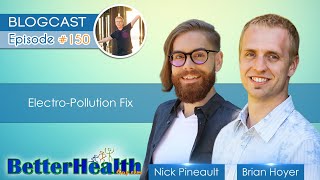
Nick Pineault and Brian Hoyer discuss electromagnetic fields and their health effects, from sleep disruption to mast cell activation. They cover practical fixes: measurement tools, shielding options like canopies and grounded rooms, and a three-step framework of downtime, duration, and distance to reduce exposure.
Chapters
Welcome to Better Health Guy Blogcasts Empowering your better health and now, here's Scott, your Better Health Guy. The content of this show is for informational purposes only and is not intended to diagnose, treat or cure any illness or medical condition. Nothing in today's discussion is meant to serve as medical advice or or his information to facilitate self treatment. As always, please discuss any potential health related decisions with your own personal medical authority.
Hello everyone and welcome to episode number 150 of the Better Health Guy Blogcast series. Today's guests are Nick Pineau and Brian Hoyer and the topic of the show is the electropollution fix. Nick the EMF Guy Pinault is the number one best selling author of the Non Tinfoil Guide to EMFs and an.
Advocate for safe technologies.
Through his unconventional approach blending humor, science and common sense, he's becoming a leading voice on the topic of electromagnetic pollution and how it affects our health. For the last few years, Nick has been interviewing some of the best minds on health and technology and facilitating the creation of courses and educational materials to raise awareness on this very important issue. Brian Hoyer's dive into health started when he became a father wanting to provide the most optimal growing environment for his family. His desire for them to thrive and devotion to discover the truth drove him to find the most insightful and effective cutting edge methods for addressing what's really going on in our bodies and our environments. This led Brian to become a functional nutritional therapy practitioner, to train with Dr. Dietrich Klinghardt, and to become a certified geobiologist trained by a pioneering naturopathic and environmental medicine clinic in Austria that's been addressing EMF and geopathic stress since 1983. Brian and his wife Lindsay built an EMF shielded tiny house in the summer of 2017. Brian travels all over the country doing EMF assessments, speaking at conferences and on podcasts, and helping families install shielding solutions. He doesn't always bring the tiny house with him. It's really not so tiny. And now my interview with Nick Pinault and Brian Hoyer. This is such a critical topic to.
Explore and mitigate to move from chronic illness to better health. When I first heard Dr. Dietrich Klinghardt talk about this in 2006, very few people took him seriously. I think we all now know that being bathed daily by the these man made frequencies negatively impacts our health. Nick and I have done a prior podcast on EMFS. Brian and I originally met through Dr. Klinghardt's courses several years ago. I'm very excited to have them both on the show today to talk about their Latest thoughts on EMFs and electropollution. Thanks for being here, guys.
Thank you. Thanks, Scott. It's nice to do these two way interviews rarely happens. And Brian and I have spent so much time together, it really, I don't know, I think it's one plus one equals three kind of thing with our partnership.
Yeah, it's fantastic. Let's start by talking about what unfolded in each of your own lives to lead you to the point where teaching people about and mitigating the health effects of EMFs became such a focus for you.
Yeah, I guess I can start that off, Scott. It's similar for me as for you. Attending some of Dr. Dietrich Klinghardt's seminars, doing some continuing education as a, you know, I started off as a nutritional therapy practitioner and one of my mentors had done the Klingheart trainings. It was in 2011 would have been the time. And I heard his talk on EMS and how he addresses that in his private practice. And it struck me as so important that I started experimenting with it in my own practice and seeing some amazing results. And I looked around and at first I started referring out to people because I didn't know much about it at the time. But then I started gathering equipment and doing research myself and realizing that there's a lot of people that are testing this stuff, but nobody's taking it to the extreme that Dr. Klinghardt is. And like, okay, this is the protocol. We have to do the bedroom and we have to do this for the daytime areas and everything. The idea that as a nutritional therapist, my idea was, hey, we need to create a more ancestral diet, a more ancestral lifestyle. But then Dr. Klinghardt kind of brought it for me full circle with helping me to understand. No, it also has to be an ancestral environment. Especially at night when you're sleeping, your brain is detoxing and there's all these juices flowing in the body that are supposed to repair the human organism at night. Because we're perceiving the stress response, it's basically halted in many ways. So that was kind of the epiphany for me. And then I started dabbling and doing more. I took some training from a naturopathic and environmental medicine clinic in Austria that was offering some classes in the United States at the time. They no longer do that. The geopathic stress was an issue too. So we, we've been working with that as well. So. And then incorporating as, as I saw other stressors in our environment, like artificial light, that was something Else that we, that we started to incorporate into our testing as well. And we've seen some, some really profound results with people who have put in solutions for all of the things we test. Six different things.
You know, I started in 2009 and 10 to write in French about my main passion at the time, which was nutrition, learning for myself how to eat healthy, and really discovering that most of what I had been taught on nutrition was incorrect. For example, the big fear over dietary cholesterol is one that now has been widely recognized as a myth. However, even in 2009, it was still perpetuated. It still is in, in the mainstream that when you eat cholesterol, it puts your heart in danger. We now know that the, there's no link between dietary cholesterol and heart disease in humans and that this is just a link that happens when you study rabbits. So it's just almost a research fluke that caused this myth. And then of course, certain industries wanted to perpetuate this, to have people eat something else than eggs, I guess. So it really angered me in some sense and made me lose faith in the authorities a little bit at the time because I felt, you know what, I'm following the food pyramid. And yet when I follow these other people who have alternative views about what we should eat, I feel way better. In fact, completely transformed my own personal health when I stopped eating certain things. So it really started me on a journey of second guessing the official information that we're getting on a nutrition standpoint. And really years down the road of elucidating what's the truth about our food supply, about many environmental toxins that are now sprayed on food, for example, and even about certain rules in food labeling or in how they can advertise certain foods that are completely incorrect, for example, cage free eggs. And these kind of terms that in the end you dig deeper as a journalist and you realize they're meaningless or some of them are completely misleading to the consumer. So I went down that road for years. And 2016 was when my mom got cancer early in the year and really shook me up and I decided to investigate alternative cancer treatments around mid year. Gladly. She recovered from early stage three breast cancer. I decided to switch my project because I had heard about cell phones and I was reading several books on the topic. Dr. Martin Blank, Dr. Deborah Davis, all the ones that were available on Amazon, I was buying them all and realized, you know what, cancer is a big issue, but what about the causes? Like I would, I would talk about the treatment, but one of two adults will get cancer in their lifetime. Why is it? And one of the big links that seem to appear for me is that cell phone brain tumor link. And I started elucidating that and I really found it shocking that I consider myself an educated, fairly intelligent person with at least a bachelor's degree, you know, and I had been studying nutrition and root causes of illness for years and years, spending all my time, and I did not get it. Still, I did not understand that EMFs could be such a big factor because when I started eliminating EMFs in my own life, I saw a difference. So, so it really shocked me and led to the creation of my book at the end of 2016, beginning of 2017, and the rest is history for me. I've been doing this full time since then.
How might a person know if they are EMF sensitive or if EMF exposure is contributing to their health condition? What are the key symptoms that you see in people with EHS or electromagnetic hypersensitivity? How common are these sensitivities? And is everyone negatively impacted by EMFs, even if they don't necessarily feel it?
So I can start by the stats. They vary widely. There's population surveys that have been done in different countries like Taiwan, the UK over the last three decades and there are several of them that I cited in my book. And it's very unclear. It's self reported and some people think they're impacted and maybe it's other causes. So it's very, very difficult. But the assessment of scientists who have been studying the question for decades, like Dr. Magda Havis, is that about a third of all people at the moment, of all humans and probably creatures, to be honest, are experiencing mild to moderate symptoms of EMF nature. And that's 3 to 5% maybe according to Havis, that might be debilitated or have severe symptoms. And she talking usually about the top five being depression, anxiety, insomnia, fatigue, and sometimes there's other ones that are seen in there a little bit more severe, like heart palpitations, tinnitus, and you would have migraine headaches probably at the top as well. These symptoms are extremely common in the overall population, in the youth and also in adults. So overall these are all epidemics of their own. So it's really hard to pinpoint when EMS or the cause or a contributor or a trigger or a co synergy in that, all these different toxic stressful exposures that we're exposed to. But how can we know? Well, I would talk to that a little bit, Brian, but I would just Say it in a sentence. When people start reducing exposure is when usually they catch up on the idea that it was impacting their health in the first place.
Yeah. And I would add on to that that there, you know, a lot of people that are wondering or asking this question about if they are electrosensitive. You don't know really, until you cut everything out. Until you experiment and sleep in a place where you're shielded from these environmental stressors. And there's kind of two lines of thinking that EMFs aren't a problem because they're not going to give me cancer in 10 years, or maybe because they're not going to give me cancer right away, or they're not going to give me this debilitating disease right away. But then we work with a lot of people who are trying to optimize their health biohackers, people into the health and wellness field, and they're trying to reverse chronic conditions or maybe just increase performance from an athletic perspective or something like that. And they're looking at all these biomarkers all the time, and they see a huge benefit to decreasing or mitigating eliminating all of these EMF sources. So it's kind of that paradigm shift between like, hey, I just want to avoid sickness, to no, I want to be vibrant and healthy and well, and this is one of the strategies that you can do to do that, that you can implement in order to do that. But it involves mitigating. And people who are sick, they do feel a benefit from mitigating these sources in their life. But then even people who are normal, everyday people, you might see improvements in your vitality, your energy levels, less brain fog, and some other, you know, if there's other things that you're like, oh, man, I'm always sort. I've had people who have twitching that they just think is normal, like in their eye, like, oh, man, that's weird. I keep twitching in this one part of my body that. That goes away after they've been sleeping in a shielded space for like a couple months. So it's like little symptoms. Like there's severe symptoms for people that are actually super sensitive, but then there's little subtle things that as an average, average person, you might be getting something and you don't realize that it could be related or the EMF could be contributing to those little quirks and things that you just kind of brush off and just let go by the wayside and you're not even thinking about it as something that's even remotely related to emf. Exposure.
Let's talk a little bit about the idea of coherent versus incoherent EMF, or maybe natural versus unnatural. Are all EMFs bad? And in the health and wellness industry, we talk about pulsed electromagnetic fields, for example, that can have therapeutic benefits. So help to differentiate those for us.
Sure. I would say that from my perspective, I'm always kind of trying to think about it from more ancestral perspective. So what did humans have in our environment that we evolved with or were created to be in? Whatever you believe, evolution, creation. What were humans in for a majority of the time? Electromagnetically. And so we're thinking about the radiation from the sun. We have uvb, UVA radiation, we have a little bit of cosmic radiation, but it's filtered out. We have infrared light, near infrared, far infrared radiation coming from the Sun. 40% of Sun's radiation is infrared. And that is a type of electromagnetic frequency. So that's a natural type that our bodies have become accustomed to. And we actually use it to produce ATP in our mitochondria. So those are some natural forms. And then you also have the magnetic field of the Earth that's a DC current and a DC voltage. Then because of lightning and thunderstorms in our atmosphere, we also have this resonance phenomenon between the ionosphere and the Earth that creates this resonance called the Schumann resonance. And that fluctuates between 7 hertz and about 40 or 50 hertz. And so those are all analog natural frequencies. And what mankind has done is when the invention of alternating current happened with Nikola Tesla in the late 1880s and 90s and 1890s, we started to get more and more exposures to pulsating waveforms, pulses of electricity that our bodies did not evolve in. We weren't created to be in that type of environment. And so it actually causes different types of stress responses in the body. And all of the wireless radiation is based on that 50 or 60 Hz pulsating frequencies. And so it's something that's not natural. We didn't have it ancestrally. And it's perceived as a type of stressor in the body. And it's been documented in many studies to raise cortisol, lower melatonin, and cause an initial stress response. There's these voltage gated pathways that cause issues and production of inflammatory molecules and general inflammation. And so the. But the waveform is the thing that is different. And I'll have Nick kind of piggyback on that a little bit because he's talked a lot more with electrical engineers. I'm mainly in like Mitigation and trying to, and testing these things and creating an ancestral environment. But there's a lot of science behind why it's messy, why it messes with our cells, and also why what the waveforms look like and how they're modulated and some of those types of things that have a huge impact on disrupting our biology.
Yeah. What's interesting to note you mentioned, Scott, the difference between, let's say PEMF or even a red light therapy device versus an artificial light like a cfl, those curly light bulbs that might have biological impact, including from dirty electricity, but also the wrong wavelength that is being used will disrupt your melatonin at night or even the pulsation or the flicker even could be. There's many characteristics that these artificial light bulbs have that can disrupt the human biology. This is the difference between a technology that has been built with human health in mind, with experiments that confirm the wavelengths in the red spectrum can heal, and then what is the right dose of these wavelengths? Because in fact, I've read a very important guide, the Ultimate Guide to Red Light Therapy by my, my buddy Ari Withen, and he points out that yes, there is a dose response relationship with red light therapy. In other words, you can probably overdo it. And if you overdo red light therapy, it blunts the response and in fact, maybe it can get on the negative side. So there's a, there's, it's just logical with most nutraceuticals. This is also the case with exercise and other hormetic stressors. This is really the difference is that the person who developed the PEMF has observed how biology responds to these signals. And sometimes it's through creating a micro stressor and then recovery. Sometimes it's through other means, like direct ATP activation in the case of red light and boosting mitochondria. But this is completely different than the technologies we're using that have been designed with other things in mind, like connectivity and basically making sure that the machines can talk between themselves using wireless signals. And there's the field of electromagnetic compatibility is extremely known and respected in electrical engineer. That's machine to machine. And making sure that the 4G from Verizon does not impair the 4G from AT and T. And that's extremely important. That's an important field in electrical engineer. And the only reason we're able to have so many different routers and things connected at the same time. And we're talking about now in the trillions of sensors that are coming for the Internet of things that can talk at the same time, but not step on each other's foot, is through the science of electromagnetic compatibility. What has not been developed is electromagnetic biocompatibility. In other words, what sensors are in the human body. We have the eyes, we have the skin, and both pick up light frequencies. We know that for a fact now, and it's in fact a very mainstream idea, at least in scientific circles, that we can pick up that light environment and that it will directly impact every single gene and every single cell, because we have clock genes. And I'm not an expert by any means in circadian biology and it's very complex to me, but we know that it's fundamental that the human body can read the light environment. Then where science is, I think, lacking in its understanding, or at least is following a wrong trail, is the lack of understanding that each cell has several components that could pick up electromagnetic fields. The late Martin Blank talked about DNA itself being a fract antenna, and that's something to follow. The skin could pick up signals and act as an antenna as well. And that's work of the Dr. Ben Isai from Israel, who talked about the potential effect of 5G millimeter waves on the skin. Then we have the work of Dr. Paul P A L L from Washington Church University, who talks about VGCCs, the voltage gated calcium channels on the cell, but other ionic channels as well that could be impacted. All of these sensors are on the human body de facto and are impacted by the electromagnetic fields around, including natural ones and artificial ones. But no one in the industry who's developing these cell towers and different gizmos that we have around us understands the biology and then make sure that the machines do not interfere with it. So that's the basic standpoint that I've been exploring, especially with a very important engineer who's been on my podcast, Pavel, with the showski, who's both an engineer and also understand the EHS side of things, being electro hypersensitive himself and also coaching people as a health coach through electro hypersensitivity, and he talks about the signal characteristics being even more important than signal strength. And that's not a popular idea. And because it's a bit damning, honestly, if you have a meter and you say, well, here in Montreal I have 0.2 volts per meter, I go in New York downtown, I see 1 volt per meter, and I can conclude, oh my God, it's five times worse. Well, that's a very, very simplistic reading on what is happening in reality. It's not just that signal strength that matters. It's the pulsation. It is the waveform. So is it a square wave? Is it a very erratic wave like a cell phone? All these signal characteristics and Dr. Havas, in her recent conference, the 2020 EMF Conference for EMF or Health Professionals, she went into, I think, 15 to 20 different signal characteristics that exist. Some of them never heard about personally. So it can get extremely complex. And all these signal characteristics are known to change how an EMF might impact biology. This tells you a few things. First, it tells you that maybe there's hope that we can have wireless signals that are orders of magnitude safer by using the right characteristics that do not interfere with our internal signals. Then it will also tell you that most studies that are inconsistent, they're not able to reproduce the results of other researchers or studies of no effect. The cells or humans or lab animals are exposed and there's nothing that happens in many cases. Or what's demonstrated is this. I'm going to backtrack a little bit. What is demonstrated is that when we use signal generators, so a machine that is supposed to emulate a cell phone, it will produce a single frequency, but it will not produce a cell phone. It will not reproduce how erratic and pulsated a cell phone is. These studies mostly find no effect. And on the opposite, when you use real cell phones and real WI fi routers and real wireless devices, you mostly find effects. So we have to keep in mind that even the researchers themselves in many situations, do not understand. And that's a big claim. I'm not even PhD level, but what I, at the moment I'm realizing is that most researchers who do these studies do not think that there will be a difference between a real cell phone and a signal generator that will send the same frequency as the phone. And in fact, these two are apples and oranges. So this is where we are at the moment.
How have you seen the EMF problem evolve over the past five to 10 years? Is it getting exponentially worse? And then when we think about the 5G conversation, I see some people that suggest it's a big issue, some people suggesting it's not as significant as it's maybe been made out to be. What do you think the impact is going to be of some of these 5G technologies, even some of the satellite technologies now that we're getting exposed to as well?
Well, I've tested a lot of the 5G technology, and right when it was coming out, just like three years ago when they started implementing a Lot of the, the new towers and I purchased for about six months and tested with a millimeter wave meter. And that's what everybody's concerned about with 5G is the millimeter waves. But it's like these people have been living in the dark with 4G because you know, they think that we're getting all of a sudden this jump to all these higher frequencies. But with 4G, we were at frequencies up to 24 GHz between these, these backhaul transmitters, those big round drums that you see up on the towers that are communicating and sending loads of data between the towers so that you can have connectivity over hills and things like that. So really the jump from 2G to 3G was big, and then from 3G to 4G was very massive. And with 5G, from my testing and my experience in the field, the thing that I'm more concerned about with 5G isn't the millimeter waves, although that is concerning because there's studies that show effects on the skin. But I'm more concerned with the concentration and the number of frequencies that are going to be installed, the number of antennas that are going to be coming from every angle and interacting with the human body. And then as far as the satellites, I'm actually more concerned about the million antennas that have been approved for SpaceX on the ground, much more than I am about the satellites floating around in the sky from a, from a wireless perspective. Now if we're talking about light pollution, maybe that's different with the satellites, you know, because it's kind of annoying to be out in the middle of nowhere and see like a string of eight satellites going by like, like a dragon tail in the sky. But the, the evolution of the wireless, wireless is really the only type of EMF that could be considered to be exponentially increasing every year. We're exposed to the same amount of electric fields. Usually we're exposed to the same amount of magnetic fields. That one could be a little bit different because we're installing more cables underground. And sometimes those cables have problems because our electrical distribution system actually operates on a whole different system than what the code is for our houses. It has this multi point grounded neutral grounding system where they actually ground the neutral wires on the power lines and put those in the ground and the ground acts as a secondary return path for the neutral wire back to the power station. And so that can cause magnetic field issues that are affecting whole neighborhoods that we've tested. And so it's kind of a catch 22 because I have a Group here, where I live in Idaho, and they're advocating for installing fiber optics, which I think is a much better technology. But it also has to be installed correctly. Otherwise we may have magnetic field issues instead of the 5G antennas out on the poles outside. So that it becomes kind of a, you know, we have to make sure that we're installing things correctly with human health in mind if we're going to advocate for it.
So a couple of things there just to clarify then. So it may not be so much that the 5G itself is a problem, but because there's going to be many more 5G antennas that are also broadcasting 3G and 4G, that those 3G and 4G frequency frequencies are now going to be closer to us, essentially. Is that right?
Yeah, they're closer to us. And they're also keeping everything that was there previously in previous generations of wireless, all those frequencies, plus adding on top of that frequencies that are communicating with our phones in the sub 6 GHz range. So before it was like around 2 GHz or 2000 MHz and below, that's what our cell phones operated on 700 to about 2000 MHz. Now they're kind of upping that so we have a little more bandwidth coming to our phones. Up to, I think Sprint is using 3.5 GHz in Houston on their towers that are going on every corner. I'm unsure what they're doing in Spokane, but I'm near Spokane and they have 5G connectivity there as well. But they're increasing slightly what our phones are going to be broadcasting out and also what they'll be receiving. But we're not really seeing the millimeter wave usage going directly to our personal devices yet. We're seeing just higher frequencies that allow more bandwidth to come. And there's a reason for that. It's because the millimeter waves don't go through solid objects very well. They can't go around hills very well. If it rains, it's really hard for them to propagate and actually work. So they're using higher frequency to get more bandwidth, but low enough frequency that we still. They can still blast it through your house and get in and get the. Have you. So that you're connected inside your house.
The other thing that you made, which I think is something people don't think a lot about, is people talk about the idea of grounding, right? Going outside, putting your feet in the grass and so on. And my understanding is that depending on where you live, if you have this issue that you're talking about with the return to the power station, that there may be some areas where grounding may not lead to the health benefits that you're hoping for. Would you agree with that?
I would say that it's kind of two separate issues. Because there's grounding. You're going to always get that beneficial DC even if you're in an electrified environment. But you're also getting a detrimental frequency in the AC range, the alternating current from the electrical system. So if you can find a place where you know you're always going to get the DC current, you can measure it with a multimeter. You just switch it over to D.C. and put a stake in the ground and then touch and then hold the electrode and then have your bare feet on the ground. You might want to wet the surface too, a little bit. You get more grounding that way. More conductivity and continuity between the soil and your feet or the wet grass. But you'd also, if you're around electricity in that same scenario, switch it over to AC and you're getting AC electricity as well. Voltage, maybe current coming through your body, maybe some dirty electricity as well that's traveling through that neutral path back to the power station. So it is really important to go to a more isolated area away from electricity to do your grounding. Or what we do in people's homes is we'll shield them and then they can safely ground in an environment where their body is not being exposed to any of that electric fields and only the DC is coming to their body.
You talked about some of the meters and measuring these things. Let's talk about your favorite devices for self testing. How much can people test on their own versus getting a building biologist that has multiple meters, professional meters, that would be too expensive for most people to afford. What are your recommendations for self testing and then for more professional support, how can people find building biologists that do this work near them?
Sure. There's one. You know, a lot of people ask me for one meter that they could get if they just had to buy one. And I have one on our website@shieldedhealing.com that we recommend called the ESI 24. And it has a triple axis gauss meter that measures magnetic fields. It will measure electric fields. And then it also has a really wide range of for the radio frequencies, the wireless frequencies, and it goes from 50 MHz all the way up to 10 GHz. And the reason I like that is because we're, we're not so as concerned about the. I mean, I am concerned about field strength, but I'm also concerned about detecting a wider range of frequencies. And it's not so much the amplitude, it's just like, is it there? Because our ancestors would have had nothing. You would hold that meter on with the volume all the way up, hold the speaker up to your ear. You wouldn't hear anything but just a little light hum like the ocean. But nowadays you hear screeching, clicking, all kinds of stuff because we're constantly exposed to that. So that meter, I think, is the best one. And when you first turn it on, it is measuring all three at once. You can go around and you start to get an idea of the nature of the different types of emf, whether it's a magnetic field or an electric field or a wireless frequency. And a lot of people are super confused about that. If they're just starting out because they have one meter and it's a gauss meter that's measuring magnetic fields and they're putting it by their wi fi router, saying, hey, it's actually not that bad. And they don't realize that you have to have it on a different setting to actually detect it. So the thing I like about this meter is you just turn it on and it's measuring all three at once. And then you can kind of start, especially if you're a beginner, it's really good because you can go around and start to understand the nature of the different frequencies and what devices are emitting different, different types of emf. And that, that's the one. Another thing you can buy that's fairly inexpensive is, is get a regular multimeter and set it up as a body voltage meter. And that would plug into the ground and you can test your body voltage in your bed. You can work on turning off circuits and gets your body, you know, your voltage on your body while you're sleeping way down. And a lot of people see extreme benefits from just doing that on its own.
I think we would all agree that EMF exposures potentially play a significant role in certain people's health. So I want to talk about a few of those. If we consider the idea that when we're exposed to EMFs, we're potentially not detoxifying optimally, that the cells essentially are in a sympathetic state, that they're not able of focus on detoxification, that we become bio accumulators of environmental toxicants. We know that people with electromagnetic or electro hypersensitivity can have higher levels of heavy metals and thus be more of an antenna that detoxification can actually minimize some of those symptoms.
And one thing that I've seen that's.
Interesting is if people too aggressively reduce their EMF exposure, they put up a canopy and they start sleeping in it around the clock. That some people can really have detoxification reactions, that the body can start unloading when maybe they're not completely ready for that. And so I'm wondering, what connections have you seen between EMFs and environmental toxicants or maybe even endogenous toxins that people are dealing with?
That is such a good question. And Nick, I feel like I'm hogging it a little bit here, but I have such a great story on this. Sure, go ahead. It's. We had a woman who had a situation like that. She's very electro hypersensitive, multiple chemical sensitivity, and she put a canopy around her bed. We helped mitigate her space. And we get a call from her several days later, and she's freaking out because she says, I've got mold excreting coming out of my sweat glands out of my body at night when I'm sleeping. And so she freaked out. She returned all of the mitigation stuff. And as a practitioner, I'm thinking, this is good. Do you want that mold still in your body, or do you want it out of your body? That's a good thing. But it was kind of alarming to her to see black things coming out of her body. And she looked at it and she could actually see that it looked like the black mold that she had been exposed to years before. And as a practitioner, there are ways to dampen the effects of a healing response, A healing reaction that you get from doing something that's incredibly healing for your body. And we know that cutting out EMF is always going to be a good thing for people. But once your body lets go of that stress and it's able to get into a more parasympathetic state at night, it's just kind of this burden has been lifted. And it's like, finally, I can detox all this stuff. I can let it go. Sometimes there's so much inside, whether it's heavy metals, mold, or some kind of bacterial overload like sibo or something like that. You need some kind of nutritional support so you can bind to those toxins and escort them out of the body properly. And sweat is one way to do that. So if somebody's detoxing through their glands, that's actually a healthy way to do it through the skin. But also if that's happening, there's likely some internal things going on as well where the body's just going to be excreting into the, into the intestines and you're going to need some kind of binder on board like chlorella, pyranidosa, charcoal, different types of clays, zeolite. Whatever you suspect that you've been exposed to in the past, you need to have a binder for that molecule that. And then also you have to support your liver in the process. So upping your N acetylcysteine, your glutathione liposomal glutathione liposomal, vitamin C, things that are going to, you know, are going to get into your body so that it can bind in the blood and also in the gut. And then, and then washing off the mold that you just excreted on your body would also be an important thing to do in taking care of your skin. And, and avoiding chlorine and fluoride when you shower is also super important.
Yeah, I love all of what you said there and it's interesting because one of the other things I think people can do, particularly with the canopy, is maybe titrate their exposure to it. Maybe start with an hour a night and then work up to two hours a night. Jumping into it for the full night can potentially increase that detoxification reaction. And I got my canopy 2006 when I was becoming a patient of Dr. Klinghardt's and it really was something at that point point that he required people to do a lot of this EMF mitigation to even be a patient. And I didn't have any problem with it. But I see more and more now, probably in that 15 years, the environmental toxicants, the level of EMFs that we're exposed to, that many people have to be very careful about how quickly they mitigate or they will have, can have these detoxification type reactions. Another connection that I'm interested in is what you've observed relative to mast cell activation syndrome. I've heard Dr. Theo Theohorid suggest that mast cells are 10 times more active in the presence of a cell phone, which when I heard him say that just a few years ago, even understanding a lot of this, that really stuck with me. That was a shocking statement if we think about histamine and all of this inflammatory response, that a cell phone can activate them 10 times more. I'm wondering if you think that we'll eventually come to the conclusion that much of the mast cell activation people are dealing with today is driven by, at least in part, the EMF exposures. And have you seen some of your clients that when you minimize the EMF exposure that a lot of their mast cell histamine inflammatory type symptoms resolve or reduce?
We've seen a lot of that with people that have put in shield we probably put in shielding for over hundreds of homes. Now, I don't have an exact count on it, but in 95% of homes that we put in shielding for, there's usually, usually people see improvements without any reactions. And as far as the mast cell activation, I'll speak from a little bit of personal experience. Sometimes when I'm on the road, I have no option but to use my cell phone to be connected and I always put it on speakerphone. I do all the things that we teach in the, that Nick and I teach in our course, but every once in a while, I'll have to use it for more than five minutes and I'll find myself just sneezing randomly, having some kind of allergic response. Like, I can't help. I sneeze like 10 times in a row. And so it's no surprise to me that there's been studies that show mast cell activation like that. But as far as like reducing allergies and the histamine response in the body, we've seen people that have been able to go back and eat foods that they could not eat before that they were allergic to before, after sleeping in a shielded space for about three months. Takes about three months for the gut to fully heal. And you don't even need to be on gut healing. You don't necessarily, I would say, need to be on gut healing protocol in order to see that happen with yourself.
So that was actually going to be my next question, But I just kind of want to restate and reinforce what you're talking about here. So in people that are maybe sensitive to foods, they're eating five things every day and that's it. They're reactive to chemicals. Maybe they're light and sound sensitive. They're. They're really hyper vigilant to many things in the environment. It sounds like some of that is kind of their bucket has overflown. And if I heard you correctly, once they're reducing some of the EMF exposure and they have a little more buffer, they then start to recognize they're as intolerant to other things in the environment like foods and chemicals and light and sound and so on. Did I understand correctly?
Yeah. And your body is able to repair it. Makes sense because your body is able to repair more at night and regenerate different cells. And you're not reacting as much to the foods that you're eating because your gut is starting to heal and those food molecules aren't leaking into the blood and causing an immune response and antibodies being created against those, those little food molecules. So the body, it just wants to heal. And when we give it the correct environment to do that, things happen that I haven't even expected. There's one woman who one night, after sleeping in a shielded room, she had night sweats for decades. They just completely stopped and never came back. And her husband was kind of. He did all the painting in the room and the shielding and everything. And he was kind of skeptical of it. But after that, he's kind of like, okay, well, if we ever move again, I'm going to be doing this again because it had such an impact on her.
I want to talk a little bit about the connection between EMFs and the limbic system and people who are really hyper reactive to many things, that their limbic system maybe is kind of signaling the alarm or the anxiety switch too early, that maybe the perception of threat is not necessarily the same as the actual threat. I don't think that limbic system retraining is something that you do without the platform of environmental awareness, without mitigating and so on. But I'm wondering if you've seen some people that were sensitive to emfs, that limbic system retraining was something that helped them to become less sensitive.
Yeah, I can speak to that without being a doctor in environmental medicine. What I've been finding is whenever I talk to functional medicine practitioners of all types, some of them being health coaches, specialize in EHS up to MDs or naturopathic doctors, almost all of them have mentioned that. Sometimes I would even argue in most situations, some type of neuronal retraining specifically for that kind of exaggerated response to EMFs is needed. And that's even something I heard for mold or other hypersensitivities, where even if you remove the offending agents like EMFs, and you spend a long time detoxing from that exposure, so to speak, or healing from an exposure, it will remain. The trauma seems to still be linked. And I've heard some people getting good results with biofeedback or other technologies where you're able to rewire the brain in some sense. But I've heard good things about the work of Annie Hopper. And also the Gupta program is also a second one that I keep hearing about, which I know you've mentioned on your website, if I recall correctly. So these approaches I think are important and, and in my community I have many people who suffer from electrohypersensitivity. Some of them have nearly fully recovered and many vouch for these programs where it was kind of the last missing piece for the recovery was retraining that pathway, that association that the body makes that somehow still keeps them hyper reactive. And if you want to live in, let's say, quote unquote, normal society, and our normal society is unfortunately quite toxic, it's almost essential to at least be able to handle a city environment for a few days per year if you want to visit relatives or even be a tourist. So these kind of everyday life examples that this is the type of stuff that people with EHS wish they were able to do and sometimes they are able to do that over time when the retrain of brain.
Yeah, I agree. I think programs like DNRS and the Gupta program can be tremendous. I think sometimes people misunderstand the idea that maybe they're going to do the limbic system retraining, but they're still going to have their WI fi running, they're still going to be in their water damaged home, those types of things. And I think that's not what Annie Hopper, Ashok Gupta are suggesting. They're suggesting you still want to improve your external environment and then you're using the limbic system retraining. So I think we're on the same page there. But I just want to make sure that listeners understand that's not a free pass to not do some of the other mitigation things that we're talking about here. So speaking about mitigation, when it comes to WI Fi, for example, mine is on a timer. It comes on just a couple hours a day for devices to connect to. It's off the rest of the time. I know there are some companies now that market low EMF routers as well, which some people seem to have good experience with. What do you suggest when it comes to the mitigation of the exposure from WI FI routers?
The best recommendation really is to try to get back on a wired connection like we did in the 90s when we had, in the early 2000s when we had LAN parties and we played Halo and all those games and stuff like that. So a lot of people can kind of relate to that. But the wired connection is the very best. It's usually faster, it's more reliable. It's what all of us are on right now as we're doing this because we know that WI fi is not usually a reliable connection when we're doing zoom or any kind of video interviews. So that's what we really push people toward. Or at the very least, sometimes there's resistance in households and you can just get them to agree to turn it off at night. And that's at least the very most important time where you want to cut that exposure and mitigate that exposure. But then there's other things in the house that are just as bad as wifi, like your cordless phone system. There's some baby monitors that are operating on wireless frequencies. There's other things in the house that are just as bad as WiFi routers. And you won't really know until you have somebody come and test your space or you get an EMF meter and you start to check around. And sometimes there's things that you buy nowadays where you don't even realize that it has a Bluetooth antenna in it or a WI FI antenna and it's constantly emitting or you get a new thermostat installed and it's constantly going and they don't have any option for something that's wired. So just generally go back to as primitive as possible. But also there's things you can, you can do where you can do the lesser of two evils. Like, hey, I can't wire my whole house. So maybe you can use Internet over power line adapters. That's another option if you don't want to be exposed to WI Fi. But the caveat to that is that it also creates a little bit more dirty electricity on your electrical system when you use that type of technology. But if you're not exposed to electric fields and you do a good job of grounding your work area and your desk area and mitigating the electric fields, you're not going to even be exposed to that dirty electricity anyway. So we kind of have a priority system that we take people through when we, when we do assessments and explain that the bedroom is the most important. And we talk about this in our, in the EMF course. The electric pollution fix that Nick and I partnered up on. And we have our priority system called the 3D system. And it has to do with your duration. Your downtime is the most important. So where you eat, sleep and detox, that's the most important. And then duration and distance. So if you're spending a lot, duration is. If you're spending a lot of time somewhere, you want to make that area as clean as possible. And then distance Is like, okay, if you are really close to something that's emitting, you want to get your distance from that as well. And so we really focus people on those 3Ds throughout that course. Downtime, duration and distance. And those are the most important things. And even just considering the WI fi router, just use that principle right there, downtime, turn it off when you sleep, duration, turn it off when you don't need it, and distance, keep it as far away as possible.
So I think the distance piece is interesting and fits into the next question, which is commonly I hear people say, well, I live in an apartment, I live in a townhome community, there's 50 Wi Fi all around, and so there's really no benefit to me turning off the one that's in my residence. Is that true or is that distance phenomenon significant enough that you really should still turn yours off, even if you're getting exposed to your neighbors?
Yeah, I think it's completely true that turning off your own machines will make a difference. And anecdotally speaking, when I talked to the average layperson, I remember that clerk at the Avis Rental rent a car outlet right here in Montreal, and I told her to turn off the WI fi at night and turn off her cell phone. And she did so. And turns out her husband was not aware of that experiment. And for a few nights he said, wow, in fact, it's the first time I don't wake up in the middle of the night for years. And these experiments and the average layperson I talk to on the street, I tell them to turn off their wifi at night or just the ph. Sometimes it's just the cell phone that is turned off versus open on the bedstand and they feel a difference. So what it means to me is that when you have the vicinity, let's say what's around you while you sleep around a 10, 10 foot or 20, 20ft bubble around you matters a lot. Of course, you're nowhere near ancestral levels if you only turn off your own things. I'm here in Montreal, I'm in a very highly electropolluted environment, less so than certain other cities that I visited, like Las Vegas or New York City. But still it's very bad compared to ancestral levels. In fact, the levels here in this room could be probably like Ole Oensen, says that researcher from Sweden. It's a quintillion times a billion, billion times over ancestral levels. And that's the average background here in Montreal, probably around 0.2 volts per meter. Or more so it's bad enough still we see a difference by removing these two sources. So it tells you something. I think that the intensity probably plays a role. And it's true that if you have a phone one foot from your head versus 20ft, there's a tremendous difference. There is probably a million times less exposure if it's at 20ft. It could still mean that at 20ft is exposing you to something and it's still impacting your biology. In fact, some people with electrohypersensitivity have been known to be sickened by a phone several feet from them, sometimes at distances that make people raise their eyebrows. And they think it's almost impossible to have that degree of sensitivity. And yet it's true these are extreme examples. However, it doesn't mean that if your neighbors are exposing you, you should throw your hands up in the air and not do anything about it. In fact, our entire course is about the fact that what can you do by yourself? To get started with, right, if you are hypersensitive, that's another question. If you're someone with celiac disease, do you live in a city where they throw wheat flour around? I don't know. That's a silly example. But just like you have that exposure or you stay in in Florida with moldy homes, in an environment where it's humid all year, maybe you'll have to move to a state where the temperature is less likely to have mold, for example. Same thing with electro hypersensitivity. But these are examples where people cannot live in an environment where they have 54 neighbors with WI fi. And you have to assess your own situation like this. If you're very sick from mystery symptoms and you don't know if it's a factor, you go outside the city for several days and you feel like a different person, then maybe living in a city is a very bad idea for you. That being said, for anyone, regardless of the symptoms, starting at home and minimizing exposure as much as you can, it's a great start. And at least it's something where a lot of people, including the non sensitives or those who don't think they're sensitive, they're going to see a big difference.
Let's talk now about the sleep canopies or sleep sanctuaries. I've used one for 15 years now, based on Dr. Klinghardt's work. I think it's been a key part of my own recovery. Should they be grounded? Do they block 5G? What are your thoughts on sleep canopies?
Well, when I was first getting into this, I didn't have any sleep canopy to recommend. I knew there were some out there, but I'd had tested a lot as I, you know, like the first year I really got into full time EMF surveys and mitigation, I did like 200 assessments. And what I found is that a lot of the canopies were, were made from materials that were, that were first designed like a decade earlier. And we'd had exponential increases since, since that, that time period. And so these canopies, they may have worked when, when a lot of the people had first installed them to mitigate the exposures that they had. But since they, you know, it could be that they started to wear out a little bit, because they do wear out a little bit over time. But, but we've also had an exponential increase in exposures, right? So, so as I was testing a lot of these in inner cities especially, the frequencies are blasting right through. And there's also this resonance phenomena that anything that you use as a shielding material, depending on what kind of metal it is that's used in the fabric or the paints or the room or whatever shielding material that it is, it has a resonance and it will go out anywhere from half an inch to as much as like two feet. And what that does is the metal is resonating with the frequency that it's blocking and retransmitting a signal that is, that is more native to the shape or the size of the metal structure. So the reason that we have, you know, the antennas, the size of the antenna matters so much is because the frequency is resonating with the wavelength, the same wave, the length of the wave that the antenna is. And there's, there's like half, quarter, eighth, 16th resonance steps in, in that. So, so you have different types of resonances that are going on. So like the human body, it resonates at anywhere from 60 MHz to about 120 MHz. And that's like right smack dab in the middle of that is the FM radio stations. So when I take like a full spectrum, I've, I've won like this really expensive German real time spec RF spectrum analyzer. And I put a body antenna on it and I like go like in the middle of someplace like Los Angeles or New York City where you just have all sorts of frequencies. And so you're high in every frequency from that range from like 0 to 12 gigahertz that this meter detects. And I would touch the top of that antenna and the biggest spikes that you get would be from around 50 MHz to 120 MHz. But then you'd also get spikes all the way up to about 4 or 5 gigahertz. But then after that it drops significantly. Like, you don't get much resonance in the rest of those frequencies, even though they're higher. So you'd see the one half of the screen basically shoot up. And that tells us that your skin, the human body, is resonating most with those frequencies between 50 MHz and. And 4 to 5 GHz. Now, the canopies and the shielding systems, they'll resonate at a bit of a lower frequency than that. You know, it might be around 50 megahertz and then on down to like, maybe single megahertz ranges. But we're cutting out a bulk of those frequencies. And with the canopies, they resonate more than like, say, what a shielded room would. Because the shielded room has all these graphite and carbon nanoparticles. They're not nano sized, but they're microparticles, I would say. So it has this absorption factor because it's layers of all of these materials smashed together. And so you get a lot less resonance from a paint, but you get more resonance in a high environment from a canopy. So in some situations, we're recommending double canopies for people if they're in a really intense area, or shield the room with paint and then put a canopy in it. And I would say that grounding the canopy is important because it will reduce that resonance phenomenon. And a lot of canopy companies, they don't even have an option to ground the canopy because it's enclosed within the threads. So I prefer a grounded canopy because it helps reduce the resonance, helps reduce dirty electricity phenomenons that we've seen and tested. And also it mitigates the electric fields, because sometimes you can have elevated electric fields if the canopy is not grounded. And turning off the breakers doesn't always work for mitigating electric fields.
So are you saying that certain canopies can also reduce your exposure inside the canopy to the electric fields and the dirty electricity as well?
Yeah, when you can ground it, the electric fields will hit the shielding material and drain out through the ground instead of coming inside the canopy onto the bottom.
And then the common question on whether or not they block 5G from our earlier conversation, maybe 5G itself isn't as significant as maybe some people lead us to think. But do we know if the 5G is being blocked by these canopies as well. And is there a specific canopy or company that you find works?
Well, it's definitely being mitigated to a certain extent. The shielding materials. For a canopy, it's hard because you need airflow in the bedroom. Otherwise, you get a moist, wet environment where mold can grow, and you want to be breathing fresh air all the time. You don't want to be breathing back in your carbon dioxide. But then your whole bed system becomes like you're wearing a mask all day, which we know is not healthy for you. So, like the canopy system, you really need it to be able to be grounded like that. And the material, as far as 5G goes, the paint works much better for 5G because it has less permeability. So anytime you can see through something, a lot of the higher frequencies are going to be able to get through. But I say that. But then also at the same time, I'm saying that really with 5G, we shouldn't be so focused on these higher frequencies as what 5G is, because really, 5G is all the 4G stuff, but closer. And when an antenna is closer, it actually has the ability to resonate with threads and then broadcast through a little bit. So in areas where we've installed canopies, and like, there's one practitioner I installed one for in downtown Seattle, right near Pike's Place Market, and we installed the canopy. It was all sealed perfectly. I helped install it myself and made sure everything was tight. But right out his window, you could. Like, about 40ft away, you could see a 4G antenna that's just blasting in direct line of sight, like, directly at the same level as his apartment. And so outside, it was maxing out all my equipment. I was like, at 10,000 microvolts, like three, maybe two to three volts per meter. And it was just really, really intense. And inside the canopy, it went down to, like, 2,000 microvolts and maybe 0.2 volts per meter. So big reduction, but it was still blasting through, and we needed to do some additional shielding for that environment. There are some other companies out there that I would recommend, and the basic guidelines I would say, is look for something that is hypoallergenic, has good airflow, and can be grounded. And those are things. And also a bed that's big, a whole system that's big enough where you have at least a foot of space on every side of the bed so that if there is a resonance phenomenon, you're not going to be getting that in the middle of the bed while you're sleeping.
Ryan, I remember sitting next to you a few years ago at a Klingheart event, and I happened to say that I wish that there was a company that would create one of these pop up tents that was made out of EMF shielding material. And you pulled out your phone and you showed me a project that you were working on that ultimately became this Silver Shield EMF shielding tent. And I'm wondering if you can talk just a little bit about that. I think it's really exciting that we now really have some portable options that we can travel with or for people maybe that, that find the canopy setup a little bit daunting that we can even use in a home environment.
Yeah. So I, you know, the last couple years I was contacted by Dr. Mercola to help his team develop a portable tent that he, that he could take. It was mainly started out as his own personal, you know, his own personal desire to have something that he could travel with and still get a good number on his oura ring, you know. But then it turned into, hey, this is a legitimate product and people need this. So after Several, after probably 20 different prototypes, we finally got it down. And yeah, it's basically just a pop up tent. Like a lot of people have those beach tents that you can pop up at the beach and you fold it up in like a circle. This is similar design to that, but it's longer and it's kind of more like a hot dog. So you go, you go in there and then you zip it up and we have this double flap system with magnets where it basically completely seals you inside. And you can put like a sleeping bag size blanket in there or mattress in a hotel. What I do in that scenario is I just put the blankets or sheets in there and then have the combination bring the comforter and the pillow in. And that's how I just basically sleep in there like that. But when you're completely sealed in there, you're blocked from the external wireless radiation and there's a little grounding snap on there that you plug into the ground of the hotel or wherever you're traveling, Airbnb, whatever, and then you're fully grounded. You don't have any voltage on your body and you don't have any of the wireless exposure and you're protected from dirty electricity as well. One of the issues we have had with the tents is that the airflow in it is minimal. So if you are in a hotel, you need to crank up the ac, get some fans blowing directly on you, turn on the ceiling fan in the room, if there is one, and that will help a lot. And then also having a meter to check, because sometimes if you do have a problem with airflow, you can unzip it a little bit and get some of the air coming in at night.
I like some of the points that you've made about grounding the canopies, grounding the shielding tent. What about people that maybe don't have an EMF canopy and they want to mitigate their EMF exposure by using a grounding sheet or a grounding pad that they're touching during their sleep time? One of the things that I was really surprised about years ago was in certain environments, my sleep location being one of them, if I measure my body voltage and then touch the grounding pad and measure it again, it actually would shoot up. And so I sometimes have concerns that without knowing if the body voltage is actually going down, that the grounding pads may not always be healthy. And so what are your thoughts on that?
Yeah, we cover this extensively in our course. We have a whole module where I think I recorded 30 minutes of audio on this topic. But basically what people don't realize is that when you're in an electrified environment and you touch the grounding mat and you have a meter, what's happening is that voltage is still around you, but your body becomes grounded. And so the voltage goes through your body to the mat instead of through your body to the meter. And then the meter detects it. So it basically reroutes the voltage through your body to the mat instead of through the meter. So it's not registering on the meter anymore because there's another grounded object nearby. And your body actually basically becomes the shield. So it's like a similar concept to doing shielding paint on a wall. If the wall is floating and not grounded, it's just this big metal object. And you test the voltage with the multimeter, then it's going to be high because it's not grounded. But as soon as you ground that thing and then you test the voltage, it's low. But does that mean the voltage disappeared from behind the wall? No, it's still there, but it's all being drained through that metal shielding material down out through the ground. And so if you think about your body more like that, and is that bad, Is it better or worse to be in that environment where you're grounded and exposed to electric fields, or just floating in the electric fields, which is better? I don't know the answer to that question. What I do know is what's more Ancestral is to be free of the electric fields and grounded rather than being exposed to electric fields and grounded.
So what about the scenario where you have the body voltage meter? You touch the grounding pad that is grounded to an outlet and you actually see the body voltage going up, then.
That means there's the ground has an issue. The grounding connection either has an issue or there's something there could be a bad connection in the grounding mat itself. And so like if the grounding mat has metal in it. So if you're touching something that's metal, usually your body voltage will go up. So there could be a bad connection in the cord or the ground set connection somewhere on that line.
Got it. How important is turning off the circuit breakers at night or installing a demand switch to minimize some of that dirty electricity? Do you recommend people do that? And if people don't do it, this is one of the things that I know Dr. Klinghardt does. Do you recommend that it's better for people to put their pillows at the foot of the bed so that their head and brain are furthest away from the field origin?
Yeah, maybe I can, I can talk about the use of dirty electricity. You talk. What is the term that you use around what you would install at the breaker panel?
Demand switch.
Yes. What we advocate inside the course and that when it comes to specifically dirty electricity is we think the most effective strategy is to use, let's say a main panel filter instead of merely using just the plugins. And that's Brian's experience. It was something that I did not originally write in my book. I was not aware of these products or maybe some specialized like PXDNA or I don't recall exactly the names, but Brian recommends the Power Perfect box from Static USA and there's a few others, but mainly using something at the panel to filter out their electricity. As far as breaker panels, I went back and forth on this because some electrical engineers tell me, well, don't tell people to turn them on and off non stop. In reality, I looked at the rating of these breakers and normally speaking, you're able to turn them on and off two times a day or let's say on and off per day for years before they become a problem. That being said, if someone does that for decades, it might be problematic. So there are certain products that can be that can do that automatically and safely, like the EMF safe switch. That's something that can be valid for people who want to do that. However, Brian's point, and this is really what he brought to the table in our course is, is why do you need the electricity in the room? And that's an idea that I thought about a lot. And unless you have your office environment like I do in mine. So in my case, okay, during the day I do need electricity here. So it's a little bit troublesome. But a lot of people who work outside the home, why do you need to even open the breakers in the first place? And if you have battery powered lamp, battery powered alarm clock, and battery powered everything, then you're all set and you can have an electricity free bedroom. And you simply never open electricity in your bedroom. So that's an idea that we try to give our members as a first line of defense. Why even bother with reopening the breakers unless these breakers are shared with other rooms? And that changes the story a little bit. In the case of that room, for example, I do need the heater to be on because I'm in Montreal and when we have sub zero temperatures, you do need heating in that room, but that's a different breaker. So they can use these products. And as far as dirty electricity goes, well, if you turn up the breakers all the time, you do eliminate the dirty electricity. Dirty electricity is on top of the normal electricity. So you eliminate the electric field. It tackles the dirty electricity at the same time. Of course, that's not perfect by any means. You could turn off circuit breakers 1, 5 and 8 and realize that it drops off your body voltage tremendously. However, I'm in a condo, three story, so the neighbor, what they're using on their ceiling, you know, it will impact me. And this is by no means perfect. So in reality, to create an environment where you would have little to no electricity and no body voltage in your environment, that would fall under the category of a shielded room and including something on the floor if you do have a neighbor downstairs. So it's a little bit tricky. But overall, the recommendation, I think the number one would be try to do without electricity in your bedroom at all. And then it will prevent you from having these behaviors that we know are not healthy, like opening very bright lights or even spending too much on your phone because it's charging. So all of these won't be possible. You don't even have electricity. And maybe you use candlelight or just a calming lamp that is battery powered. And we offer these options inside the course.
So if someone's somewhere like a hotel maybe where they can't do some of those things, is there some value to keeping your head as far away from the wall as Possible, I would say, yeah.
A lot of hotels, if you have a meter, you can test your hotel, too, and see if. If it's even going to be necessary, because there's some hotels, not all of them, but some of them actually have all the electrical in grounded conduit. And so in that case, the most important thing in hotels is to unplug all the lamps and things that are plugged into the walls. And I would say that, yes, Scott, there is value in. In bringing your. No, even moving the bed more toward the middle of the room and then maybe having your head, because really the bottom half of your body has a lot less surface area than the top half of your body. So the more surface area you have closer to an electric field source, the more voltage that's going to come onto your body. So if your feet are more toward the wall and your head is toward the middle of the room, I think that probably would lower your body voltage as well.
We've talked about the really important focus for mitigation being in the sleep location at night. More recently, I'm talking to doctors that feel like for some of their sensitive patients, that that's no longer enough, that people need to reduce their EMF exposure during the day as well. We can implement a lot of these mitigation strategies in our homes, but what about when we have to go out into the world to an office where we have limited control? What do you think about things like T shirts and undergarments and beanies and things like that that are shielded? The shielding clothing, does that have some potential value?
We talk about it extensively, the course, but maybe the short version of which is, again, I think, similar as the grounding mats. It's always. It's not as simplistic as people would like it to be.
Yeah, it's. If you think I always have people go back to this idea of like the bunny ears on your television antenna and say the reception's not coming in very good. And so you're like, hey, Joey, go to the kitchen and grab some aluminum foil. Let's extend this antenna and make it so the reception's better. And so you do that and like, oh, wow, the reception's better. Or you can even reach out your hand and touch the antenna and it gets. Makes the reception come in better. The same is true. The same can be true of putting shielded clothing that has direct contact with your conductive skin on your body is that it can make you actually more of an antenna for these frequencies. And now when you take an EMF meter You're measuring the like behind it, but the meter is not touching it. If you have a meter that actually touches the shielding material, you'll see, like we have this one that we measure the body as an antenna. Well, if you measure the shielding material as an antenna, it's just as high as what your body is, and you're conducting that right onto your body. And so if you test your body when you're wearing the shielded clothing, it's going to be just as high as if you weren't wearing it all over your skin. So, so it's. It'd be better if there was clothing that was designed where you didn't have to touch the shielding material, number one. But generally speaking, there's also this resonance phenomenon that's happening with the shielding, and it's right up next to your body. So that's why, like a lot of the customers that we've done assessments for who are ehs, which is for, for shielded healing, it's probably about maybe 15 to 20% of our customers are like that. A majority of our customers are just really into health and wellness. They're biohackers. There may be people that are chronically ill with Lyme or some autoimmune disease or something like that, but they don't really consider themselves to be electro hypersensitive. The ones that consider themselves electrohypersensitive, or maybe the 15 to 20%. But some of those people who are hypersensitive, they do feel better in certain environments with that. And I think with the shielded clothing, and I think it's based on the frequency of their environment that they're exposed to. Maybe the frequencies don't resonate very well with the shielded clothing in that environment, whereas they do in a more intense environment that has a frequency that has that, that resonates better with that shielding material. So it really depends, I think, you know, based on my experience, it really depends on the environment that you're in, whether the shielding material is a good idea or not. And I would prefer that people use it thinking, not about the cell phone towers, but thinking about, okay, what exposures I have in my house that my spouse doesn't want to give up, my teenage daughter or son doesn't want to give up, or I have to use a cell phone, so I want to have a shirt that blocks that primary signal from the thing that's near me. So shielding clothing from outside sources from towers is, I would say, is not a, not a good idea. But maybe from things inside your environment, it could Be a good idea.
You mentioned the graphite paint solutions. I'm just wondering how many people implement those solutions, given that you then have to be even more careful, as I understand, about having devices and things that are emitting inside that kind of graphite paint cage or Faraday cage, that you really don't want any devices then. And then also, is there a potential issue when you sell the home later that you now have a room that maybe somebody isn't going to then be able to use their devices and things? How common of a solution is that? And can it be removed?
It can be removed. And we've had several people sell houses that have shielded rooms. I mean, just this last year, my parents, they had a house in California that they sold and it had a shielded room. And the person thought it was cool that there was one bedroom in there that was completely grounded and shielded. And they were someone that worked in the Silicon Valley. And so who knows, maybe they thought, hey, I could put my equipment in here and it's not going to have any interference or it's not going to have any, you know, whether it's electromagnetic or radio frequency interference or whatever. But it can be a bonus for selling if you sell to the right market. There are realtors out there that have healthy homes exclusively listed on their website, and people from all over the country are looking for those types of homes. So in those instances, it actually can add value. But the way to remove it, the only way to remove shielding paint would be to take down the drywall and redo the drywall in there. And that can cost as much as little as $1,000 to maybe $2,000 to have it taken down and put new drywall back up, which in the grand scheme of things in house remodels isn't really that much if you're going to be doing some remodeling, you know.
Yeah, I'd be pretty excited if I was moving into a place that had that all already installed. Personally.
You know, years ago, we used to.
Get so focused on smart meters and everybody was worried about their smart meter. I don't really hear so much about smart meters anymore. I'm wondering how much of an issue at this point do you think smart meters are in terms of their contribution to the things people with EHS are reacting to?
My God, smart meters. There's still a problem. And there's of course, the water meters, the electricity meters, the gas meters. There's also the solar panel meters that can be installed as well that I learned about from BJ Hardik, the guy from Sadic, the CEO. And you know, it's a problem for two reasons. The wireless can be a problem, although it's hard to know why. I think it's a very short pulses of very high intensity. And even most meters, when they measure how much radiation is being emitted by the smart meter, they kind of do an average. So it's hard to know exactly how rough the pulse is. And the industry gets away with, let's say, a pulse that can even go beyond our safety standards. But because it's average over time now, it becomes okay. So I know for a fact that I was in an apartment with a smart meter in the kitchen, of all places, because in Montreal, in several small apartments, they were installed inside the apartment. So I was cooking, and the smart meter was a foot from my face. And I know I never felt bad like that as I felt in this apartment for that summer, for four months. It was just an anecdote.
It was cooking you while you were cooking your food.
Pretty much, yes. And so. So that's the pulses and proximity is a big problem in. In some situations, I've heard about people realizing about EMFs and then telling me, you know, I feel sick about EMS, and, yeah, there's this wall of 37 smart meters right outside my bedroom. In these situations, obviously, it's equivalent to living near a cell tower or right next to a cell tower line of sight, where this exposure can be so high, I don't even know if it's a good idea to live there. So in these situations still exist, and unfortunately, they're hard to mitigate, especially if you have an entire wall. Right. You have little control over that. In the course, we do talk about the fact that you can use certain things to dampen the signal, but replacing a smart meter with an older analog meter remains the best strategy to roll back on that technology a little bit and to avoid that wireless exposure. All that being said, the smart meters, it's also about the dirty electricity. And some doctors and even building biologists I spoke to say that smart meters might be worse now and from the dirty electricity perspective and not necessarily the wireless for some individuals. For example, in many situations, building biologists told me, well, people said, I feel sick because my smart meter got installed. And I can pinpoint the exact day where I started getting these headaches or tinnitus or name it. And turns out the wireless exposure isn't so great. And sometimes it's at the other side of the home. However, the dirty electricity can go tremendously up and and this is why across the board, our recommendation is to have a power perfect box or some equivalent technology at the main panel to filter out what comes from the utility company, and that comes into your home. Because if you replace your smart meter, but you still live in a place that's fairly highly populated, everyone will still have a smart meter, unless maybe you get your neighbors on board, which would be good, but. But still, realistically, all the lines now are polluted with that dirty electricity, which means that thinking about your own smart meter is good. But filtering dirty electricity at the source might be required, just like I would consider filtering tap water at the source required if you live in a city environment, just because of the. Everything that came out around heavy metals and other toxins that aren't even regulated. And here in Montreal, we got notices. Oh, your home might have still these lead pipes around it, but it's a big question mark. And I'm like, oh, my God, this is bad. We're so retrograde about that. Dirty electricity is even worse because we're just starting to understand that issue. So do try to replace your meter within that analog one. Consider shielding it if it's impossible, but the dirty electricity problem will remain regardless if you still have that smart meter on.
You mentioned tap water, so I'm going to segue to another question, which is when we think about the structure of water, the work of Dr. Emoto wondering what impact does having cell towers on the top of water towers have? Does it potentially change the water molecules, or is it unlikely that that cell tower is actually penetrating into the water tower?
I'll just mention one study that I saw around millimeter waves specifically, and what the researchers said it was water researchers. Of course, millimeter waves will permanently alter certain water characteristics. And of course, we don't have any conclusion as whether this impacts biology or not. It probably does in some way or shape, but we don't have the correlation with illness or with oxidative damage or anything like that. We just know that it does something to the water. And it got me scratching my head and that they say permanent changes. I'm like, oh, my God, this is we.
And what is our body? 75% water. Right? So. Or more. Yeah. So I, I think, I think that as far as the water tower question, I know that there's going to be resonance phenomena that's, that's blasting in internally to the water. So there is going to be exposure. It's not completely protected because it is a metal structure with the antennas right there. And we think about the Antennas transmitting one direction, but really they just kind of blast like a grenade in every direction. It's more like, if you think of radio frequencies and wireless radiation, more like very intense bright light, Then you get a better idea of how it, the nature of it, and that's what we tell people about when they're shielding a room is to act like. Like there's a big, like, you know, there's. There's like 10 trucks that are just blasting their high beams at you through the window. And you want to make this window completely dark. But the same way with these antennas on the water tower, if they had huge lights and it was a clear water tower, like glass, you would still be able to see the light, like pretty intensely from the other side. And it's going to be resonating with, with that metal and rebroadcasting a signal in there so the water will be exposed. Whether that affects the water or changes the structure, I would be surprised if it did not do that. And, you know, so structuring water becomes a whole other topic of how to do that and what's the most effective way to do that. I know you can do it with infrared light. The sun will structure, structure water, restructure water. And it would be interesting. I don't know if it permanently. If millimeter waves permanently damage water, can that water be restructured or is it still permanent? That's a good question. I don't know the answer to that.
Let's talk about electric cars. What do you see when you measure the EMFs from electric cars? Can that be a healthy option for someone that is maybe sensitive to EMFs? And then taking things a little further, are there things one can do in any car to minimize the EMF exposure that's coming from all of the advanced technologies that these cars today have?
Yeah, I'll just maybe speak. Brian, to the last point. What everyone should do is not buy a car and do this at the car deal at a car dealer. Go in the settings of the car and look at the different options that might have Bluetooth or Wi Fi hotspot or sometimes a 4G. And even who knows, they're going to put the 5G hotspot in the dashboard. I rent a lot of cars, so I can speak to many, many different brands. Sometimes I have Kia, Hyundai, Honda. I have all of them. And some of them give that option, Bluetooth off, and then I'm verify with my meter, it's off. And some of them, it's no options. You have the Bluetooth and then you have a 4G LTE hotspot in the dashboard blasting away at your face all day, every day. And you could technically, if you're handy, open the dashboard and probably disconnect the antenna. And hopefully it's not going to give you an error message or void a warranty. But it's not something that I would personally do because I'm not a car guy at all. So don't buy a car without these options anyway. The problem that I foresee for the future is that more and more cars will come with more and more sensors and different wireless tech in it. And at the moment, it's not a popular idea necessarily to give the user control over which antenna is on or off. And Brian, what about testing? I get reports that sometimes Tesla is clean and it's not. Then do you have blanket statements on which cars are cleaner?
There's really not a blanket statement. I can say. I've tested Teslas, I've tested Nissan Leafs, I've tested hybrids like the Prius and others like that. And there's several different things to consider with the car. And one of the big things that you get exposed to in any car is magnetic fields. Just from the tire spinning from the alternator, the engine, you get high magnetic fields no matter what. And so cars just by themselves are usually a pretty high EMF environment to begin with. And then on top of that, regardless of what technologies installed in the car, whether it's electric or whatever, because we're moving so fast between these cell phone towers, when we're on the highway especially, we are continually our phones. If you have your phone on. You know, I always recommend people travel with your phone on airplane mode because if your phone is on, you're getting exposure to towers all the time and your phone is continually switching, ramping up the signal and then going back down. But even if your phone's on airplane mode, you're still going past all these cell phone towers. You're going underneath power lines. You're, you know, I've traveled places with my, all of my equipment on, and it's like it goes up and then it goes down, and then it goes up and then it goes down. And so you're going to have exposure no matter what in the vehicle. So I would say, like, more important than what car you get. It's important to have a healthy lifestyle, a lifestyle of mitigating the damage of the EMF with different nutritional supplements that you can do. Antioxidant supports, NAD is a good one. Molecular hydrogen, Astaxanthin, can be very helpful. Liposomal vitamin C. Like there's strategies that you can do from these nutraceutical approaches to help mitigate the damage done from the EMF exposure that you have during the day. And then Also things like Dr. Zach Bush has this nitric oxide dump that Dr. Mercola helped to popularize doing that two or three times a day. If you look him up on your favorite video online search place, you can look up Dr. Zach Bush nitric oxide dump or nitric oxide release. And what that does is it releases the nitric oxide from inside the cell. And we know about these voltage gated calcium ion channels. And when voltage hits these channels, it opens up and lets calcium flood into the cell. When that calcium floods into the cell and nitric oxide is present with superoxide, it creates peroxy nitrite. And that is the inflammatory molecule that causes this cascade of oxidative stress in the cell intracellularly, everywhere. And so if nitric oxide is not present in the cell because you've done this nitric oxide release workout, then it's not going to cause as much, nearly as much damage when you're exposed to emf. And then other things that help release nitric oxide out of the cell are things like near infrared light therapy, sauna therapy and cold therapy, cold plunges. All of those things which could be considered ancestral practices, help to get that nitric oxide out of the cell. So that the. And this has such a huge importance for our daily lives and our habits in this modern EMF polluted environment that we need to incorporate these. Especially if you are electro hypersensitive, you need to incorporate some of these strategies and behaviors into your life so that you can lessen the damage that's happening during the day. And then if that, you know these habits, this is what I've been coaching people on, mainly who we do assessments for those habits. If you can get those habits in line and then have the shielded room, you're going to be much, much better off than people who don't understand this, don't have the shielded room. But even these daytime things, you can do them right now. You don't have to wait to have a shielded room. First I got to get a shielded room and then I got to start doing this exercise. No, do the exercise right now. Do you know, get out in the sunlight, get your near infrared therapy from the sun. For right now, that's free so far as I know and you know, as it exists in the world right now. So we can go outside, we can get sunlight, we can get grounding, we can, we can, we can expose ourselves to cold, we can take cold showers, hopefully filtered cold showers. But you know, all of these, all of these things are at our disposal for helping to reduce the damage from ems. So daytime exposures, like in the car or at work, these are areas where we need to develop these habits and have these strategies at our disposal.
Yeah, those are some great ideas. I sometimes think of magnesium as well, melatonin, rosemary propolis. Those are a few that Dr. Klinghardt talks about as well. So absolutely agree. Those can be really helpful. As we start getting to our last few questions, I want to get into a few. A topic that's fairly debated and that is the whole idea of EMF harmonizers. What we're talking about so far really is EMF reduction mitigation from a physics perspective, reducing our exposures. I know Dr. Klinghardt's always said that's really, really critical, that we're not going to stick things on our devices, stickers and so on, and really move the needle. That that's kind of in my mind like taking an aspirin to dull the pain from hitting your head against a brick wall, but continuing to hit your head on the brick wall and you maybe need to take an aspirin. And so I've had a whole drawer full of wearables of different kinds. As you can see, I'm not wearing any of them right now because I never really felt a big difference. But some people do. I know there's some people that cannot sit at their computer without getting flushed and burning skin and whatnot. And maybe they find a particular type of harmonizer that allows them to then be at the computer. So I'm wondering if you've seen any of these things make a clinical difference and if we are in fact mitigating and reducing it exposure, can some of these harmonizers essentially be icing on the cake? As long as we're not forgetting that we need the cake, so to speak.
Yeah, I'd say, you know, I have an entire tree three part discussion with. The first one is a solo episode and then a two part discussion with Pavel, with Pischowski, the engineer I mentioned previously talking about this very problem of harmonizers and problem because. Because the first problem I have with harmonizers is the marketing around them. So in your question it shows me you understand these things very well in the sense that minimizing EMFs, reducing sources, cleaning the bedroom, doing what you can, considering a shielded room, a canopy, all These strategies are still valid and the harmonizer should not replace this entire work. But for the average layperson, and the way I see, I would say most of these companies marketing themselves, they sell it as a magic pill, a magic bullet. So you install this thing on your phone. I've heard claims your phone now becomes healthy. I don't want to be their attorney, to be honest, because I hope it's true. If it's not true, people will be exposing themselves to what is, is potentially becoming a Class 1 carcinogen to the head. I don't want to be in their shoes in that situation. If they really sell a benefit that is untrue in the end years, decades down the road, the person develops a brain tumor. I don't know if that's going to happen. That's just an example of what could happen with bad marketing. So there's a lot of promises of 100% protection. Sometimes they're backed by some studies, sometimes human trials, sometimes placebo controlled. I have seen things that, that make me think that there's something to it. It's a lot of focus on certain biological markers. Like you see these people have lessened stress response when exposed to their phone, or sometimes no stress response when exposed to their phone. Sometimes it could be skin conductance or hrv or even their heart rate per se, or blood pressure. So. So measurable responses that are lessened by a gizmo or some harmonizer. So some companies show me there's something to it. And this might be part of the field of bio, of electromagnetic biocompatibility. What can we install on a phone to create some sort of resonance phenomenon where the waves aren't as harmful to certain of our sensors or even maybe to the human biofield? And that's being also elucidated by Beverly Rubik and other researchers in a very serious scientific matter, as part of the frontier science of the biofield, or what natural energies are emitted by the human body. But all of this is in its very infancy. So the problem I have is how can you guarantee that you're tackling all possible biological effects 100% when we don't even know the full mechanisms of harm. So it looks to me to be, to be very simplistic in how they talk about it. I've seen a few companies be realistic in what they offer. They talk about a reduction of EMF related symptoms. You can make that flame, I'd be okay with it. A reduction of EMF stress, yes, I'm okay with that. But the 100% protection and even saying in their marketing will always be exposed to more frequencies and they kind of oversell. They throw their hands up in the air for the consumer saying there's nothing you can do about it, but we have a device that can save you. That's really the main problem I have with these. And then anecdotally and talking with for example Peter Sullivan, who's ex Silicon Valley, very high level inventor, early stuff with Netflix interface and these kind of things. He's used to be EHS himself. We had a very candid conversation on my podcast. He talked about over a dozen products. I think he said, you know, this one helped for that. This one kind of gave me a sense of peace. It's kind of a Schumann resonance generator. So that's a different thing. That would be a kind of frequency producing machine. But all of these can be valid. And he shared that some of these are very serious and they're scientific approaches, but in the proper context, of course he wouldn't recommend to just expose yourself to whatever you want and then use these gizmos. So this is really where Brian and I stand where if you do the, the. If you would do what you can to clean up your environment and then you realize that you have to travel and feel extremely sensitive to an airplane and this and that and you experiment with a pendant, with a wristwatch, with homeopathic drops, whatever works for you, try it. But don't be lured into the idea that spending $3,000 like some of our pre before meeting our course, someone spent 2k on these devices and said well I don't really feel good. That's a problem because spending all your money and time in the wrong direction is really be troublesome and I find it just sad. So it needs to be used in the proper context.
Yeah, I think that's a really well balanced way to look at it. Certainly some people do get benefit, but long term, if they're not also reducing their exposure, they're probably still going to be, you know, inflicting unnecessary stressors on their body. So I absolutely agree with that. We will link to your new electropollution fix course in the show notes. I recently started the course. I've heard very positive comments from others as well us what people can expect to get from taking your new course.
What I really brought to this course is more of the practical experience of actually guiding people through a lot of these solutions and understanding what the obstacles are. For somebody who's wanting to install a lot of the solutions, one of the things that we really focus on is how can we make this a more interactive course? How can we make it so that like each module there's homework and so you go around and you actually will measure things. And there's different ways that you can do that where you don't need to buy some extra equipment and there's other things where you're just taking inventory of what's in the house. But a real big focus of it is making sure that you can get everybody in the household on board so that you have a better chance of actually getting some of this mitigation done, some of these things that are done. Because a lot of times there's someone in the house that's very skeptical. So we have a whole video that talks about how to deal with skeptics in the house and maybe even just friends and that sort of thing. And then also there is an EMF meter that we do recommend for the course if you do want to have one, because it is very useful. And so we have a tutorial on how to use that and go throughout the house and measure different things. And really we're focusing on light, artificial light, which is a type of emf, which a lot of people don't put that into the category of electropollution. But we have a lot of light pollution. There's flickering, there's too intensive light at the wrong time of day and there's also the wrong spectrum of light. And then we have electric fields, dirty electricity, radio frequencies and magnetic fields. Those are the things that we basically talk about in the course. And we go in depth on how to, how to basically mitigate those as best as you can without spending thousands of dollars on professional equipment.
Beautiful.
And I would say where this differs from other approaches that we've seen before is, you know, Brian, when I got him on this project, we started talking about it. He wanted to make it easy for him and his EMF consultants that work for shielded healing to come into a home that is already pre cleaned. Because these folks, these customers, oftentimes they don't realize that there are so many things they can do by themselves before they seek the help of an EMF mitigation specialist, which is always good. That's the next step. But what can you do by yourself without having a professional come in and then doing the shielding and all this. This before you can take care of your bedroom. We Talked about the 3D system. Downtime, duration, distance. Well, we run you through each type of EMF and then run the 3D system and give you guidebooks with it to look at. Okay, what are my solutions for WI fi? And it's not a one size fits all by any means. It's not okay, turn off the WI fi at night and remove the cordless phones and call it a day. No, we do address all the potential sources. People sleep too close to an air purifier or they have a CFAP machine and, and all sources that are possible in the home. And you pick and choose your adventure based on what your situation is. And if you live alone, then maybe you can do more and more rapidly. But if you're in a big household with four kids and a skeptical husband, that is often the case, unfortunately as a husband, sometimes as the wife, but mostly men that love their tech. Well, how do you deal with that? Because trying to do everything all at once can be dangerous to your relationship in some sense. And maybe you have teenage kids and they hate you for it because now you say no more WI fi. So it's also a strategic course and how can you apply it with while respecting your budget and also your time allotment depending on how busy you are. So it's really a step by step approach like this.
Excellent. Yeah, I think it's really empowering for people to have the information you put together. I know it's very, very detailed and goes into a lot of different strategies and approaches people can take. So I would recommend people check out the course. My last question is the same for every guest and that is what are some of the key things that you do on a daily basis in support of your own health?
Well, I can start. I do too many things to mention to be honest. Maybe I'll tell the new thing that I've been doing is these daylight blockers. After the interview, it's one of the bonus interviews inside our electropollution fixed courses with Dr. Ben lynch, one of the foremost experts on epigenetics, among other things. And he was wearing these or had them on his desk. And he told me, nick, you won't believe the difference that these yellow tinted glasses during the day would make. And I was aware of the orange glasses at night where you block maybe the TV signals or looking at devices and you maximize your melatonin production and increase deep sleep. And I was aware of the effect I put them on when the sun starts going down and I feel sleepy after a while. So they work. But during the day it really improved my ability to concentrate and I don't get brain fog as much especially this is a two hour interview and I don't feel as drained, for example, and I don't know exactly what the mechanisms are. Maybe I'm, I think I'm fairly sensitive to, to these frequencies. And even considering my screen normally is pretty amber, using software based approaches like, like Flocks or the Iris software, these glasses is just another dimension of being able to concentrate on copy that I'm reading or writing. And as an author this is really an edge that it gave me. So these are blue blocks and there are several good brands, but the fact that they are yellow blocks, a large fraction of the blue spectrum. And for me, I'm unable almost to work on a computer now after three months of using these every day on a computer without having yellow glasses. So it made a bunch of difference for me.
And for me, I think the basic things that I do every day is, well, I sleep in a shielded room every night, so that's always helpful. And then the first thing I do in the morning is get a big drink of water that's loaded with, with minerals like very high in magnesium. And then I go outside and take off my shirt, get the sunlight on my skin first thing and in my eyeballs. And that helps to set the tone for kind of the rest of the day. And I'll do a little bit of, you know, I'll do my nitric oxide dump in the morning and while I'm outside that's like the very first thing that I do. And then that gets your blood pumping and you can actually feel the tingling in your fingers. The tingling in your fingers is the nitric oxide kind of flowing out. And that starts off the day for me. And then I have a very specialized diet where I avoid nightshade vegetables and a lot of most grains, gluten. And I eat more higher fat and protein diet and kind of lower carb. Carb. And that works for me. It's not going to work for everybody, but those are the things that I do. And then, you know, I've got my own like adrenal supplements and testing that I do for my family and myself as well. So I'm always usually on some kind of protocol, something that's, that I'm, that I'm working on. But as far as habits go, I mean that getting out in the morning and setting your circadian clock first thing so important, getting that shielded sleep, it's a game changer. Once you start to do that, you never want to, you never want to go back. And it's a bummer going on the road if you don't if you don't have this shielding with you.
Absolutely. Totally agree. This has been such a great conversation. I feel like I've educated myself pretty well in this realm and I still learned a number of things from both of you in our conversation today. I think it's really amazing that you've been willing to spend so much time putting this course together. The electropollution fix. I know a lot of people really benefit from it, and I just want to thank you both for being here today, for being very generous with your time, and for doing all that you do to help minimize those that are dealing with these EMF sensitivities and to create an environment that will really help shift us towards better health. So thank you so much for being here.
Thanks, Scott.
Thank you, Scott.
To learn more about today's guests, you'll find nick pineau@theemfguy.com that's the EMF guy G U theemfguy.com or find Brian Hoyer at shieldedhealing.com that's shieldedhealing.com shieldedhealing.com and to check out their course electropollution fix, you'll find the link in the show Notes. Thanks for listening to today's episode. If you're enjoying the show, please leave a positive rating or review as doing so will help the show reach a broader audience. To follow me on Facebook, Instagram, Twitter or MEWI, you can find me there as Better HealthGuy. To support the show, please visit betterhealthguy.com donate to be added to my newsletter, please visit betterhealthguy.Com newsletters this and other shows can be found on YouTube, Apple Podcasts, Google Podcasts, Stitcher, and Spotify.
Thanks for listening to this Better Health Guy blogcast with Scott, your Better Health Guy. To check out additional shows and learn more about Scott's personal journey to better health, please visit betterhealthguy.com.









