In this presentation Dr. A addresses the common question of whether glutathione is a friend or foe in cancer. He explains that glutathione is essential for normal cells to maintain redox homeostasis and immune balance, so every living person—including those with cancer—needs a baseline level. However, some tumor cells can produce their own glutathione and, when exposed to excess exogenous glutathione, may become more resistant to chemotherapy or radiation. The scientific literature shows a mixed picture: in some models glutathione blockade sensitizes tumors, while in others glutathione deficiency also promotes resistance. Consequently, there is no simple yes/no answer. Dr. A recommends a nuanced, clinical approach: use glutathione sparingly and only at specific times—such as after radiation, during recovery from surgery, or when treating radiation‑induced burns—delivered in low‑dose, punctuated courses (e.g., 1–2 days per week) rather than daily. Glutathione should be withheld during glutathione‑depleting cancer therapies. For long‑term cancer survivors without a clear need, routine supplementation is unnecessary. The talk emphasizes the importance of balancing the protective needs of normal tissue with the potential for supporting resistant cancer cells, and highlights that definitive human trials on continuous high‑dose glutathione are lacking.
Chapters
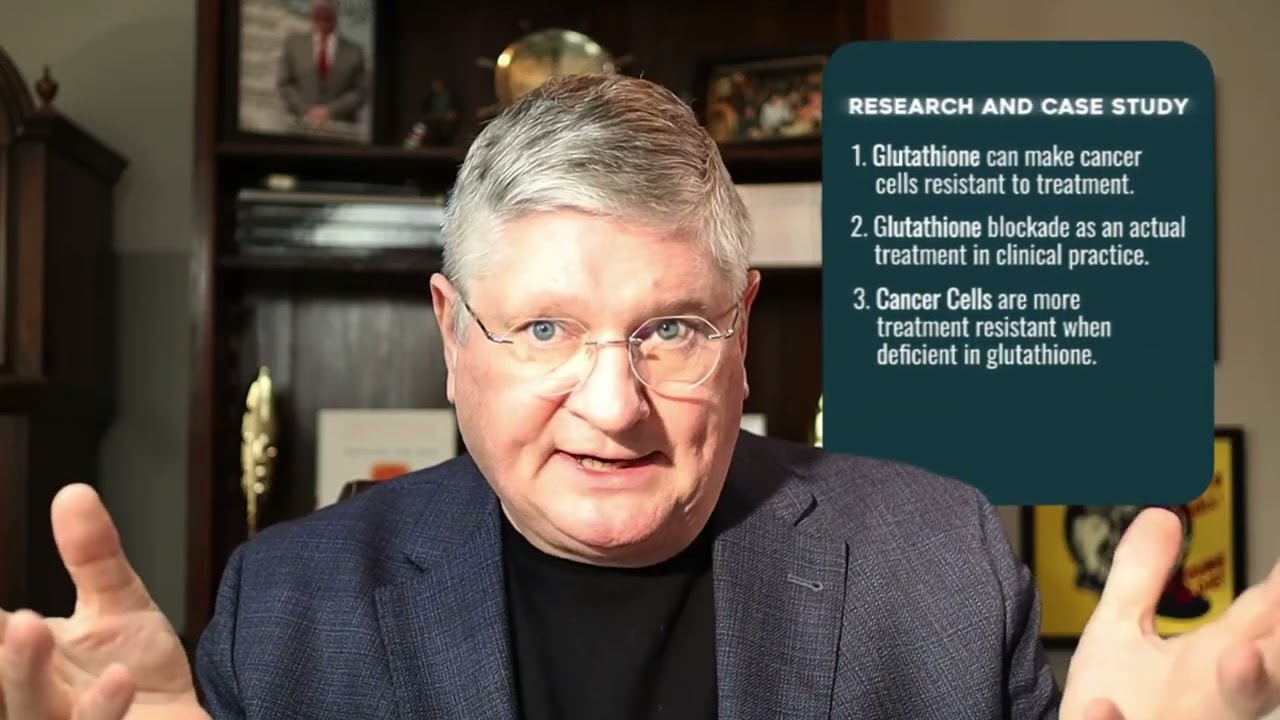
You also, in a real live human who has cancer, not just have their tumor, but you've got also all the normal cells, which must have glutathione or you will die. Hey, I'm Dr. A. Gonna answer a big question that I got multiple times, and that is glutathione and cancer, friend or foe? Glutathione and cancer is a lot like a number of other things in cancer where There is not a yes or no answer, but when it comes to cancer and many things that are nutritional like glutathione, often the answer is not always no or always yes, but there are appropriate amounts and appropriate times for glutathione to be in our body and to maybe be augmented under certain circumstances. But there's also inappropriate amounts and times of augmentation, et cetera, for glutathione. How do we think about that in a way that makes it a little bit more understandable and also safer for everybody. So first, what we want to think about is in a person who does not currently have cancer, glutathione is responsible for maintaining the redox homeostasis in your body along with vitamin C and vitamin E and then other peripheral antioxidants. So if we think about it that way, we would be dead without glutathione. So glutathione must have some base level of operation we need. Well, here's another thing to think about. Glutathione is partially responsible for helping you maintain balance in your immune response. So we see more inflammatory activity and more disruption in glutathione levels in people who have diseases. So if we then go to the next step and say, well, what, what happens when that person now does have cancer or a history of cancer? How does glutathione fit in there? Well, the important thing to consider there is you still have a body that has a lot of more normal cells than cancer cells, or you wouldn't be here. So the normal cells still need their amount of glutathione to keep their redox levels stable, and you need that to keep the body healthy. Counterpoint to that, and this is why people will say, well, you, you, glutathione's very dangerous in cancer. If you have too much glutathione available, You will wind up with glutathione, but potentially supporting resistant cancer cells. So it's not, it's all good or it's all bad. It's how much are you supporting in your body to keep the normal levels working? So the way to look at this with a more balanced sort of outcome and mindset is even if you look at, and I recently did a research review and a presentation for physicians about this, And there was a big long list of research papers that had to be gone through for this. And so first off, what you need to know is there's research that shows glutathione can make cancer cells resistant to treatment. Now, one thing you need to know about that is most of the glutathione that makes them resistant is made by the cancer cells. They don't bother to use your glutathione. Okay? They make plenty of their own. But if you bathe them in more glutathione, it may support their activity. Now, this is not all cancer cells, but some do that. So that's one issue. But then the next issue is if you look at tumor biologists, they will say, well, certainly there is this idea that if we could block glutathione, we would take away the strength of some of these cancer cells. Glutathione blockade as an actual treatment in clinical practice, so not in research but actually in the average human, is not as rewarding as we thought it was. And then there's also research that shows that There's other cancer cells that when they become deficient in glutathione, they're actually more treatment resistant as well. So if you look at the bulk of the evidence in the medical literature, there's a spectrum. But remember, you also in a real live human who has cancer, not just have their tumor, but you've got also all the normal cells which must have glutathione or you will die. So then this comes to clinically, how do we manage that? Well, What I usually tell clinicians, patients, et cetera, is because it's not a yes or no answer, you have to judge clinically the amount of glutathione that you want to put into the person if they need it. And for what reason are you doing it? Reasons that we have used glutathione clinically in people with known cancer would be after radiation is done and they have radiation damage. That can be a time where it's useful. certain other instances, recovering from surgery, et cetera. But what would be the safe way to do that so that you don't engender a lot of excess glutathione that would tip you over into the bad glutathione land? Well, the way to do that is not to give it every single day, but to give punctuated doses with its support nutrients so that you have fairly low-dose glutathione going in. in little bursts. So, the cells get it, but you're not packing it in every day. So, when we do these treatments with people who have had radiation damage or they're healing from surgery, we may do 2 days out of a week. And then, the rest of the time, they're not getting any extra glutathione. That is certainly much safer than a 7-day-a-week protocol where you're always slamming glutathione in there. So, there are appropriate times and inappropriate times for glutathione. Generally, if you're using a particular therapy that is glutathione depleting, either incidentally or by design, like many cancer therapies, we will hold and not give the glutathione during that. But we may give it in the recovery phase. Certainly after radiate— not during radiation, but after radiation therapy. If you have burns, we'll use it then, et cetera. But the important part is we're not gonna give it 7 days a week. We're gonna have a punctuated amount every week. 1 to 2 days a week where we lift the levels, give the cofactors, and the rest of the week we're gonna let your body work off of that. So we don't have an excess ever going into the body. And that's basically how you stay away from the danger of excessive glutathione in a person who has cancer. Now, this research study has not been done and it probably never will be, but the— a way to test this out in humans would be to Put them on a glutathione intravenous pump and have it deliver a dose strategy of glutathione over every day for 7 days a week over time and see what actually happens to their tumor biology. Now we've experimental models of that and certainly 7-day-a-week protocol, probably not worth doing. You don't want to do that, but also you don't want to do zero if you actually have a need for glutathione. Now someone might also say, well, I'm, you know, 10 years out from my cancer. I'm in secondary prevention. I just want to stay healthy. And I'm a rather healthy person. I recovered well. Everything's going well. In a person like that who doesn't have an overwhelming need for exogenous glutathione, they don't need to add it in. And so you think of it as a, as a short-term treatment. Think of it as a recovery treatment. And you also think of it as a punctuated treatment so that you're not having a 7-day-a-week protocol. It's just a couple of days a week and then let your body deal with it. Live off that.