HERBS FOR IMMUNITY : PREPARING FOR COLD & FLU SEASON
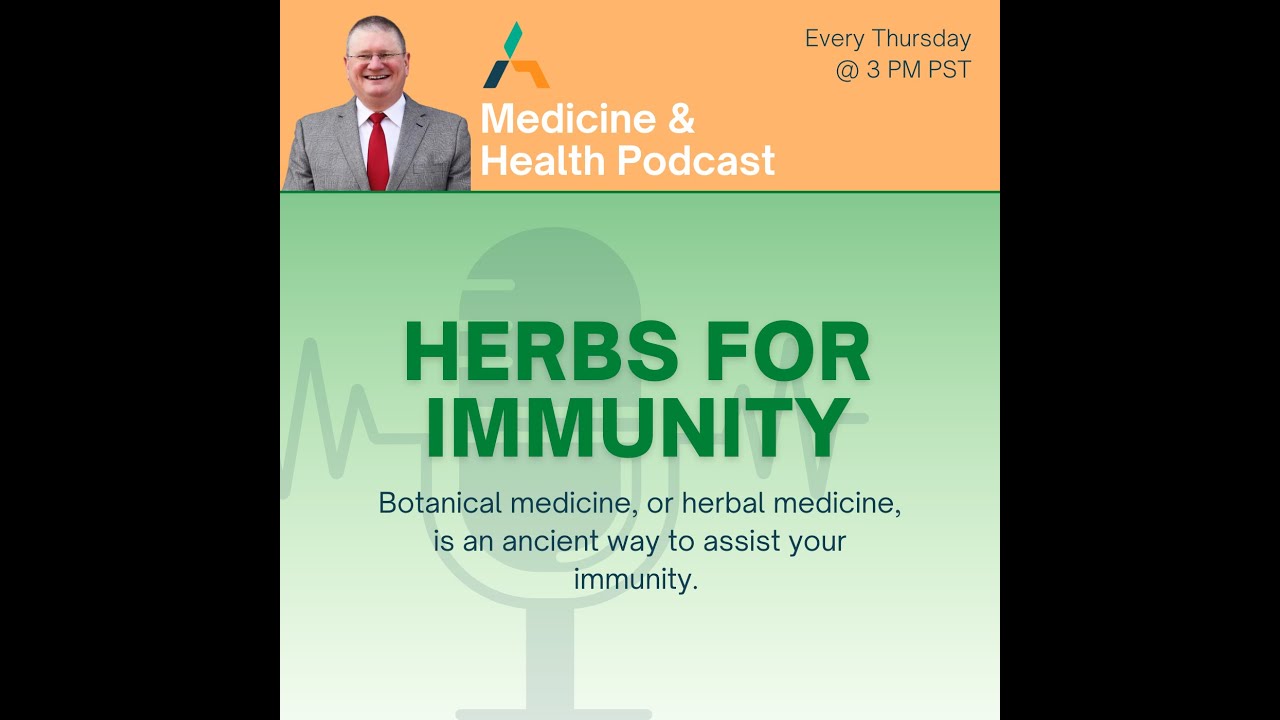
Dr. Paul Anderson covers herbs and mushrooms for immune support during cold and flu season, including echinacea, elderberry, oregano, and medicinal mushrooms like maitake and shiitake. He explains how berberine-rich plants and artemisia work antivirally, warns about proper dosing and potential side effects, and stresses consulting a practitioner before combining herbs with medications.
Chapters
Good day and welcome to Medicine Health. I'm Dr. Paul, and today we're doing what can you do to prepare for cold and flu season, uh, natural lifestyle, etc., edition. And so this section, I want to talk about, uh, herbs, plant medicine, botanical medicine, whatever you want to call it. And there are literally thousands of plant medicines, and there are as more ways to combine them in different traditional medical systems. So there is a Western herbal tradition, there's Chinese medical herbal tradition, there are different Native American herbal traditions, there are South American, there's Ayurveda, there are specific ones in the Soviet Union, etc., former Russian states. So We're not going to get into all that. I'm just going to talk about some of the ones we commonly hear about and how they likely work in this setting. Now, a lot of people will say, well, if we're looking for prevention and getting ready for cold and flu season, wouldn't herbs be more of an interventional thing instead of a preventive thing? And that's a good question. So the idea with an an herbal product or the difference between prevention versus an intervention is if I'm taking something like the nutrients we talked about or the lifestyle adjustments we talked about, those are truly preventive. They're trying to keep your body active, your immune system active, trying to keep you as the best immune version of yourself, trying to make you a small target for viruses, bacteria, et cetera. Now, as I always say, does doing any of these things guarantee you're not going to get a cold or the flu or COVID or some other new thing that comes along? No, of course not. That'd be stupid. There's nothing that can guarantee you that. Even sitting alone in a room won't guarantee that for you, but it does make you less likely or less of an opportune target for these infectious things. The other thing is, like we've seen a lot with COVID certainly not with everybody, but like we see a lot with COVID or colds and flus, if your body is prepared and it's really in good shape when you go into it, you have a better chance of not only having maybe a shorter experience with it, but also coming out the other side with less long-lasting aftereffects. Now, do we see people sometimes who did everything they could and they still have like long COVID or post-viral syndrome from some other thing? Sure, that can happen. But again, why not do all that you can to make yourself as resilient as possible? So yes, most of what we're gonna talk about are gonna be more on the intervention or maybe preventive in the setting. I'm going to a lot of holiday parties and I just wanna have my immune system up. So definitely all those nutritional things we talked about in the other section, all of those lifestyle things we talked about. And then you hear a lot about things in the family like the berberine, Berberis family. So you, this would come from things like Oregon grape, et cetera. And they have sort of a short-tail relative called Hydrastis, also known as goldenseal. And usually in the, in that end of the spectrum for plants, we prefer things like, you know, Oregon grape, Berberis. because it's a little easier to come by, it's a little less endangered, etc. But if you've heard of goldenseal or hydrastis, it's kind of the same idea. Now the first thing to keep in mind is we think of this kind of family of these sort of dark, meaty herbs like, like berberis maybe as antibacterial, but in reality they're very broad spectrum. They have antibacterial, antiviral, some antifungal effect. Also in the case of berberis. It helps with maintenance of the GI tract's flora. There's some newer research out about how it shifts the flora in a direction where some of the things that we eat that might be turned into toxic material actually are not turned into toxic material. So that's kind of cool. So you often see this in some sort of a mixture. Now, a real popular mixture, it goes by EHB. And that is echinacea, hydrastis, and berberine. And so that would be berberine, goldenseal, and then echinacea. And we'll talk about echinacea separately. So anyway, it's the kind of thing where you might be put on it chronically for other things like blood sugar or gut function or some other thing that's different, but it'd be beneficial. But we use it a lot acutely with people who are either— they know they're exposed, they're going to be flying on an airplane, they're going to parties, whatever, or— people who are starting to feel like they might be getting sick. So again, that's there. Now remember, with all these things we talk about, this is information for you. It's not medical advice. Please work with somebody who knows about herbal or botanical medicine if you're going to start taking a bunch of stuff, especially if you're on other medications or you've got other, you know, underlying illness. It's really good to get some ideas. This is just— non-medical advice information I'm giving you. Um, echinacea I mentioned. So echinacea is kind of really popular for, um, viral illnesses, uh, flus and colds and stuff. The earlier you take it when you're sick, the better usually. And there was some interesting, um, I guess, publication— publications that came out number of you, probably 20 years ago. And, um, some of them were like, well, echinacea doesn't prevent this or that, or it doesn't help with colds, etc. And, uh, I was on a review team that reviewed one of the more famous ones of these papers. And basically what, what they did, which you have to be careful of with some of the negative data that comes out about anything, but especially herbal medicine, uh, is they used basically the wrong kind and they didn't use enough of a dose to do anything. And so if that's the case, it would be like me saying, well, penicillin doesn't work for certain bacterial infections, but I set up a trial where I gave, you know, 1/10 the normal dose of penicillin and said, oh, look, this penicillin stuff doesn't work. Well, no, it's— I gave the wrong dose, and all I proved with that is that that dose is inappropriate. So echinacea can be helpful. Now, there's a lot of concern in certain people during COVID, and they're like, oh my God, don't do echinacea because it stimulates cytokines. You'll go into cytokine storm and you'll die. And well, that's not true. Um, echinacea does stimulate cytokines, so on the front end of it almost, it's not bad to have it in there. Is it going to be strong enough to perpetuate a cytokine storm? Or no, it's not going to do that. Uh, so if you are using echinacea, there are some people that react to it. There's some people that have sort of an autoimmune type reaction et cetera, which again is why you should work with somebody who's trained in botanical therapies. And sometimes that might not be your primary care provider unless they've done extra training in that. But all in North America anyway— I'm speaking from North America, so I'll speak to our system here— all Chinese medicine providers, traditional Chinese medicine providers, are trained in traditional Chinese herbal medicine. Now, they might use different things I'm talking about, but— They would be a good source. Registered or certified botanical medicine providers or herbalists are there. All naturopathic physicians who are licensed and have passed their boards, they're all trained to do this sort of thing and many other categories as well. Another one, since we talked about echinacea creating some problems in people worrying about cytokine storms, et cetera, Um, another one is, uh, elder, black elder, sambucus. And there's a medicine, patent medicine called Sambucol, that we give the kids a lot, and it's got some sambucus and it tastes good, so they'll, they'll usually drink it. Um, so elder or sambucus was also said, oh my God, don't, don't use that. You know, it's used, it's used during colds and flu. Don't use it with COVID because you'll have cytokine, it gets same story as echinacea. It's not gonna be strong enough really to do that. Uh, next one is wormwood, or the Artemisia family. Now Artemisia family comes from the wormwood plant, and, uh, the wormwood plant gives us a lot of different subconstituents. So there's like artemisinin is a common oral version, whole plant wormwood's another oral version, artesunate, and then there's a whole bunch of other ones that are used as drugs. Um, these are known to be very antiviral, antiparasitic. They're used— their constituents are used in malaria, all sorts of stuff. And now there's publications and some case reports of people using artemisinin or wormwood extracts in COVID, in treating COVID, etc. And so that's another one. Now, it can have some side effects that you want to just sort of watch for if you're taking like a wormwood compound for a long time. it can decrease your iron levels. And, you know, initially if you have too much iron, that may not be a bad thing. And we use that to our advantage when we use artemisinin and artesunate, those sort of things, medically speaking. But long-term use really should be monitored. Your blood count should be monitored, etc. Short-term, as I say, in these case studies with COVID etc., it's shown to be quite useful. We also, long before COVID We were using it in cancer research. It's now being developed beyond its malaria drug status into cancer drugs, and it works quite well in the cancer setting. But what we noticed incidentally was in the clinic we're doing the research for the cancer patients, we had a lot of people with chronic infections who didn't have cancer. And so we started to use the artesunate, the intravenous version of this, which is a little Packs a little more punch with those folks with some viral infections. We get very unique but very helpful responses to the viral infections with that family. Another one you hear a lot about, known as Logostichum or Osha, and Osha can be spelled a couple of different ways. There's a lot of species in the genus, but Osha or Logostichum is used a lot in many traditional medicine types of formulas, and we use it a lot for an anti. It's primarily antiviral. It does some other good things, but that's another one that you'll see. Then one of my favorites, 'cause it kind of covers most infectious agents, is oregano. And you think, you mean like oregano I'd put on my Italian food or something like that? Yeah, it's in that family. A lot of the supplements are made with a stronger version. It's usually Mexican oregano or an extract thereof. And we use that. It's got good antifungal coverage. It can be antibacterial, antiparasitic.
Interesting.
and antiviral. So oregano can be very useful as a supplement. Um, and then, uh, the last big area I want to talk about because it's so popular and so useful is, uh, our medicinal types of mushrooms. And so here I'm not looking so much at the psychedelic versions of medicinal mushrooms, although we could do a show all about them. Looking at more of the immune, immunologic mushrooms. So you think about things like maitake and shiitake, also astragalus, cremini mushrooms. And then, you know, people always gave white button mushrooms kind of a hard time in the, in the medical industry until all of a sudden someone published that simply by eating a certain amount of white button mushrooms every day, people's immune functions would shift. And so now some of the supplemental companies actually have white button mushroom, you know, extracts, etc. So all mushrooms have these properties. Now most of them are immunomodulatory, so they're there to help regulate. Sometimes they're a type of thing that you might take preventively just to kind of keep your immune system, you could say, spunky and online throughout the cold and flu season. There are some mixtures of immune mushrooms. Some people will do that and they'll rotate different mixtures every month. And then sometimes, you know, if you're sick, your practitioner might give you a lot of one kind or one family or something of that nature. So mushrooms can be very useful. Now Anything you can eat is also a benefit. So if you can incorporate eating mushrooms into your regular dietary plan, you'll get some of the immune benefit from that as well. You're just going to get more concentrated version from the, you know, the supplement that you might get, or maybe a concentrate that you make into a tea, or some other thing that your practitioner might give you. But the way to think about mushrooms is most of them really are immunoregulatory. But that's not a bad thing on the preventive side of the scale because they can help the immune system kind of stay level and steady and work at its best. And like I say, if you're getting exposed or, you know, or you know you've gotten exposed, you might be, you know, feeling a little rough, taking these things early and along the way is much better than waiting. It's sort of like a lot of things. We see this a lot with antiviral drugs. If you wait to take them until you've been sick for a while, the drugs don't do a whole lot for most people. So earlier is better. Well, it's kind of the same with supplements. Yes, you can kind of reel it back in after a while. But you would just want to keep in mind that the supplements, a lot of these herbs that we talked about, you might want to keep a little bit on hand and then take them as soon as you start feeling like you caught something or you were exposed to something. And again, you know, this is just information, not medical advice. You need to check this out with whoever your healthcare provider is. When it comes to herbs, you may need to find a healthcare provider who is trained in the use of herbal medicines to really get good solid information. All right, this is Dr. Anderson. We're about done with this section. Please remember to like, share, subscribe, whether that's on the YouTube channel. We're getting new subscribers there. Thank you very much. Also do the notifications because sometimes on YouTube we get shoved over in the algorithm and nobody sees what we're doing. And also, if you're on one of the many pod burners, we're on all of the main pod burners, Medicine and Health with Dr. Paul Anderson. Make sure you like that and check out the notifications there. All right, I will see you all in the next session.
You've listened to the shows on CTR, and perhaps you've found yourself thinking, maybe I should host my own show, but I don't know how. It's easier than you think. From the beginning with private coaching sessions to your own live broadcasts, CTR Network will prepare you on every level to share your knowledge, Expand your brand and take your business to the next level. At CTR, we nurture your vision and make it a radio reality. Contact Cameron Steele at 425-221-3646 or cameron@ctrnetwork.com and put your dream into motion today.









