House Wrap & Window Flashing The Right Way! Ep. 12 Building Well & Avoiding Mold
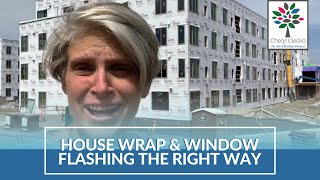
YouTube video transcript of an on-site walkthrough by Cheryl Sico (licensed architect, building forensics) inspecting a multi-unit construction project in Minneapolis. She evaluates house wrap (Tyvek), window flashing, rain screen details, and stone-to-cladding interfaces, highlighting proper shingling, potential defect locations where materials meet, and the importance of drainage and drying to avoid mold and water damage.
Chapters
I'm just observing from far away. But this is the part that right here where they. And this is often where we see problems and defects in buildings is where two materials come together and they don't get shingled properly or they don't get detailed properly. Hi, I'm Cheryl Sico from avoidingmold.com licensed architect specializing in building forensics, building defects and helping people create their own healthy homes. So I'm out on a job site and we're going to talk about this project a little bit. It looks really pretty good. This is a really well sealed house wrap situation. It looks like the windows seem to be done properly. The only place where I'm seeing and I'm curious about is how the stone is meeting the other cladding, which appears to be from other projects that are on this complex on a rainscreen system. But I see this black above the. Above the stone that seems to be stuck to the Tyvek seems to be over the Tyvek and it seems to be not stuck in some places. So right now if I were to say where I. One place that I'm concerned about and if it were me, if I were the architect on the job, if I was a contractor in charge of this job, project manager, I would just want to know, is that the way it's designed and how is that working? And if it is the way it is designed, then I'd just be trying to follow through where the water goes in construction defects. That's what we want to do. We want to be looking from the top to the bottom, the way the rain hits the building and then what are all the ways and all the paths for water to go? And can the water get out? That's the key. Can the water get out? Can the building dry out? Can the sheathing and the cladding. The sheathing stay Dr. Can the cladding dry out, can the stone dry out? Or does water collect anywhere? That's where we start to have problems. So that's what I'm seeing here. And this is in Minnesota, Minneapolis, south Minneapolis area, where I do see a lot of pretty well done projects in terms of air barriers and moisture proofing. Now I think it's more common in places like Minnesota where it gets very cold in the winter and they're very concerned about air infiltration for their energy. But these are examples that you can see a lot of the different layers that we have going on. We have the house wrap. In this case, it's Tyvek, which is a water resistive barrier. It can Also be acting as an air barrier. And you can see the detailing of the exhaust fans. Everything looks very well sealed. That I can see from down here on the ground. But you can see the tape around the exhaust fans opening. That's something that gets omitted in residential construction frequently. Let me zoom in a little bit here so you can see a little closer. And so that's one thing to look at on residential. This appears to be a rain screen system. So you see these vertical members, and they're putting the cladding over that. And it provides an airspace between the cladding and the waterproof membrane. The horizontal ones, I'm not sure how those are working. Because typically horizontal doesn't act as a rain screen. So I'm not sure if that's just part of this must be just part of the stuff system. But at the top, at the parapet, that has to be flashed. And I do see tape there. And there needs to be something coming over that horizontal member so that water can continue down the wall and ultimately come out. And at the bottom in the masonry, you can see there's what's called head joints. And they're open. Must have some kind of wicking material in there that allows the water to get out. So not sure. It looks like that black stuff on top of the stone or the tile is hopefully coming from behind the house wrap. Otherwise that's not properly shingled. But I can't really tell from this point. You can see where the balconies attach. They have some metal connectors there. That's where those patio doors are. And they look to be taped. Well, that's another place that we often have leaks and sometimes failures of the deck itself. Something back there that's purple. It's like a gypsum product that's purple. And you can see some of the other. And it looks like it's being done pretty well overall. It's definitely a wood frame construction from what I can see. I can see some studs in through some of those windows. The house wrap water resistive membrane looks to be done really quite well. I see all the vents look to be sealed, Although there's a few that I'm not sure about. Actually, that would be something that I recommend people really look at closely, make sure nothing got missed when somebody answered their cell phone. Looks to me like some of those above those vents in this area are not. They should be taped again, but they are overlapping. And that's really good. And that's the right way to do it. The place where I'm a little Bit less confident is in where we have this stone material, so this black stone. And then you see something black behind the black stone and that seems to be something that is adhered to the house wrap as opposed to the sheathing. And that's typically a place where we usually see some sort of flashing where you bring two materials next to each other. And it doesn't look to me like there's any flashing there going under the house wrap. But it could be something that I can't see from this angle. But that's some place that's something that I'm looking at and I'd like to. I would probably be asking more questions about it. There's a spot up here that I'm not sure it might be a hole. You can see the windows are pulled out. The house wrap is pulled out over the window flange. But for some reason there's one that's not taped and the others are. So that's the kind of detail that builders have to really pay attention to and make sure they haven't missed one window, for instance, like this one up there when all the other ones have been done. So a lot of attention to detail goes into these buildings. And the same is true for single family. Single family just misses a lot more. You can see the Tyvek word is very dark blue. That means it's not. The more it gets affected by uv, it starts to degrade. So I think Tyvek last time I checked was about 120 days. It could be exposed to the sun or ultraviolet light before it starts to actually degrade and would need to be redone. And usually one way to tell my understanding is that when the word Tyvek becomes light and not dark blue, then it's time to really reconsider. Going to have to reconsider putting another layer of house wrap up. Building wrap water resistant membrane. So yeah, that's what I see on this project. And let me know if you see anything that I'm missing in these videos while I'm walking around here. Here you can see these windows, the flaps are blowing up and you can see the tape underneath them. So that is done. Correct. But it does need another layer of tape over the top. So one thing I am noticing on this area of the project and I was wondering about this when I was looking at another section further down. Huge, huge project is what this black stuff was on the top of the, of the stone section and that should have flashing over it. That should not be in my experience and my what I've Researched is that that should not be the house wrap. The Tyvek commercial wrap in this case, coming down past there. Not exactly sure where. Then it has to come out. The weep holes. It really should be coming out, although it looks like there's weep holes on that top layer. But it doesn't look like the black is behind the house rack. So that's the part that I. One part that I see here that I just would have questions about, I'm just observing from far away. But this is the part that right here where they. And this is often where we see problems and defects in buildings is where two materials come together and they don't get shingled properly or they don't get detailed properly. The different trades and a lot of different trades involved here. We have the mason, we have the ventilation aspect installers, we have the house wrap, we have the build, we have the actual contractors and builders, we have the window installers. So a lot of stuff going on here. So I'm not sure about whether that's gonna look good. But I'll probably be here again another time once this is built. And it'll be interest to see the final product and maybe even over time and see how it ages. But that would be one concern that I see. But otherwise, the house wrap looks really nip and chuck and seems to be well done according to the instructions. Any instructions that I've seen on how that works should work. It's just the stone part that I'm a little curious about. So now on these, you can see actually the roofing coming over the top. That's gonna have to get. Well, it's actually a parapet. It looks like there's a balcony up there. And then you can see the windows. The flashing over the top of the windows pulled out over that is the right way to do it. And then they. They can come back and tape that later. But they have attached. This is proper shingling. And you can see actually in the corner, there's a good example of how the window is turned up. That one window there. And then they tape to the sheathing behind it. And then they're going to bring the house right back down. But that's. It's called sheathing. Proper shingling. They're clearly not done here. But on this particular one, they looks like they have more work to do. But they're doing a good job at. Actually, from what I can see, nothing's jumping out at me other than what I was saying. The black there, I'm assuming that that's flashing at the top of the stone, but I. I can't tell from this angle and that would be something. I'd have to look at the drawings and see what they were doing. So anyway, it's always good to keep an eye out and see what you see and, and there's lots to learn. So I hope this is helpful and I look forward to having you join me on the next video. If you enjoyed this video, hit subscribe. For more free information on safe building, avoiding mold and water damage, visit avoidingmold.com.









