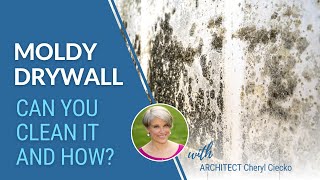
Cheryl Cicco explains when moldy drywall can be cleaned and when it must be removed. Surface mold on painted drywall can be wiped with mild detergent and dried thoroughly, but flooded or fully saturated drywall needs to go. Use a moisture meter: drywall should stay under 4-5% moisture content.
Questions this video answers
Generally under about 4–5% (close to zero); high single digits or double digits indicate a problem.
When drywall is fully saturated (e.g., flood) or the backside has been wetted; significant wetting requires removal.
Chapters
Today I'm going to talk about drywall and specifically how to remove mold from drywall. Now drywall is one of the most common materials that ends up being moldy. And the reason why is because. Hello everyone, I'm Cheryl Cicco, avoidingmold.com so what is drywall? Drywall is used on our walls and ceilings almost ubiquitously in the United States and in Europe since really in contemporary times. Prior to that, older buildings might have plaster, which is a complete is not completely different. Actually some of the components are the same, but drywall usually has a paper coating on either side that's holding it together. It's made out of basically a lime product that's been gypsum rock, which is sometimes called gypsum board. And, and it's water soluble, but it's been basically the water has been sucked out of it to create it. And it uses very high heat process and the paper is actually holding it firm and keeping it all together. There is non paperless drywall, but it has something else on it holding a tail, usually fiberglass or something like that. And this material is heated to get the water out of it. So what ends up happening in our buildings is if the drywall gypsum board, whatever you want to call it, Sheetrock is another name. If that's getting, taking on a lot of humidity and moisture, then it gets, it gets absorbed by the gypsum material that's in the product itself and, and that's not a good thing. And sometimes if there's a leak externally, it can also create mold on the surface. Now whether you have mold on the surface of drywall that's been painted versus mold on the backside that maybe hasn't been painted, then that can have a different solution. We always want to measure the drywall and know how much moisture content is in it. Because even though a leak, well, leak is always a case, if it's really saturated, then the drywall needs to be removed. So that would be the case of a flood. So say you have a flood in a, in a basement or in a bathroom or something and water has been up against it and actually wicked up inside of it. That's 100% that drywall needs to be removed. If it's just on the surface, say for instance something was leaking, somebody opened a can of soda or something or champagne, and it's on the wall, the wall is painted, you can usually wipe that off. If there's a leak behind a wall in some way and that has gotten the backside of drywall wet, that can be a lot more difficult. And usually that drywall does absolutely need to be removed because we don't paint the backside of our drywall and the backside has paper on it just like the front, but has absolutely no protection. And dry. And paper, even paper and books, is pre digested mold food. It's so processed that it's just ready to go to be moldy. And a lot of the products that we use that have paper coatings are using recycled paper. You can only imagine what's in that paper. So yes, it's a heat process, but mold is never truly dead. So if there was mold on the paper to begin with, it may be inert as long as it stays dry. But if it gets wet, it can come back to life. So when, when drywall gets significantly wet, it always has to be removed. And the best way to test that is with a moisture meter. I do have a webinar on that topic. Brought in a specialist, Eileen Cohn. She does a great job describing how much moisture meters work. But know that just high humidity over a long period of time can absorb into the gypsum itself in the wallboard, drywall, jet board, whatever you want to call it, and end up causing moisture damage and actually a lot of mold behind the wall. I've even seen stachybotrys behind the walls just from constant humidity, such as in a bathroom. So drywall gypsum board Sheetrock doesn't go well with moisture, so we want to keep the humidity down. So the question was how to clean this. Well, the paper coating is really not likely going to be cleanable unless it's only on the painted surface. If there's something on the painted surface, you may be able to wipe it off. And I have another video where I talk about actually that cleaning process, which is damp wiping with a mild detergent, always using clean rags or sponge and then completely drying, but also checking humidity. We want to never add too much water, do not use bleach and dry, dry, dry and measure. Dry. Dry is a measurement. Drywall itself should have really a zero moisture content. Anything under five might be okay. Four or five. Sometimes the moisture meters can be calibrated so that they're not exactly reading correctly. But if you start seeing absolutely single digits up high in the high single digits or even double digits is not a good thing for drywall. So every material has a different, different number that is okay for moisture content that is considered dry. But drywall and Sheetrock gypsum board is one of the driest materials out there. And should be easier, as close to zero as possible. So I hope this is helpful. And check out my website, avoidingmold.com, my blog posts, I have online videos, webinars we've recorded to share more of information like this, and those all have a lot of pictures and a lot of illustrations and I go through things in way more detail, so check those out. And thanks for joining me. I hope this is helpful.
If you enjoyed this video, hit subscribe. For more free information on safe building, avoiding mold and water damage, visit avoidingmold.com.