MY DOCTORS DON'T AGREE - WHAT DO I DO
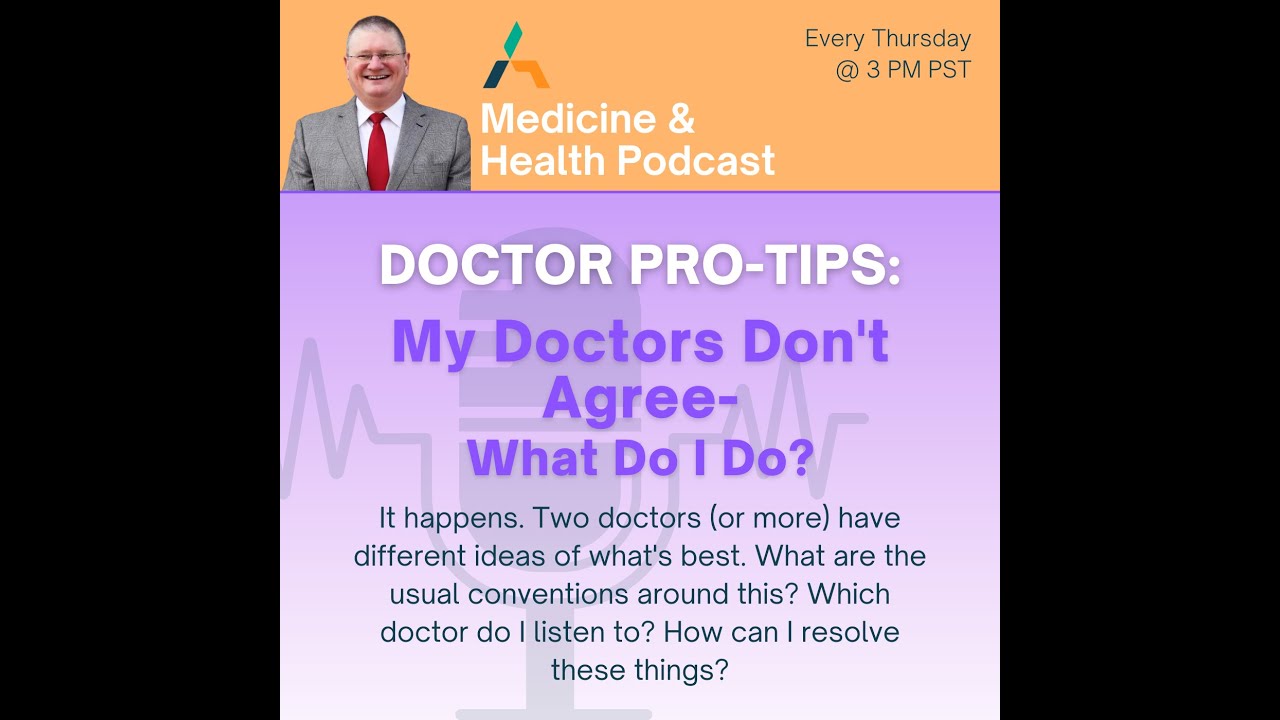
Dr. Paul Anderson explains why doctors disagree: different specialties, training, and focus areas. Keep your providers talking to each other, stay clear about your health goals, and don't hesitate to switch doctors if one isn't working for you.
Chapters
Welcome back to Medicine Health. I'm Dr. Paul, and in our Doctor Pro Tips, this section is called My Doctors or My Healthcare Providers Don't Agree, What Do I Do? Believe it or not, all doctors, all healthcare providers, even though they have maybe similar training and may like each other and all that, they don't always agree. And the more healthcare providers that you get involved in your life, the more chance there is that there's going to be a disagreement about something. So in the few minutes that we have here, what I want to just go through is why does this happen? How can you see it coming, maybe prevent it or work around it? What are the rules around which these disagreements are supposed to be sorted out? And then what do you do if you reach an impasse with a particular healthcare provider? Now, the first thing to keep in mind, like I said in another section here, is that generally your healthcare providers are doing the best they can. If they're specialized in an area, that's their area, that's what they're focused on. They may not think about other things because their focus is elsewhere. If they're a very busy primary care provider, they may only have time to do X and Y with you and not A, B, C, D, and E. So there's a lot of limitations for things. Then there is the idea that an idea from a consulting doctor or a specialist or somebody else is just new to them because we all have different specialties, we all study different things. And so if you're really, really involved with the palliative side of cancer care and healing after therapies, et cetera, you're going to come at that from a different point of view than the average primary care doctor, for example. If the majority of your practice is spent with people in prevention, and so you're trying to work with people to not become a type 2 diabetic or not to have their eyesight fail or whatever you're preventing, your focus is just going to be different than somebody dealing with acute care medicine, emergency medicine, or in a specialty. So the first thing to keep in mind is how do the boundaries work, etc.? Well, the bottom line is, is that And this doesn't always work out, but you should be the focus of your healthcare regardless of how many healthcare providers you have involved. So if the focus is not on you and your needs are not being met, you need to reassess who your healthcare providers are, probably. But the next thing is that the healthcare provider who prescribes, whether it's things for you to do or nutritional advice or supplements or drugs or whatever, surgery, the healthcare provider who prescribes something or recommends something is supposed to be in charge of that area of what's going on. And so while you may go to your other doctor and they may say, I don't get why you're doing this stuff from, you know, this other doctor, that doesn't look like what we do over here for that problem. That is the purview of the other doctor to make comment that they don't understand it or they don't like it or whatever. But then, unless they're going to take over all of that care of the other— the reason you're seeing the doctor number 2, they kind of have to stop with the comment about that. Now, they often will call the other healthcare provider and say, I don't get why you're doing this, or, you know, this doesn't seem to match the patient, you know, and whatever. Um, So that could happen. There could be some interesting discussion back and forth. But a lot of times that's what it is. Now, there are times where you might get a couple of doctors in, and let's say you get a doctor looking at a number of body systems at once. And so you've had a specialist in the endocrine world, the hormone world, who has looked at a little bit of endocrine hormone stuff with you. But now you're seeing another healthcare provider who's looking at endocrine and how that might interact with your immune system and other things. And so they may make alterations in what goes on. Now, normally, uh, you would want your other providers to know what's happening just so that they don't, you know, get surprised by something, etc. But there's also phenomena that happens, which is not that uncommon, where maybe you were sent— so you had a primary care provider and they were doing general primary care, seeing you once or twice a year. and they noticed that you were having a problem that they sent you to a specialist for. The specialist kind of finds a little bit of a disorder, disease. They're treating you for it, but it's not really, you know, it's not really a high-grade thing in their specialty. They're just going to treat you for it. You might go to another healthcare provider who's doing more of an integrative approach or looking at more systems, and they might take over the care of that one thing that the specialist was doing. That's totally fine. People just need to know. They just need to be let, uh, let in on the deal, you know, what's going on. And we've had that happen a lot with patients where maybe they were seeing, say, an endocrinologist and they were getting, you know, their thyroid managed. It was pretty straightforward. And then, um, you know, we were going to work with their other hormones and their thyroid and some immune stuff, etc. And, uh, we, we may have just folded in that one little bit that the endocrinologist was doing, uh, along the way because it wasn't, you know, some high-grade thing. It wasn't like an endo Endocrine cancer or a real tricky you know endocrine disease that was you know something that you know has to be monitored with you know very high precision monitoring, and you really want your endocrinologist to do that. So there's a lot of that that goes on. Now, why would doctors, healthcare providers disagree? Well, beyond just different perspectives and different specialties, sometimes there's disagreement just because of the way that you know one provider is trained. Versus another one. So for example, uh, in more of an integrative or naturopathic practice, etc., you might be aware of and trained for the way that, you know, that your primary care doctor is going to work, or a specialist, because many of those people, you know, used to do primary care or specialty care, etc. Uh, so you understand it, but you may be coming from a different point of view. And one of the things that's incumbent upon you and your doctor when you're talking about these new things is, are my other doctors going to think this is crazy, or is there any dangers here, or whatever? You know, just explain it to me. And what I have found in the long run is if you are aware upfront and, you know, let's say I'm the consulting doctor and I'm going to change something, I will warn you that your primary care is not going to understand why we're doing it this way. They'll understand what we're doing. They're just not going to understand where that fits into the picture. So don't be surprised if your primary care doctor says, well, that looks weird, or that looks, you know, whatever. Here's why they might think it's dangerous and it's not. So you need to be able to explain those things as you go along. Now, the other thing to keep in mind is it is supposed to be about you. It's your health. And if things go really badly and you have a doctor that doesn't want to play well and work well with others, uh, unless they hold the keys to something that's keeping you alive and they won't refer you, you can fire any health healthcare provider that you want because it is your health and it is your healthcare. Now, we try not to have that happen, and we don't like that to happen, but that is sort of a last resort if you can't get the person on board. And a lot of times this will come when maybe you're seeing a doctor and they're really, you know, they, they've told you, look, your labs are fine, I don't know why you feel sick. And you go to see somebody else and they come up with reasons and a plan to treat you. Sometimes the original doctor will, you know, take that the wrong way or and just— and get real obstinate and say, no, you shouldn't be seeing this other person there. You know, what they're doing doesn't make sense, and you may indeed be getting a lot of benefit from it. Well, we're just about out of time. I'm Dr. Paul Anderson. Uh, check us out, dranow.com. Check us out over on YouTube, All the Pod Burners, CTR Radio Live, and Facebook. And I will see you all on the podcast next week.









