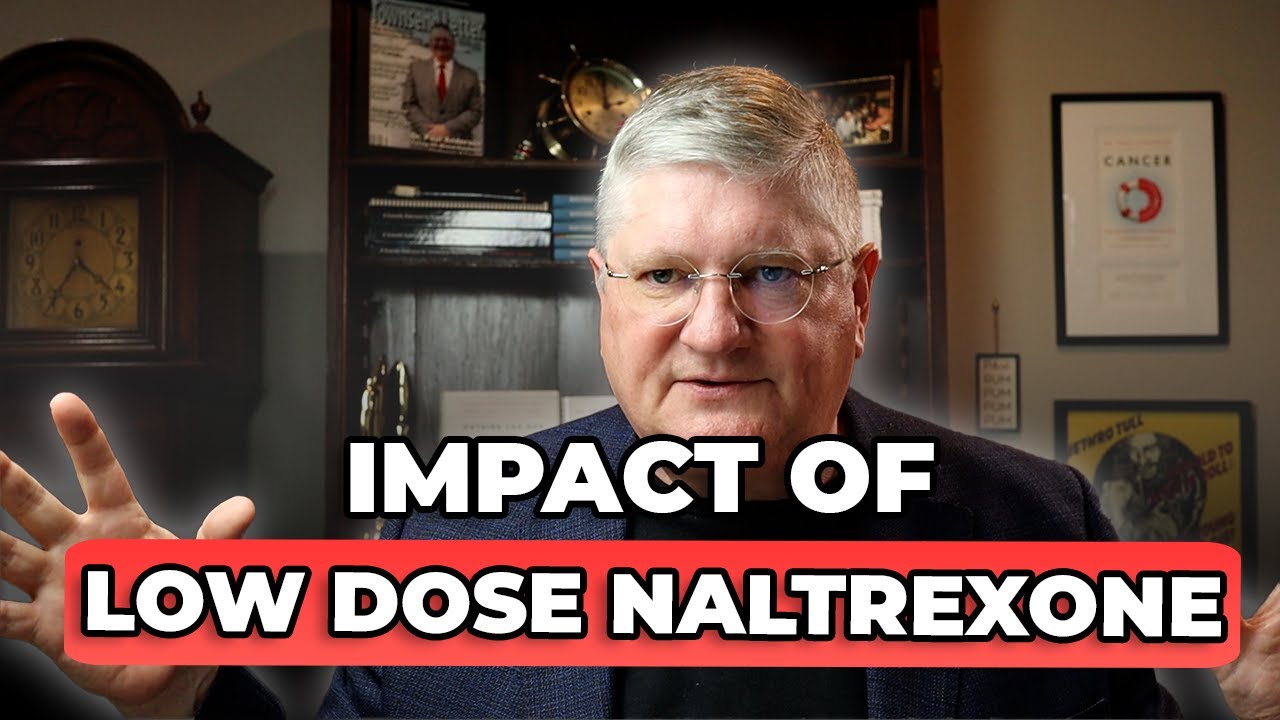
This content was created by Matt Kelly. This content was uploaded by Matt Kelly. This is a YouTube video titled "The INCREDIBLE Impact of LOW DOSE NALTREXONE - Dr. Anderson's Top Reasons for Doing It" (published 2024-05-22) featuring Dr. Andersen presenting a monologue on clinical uses of low-dose naltrexone (LDN). The speaker explains LDN's proposed mechanism (modulation of opiate-related receptors with downstream effects on T-cell–mediated immunity), outlines primary indications (supportive use in cancer, chronic infectious illnesses, mast cell activation disorders, autoimmunity such as MS and rheumatoid arthritis, fibromyalgia, chronic fatigue, and certain chronic pain states), and summarizes dosing considerations (median ~4.5–5 mg, ultra-low <1 mg, higher-low ~10–12 mg, and strategies like microdosing or reverse tapering).
Chapters
So there's a lot of ways to use it, but the primary reasons that I employ it clinically are for chronic illness and cancer. And then the chronic illness can subdivide. Welcome to my channel. I'm Dr. Andersen, and we talk about all things chronic illness, cancer, integrative medicine, answer your questions, et cetera. And a big question that I get, because we've done content on this medication before, being low-dose naltrexone, is what are the top reasons why I use it? And really, how do I use it? So let's get into this. First off, low-dose naltrexone. If there is a low-dose naltrexone, there must ergo be a high-dose naltrexone. And indeed, it's the same drug, just dosed differently. So high-dose strategy may be ten times higher than a low-dose strategy or much more. So low dose is truly low dose. And the reasons for that are that at high dose, it has more of a suppressive effect, and it's used to block. Opiate and other related receptors. If we take it down to a tiny dose, what we get is a little bit of blockade, but more of a modulation of that receptor category. And then we get a downstream effect on things that affect a lot of the body, like cell-mediated immunity, the T-cell families, which regulate a lot of your immune system. So my top reasons for using it include things where we have that crossover of cell-mediated immune response needs. So you might think, well, how many things can cross over there? Well, it turns out a lot. We think of immune system response. The immune system is a big complex set of cells and tissues and all kinds of stuff. And think of hundreds, if not thousands of inputs all crossing over and talking to each other. And they eventually converge upon a number of families of cell types or activities. 2 of the big families are the B cell family, which does your humoral or antibody immunity, and then the T-cell family, T like Thomas, which does your cell-mediated immunity. So if you're using it for normal immune purposes, the T-cell, the cell-mediated immunity side, makes a specific killer cell, killer T-cell, cytotoxic T-cell, that is targeted towards an invader. Now that's fine because we want that to kill the invader, but it can't do that without its other friends and helpers, literally helper T-cells, regulatory T-cells, etc. So it's family of T cells and they work together. So one place it might be used is in people with chronic infectious illnesses. So not as much acute, but chronic infectious illness where the T cell families can wear out or they can get deregulated in some way. Another area where the T cells need a calming down and regulation are in chronic inflammatory states. So mast cell activation syndrome, mast cell disorders, big place where we use low-dose naltrexone because a piece of the pathology there is T T-cell deregulation. Another place where T-cell regulation is incredibly important is the crossover with the immune response in cancer. So low-dose naltrexone is not a primary cancer treatment, but it is a supportive treatment to try and help the immune system deal with the cancer that is on board, so to speak. The next area would be similar to the inflammatory triggering of, say, a mast cell state, and that would be in autoimmunity. The first patients that I generally used it in, say, 20 years ago, were autoimmune patients, and I still do. People with multiple sclerosis, adults and children with rheumatoid arthritis, etc. Autoimmunity. In more recent years, meaning the last decade, we've seen it used more in another area, which I've had a fair number of patients, and that is things such as fibromyalgia syndrome, chronic fatigue syndrome, chronic pain states of certain types. And these all, just like mast cell, just like other things, have this crossover with cell-mediated immunity. Now there's a few things clinically that we want to consider. And so if you're working with a practitioner who's learned about low-dose naltrexone, they will tend to be aware of these things. But number one, it is low dose, but low dose is a range. So they may start out with their typical sort of dosing strategy, but for you, the lower end may be better. In some cases, almost microdosing is better. For some people, say an out-of-control mast cell case, out-of-control autoimmune case, a higher end of the low dose— so not high dose, but the higher end of low dose— might be better. And for some people where there's a Pain overlay, et cetera, they kind of tend to fall onto 2 sides. One is if they have a lot of other comorbid symptoms, we might do a reverse taper where they go up to a borderline suppressive dose and work down. In people where it's mostly chronic pain, we may start at the very low end of the spectrum and work up. Okay. Now keeping in mind the median dose is considered 4.5 to 5 milligrams, the spectrum sort of falls on each side of that. So ultra-low doses are under a milligram and high-low doses Or, you know, 10 to 12 milligrams, something like that. So there's a lot of ways to use it, but the primary reasons that I employ it clinically are for chronic illness and cancer. And then the chronic illness can subdivide into things like mast cell disorders, mast cell activation, autoimmunity, chronic pain syndromes, chronic fatigue syndrome, fibromyalgia, et cetera. All right. I hope this answered the question. What are my top uses for low-dose naltrexone? Gave you a little background on it. Check out our other videos on it. We're gonna link some other videos and check out the main channel. We've got a lot of good content there. I'll see you all on the next video.