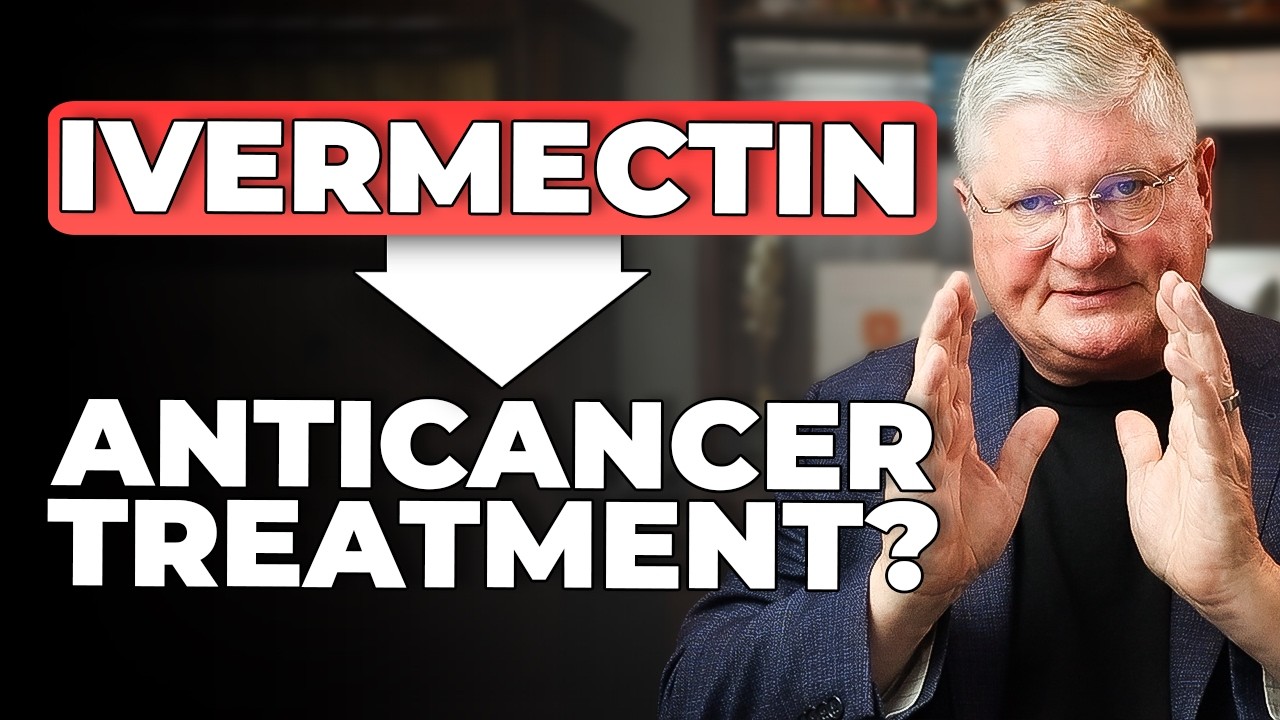
This content was created by Matt Kelly. This content was uploaded by Matt Kelly. This is a YouTube video titled "The SURPISING Link Between IVERMECTIN & Cancer | Dr. A Explains" (uploaded/edited 2025-07-27). It is a single-speaker explanatory video (Dr. A) reviewing the rationale and evidence for repurposing ivermectin in cancer care. The speaker describes ivermectin's antiparasitic origin and emphasizes its immunomodulatory properties, then outlines potential anticancer effects: slowing tumor cell proliferation and metastasis, promoting apoptosis, inhibiting tumor (stem) cells, reversing multidrug resistance, modulating the tumor microenvironment, inhibiting angiogenesis, and improving sensitivity to other therapies. The video notes ivermectin has been used off-label in oncology for ~20 years, is not a standalone cure, and closes with a call to subscribe.
Chapters
Ivermectin and cancer. So much information coming out about it. We've had a ton of questions. I just wanna break down why in the world we'd be using this drug in cancer, how long we've been doing it, and why might it work? Why might it help, et cetera? What are its limitations? So the first thing is ivermectin is well known as an antiparasitic drug. It has a few other properties. And so that might make you think, well, that's Weird that we're trying to treat cancer with an antiparasitic drug, but if you look at the modern movement of repurposed medications, one of the themes that you'll see is that the antiparasitic drug class is used a lot in repurposed medication for cancer. Now, there certainly can be some parasite overlay and infectious overlay with cancer, but largely these drugs are also immunomodulatory. And if we look at a lot of the modern immunotherapies, a lot of the maybe more tan. Tangential immunotherapies that are used in cancer, immunomodulation is a huge, huge thing. So if you have a drug regardless of what else it does, but also is an immunomodulator, it may have a role in cancer and in the care of a cancer patient somewhere in the entire macrocosm of their cancer care. So what I want to do here really is get to some specific questions that people have asked as far as okay, well beyond killing parasites, what might ivermectin help me with? So Let's look at these one at a time. One of the potential possible positive benefits is ivermectin appears to slow the proliferation of cancer cells and also slow the metastatic drive to make more cancer cells in distal other places. So its ability to slow down proliferation, slow down the movement metastases of cancer cells is very, very important. Another property that it has is the ability to increase apoptosis, or apoptosis if you like to say it that way. Apoptosis is a natural process built into all of our cells to self-delete. So if there's signals from within or without the cell that says, hey, this cell's not working correctly, there's a self-deletion program that goes on that's called apoptosis. Well, in cancer, we want to do more of that because we'd like those cancer cells to self-delete. And so it turns out ivermectin can help support the apoptotic drive as well. Also, and if we went into all of these, we would have to add another hour onto this video, so we're not going to do that, but there's a whole lot of immune cell signaling pathways that cancer cells have that it turns out that the immunomodulatory effect of ivermectin counteracts or counterbalances. This is really important because the growth, the aggressiveness, and the spread of cancer is what eventually will kill the patient. And so if we have growth and aggressiveness and spread, and we look at what triggers that process, it is these immunomodulatory immunosignaling cascades. Well, if I have a natural substance or a drug like ivermectin that can be immunomodulatory and oppose those signaling cascades, I have an increased amount of opposition of growth of the resistant aggressive phases and the spreading phase that can push back against the drive for cancer to want to take over. Another very important factor that ivermectin can provide in cancer is to oppose the tumor stem cells. Now, in the one of the books over my shoulder, Outside the Box Cancer Therapy, we talked about when we wrote the book, there was growing evidence in tumor biology community that the cancer stem cells would be made stronger by chemotherapy and radiation. So I get chemotherapy and radiation, it beats down my cancer, but my cancer stem cells actually are much more strong. Well, that's very true now. So we wrote that book about 6, 7 years ago and we're updating it right now. Still true. So what can I do to oppose cancer stem cells? Because normal chemo and radiation doesn't do that. Well, it turns out a lot of the repurposed drugs, especially ones like ivermectin, are able to decrease the activity and the signaling of tumor stem cells, which is a whole different thing from the immune signaling we're working on with the growth and resistance and spread of cancer stem cells. So it's hitting on a couple of really important parts about the cancering process. It also can help reverse multidrug resistance, which is a gambit that cancer stem cells use to survive, to sort of avoid and evade the normal treatments that we have. So inhibiting the stem cells, one side of the coin. And stopping the promoting and resistance and metastases drive, and then also turning on drug sensitivity and turning down resistance so that whatever we use has more of a chance at getting at it. Then there are the effects, which we've talked about with other of the repurposed cancer drugs, on the tumor microenvironment. So the tumor microenvironment is something, of course, we've known about for a long time, but we know a lot more about the science around the tumor microenvironment now than we did before. And what it turns out is, remember I had mentioned that the cancer stem cells might actually be made stronger by chemotherapy radiation, whereas it'll kill the daughter cells, the weaker cells of the cancer? Well, the tumor microenvironment is the place where the cancer stem cells can go and hide out, and then they wait for an opportunity. And the tumor microenvironment has all these inputs going on that can then have the cancer stem cells either recruit normal cells in and create more cancer, or have the cancer stem cells create more daughter cells and push the cancer out again. Therapies that can affect the tumor microenvironment become critically important in all phases of whether it's primary cancer treatment or secondary prevention when we're in remission or stable disease or whatever. Some of the things that ivermectin can do specifically in the microenvironment, in addition to the, the other signaling pathway stuff we talked about, et cetera, would be to inhibit angiogenesis, which is a way to build new blood vessels and invade other areas. So it can inhibit the angiogenic drive, and then also it can improve improve the sensitivity of the microenvironment to the types of both natural and drug-type therapies that we are trying to use to manipulate the tumor microenvironment. And what do we want to do with tumor microenvironment? I want to manipulate the microenvironment in a direction where the cancer stem cells stay quiet and they don't want to go anywhere or divide or recruit new things. And I want the immune system attack on the tumor microenvironment to be— the natural immune system attack to be appropriate. To beat back this environment of pro-cancer, which is what the tumor microenvironment is. So it turns out ivermectin is one of the things, along with many, many natural substances and other off-label drugs, that are able to do that. Now I've been asked in recent time, "Well, didn't ivermectin get like really popular with COVID and stuff like that?" And well, the answer is yes, it did get popular during COVID But we were using ivermectin off-label for cancer twenty years ago. It's this is nothing new. We understand more scientifically about why ivermectin may be helpful in and around cancer, either in the therapy or prevention side. But it's been around a long, long time, and it is a very, very useful substance in the overall treatment of cancer. It's not something you do just that, but it is a very, very useful substance in the bigger picture treatment of people with cancer. All right. I hope that answers those questions. We're going to put up some other content here you can take a look at. Thank you, all you subscribers. If you're not subscribed, please do subscribe, or at least consider it. Doesn't cost you anything extra. I'll see you guys on the next video.