Total Gut Restoration | Aicacia Young, RDN | Microbiome Labs
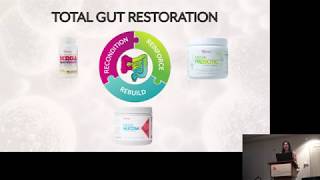
Aicacia Young (Microbiome Labs) presents a 'Total Gut Restoration' approach to repairing dysbiosis and mucosal barrier dysfunction. She outlines characteristics of a healthy gut (high microbial diversity, thick mucosal gel layer, intact tight junctions, low inflammation), drivers of gut damage (antibiotics, alcohol, stress, intense exercise, artificial sweeteners, dietary fats, glyphosate), and research linking dysbiosis and mucosal breakdown to chronic diseases (IBD, obesity, type 2 diabetes, colorectal cancer, autoimmunity). She introduces a three-step system (Recondition with MegaSpore bacillus-based spores; Reinforce with a targeted oligosaccharide 'precision prebiotic' blend of FOS/GOS/XOS; Rebuild mucosa with MegaMucosa containing four amino acids, bovine immunoglobulins and citrus polyphenols) and gives practical sequencing and tolerance guidance for clinical use.
Questions this video answers
250 billion CFUs
About 21 to 28 days
Up to 450 degrees Fahrenheit
About 40% increase
45% reduction in LPS compared with baseline
Chapters
Okay, so today we're going to talk about the gut microbiome. And as most of you are probably familiar, the gut microbiome is really like a vast ecosystem. So it's not really this static environment. It's going to be constantly changing. It's very dynamic. So you can think of it kind of like a rainforest, right? There's going to be a bunch of different organisms, they all work together, some can kind of oppose the others, etc. So when we're looking at the difference between a healthy gut and an unhealthy gut, I just want to go over some of the characteristics of a healthy gut. So in a healthy gut, you're going to have increased microbial diversity, just like you would if you were in a jungle or a rainforest. You're also going to have low levels of pathogens and toxins, right? So they're not going to be a ton of pathogens and toxins causing disease. In a healthy gut, you're going to have a thick mucosal barrier. So you can see from this diagram, which might be kind of small for some of you in the back, but you can see like a purple area at the bottom. You can see a darker blue and then a light blue sort of at the top. So the mucosal barrier that we're talking about is going to be the thick blue. And so that one's going to be kind of a gel like texture. And that's what's going to protect the intestinal lining from invading pathogens or toxins. Another characteristic is going to be strong tight junctions. So this is talking about the tight junctions that are holding your intestinal cells together, right? So each of those little finger like projections, those are going to be your intestinal epithelial cells. And those are all stitched together very tightly by tight junctions. So if those get torn apart, essentially what will happen is you'll have holes in the intestinal lining and that's what's causing what's known as leaky gut. The other thing is that you're going to have very low levels of inflammation in that mucosal lining and in the intestinal lining. So these are some of the characteristics of a healthy gut. And this is a little depiction of what happens in leaky gut. So we'll go over this a little bit more in detail, but as you can see, there's much more pathogens in the lighter space. So that's going to be the outer mucosal layer, and you can see that it sort of degraded that mucosal barrier. The thick one that's really protective. You can also see that there's some inflammation of the intestinal lining depicted by the red cells and that they're torn apart. So it's going to be a very leaky gut and that's allowing toxins to seep in and that's allowing toxins to get straight into circulation, which is where then they're able to increase inflammation. So some of the gut damaging factors that you guys might be aware of already would be antibiotics, of course, because that's going in and wiping out a lot of the good bacteria. Excessive alcohol consumption, smoking, stress, lack of sleep. Intense exercise is also one that's kind of surprising to most people because they're like, but I exercise really frequently. That's good, right? I'm healthy. But physical exercise is still going to be physical stress on the immune system and on the gut. So if you guys do see elite athletes, just let them know that their training is going to be damaging their gut lining. Artificial sweeteners can of course disrupt the balance of gut bacteria, and then saturated fats and glyphosate, those can both increase the toxicity of lps, which is an endotoxin that's produced by the gram negative bacteria in the microbiome. So here, just once again, just to show you guys a bigger picture, on the left side we have the healthy gut, and on the right side we have a leaky gut. And so what we did at Microbiome Labs was come up with what we're calling the total gut restoration system. And I will get into that a little bit later. First, we're going to go through some research to kind of justify why we came up with this process. But if you can see the little symbols on the left, there's a little pink one, a little green one, a little blue one. Those are going to be each of the three steps that we're trying to address in this total gut restoration system. And so, as I'm sure you're aware, whenever you have people with gut health issues, which is a lot of people, right, maybe the majority of your practice, there's not a lot of great protocols to follow. And so the few that are out there will cling to and we'll try, but a lot of times they don't work because they can be a little bit too cookie cutter from time to time. And so you'll have those patients that if they don't fit the cookie cutter mold, then they're just kind of out of luck, right? So what we've come up with is something that's not necessarily cookie cutter. You can use it in your practice with other modalities, other therapies, and really use it and make it your own. So the first thing we're going to talk about, I have about four studies just to show you really quickly just linking the disruption of gut microbiota to other chronic diseases. So this particular study was looking at just connecting the disruption of gut bacteria. So we can also think of that as just dysbiosis. So this one was linking dysbiosis to other conditions like obesity, IBD, IBS, type 2 diabetes and colorectal cancer. And they also suggested that modulating the gut bacteria was going to be potentially beneficial for human health. And so they were suggesting that we need to do more research in this direction because this might be something that could help a lot of people. Here we have a study that is looking at dysbiosis with ibd. So what they found is that the most consistent observation in patients with IBD is reduced bacterial diversity. So bacterial diversity was something that we talked about in a healthy human gut. So this is again, just connecting those dots that in IBD you're going to have reduced bacterial diversity in the gut microbiome. And this one also suggested that therapies that are correcting the dysbiosis have shown to be promising in treating ibd. So here we have a study that was looking at Akkermansia mucinophila. So this is considered kind of a new generation microbe. It's not really anything new, it's just that we're learning more information about it. So it's been inversely associated with obesity, diabetes, heart disease, low grade inflammation. And so the reason that Muciniphila A. Muciniphila is so important is because it can actually trigger the fat burning genes in the body. And so this is what is essentially getting triggered when you're doing intermittent fasting. And this is part of the reason why intermittent fasting is so effective is that Akkermansia feeds off of little glycoproteins in your mucous layer. So it can only feed when you're in a fasted state. And so fasting for longer than when you're asleep, which is generally eight hours, you know, extending that to 12, 14, maybe 16 hours, is what allows this bacteria to actually thrive. And that's what allows it to turn on and trigger the fat burning genes. And that's what's encouraging a lot of the fat loss that we're seeing with intermittent fasting. And another bacteria of interest that you'll probably might already recognize, but you will definitely see my of in the future. It's called the Calibacterium prosnitzi. And so this one is starting to be known as the anti inflammatory bacteria of the gut. This one has actually been associated or the abundance of the Calabacterium is associated with a decrease in ibd. And it kind of goes both ways. So people with IBD are not having as much pacala bacterium and the people with a ton of the Cameobacterium have very low levels of intestinal inflammation. And so it appears to be protective against intestinal inflammation. And so for that reason, one of our products is definitely trying to target and increase the abundance of this bacteria. And then the other factor that we talked about, besides fixing the abundance, increasing the diversity of bacteria in the gut is the other thing that we want to focus on is the mucosal barrier, because that's an actual physical barrier that's keeping toxins and pathogens out and keeping them from getting into circulation. So this particular study was just showing that both the intestinal lining and that mucosal barrier are really important, protecting against disease. This also is just bringing up, which I'm sure most of you are familiar with, that a lot of autoimmune diseases are now showing more association with bacterial infections, both viral and bacterial, but definitely bacterial. So this one was suggesting that by protecting the intestinal barriers you are then able to protect against multiple diseases. This particular study was looking at LPS and leaky gut. So LPS was something I briefly mentioned before. The results of this was essentially just saying that having mucosal dysfunction in the gut was allowing LPS to enter into circulation and then that's going to be triggering low grade inflammation. LPS is something that I will bring up at the end. So I do just want you to remember that it's going to be triggering low grade inflammation. So trying to reduce LPS is going to be really important in treating pretty much any chronic disease that you're seeing in your clinic. And this study was just showing that GERD could actually be caused from mucosal inflammation. So just wanted to give you guys some examples so that you know, I'm not crazy in making everything up. And this is another one that is talking about mucosal immune dysfunction happening pretty quickly in the pathogenesis of aids. So it may not be the initial insult to the injury, but it could be perhaps secondary. So it's happening pretty early on in the pathogenesis. So I thought that one was pretty interesting as well. Okay, so now we have the total gut restoration system that I mentioned before. So the three steps, you can remember it pretty easily with three Rs. It's going to be reconditioned. So you're going to recondition the gut bacteria. So reinforce. So you'll want to reinforce those changes that are made and then rebuild. And so there you're going to want to rebuild the mucosal layer. So again, here's that little picture we talked about. So those are going to be the steps on the left. One, two, three. This beautiful depiction. Okay, so most of you, I think, are already familiar with Megaspore. Can you raise your hand if you're already familiar with Megaspore? Most people, yes, but some people know. Okay, so for those of you who aren't familiar with Megaspore, just quick pitch you on it. It's the best probiotic that you'll find. Just believe me. Instead of using Lactobacillus or Bifidobacteria, we use five strains of Pistillis. And the reason that we use Bacillus is because it has two life forms. So it can be dormant or it can be active. And in its dormant form, it will actually form an endospore or a protective shell around it. And that's what allows it to survive in harsh environments. So you never have to refrigerate it. It doesn't have any special enteric coating on the capsules. You can open the capsules and sprinkle the tasteless powder into food or drink if you want. You can even bake with it up to 450 degrees Fahrenheit, because it is going to be so rugged and resilient in that spore form. That's what allows it to naturally survive digestion. So it's going to survive digestion, which is where a lot of other probiotics die off. And then once it gets into the large intestine, it'll actually communicate with the colonocytes, realize that it's home, and then come out of that shell. So then it'll go back into its vegetative or active state, and that's when it'll really start to colonize in the gut. So it's really only going to colonize for about 21 to 20, 28 days before passing through. So there is a need to keep taking it, but you can work down to more of a maintenance dose where you don't have to take it every single day for the rest of your life. But this is how our ancestors would have naturally gotten probiotics. In their diet because the soil was rich with bacillus species. So at the time, they weren't like chugging kombucha or eating a bunch of yogurt or popping pills. With 250 billion CFUs, they were just eating produce from the ground and they were eating animal intestines. And this is how they were able to get probiotics in their diet. So in terms of total gut restoration, what megaspore is really good at doing is reconditioning the gut. So if we go back to thinking of it as like a garden, for example, it's able to go in and pull some of those weeds, refresh the soil, right. And sort of fertilize. The next step will be the main fertilizer. But this one's very active in really going in and revitalizing the. So it's able to increase short chain fatty acid production, like butyrate by 40% and that is going to indirectly increase the microbial diversity in the whole gut as well. So I know a lot of people think, but I need to take a probiotic with 15 to 20 different strains, right? If I'm going for microbial diversity, it makes logical sense. So they're like the Urus only has five of one genus, so I don't think I'll get any diversity. But because a lot of the Lactobacillus bifidobacteria species don't survive digestion, it's not generally creating enough microbial diversity. So we've actually found is in doing a simulated gastric study. It's called a Shime model. We have seen a 40% increase in other bacteria, most, most notably Akkermansia pacala bacterium and Bifidobacterium. So that is the first step. Oh, we do also have, for those of you who don't know, we do have a leaky gut study that I will show you on this next slide. Okay, perfect. And this was on for college age students. So we gave them a challenge meal of a McDonald's breakfast. So we wanted it to be high fat, high calorie, because that's what helps to stimulate LPS release, measured their LPS levels and then sent them away with MegaSpore for 30 days. So all they did was go live their healthy college age lives and take Megaspore for 30 days. Then we brought them back, we gave them another challenge meal and measured their LPS levels. And what we saw in the score treatment group was a 45% reduction based on what they started. But then interestingly, in the Placebo group, we saw a 32% increase. And these are young college age students, they haven't really done anything super damaging yet. And so the difference between the 2 was a 60% drop. So when we think of autoimmune disease, for example, we think, oh man, how did that. Just came out of nowhere, right? Just in their 40s or in their 30s, they just all of a sudden, out of nowhere came up with this autoimmune disease. But what we're actually seeing is that autoimmune disease in any chronic disease is breeding very, very slowly. It's starting with very low grade inflammation and just building over the years. So what we're seeing is it's starting as early as college age students. It could be starting before that depending on a person's diet or lifestyle. So once we reconditioned the gut and really controlled the pathogens in the gut and really boosted some of that good bacteria, the next step is to reinforce those changes. So what we want to do is send in a precision prebiotic. So the issue with most prebiotics, as I'm sure you're already aware, is that they can feed good bacteria, but they can also feed not so good bacteria. So if you have a patient with a gut infection and you throw a prebiotic at them, they can get worse sometimes. So sometimes that can exacerbate their condition. Not really what you're going for, right? Like you're trying to help reduce their symptoms. So a lot of people with gut infections are really scared of prebiotics. So what we did was we came up with a targeted prebiotic. So we're using oligosaccharides that are non digestible. And so these are going to be xyloigosaccharides, fructooligosaccharides, and galactooligosaccharides. And what we saw was that these oligosaccharides were able to boost the abundance of Akkermansia faecala bacteria and Bifidobacteria without feeding other pathogenic bacteria in the gut. So that's why we coined the term a precision prebiotic. And so in some of the studies looking at these different oligosaccharides separately, FOS was able to increase faecalum prostitute by 100% in four weeks. It was able to increase akkermansia muciniphila by 8,000% in five weeks. GOS, which is the galactooligosaccharide, was able to increase Bifido by 67% in just one week. And Xylo oligosaccharide is also able to increase Bifido by 21% in four weeks. So this is where those three came from. In case you were wondering why we chose those three. And the third step, which again, you can change the order, but we'll get to that later. But the third step is to rebuild that mucosal layer. So the important thing is going to be butyrate production and Mucin 2 production. So most people know that butyrate helps to increase Mucin 2 production, but what they don't know is that the body needs four amino acids in order to use them as building blocks in order to create more mucin ii. And mucin II is going to be the type of mucin that's very thick and gel like. So that's what's going to be in that darker blue layer that I showed you in that depiction. So that's going to be a bit more protective mucin, mucus. So what we've done is we formulated megamucosa. So megamucosa has four amino acids and then it's also going to have serum derived bovine immunoglobulins and citrus polyphenols as well. So what the immunoglobulins are able to do is bind to any toxins. So you can think of them as kind of a defense or a band aid. So to say, just like if you have a wound, you would cover it so that it wouldn't keep getting dirty. That's essentially what the immunoglobulins are going to do. So they're going to go in, they're going to bind to any toxins that are in the gut, just to give your gut a second to heal. And then the amino acids are going to go in and work along with butyrate to help improve and increase that thick mucosal barrier so that then you'll have that good protection against having more toxins. Because toxins are inevitable, right? They're going to be, they're in the environment. Every time you eat, you're releasing some toxins. So the goal isn't to avoid toxins altogether. It's to just allow your body to protect itself naturally. And so this is the study that was looking at mucin synthesis. So by using threonine, serine, proline and cysteine, they saw a 95% increase in colonic mucin synthesis. I am running out of time. But that again is the total gut restoration system. Everyone wants to know what order to use it in, how long to use it. This goes back to again, it not being a very cookie cutter protocol. So you can use this as needed. The suggested use is going to be megaspore for about four weeks. Really let it recondition the gut, let them titrate up to the full dose. Sometimes that takes some time for people because it is very potent. Then introduce the prebiotic. You're going to reinforce all of those good microbial changes that you've made. Do that for four weeks and then introduce mega mucosa. You can have them take all of them throughout, right? So they start megaspore and they just keep taking it throughout. You can have them take the prebiotic for a month or two, then maybe weaned down. So it's really. You can make it your own. But that is going to be. The general order is going to be megaspore, then the prebiotic, then mega mucosa. If you do see a lot of IBD patients, if you see a lot of Crohn's or colitis, we have seen success with doing mega mucosa first and then megaspore because a lot of times the people with really, really intense intestinal inflammation, they can't really talk megaspore because it is so strong. So by starting with the mega mucosa, you can help them build up that layer and then that allows them to tolerate megaspore a little bit better. So you have options. If you would like more details, you can come see us at the booth. I don't want to run into the other person's time. And if you have any questions, please feel free to come see me. We're right on the other side of this school at the booth, the microbiome lab. And thanks for staying awake.









