How to use MSKUS in diagnosis
In this 40‑minute webinar, Matthew Gallogly (CEO of Mavericks Profit System) together with MSK‑ultrasound experts Colin (co‑founder of Advanced Musculoskeletal Ultrasound Center) and physical therapist Ryan, present a blended clinical‑business framework for converting patients to cash‑based orthobiologic procedures using point‑of‑care musculoskeletal ultrasound (MSK‑US). The session opens with Gallogly’s mission to free 100,000 providers from insurance‑based care, outlines the financial upside of cash practices (e.g., $50k‑$100k months, 3‑year lifestyle freedom), and introduces the “beachhead” marketing concept—focus on a single, clear offer to a defined patient segment. The bulk of the presentation is devoted to three live case studies (a 45‑year‑old with a partial‑thickness supraspinatus tear, a 55‑year‑old with lateral epicondylitis, and a 63‑year‑old with gluteal tendinopathy) that demonstrate how MSK‑US provides real‑time diagnosis, enhances patient education, and creates a bonding moment that drives conversion to PRP or other orthobiologic injections. Technical details include ultrasound advantages (portability, high resolution for tendons/ligaments, low cost of handheld devices $2k‑$8k), limitations (operator dependence), and injection techniques visualized in‑plane. Business insights cover pricing (PRP $1,500‑$1,900; BMAC/adipose $4,000+), script‑driven “signature solution” sales, and promotion of the upcoming Business of Orthobiologics event (March 23‑24, Dallas) with CME credits and team‑member incentives. Throughout, the presenters blend instructional, persuasive, and conversational tones, emphasizing enthusiasm for cash‑based models and a critical view of insurance‑driven care.
Chapters
And we're gonna be talking to you tonight. Well, they're gonna talk to you tonight about leveraging the use of musculoskeletal ultrasound in your practice and utilizing that to help convert more patients into cash-based procedures. Now, we have a lot that we're gonna cover tonight, and so I'm gonna go ahead and just dive right in. And so let me pull up the beautiful screen that we can share. so that we can dive right into this and not waste any time and get right into it. So again, my name is Matthew Glogli. I am the CEO and founder of a company called Mavericks Profit System, and we work and help doctors convert their practices to 100% cash. We work with orthopedics, pain management. Those are our 2 biggest groups. We have a couple of other, you know, other modalities as well. But this is one of the best tools that we have found that you can use to start to convert patients into cash-based procedures. So we're gonna talk about this tonight. We're gonna talk about some of the problems. And this is part of what we call the Business of Orthobiologics webinar series. And the Business of Orthobiologics is an event that is— that I'll talk about here in just a minute. Now, what we really want you to be able to do is we want you to be able to heal your patients faster, and help increase your bottom line by 3x or more. In talking with our doctors, in using orthobiologics the correct way, in the average time that a patient will see a 50% improvement in their condition is right at 6 weeks. Our average client that we work with within 60 days adds $50,000 of cash procedures, cash revenue collected into the practice within 60 days. And our average client within 12 months of working with us is at $100,000 a month in cash procedures. After about 18 months, they're starting to take a minimum of 4 weeks off a year. That's the no cell phone, no laptop, no checking in, no conference calls, no patient calls, nothing. And after 3 years, they're reducing their time in the office to as little as 4 days a month if that's what they wanna do. And then you can start to talk about how you can exit your practice. We're not gonna dive into that tonight, but that can be through sale or bringing in other people to handle the day-to-day. So the key, one of the keys to be able to do this and do this effectively, all of what I just shared with you, to be able to have 6-figure months in cash, to be able to walk away completely from insurance, to be able to take 4 weeks off a year or only see patients 4 days a month, all of that, and by the way, increasing your personal income, one of the keys to doing that is mastering musculoskeletal ultrasound for enhanced injury diagnosis. And treatment using orthobiologics. And that's why Colin is here. So we're gonna dive in here. And, um, before we do, well, let me tell you a little bit about Ryan, his business partner, and, um, and what they do. And so, uh, let me just pull this up here. Sorry about that, Colin. I just had to switch my screen for a second. So, well, Colin, why don't you tell us about Ryan since you know him better than I do?
Yeah, yeah. Ryan and I, we've known each other a long time, over 10 years. He's a physical therapist with additional skills in musculoskeletal ultrasound as the main niche. Okay, and he's worked as, like myself, as a physician extender for the majority of his career. He does have a specialty in MMA. He's well known kind of in that arena for helping their physical therapy team become more more, you know, better at what they do. Ultrasound is one of the points. Okay, so all around, all around a really solid guy, a good friend, and one of the most highly skilled, dynamic individuals you'll meet in the field.
Great. And then I'll introduce you to Colin. So there's Colin, you can see him on the screen as well. He is a co-founder of Advanced Musculoskeletal Ultrasound Center. We actually have them at our events. He operates and consults in the MSK ultrasound to various practices around Greater Phoenix, and he is on the adjunct faculty at A.T. Still University PT therapy program in radiology and imaging. And as you know, he lives in the Greater Phoenix area. So, well trained. The other thing that they did not put on here is Ryan and Colin are instructors for OrthoSono, Don Buford's training that is held a couple of times a year in Las Vegas. You'll see them at IOF, you'll see them at all the top events because they're that well respected. Okay, and for those of you that don't know who I am, and then we're going to dive right in here, um, my name is Matthew Gallogly. If you don't know who I am, I am the founder and CEO of the Carolina Men's Clinic. I sold my interest in those in 2017. I am the founder and CEO of Maverick's Profit System, and I still— what I do is I help doctors break free from insurance and scale up their cash practices, and we focus primarily in the orthobiologic space In the anti-aging longevity space, I still own interest in clinics seven clinics today that do regenerative men's sexual health, high performance health, and weight loss. So the reason why I tell you that, I want you to really understand this: everything that we're going to be sharing with you tonight is field tested, meaning this is what we're doing today. This isn't what was working five years ago. This is real life stuff today, and at our company here at Mavericks, we have a passion about sharing the most recent updated stuff. Okay. So, here's what I want you to think about. So, when you get ready to master a new skill as a doctor, what do you do? Right? So, what you do is you wind out, you look for a mentor, or you attend an event, or you sign up for a fellowship, right? That's how you learn as a doctor your whole life. And when I say doctor, I should really be saying provider, right? Because of— I know that we have people in here that might be NPs or PAs. So as a provider, what you do is you're always looking to enhance your medical skill. Well, one of the things that's challenging with that is if you just spend your time enhancing your medical skill, your business isn't always necessarily going to grow. And what we know is that providers get as much business training in medical school as I got medical training in business school, which, by the way, Colin, that was zero. Okay. Business school is vastly different. Going to college for business and marketing is vastly different than going to pre-med. We spent a lot of time out. At the bar or the golf course. So, but today, like, if you think about it, what top learners do is they want to spend time, they want to learn how to do things from mentors. Okay. So, reason why I share that with you is I want to let you know we're going to just spend a couple minutes on this, is that last September, myself and Dr. Demers and Colin and Ryan were there. We hosted an event in Dallas called the Business of Orthobiologics, and it's a 2-day event. And it's exactly that. It's 50% medicine and it's 50% business. So every session is 2 hours. And in those 2 hours, you get an hour of the medicine and then you get an hour of how to apply that from a business standpoint into your practice. It was the first event of its kind. We are doing it again. We're doing it again in March in Dallas. I'll give you the dates in just a minute. And like I said, you're going to get the science behind business so you can take what you learn and make money. Now, here's the beautiful thing I want you all to understand. Medicine is based on science, right, Colin? Like, your everything that you do in your world is based on science, correct?
Absolutely.
Yeah. And why is it based on science?
Because we need to have a working algorithm and, and, you know, have a checklist of steps that we go through to make the best decision.
Yep. And by the way, business is exactly the same. So business is incredibly scientific. If you violate science and medicine, bad things happen. If you violate science and business, bad things happen. Okay, so we put this event together, um, and we have live case studies of doctors who have taken this information that we share and make money. We're going to actually share a case study with you tonight of how doctors are using this. Okay, so it's all designed to help you reduce the pain for your patients and add profits with orthobiologics. So we're going to show you how to reduce the amount of time you spend at the office, help your patients recover faster without opioids and steroids, increase the freedom to give your patients what they need, get more referrals, um, and optionally as well, open more practices or exit when you are ready. Okay, so we— better outcomes. And I— my co-presenter in this is Dr. Ariana Demir. She is currently, at the time of this recording, the president of IOF. Um, and she is— she teaches this class with me. She's board-certified, fellowship-trained orthopedic surgeon, and she is the current president of IOF. Um, she has successfully moved her rural practice almost completely away from insurance. She's down to doing surgery one day a month, and she just had a 6— her first 6-figure cash month. So, um, and like I said, she's doing 6, um, to high 6 figures a year, and 85% of her patients are Medicare and Medicaid. And then I'll teach with you as well. You already know about me, but I grew our locations. We started in the erectile dysfunction space, did about 100 PRP injections per month for ED and Peyronie's, and we grew that from 1 location to 3 in 18 months, doing $6.5 million a year. Um, our clients have added over $125 million of cash-based revenues using things like what we're going to be talking about here to their practices. We've been doing— we've been working with doctors since 2018 to help them do all of that. Now, I tell you all of this because I want to let— I want to make sure that you know about an opportunity for you, and that opportunity is that you have an opportunity to attend the Business of Orthobiologics event. It's the second one And it's gonna be March 23rd and 24th. That is a Saturday and Sunday. Colin and Ryan will be there. We actually bring them up. They'll do— we'll do some live demo on a patient, do a shoulder or a knee or something like that. They'll actually show you how to do the exam. Ariana Demires will talk. Dr. Demires will show you how she presents the findings and how she converts the patients into a paid protocol. That's just one of the 8 segments that we're gonna go over with you. So up on your screen, what just came up is that you have an offer. And I just want to let you all know, and then we're going to dive right into the topic tonight, is that if you register and sign up for the event before December 31st, 2023, you can save $1,250. So the fee is half. So it's $1,250. You can pay that today. Or if you want to spread those payments out over 8 weekly payments, it's $156.25. per week. And all you have to do is just click the button that says learn more, and you can find out about that event. You can find out some more details. We do give you 10 CME credits. Breakfast is on us both days. Lunch is on us both days. We have a cocktail party on Saturday night. So it's a great opportunity. Plus, we want you to bring one member of your team for free. It's a business partner, team member, key employee who's on your payroll. Can't you bring your friend down the street and say that they work with you if they got another clinic? So you can go to mavericksprofitsystem.com/bob or just click the button here. And so before we go into that, now, Colin, what were some of the— I know you were there, putting you on the spot a little bit.
Yeah.
But what did you hear from people who were at that event? What was kind of the experience of what was going on there?
I think you broke down a lot of barriers on what people are, especially physicians, are uncomfortable talking about, which is business. And, and you made them reflect on where their gaps are. Not just from a, not from a clinical perspective, from, but from a business and application perspective. And I thought that the way that the conference was just dialed in from, from, from every aspect, there was so much detail with everything you guys did, Dr. Demers, yourself and your team. Really engaged the audience. And I think the— there was so much, so much value in introspection that you guys really passed on to the people who came there that they were not expecting to encounter when they signed up for the course. So it was, for me, I mean, I got so much out of it just as an observer and a sponsor that, you know, it makes me want to be a part of every single one you have.
Yeah, and we're going to do it again in March. Everybody's asking, are we going to do another one? Probably in September, but right now the March one. So check it out. We want to get to the content for tonight because that's why you're here. Um, but just remember, there's never been an event like this. Um, this is the first of its kind. It's the first time that this has ever been done, meaning when we did it in September. And we're going to continue to build on this, but we're going to change the way medicine is done. Our mission at Mavericks is very simple. is to free 100,000 providers worldwide from the chains of insurance-based care by the end of 2033. And I'm gonna tell you right now, there is zero future, zero future as an insurance-based doctor, especially if you're on your own. And if you are a doctor that's working part of a big hospital group, there's even less of a future 'cause they're gonna start cutting your pay pretty soon too. So let's dive into this. And I see that, let's dive into our topic tonight of mastering musculoskeletal ultrasound. Awesome. For enhanced injury diagnosis and treatment using orthobiologics, and Ryan is fresh from treating patients. So he is with us now. Give a wave to everybody out there, Ryan. We already introduced you, so they think you're an amazing human being, which you know we'll just go from there. Okay, so what am I showing you right here? So just like in the bit in the Bob, as we call it, the business of orthobiologics, the problem that I see as a non-doctor, as a business person. is what happens is all these events just talk medicine and they never get an opportunity to go deep, okay? And they never ever connect, build the bridge between medicine and business. It never happens. And to me, that's a massive fail because in order for doctors to have autonomy, to be able to treat their patients the way they wish, the way they see fit, for them to actually have a relationship with the patient And to advise, guide, and recommend with the patient based on what's best for the patient, not what's best for the insurance company, not what's best for their bottom line. Cigna made $5.6 billion last quarter, folks. That's just one. They make an average of, I think it was $20 billion last quarter alone. And what do they do? They whack your reimbursement fee another 3.5%. Oh, and guess what they're doing now? They're jacking the premiums on the patients and the businesses on an average of 10%.
Wow.
Average of 85% this year. Oh, and they're cutting back on what is covered. Okay, so to think to continue to think that there is a future in insurance-based medicine is bad thinking. That's like believing that putting leeches on people and doing bloodletting when people are sick is still a good idea because it's not. The science, the data will tell you a thousand percent there is no future in insurance-based care for the for the doctor, for the provider. So what are you going to do, right? And don't sit here and think that by offering cash services you're only going to be serving the wealthy. We're going to disprove that to you tonight, okay? I have clients that have 85% of their client base is Medicare, Medicaid. You saw Dr. Demers. That's just one of many. I have rural doctors all over the United States and Canada. I have doctors in Canada, the single-payer system, and their patients are paying $5,000 and $8,000 and $10,000 and $15,000 for, for orthobiologics procedures. Okay, and they're getting phenomenal results. So how do we do that? Well, how we built. So what we're going to do is we're going to give you a little example sample of what the Bob is like. So what they're going to do is Ryan and Colin are going to talk about the science of what they do, and I'm going to show you how you can apply this from a business standpoint. So what do you see in front of you is you see what is known as the stairway system. Now the stairway system is what we used to grow our practices from startup to To 3 locations in 18 months doing $6.5 million a year. We were averaging 100 PRP injections per month. It's a lot of blood, okay? We were doing about 75 to 80 hormone pellet insertions per month. We were seeing on average per week, 150 patients per week, all cash between the 3 locations, okay? So we were a machine, like, but we provided great, amazing care. And And the first concept that we're gonna share with you is this one right at the bottom, and it's called the beachhead, okay? So the beachhead is a very simple concept, and basically it's, we wanna focus on one message to one market with one offer, okay? So here's how this looks. Most doctors, what they do is they say, oh yeah, we do that. They think that in order for them to be successful in cash, they have to go, oh yeah, we offer that. Oh yeah, I do ozone therapy. Oh yeah, yeah, yeah, we can do PRP. Oh yeah, yeah, yeah, I can do HRT. And the reality is, from a business standpoint, that's bad science. Think about it. Does Chick-fil-A offer burgers? No, but they offer an incredible chicken sandwich. Do you want to know what the number one fast food chain is for Gen X and Gen Z?
Chick-fil-A.
Okay, so they're experts at doing one thing better than anybody else. Okay, so the concept is, is that this is what it looks like. We're gonna have a core offer. What I'm about ready to have Colin and Ryan share with you. There's a core offer and a core process that if you do just this, we have clients that are having $50,000 weeks with what they're getting ready to share with you. Okay, so I hope you're ready and I hope you're paying attention because we're gonna have a lot of fun here over the next 40 minutes. So Colin, Ryan, you guys ready to rock and roll?
Absolutely.
All right, let's do this. All right, so the biggest issue that doctors tell us is getting patients in the door for cash procedures, right, Colin? You hear that? Right? Biggest headache in the world, right? Mm-hmm. All the time. Okay. All the time. So we do live in an instant fix society where people, and especially patients, have become more impulsive, right? They make— they're making very big payment, big procedure, quick decisions. And it's all about how you position. So, Colin, let's dive into this, and I'm gonna let you take it from here in this segment of how to leverage ultrasound.
Yeah, sure. That's a good lead-in because a lot of the patients who come and find us, at least in our practice here, in our practice locations around the Valley, they, they want that diagnosis same day. Okay. And they Google your office wanting— okay, you have ultrasound. Okay. This is a real-time diagnosis. I want to know what's going on so we can, we can figure out what to do. Okay, so leveraging ultrasound in your office is a great reason to— is a great leverage point to get them in the door and help them with their problem. Okay, so we go on to the next one.
Yep.
Okay, so some advantages of ultrasound. Okay, it's real-time point-of-care diagnosis. Okay, you're having this, you're getting to the bottom line most of the time that first day. Okay, so it's portable. There's a superior resolution quality for all your extra-articular structures, tendons, ligaments, nerves, muscles, cortical surfaces of bone. It allows you, and this is a big one, okay, the 4th bullet, this time with the patient. Ultrasound is an extension of your clinical skills. Your clinical mind is a conversation piece. It's an extra time you get to spend with the patient. With this probe on their skin looking underneath there, you're like a tour guide of their anatomy. They love it. It's a great interaction time, okay? And it positions you as an authority in the space. And it also, it expedites the care and treatment recommendations because you're not sending them out, okay? Most, more often than not, sometimes there's a place for MRI, okay? But a lot of the times we get what we need with the ultrasound. Some disadvantages. Okay, it's operator dependent. Okay, so anybody who's doing ultrasound knows that it's only as good as the person using it, which means that there's a learning barrier in a lot of cases. With some limited interarticular viewing windows, okay, is in my opinion is the main, the main limiting, the main rate limiting factor of what you can and can't see. More importantly, With ultrasound, okay, which really only limits us to a few structures when you really think about it. Okay, so the advantages far outweigh the disadvantages.
Okay.
So we'll get into the first case study. Okay, we have a 45-year-old male, left shoulder pain. Let's go here. So we got You know, 3-week insidious onset, left-hand dominant. This is a coach and a teacher at a local school. Okay, is athletic, wants to get back in the gym, wants to be able to get back to throwing a ball with the students in the team he coaches. It's been interrupting his sleep patterns and says have stopped working. There's no history of traumatic mechanism injury. This person does have a history of overhead athletics in high school and college.
Okay.
So we want— again, so you, you, you want to pick out what, what is it they want to get back to? Okay, what about your experience with them that can you help them get back to and, and make that— and make that a— make that a point as, as you go through the rest of your exam? Okay, so the patient was seen by primary care. They did come with an MRI indicating some vague findings insertional supraspinatus tendinosis. Came back to our office to— they want— they came to our office to avoid surgery. So we both on Google and the primary care networks of people we see most patients from, they refer to us because they know we take care of everything that's not a surgical thing. Okay, so for primary care, they said, okay, we don't have to take care of anything from here. These guys got it. And if it is a surgical case, which happens maybe 5 to 10% of the time, then we have a network of people we do that with. Yeah.
And I think that's important for people to understand is, you know, the— I'm in my mid-50s and if you're 50 or less, people don't want to do surgery. They want to be— patients want to be more involved in that decision-making process. They want to know they come in way more educated, right, Colin? I mean, they— Dr. Google is in full, in full Right? Like full, full dress.
Yeah, the patients know. Patients know when you go to see a surgeon what's in their toolbox, right? What do they do? They do surgery. And that's not the conversation they want to start with. They don't. They want to exhaust whatever they can kicking and screaming before they have to go that route, which, when you come to really think about it, there's maybe— I don't know, there's maybe some argument here, but in my opinion, there's maybe 10 to 15% of patients in a surgeon's office who are actual surgical candidates. Okay, maybe different in some locations, but by and large, you know, we feel like, you know, we can manage that better in a lot of cases than they can, honestly.
Yeah.
Okay, so let's talk about the eval.
Yeah, sure. So we'll just go through this pretty briefly here. Okay, so in most cases, Peripheral issues in the upper extremity. We're going to clear the cervical spine. Okay, so making sure this is not a differential radic pattern that we're missing. There's some limitations in manual muscle testing. This person is mainly 5 out of 5 with some apprehension in right shoulder abduction and external rotation pain with abduction. Deltoid referral pain pattern. Okay, special testing indicates, you know, Hawkins-Kennedy, Neer's, Yocum's, all those impingement signs, okay, our cluster exams are pointing to this being a contractile issue, a rotator cuff issue. So, you know, what do we do in these cases, especially in the peripheral joints, okay? We have imaging, ultrasound imaging in our office. We have the equipment and the expertise. We're gonna scan this joint, okay? So we decide to scan and we complete the scan. And then the next slide we'll go into What are the what are the main findings? Okay, so the the main takeaway is we we found a partial thickness supraspinatus tendon tear, which oftentimes when you get an MRI indicating some kind of insertional it it insertional tendinosis. You know, honestly, with ultrasound, I think we see that a little better resolution than than an MRI does sometimes. It also depends on the reader, the radiologist. And whatever the slices were, but in real time, in our— under our hands, you know, it's just an easy diagnosis to make. And so we found some fluid in the biceps and cortical irregularities where the tendon inserts to the bone, which, you know, just to throw in a little research here on what those 2 findings mean, if you see those 2 things, more often than not, there's going to be some kind of cuff tear that you need to investigate and figure it out.
Okay.
So this is the, this is the picture with the biceps with some fluid in there. Okay, so, and in this, that's one indicator. Okay, so if you look at the, looks like you're looking down the barrel of a gun here with the bicep tendon, right? And right in the middle and where the bone is, and then the dark stuff, the fluid right underneath it is the, is the effusion in the bicipital sheath. Okay, so that's just one marker. We can go to the next slide.
Okay. Okay, looking at here.
Yeah, this is the supraspinatus tendon. And so this is, you know, if you're looking at a coronal MRI, okay, this is exactly that, except with— it's magnified. It's magnified greatly here. Okay, and so it doesn't take a— you know, I could teach any patient to see what What are we seeing here that's not normal? You see this bone that should be nice and smooth, and then you see the part of the bone that's not smooth, okay?
Mm-hmm.
And then all the dark stuff that's next to it that represents the piece of tendon where there's a tear, okay? That is where the structural issue is with this piece of anatomy. And so again, this creates a nice conversation with the patient as far as what we're dealing with here. This explains why they're experiencing what they are, in tying it back to their function and what they want their outcome to be, okay?
Yeah.
In terms of what they want to get back to. And so again, just this literature is out there. You guys can find it. If you're doing ultrasound, hopefully you already, you know, know a lot of this. But this is one study that details the accuracy of any rotator cuff tear with ultrasound, okay? Sensitivity, 85%, with MRI is 85%. Okay, this is any rotator cuff tear. And specificity, 92%, and MRI is 90%. Okay, so—
Wow.
This is in— this is— this is in the right hands, right? And so with our training and what we do and how we operate, like, this is in your office with the patient in real time. Okay, so it's just a powerful tool to get to the bottom of what's going on with, with, you know, whatever— whatever they're dealing with.
And the ultrasound machine is relatively inexpensive comparative to, well, a lot of other equipment that they might have to buy. I mean, it ranges— what are the ranges in the prices? I mean, there's some pretty good handhelds that are below $10K, right?
Oh, for sure. You can get a good handheld for less than $5,000 now, good resolution. Um, you can get a good laptop model for between $15K and $25K now. Okay, the barrier to entry as far as price goes with equipment is as good now as it ever has been. And what do you think, man? Do you agree?
Yeah, can you guys hear me?
Yep. We can.
Yep, perfect, perfect. I was using my old school gold mic, but I'm not getting it to work right now, so we're gonna use the computer mic for now.
It's coming along great. You sound awesome.
Yeah, good. Thank you, thank you. Yeah, as far as pricing goes, it's all, you know, you can get 'em down as low as $2,000, but you're going to get what you pay for. pay for. You get them up to $4,000, $6,000, $8,000, and you're gonna get amazing quality. You can spend— sky's the limit. I mean, honestly, you can get the Ferrari and you can walk in the patient's room with like an extravagant, you know, $100,000 machine. But guess what? You can get all the relevant information from that $6,000 to $8,000 kind of price range.
Yeah, and it's— I will tell you, as a patient, um, I've had this done on me with just with a small handheld, and you could see everything beautifully. The reason why we share that is that, look, you wanna be able to keep your costs. One of the things about business and science of business is keep your expenses low. Don't go into debt. Debt's a killer in business, okay? So you can use this concept of using this ultrasound as what we call a beachhead, making a message and an offer to a specific group of people for them to come in and they don't have to wait. And we're gonna talk about that next, right? Oh, here's the injection approach. I think I almost forgot about this. So talk about this.
Yeah, yeah. So, you know, in our practice, how Ryan and our locations in the Valley and the other physicians we work with, okay, we're— our philosophy is a non-surgical approach. We have a network of physicians to use if that's the case, but we're practicing best practices here, okay? We're offering the best non-surgical option for these conditions, okay? And in this case, is the, the first option should be PRP, all right? And, and you guys can go to courses and look at, you know, talk about the science around why, okay? But for the purpose of today, okay, this is what, this is what is, this is what the emerging evidence is, is telling us, okay? And this is what we practice. Mm-hmm. And this is the approach, okay? So, um, you can do this in supine as well if you're worried about a vasovagal response, okay? This is, this picture was taken for, uh, for a book purpose, but There's multiple ways to do this injection approach. This isn't, you know, this is kind of beyond the conversation today, but you see the trajectory of the needle and the rotator cuff tendon where the arrow is pointing to with the direction. Okay, you're going to locate the, locate the tear and you're going to want to direct the needle to the tear.
Mm-hmm.
Okay. All right. So now, so again, what we did is we just talked about the beachhead. How can you use the concept of MSK-US to get people Um, you know, use it to get them in the office or engage in the conversation when they're already in the office from an insurance visit. Okay, so then the next thing is the reason why doctors— so I will tell you, somebody who's in sales, most people, even if you're in sales, we're trying to figure out a way to make the sale go easier. Okay, trust me, as somebody who's been selling since he was 6 years old, and I'm in my mid-50s at the time of this recording, You're always trying to figure out a way to get people to say yes before you even ask for the sale. And what I learned at a very early age was that I learned working at the country club. I won't go into the full story, but basically I used to grab the clubs for the members, and then I learned how to shine the shoe. I would shine shoes for them. Then one day, because I was doing such a good job at that, one of the members flipped the keys to a 7 Series Beamer and told me to wash and wax it. Before we knew it, we had like 10 members that we were doing this for. while they were out playing golf. It was a good little business in 1983, okay, and the reason why they did that is they knew us, they liked us, and they trusted us. So if you wanna get more people to convert into cash, there are specific things that you can do to get people to know, like, and trust you. This is what we call the educate and excite stage. Now, I don't have time to go into all the details of it and how you can do it. We'll do that in Dallas at the Business of Orthobiologics because here's the thing, here's the big idea for this next segment. You can't build a bond with the patient by sending them out for imaging. I want you to think about that because, Colin, how long does it take to get an appointment for imaging?
Weeks?
Months?
It can take weeks. Yeah, absolutely. Yeah.
Yeah. And then what most people don't realize is even with the deductible, What most doctors don't realize, providers don't realize, is that like my out-of-pocket expense on my last MRI was $1,100, and we have great insurance. Doc, the MRI place made $400, and I still had to pay $1,100 out of pocket. So believe me, we want, as a patient speaking from a patient, we want to find different things. So your conversion rates go down once you send them out. This is what I can guarantee you. This when they leave the office, conversion rates are going to go down. So let's talk about this. Guys, and let's talk about how to develop this deeper bond using ultrasound.
Absolutely. Ryan, you want to take this one?
Well, I mean, creating that bond right away. So I mean, I'll go ahead and I can do the case study here, and then we can talk a little bit about like, you know, how we develop that bonding. But so case study 2, it's going to be your run-of-the-mill, what we call your tennis elbow, or your common extensor tendinopathy or tendinosis.
And so I prefer to call it, I prefer to call it golfer's elbow because, you know, it's if you're a golfer, it's a golfer. Anyway, I'm just messing with you, Ryan.
No, no, no, that's, that's fair. And so actually, that's one of the differentials. That's one of the things that we have to rule out. Is it golfer? Is it tennis? Is it— what is it? And so if you don't really know, um, and we will talk about like special testing and things like that, um, you know, there's some, some tests. And then I think the ultrasound is a very good complement. So we have a 55-year-old female. She was referred by PCP, and I think that makes That makes, you know, that's one thing that we have to talk about is who are these people coming in from? Are they coming from, you know, off the street? Are they coming from a family practice? How are they coming in, right? So it's her right elbow, intractable pain. So it's there, it's been there for 6 months, insidious onset, and there's been no previous imaging or physical therapy or any other treatment. So I think that's important to know that they haven't had anything at this point and they don't wanna do anything invasive. They're a part-time worker, project manager, very active in the gym. They play tennis and pickleball, 2 racket sports, which I think is pertinent to the situation.
Yep.
So we can talk a little bit about the eval. So this is your sports medicine, your physical therapy, ortho type of evaluation. So you always wanna check the neck, just make sure that there's nothing ridiculous coming down that chain of events. So you're checking the neck and you're making sure that it's not something coming from above the chain. Now, there was some mild restrictions right over left rotation, but overall very functional and very normal within limits. The shoulder and T-spine were cleared out, always making sure you check the chain of events. Grip strength was mildly reduced. Cozen's, which is a grip test that you're checking for, it's positive for lateral elbow pain. And then resisted middle finger extension is another one that is positive for what they call the extensor tendon complex or the CET, the common extensor piece. So palpation or feeling through that is there's tenderness over the lateral epicondyle and a little bit into the body of that common extensor. Reaching, grabbing, turning, twisting items with their wrist in a slight upward position definitely increases pain. So we are already on a path of understanding, okay, we think we know what it is, but maybe we don't know the extent of this. But they want to play tennis, pickleball pain-free, and they want to get back to the gym, and they want to reach and grab items without pain. And so it's our job to find out, okay, what's the extent of this, to know how do we treat this appropriately, right? So the decision— and again, these are case studies that we've actually gone through, so these are not just completely made up— but this, the decision was made in-house right there to make, to do a scan, you know. So lateral elbow scan was made. And so I think the next slide is a little bit more about some pertinent information. So here's the pertinent takeaways. So the common extensor tendon was heterogeneous, so meaning that it didn't have a consistent pattern. Homogeneous, so we think of Homo sapiens, singular. We think of heterogeneous, different. So it did not have a consistent pattern, and there was thickening Meaning that it did not have a consistent or a standard depth that we would like to see, and there was hypoechoic clefting. So dark little tears in the in the middle of the of the tendon. There was loss of that fibrillar pattern, and again, these are all terminology that is consistent with tendinopathy. The RCL, so that radial collateral ligament or the lateral collateral ligament, as some people may call it, was intact. Maybe some secondary tenduations, some weakening. So there was there were signs that it's. taking over and doing more of maybe what the tendon should be doing. Again, everything's pointing to the same thing. And then no atypical RC joint or radiocapitular findings, meaning that we didn't see any osteoarthritic changes, no significant degeneration in there.
Okay.
So when we look at the relevant imaging, we can see on the left of the screen that white line. So that's gonna be the capitulum. Yes, exactly that. The white line that kind of rolls down like a roller coaster.
Yes.
That's the capitulum. Okay. So we know that's the capitular side. And then we see a dark little gap in there so that that's going to be the joint line. And then the radial head is the next white line. We know the tissue that overlies all of that is the common extensor. And it goes and attaches to the left of the screen where that arrow, the dash, dash, dash line is. When we look at that, we know that it's an atypical finding. And we could see multiple views to make sure that that dark space is really truly a dark space. Remember, one view is no good. It's been hammered on, you know, every board, everything we've ever looked at in radiology. One view is no view. So we would take multiple views of this, but we know that there's a dark space in there and it's, you know, thickened and it's not the same consistent pattern that we are used to looking at. So very consistent with tendinopathy.
Okay.
And so this is the evidence-based treatments that we talk about. Again, as Colin said before, Everything that we talk about in here is evidence-based, or at least we have literature to support it. We wouldn't just say, oh, this this does well because XYZ. No, but we we have literature and it's empirical data to kind of back up some of the reasons that we do this, right? And so when we say we consider, we're talking about the medical team, you know, the staff, you know, using the protocols that we have. They consider PRP injection. Okay, so they're using it for lateral epicondylitis. So lateral epicondylitis. We we try not to use the term itis unless it's acute. Right, unless it's inflamed and it just happened. Most often we catch them weeks out or months out after, you know, these types of incidents. So we call it like an algia or an opathy, right? And so the lateral elbow, it shows that it's a safe tool for reducing symptoms and has shown to reduce the need for surgical intervention. Like right there, it hits the nail on the head, reduces the need for surgical intervention for these types of patients, right? So we've saved them possibly a trip to orthopedics there, right?
Great.
And so the next one is kind of the approach. You can see here, Colin was taking the picture with, actually, I believe at the time he was a resident. Is that true, Colin? Was he a resident at the time or was he a— Yeah, he was. Yeah. So he's out and about treating as a full-fledged doctor, but he was a resident at the time. And we were at one of our surgical centers. And you can see here, the patient is laying, Uh, supine with the arm crossed over. So it's kind of draped over. So his, his ipsilateral wrist is actually draped over towards Colin, right? And then Colin has the probe on the lateral epicondyle in long access to the common extensor tendon, whereas that needle injection, uh, direction is going in line. So it's just going to look like playing pool, right? So the, the needle is in line with the probe, and right behind it, you can't see the picture of the ultrasound machine, But the ultrasound machine is right in front of Colin in that picture. So it's all like playing pool. So he's just hitting a straight shot corner pocket, you know, 8-ball corner pocket. Now on the left, you can see the ultrasound picture and you can see the bright hyperechoic, that bright white line that goes across the top is the needle as it goes to the epicondyle. And again, I don't believe this is the exact same epicondyle, obviously, but we do know that the injection technique is the same. And you can see it's hitting that epicondyle. It would draw back a little bit. And again, where you see damage is where they filled the PRP.
So if this is just like shooting pool, is there like $20 on the side there that you're gonna, you know, get it right the first time? You have to call the shot. Never mind, you don't have to answer that. Um, so, okay, I couldn't pass it up, Ryan. Come on, that's too easy of a joke, right?
You set—
you teed it up for me. Okay, so what we're doing, and I want to talk— I'm gonna, uh, come back to this here in a second. So here's how I want you to think about this from your ability to— when you start to lay hands on the patient. So one of the ways that you can connect with somebody at a deeper level is to do 2 things: have them expose a piece of their body that is covered by clothing. I wasn't going to say you can get somebody to take off a piece of clothing because that would be like probably taken the wrong way out of context. Right? But if you think about it, when you say to them, look, hey, let's take a look at your shoulder. What I need you to do is I need you to remove this shirt so we can see the shoulder, right? And now what you're doing is you're putting gel and you're laying your hands on them and you're commanding them where to go. So what you've done is you've just bonded with them at a very deeper level, even though it's purely platonic and purely medical, right? It's nothing creepy over here. But really what's happening subconsciously is they're letting you touch a part of their body that was just covered with clothing. And so when you send that out for imaging— now look, there are some cases that require imaging, right? The more detailed imaging via MRI. But in many of the cases, I mean, Colin, how many of the cases that you see come in really can be diagnosed with handheld imaging?
90% plus in our practice.
Yeah, now you gotta be trained, right? You gotta— you have to have training. And, you know, we always talk about that. Go, you know, there's great training with Dr. Don Buford at Ortho Sono in Las Vegas. And there's a lot of places— there's some good places to go. There's a few that are great, okay? But you can learn this skill. But if you understand from a business standpoint what's going on— now I'll tell a quick story. So I owned erectile dysfunction clinics, okay? And so the patient would come in, they'd meet with the doctor, we'd give them an injection of Trimix, and we'd get an erection in the office. Now, once the timer went off— we set a timer for 10 minutes— the timer will go off, you have to go and you have to check the patient. And so what you would say is, okay, sir, I need you to drop your pants and I need to check your erection. And you put a glove on and you would check for firmness. You actually had to touch their erection. Now, I know that sounds really, really funny. There are a lot of great jokes. If you're at one of the events, I'll tell them to you. But here's what I realized, having 25, 30 years in sales at that time, is they are able to witness and see what the result is going to be. And they just followed a set of commands and they let me touch them in their most private place and they don't know who the hell I am or one of my staff members. Okay. In this case, it's sort of the same thing. They really don't know. Maybe they don't know you all that well, but you're taking the relationship to a completely different level at a subconscious point. Okay, so when we talk about know, like, and trust, and in this you are exciting them and you're educating them. So you're educating them what's going on in the tear, and they can now visibly see with where that tear is, and now they can start to connect visually With the pain of where it is and what is going on. So you miss this if you're sending this out for imaging. There's no reason for you to do that. Comments on this, guys?
No, absolutely. I always tell patients, like, I'm gonna— I'll be your tour guide, okay? We can talk about what we're seeing. No, because it's pretty cool. They want to know what they're looking at. Like, everybody says, oh, I don't know what— I'm sure glad I know what you're looking at, because I don't. And then it's a conversation starter. And so, you know, depending on the dynamic you've established, you break down some barriers this way. Okay. Hey, this is your bone, this is your tendon, this is the muscle. Okay, here's what I'm seeing here. Let me get through this part and I'll walk you through exactly kind of the stepwise what, what we think is going on.
Right.
But it's— it creates a dynamic that in no other way could you Could you recreate by sending out for imaging?
Yeah, yeah. So you're taking that relationship to a deeper level now. Okay, so we hear this all the time, right guys? And so I want to go back to this. So now what we're going to do is we're going to talk about how to convert. Now in our process, which I don't have time to go into tonight— again, we'll do that in Dallas— is we always use scripts and we create what's called a signature solution. So we're not just selling a PRP injection, we're selling a solution to their problem. Which allows us to then do premium pricing. Okay, now again, time doesn't allow me to go into all of this. We'll do some additional webinars over the next couple of months that you can get a little bit of a taste on that. Okay, but here's the bigger thing. How many times do you hear this from a doctor, guys, or a provider? My patients won't pay for cash procedures, and we've already asked them and they've said no. How many times have you— have you heard that in the last 3 months?
All the time.
A lot.
Yeah, I hear it. We hear it just about every day. Okay. So we're gonna show you in this next round of how to get them to pay cash. Okay. Even if you failed miserably at it and you're afraid to ask them for money, we'll show you how to do it. So it all comes down to how are you bridging the patient-provider communication gaps? All right. So guys, take it away.
So bridging the communication gaps, okay, we've already touched on the medium of what to fill that gap with, and that's for MSK patients, it is ultrasound for us. Ryan and I work as physician extenders. You know, we're not your average physical therapist here, okay? We've worked as an extension of the physician for both in surgical and nonsurgical environments. But ultrasound has always been our medium to have these conversations between us and the patient, between us, the patient, and the doctor, and making the best decision based on what's in their interest, what they want to get back to. Okay. And being evidence-based. So this is a great tool to enter in what, what you're finding and direct towards what intervention is, is best for them. Okay.
So we got a case study with lateral hip. Let's dive into that. Okay.
Lateral hip. Absolutely. Okay, so 63-year-old male, okay, 16-month onset. So this is a long time, okay. This person has been compensating well until about 4 months ago, retired, plays a lot of golf, very active, is dancing, in the gym, still working out, okay. This is a snowbird. So here in the Phoenix area, you know, our population grows by about a million people every fall and winter and through spring, okay. So we see a lot of these, okay. This person wants to avoid surgery. That's why they're here. Okay, so all the traditional physical agents, ice, NSAIDs, have stopped helping. Okay. Okay, so just like, you know, just like any extremity, you know, in the upper and now here in the lower, this person has some radiating pain going down the lateral thigh, which is a classic glute pattern, but it could also be an L5 pattern. So we want to rule out the lumbar. As we're looking at the limitations in bilateral hip range of motion, most notably Faber, which could be, could be a number of things, but if it's reproducing that trochanteric pain, it's because it's impinging those tissues, okay? So pain with squatting, pain with sitting in a low chair, palpation globally to the trochanteric region. In this case, it's more posterior than anterior, okay? Very indicative of what we think it is, okay? So ruling out the lumbar, we think it's trochanteric issues. We're going to look at with the ultrasound those structures to get a feel for what the severity is, okay? So we'll go to the next. Okay, so we're going to scan this hip. Okay, we're going to look at, we're going to take some joint line views because of the patient's age. Okay, we're going to look at the lateral side. Okay, so anteriorly, as expected in a 63-year-old, we're going to find some mild FAI signs. Okay, which are more associated with, you know, some arthropathy. Otherwise, the anterior structures are pretty much unremarkable, okay? So we have some non-homogeneous cortical outline of the lateral and posterior greater than anterior trochanteric facets, which really translates to this is more of a glute medius issue more than glute minimus, okay? So we'll go to the picture here. And so what you're looking at is this is a long-axis image of the glute med insertion. So this This step pattern. Okay, you see these bright white lines with this step-off here. Okay, that's a cortical irregularity where that is— that signifies a chronic avulsion from the tendon-bone interface. Okay, so we have, we have a gap there where the tendon is attached to the bone and it's starting to disengage, it's starting to detach. Okay, and then over the top of—
Mm-hmm.
You have this, this dark line that represents some trochanteric fluid Okay, as a result, yep, absolutely right there, that trochanteric fluid, that's a secondary sign from the chronic inflammation that's going on. Okay, so this is evidence that lines up right with their history. Okay, so this is a— this is again a bonding moment. Okay, we have to get this person in some gown shorts. We have to cut those shorts up. They're on their side on the table. We'd likely have to drape part of their glute. Okay, so not all the way exposed. And this is time you're spending with them, okay, going over what the findings are. They want to know it's not in their head, okay, and why they're— what it is and what to do, okay. And so, you know, back to the way Ryan and I practice, okay, um, it depends on the doc we're working with. A lot of the docs like to do the close themselves, okay, so they're perfectly good with Ryan and I going through the diagnosis, walking them through what it is. We inform the doc and the doc comes in and does the and does the cursory consult and then does the sale. But we also work with some providers who actually prefer us to have the conversation in terms of what options are in our setting, okay? And every day of the week for this type of issue in the glute, okay, we're gonna look for a nonsurgical option that biologics is the best nonsurgical option here, okay? I don't know if there's any— listening to this, but the outcomes for these repairs are terrible. 50% at best. Nobody's, nobody's gonna want to go through this, okay? And the rehab and all that stuff, okay? So there's mountains of evidence out there for PRP to the— for the, for the glutes, okay? I just picked a couple here. I'm not even gonna read it all, okay? This just states that the PRP injection was 2 years, and then the corticosteroid was max 6 weeks and wore off by 24 weeks. So 2 years to 24 weeks. No-brainer, right? Okay.
Right.
And then another one, you know, just talking about, you know, this is— PRP is a superior option. It's a really good option for these types of recalcitrant insertional gluteal tears/tendinopathies, okay? We have really good outcomes with them, and we have— we develop rehab protocols as well in our practice to really synergize, you know, synergize the care, okay? So the rehab side is, in our opinion, is equally as important to what kind of intervention they're getting on the medical side. And we feel like we've done a really good job of blending those 2 together, but all day long, this is a PRP case, okay?
Yeah.
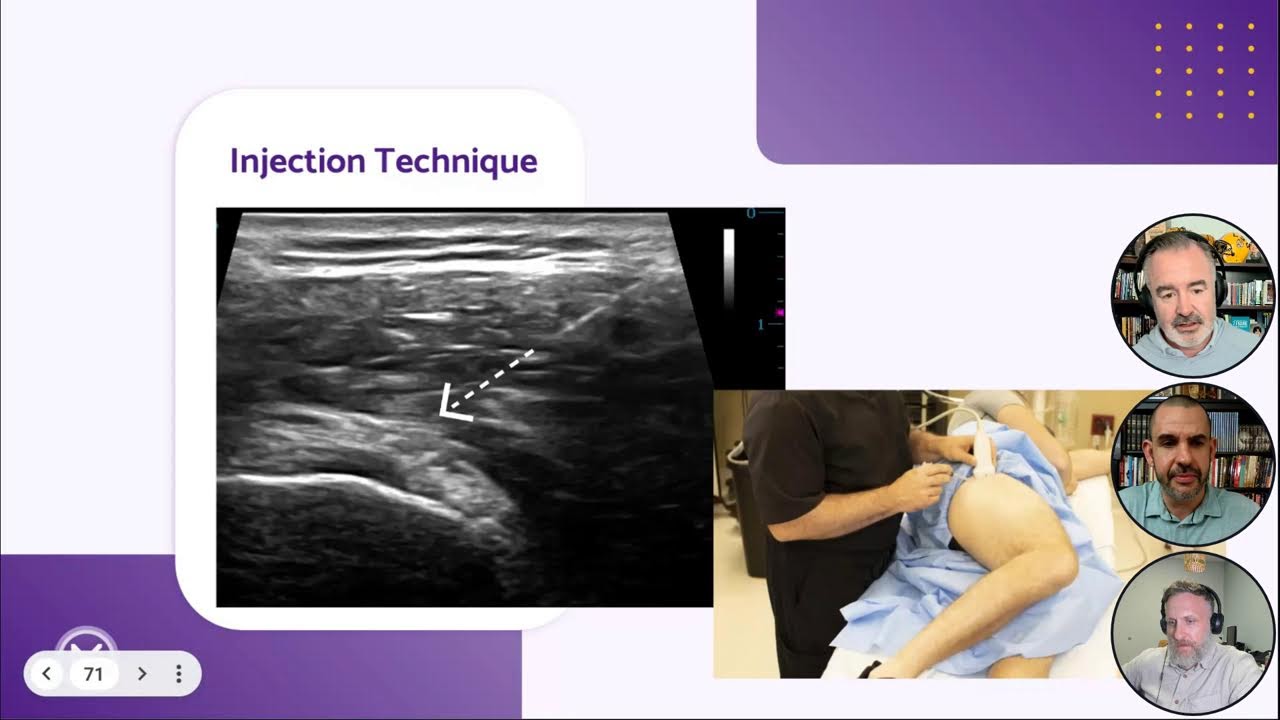
And so, you know, again, just the ultrasound is the medium for bringing this all home, okay? This is the injection technique. And so you see the patient, the way they're draped, okay? We have them positioned on their side. in the lateral recumbent position, and we're moving the needle from posterior to anterior, and you're looking in-plane with the probe. And the provider has to be, you know, good enough to locate where the structure is, where the tear is, and direct the needle towards that issue.
Yeah. Okay. So, and I wanna, you know, I'm gonna back up here for a second because I want people to understand So I'm going to put you— I'm going to put both of you on the spot. I don't know who's the right one to answer this. What do you see from your— the folks, the doctors that you work with when they're doing this process? What are they able to— what are they charging for these type of injections? I know a lot of people charge $650 or $750. Are they charging more than that? If so, are they charging more than that? Like, what kind of fees are you now seeing your doctors getting? Over the last couple of months?
$1,500 to $1,900.
Yeah, so $1,500 to $1,900, and that's just for a single PRP. If they're doing, uh, BMAC or adipose, what do you see them getting with something like that?
You're up into the $4,000.
More from Neo








OUT OF THE SYSTEM | How 100,000 Free Doctors Could Save Healthcare $40 Trillion