How AI Will Build a $300 Billion Healthcare Revolution ft. Max Marchione
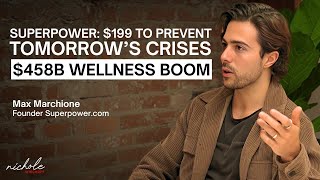
Max Marchione built Superpower, an AI-powered preventative health platform charging $199 annually for in-home blood tests, medical data integration, and personalized treatment plans. The company hit 100% month-over-month growth after removing its waitlist and raised $30 million to reshape what Marchione sees as a $300 billion market currently dominated by sick-care insurance models.
Chapters
100 million Americans are pre-diabetic.
Diabetes is a growing epidemic in the United States, affecting more than 29 million people in our country.
Testosterone is chronically low for men. Progesterone is often low for women. Thyroid hormones are often out for women as well, right? And heart disease is the number one killer in the US. I had a host of health problems, many of them just culminating in not being able to sleep. Had surgery, was told to medicate for life. No one knew what was wrong. It made me realize that there are genius doctors out there and they practice a model of medicine that is really advanced. Why Americans are —paying dramatically different prices for the same medical procedures. The problem is that that model of healthcare typically costs around $100,000. So I've been really obsessed with how do you take that kind of healthcare and make that accessible to everyone. I didn't think it was possible until November 2022 and ChatGPT came out and started to show us that AI actually would provide a path to replicating and surpassing human cognition. And the AI is far better than our team of doctors taking several hours.
Max, thank you so much for joining me in the studio today. I am so excited to hear about your company. Um, we have some mutual friends, I guess folks on your cap table. I think I missed you in 2022. Um, but you started Zero Power back in 2022 with two co-founders, and I believe all of you had some sort of health crisis at a certain point that led to starting this business. So I candidly need to sign up for it and get moving because I did all my research today. I was like, I need this. But give us sort of the founding story. Like, where did this all begin back in 2022?
Yeah, for the past decade or so, I've been really obsessed with this idea of how do we bring high-end healthcare to everyone. And I remember when I was 15 years old, I even emailed Peter Attia saying to him, 'Can I work for you?' And when I was 15, no one knew who Peter was, right? He was some like esoteric internet personality. But I think the, the real catalyst for me to become interested in health was going through a challenging personal health experience. Basically, from age, call it 10 to around 18, I had a host of health problems, many of them just culminating in not being able to sleep. So it would take me around 3 hours to get to sleep every single night. I would sleep through half of my high school classes. I used to play semi-professional or sprint like semi-professionally, play competitive soccer. I'd be asleep literally like 15 minutes before a sprinting race in the corner of a tent, right? And I had chronic migraines, chronic sinusitis. I saw over a dozen doctors, had surgery, was told to medicate for life. No one knew what was wrong. And when that happens, you start to become a health geek, right? I tried and tested everything. I remember wearing this big fat Gen 1 Oura ring, taping my mouth when Mouth taping was not a thing and everyone thought I was kind of psychopathic, right? Now everyone's starting to do this stuff. 10 years ago, not really. And I ended up solving my health problem by finding someone I call a 10x doctor. And it made me realize that there are genius doctors out there and they practice a model of medicine that is really advanced compared to what most people have access to. The problem is that that model of healthcare typically costs around $100,000. So I've been really obsessed with how do you take that kind of healthcare and make that accessible to everyone. And that was the, the, I guess, initial idea. And I didn't think it was possible until November 2022 and ChatGPT came out and started to show us that AI actually would provide a path to, to replicating and surpassing human cognition. Mm-hmm. And I think the only way we actually create a health system that pushes the world forward is we move to a world where AI is delivering care rather than humans.
Yeah, so you and your co-founders, like, how did you meet them? And then were they all kind of on their own journey as well that led you guys to doing this?
Yeah, I was, I was living in London for a short period and I hosted some tech event there. And one of the guys I met at the event is like, you have to meet my friend. And this is what— and he puts me in touch with one of my co-founders today. And he says, you're the two most health-obsessed people I know. So I met Jacob, one of my co-founders, and we just bonded over health trauma and just shared philosophy over where the world is going. And the really interesting thing is Jacob and I both knew that we were obsessed with the space and wanted to start a company. We started separate companies in the space. And then a couple of months in, we're being a little coy to each other. So here's kind of what I'm working on. And we're like, fuck it, we're gonna join forces. So we teamed up and then I met Kevin, our third co-founder, through Jacob. That's awesome.
And did all of you have operating experience prior at some tech company?
I didn't. I moved to the US when I was 22 years old. I didn't really know what I was doing. And I'd started a handful of things. I've probably started 10 small businesses before that. 2 were doing reasonably well. My brother's the CEO of one and my friend runs another, but I knew, not that much about tech. I'd spent a bit of time in VC around my own fund, but I still didn't know much about tech. And I knew no one in the US. This was the first time I'd been to the US. So I guess at the time I thought I knew more than I did and I was like naively optimistic. And then I look back in retrospect and I'm like, holy shit, 22-year-old me knew nothing. Kevin and Jacob had a bit more experience. Jacob had started 2 companies. Kevin had gone through Y Combinator. Kev in 2018 or '19 went through YC and he wanted to create AGI. And he said to Y Combinator, well, I want to do this. And they're like, no, AGI is impossible. Build enterprise SaaS instead. So he built enterprise SaaS. He couldn't sell said enterprise SaaS. So he exited the company for a small amount. Okay. That's amazing.
So it's 2022. You're starting this company. You want to solve these challenges for consumers. Let's fast forward to maybe what the product does now. Was the idea when you started to do blood tests but run many more labs and do like, you know, 100 different types of tests versus now I feel like, correct me, but you go to a doctor, you say you feel iffy and they'll run some tests and maybe you get your iron results back. You say, hey, I'm super tired and they check for iron. But right now what you guys do is largely try to get a really full picture of how, like, just through blood work. Is that correct? You do that annually and then you can create this kind of holistic profile on a consumer. Where it seems like table stakes to do that, but you really don't get that if you go to the doctor. They try to narrow it in and say, well, let's start here and run a few tests, and then let's start there, and no solution.
Yeah, well, the initial idea was how do we create a new healthcare system, right? And then the belief was that if we're creating a new healthcare system, it should sit in front of the existing system, and it should help people be their best selves, right? It should help people— we— our belief is that health is how you feel, health is energy levels, health is sleep, Health is how you look, health is being happy, that is what health should be. And the challenge I had was that health, the healthcare system was not helping us do any of those things, right? If you go to your doctor and say, I want more energy, I wanna look younger, I want to prevent a heart attack in 20 years from now, they're like, I don't deal with that, I just do sick care. So that was the initial belief and then the question is, how do we actually make that come to life? And the way we make it come to life today is we have an annual membership that's $199 a year. And at that price point, we try to create a protocol that tells someone, here's exactly what you should do. And the first part of that journey is testing someone's whole body. So we'll send a nurse to your home and they'll collect over 100+ blood biomarkers. And that's around 5 times more than an annual physical. Think hormones, gut health, inflammation, Liver health, different toxins, all of that will be in the blood test. Mm-hmm. We'll pull all of someone's past data in as well. Really important cuz when AI delivers care, it needs context. And that's the starting point. The reason we do that is so that we can connect the dots across all of this data to build this protocol for someone. And when we started, our protocols took a team of doctors around 3, 4 hours to create. Now the AI does it and the AI is far better than our team of doctors taking several hours. And we recently put a survey out to our members and we said, how does this protocol compare to your primary care doctor? And 93% said it's far better or life-changing, which is crazy, right? Um, so, so we'll give someone the protocol and then the goal is saying— and then the protocol will bear in mind someone's preferences, budget, the areas and goals they have, what they want to achieve. And we'll give someone that protocol and then rather than saying go off, do it yourself. We'll say, let's make it really, really, really easy to take action. And we'll say, here's exactly what you need. You can get it all as a Superpower membership. Anything someone buys as a Superpower member is 20% cheaper than it is elsewhere. GLP-1 is 20% cheaper, supplements 20% cheaper, hormones 20% cheaper, gut microbiome testing cheaper.
So if someone, let's say they have super high cholesterol, yeah, the first time they're finding out, maybe they've never really had blood work in 5 years, is that something that you say, here's the solution, and then they get a 20% discount. Could that be connecting them with another doctor maybe in your network? Do you, do you have folks that are sort of in-house, or is everything a partnership?
Uh, we don't refer out today. Um, right now we do it in-house. Now there's some things we won't do, right? Like let's say someone has a chronic disease, we'll say the healthcare system is pretty good at handling that, we'll leave that to the healthcare system. If someone has problems today that could result in something downstream, that's when we'll kind of step in and do stuff. Yeah. So anyway, that all comes together. Annual membership, $199 a year, all testing, all data protocol, and then the action layer as well.
That's super interesting. So are you finding like, are there any commonalities between like, I don't know, maybe people's age group and then the most common things that get flagged that you find that you're working on? Like, I'm assuming just even more broadly that even fit people like I've tried GLP-1s like off market just to see like how they operate. Like, it was hard for me to believe that you just don't have cravings. So is it sort of tied to maybe trends in what's going on in the world right now? Or are you noticing that a lot of folks hit a certain age and here are the 3 big things that usually get flagged that you know that you can help with?
Yeah, there are probably around 3 things we always see that are out of balance. One is metabolism. So a lot of our members are pre-diabetic. 100 million Americans are pre-diabetic and 80% don't know it, which is crazy, right? Because that results in so many diseases downstream.
Is that your A1C or?
A1C, fasting insulin, fasting glucose. Okay. So you're testing for all of those things? Yeah, yeah. There's a couple of other markers as well we'll test for as well. The second thing we see often is hormones out of balance, particularly amongst men and women between the age of 35 and 50. Testosterone is chronically low for men. Progesterone is often low for women. Thyroid hormones are often out for women as well. And we have so many stories of customers who come to us. They're like, I'm feeling low energy. I don't feel like myself. I'm putting on a lot of weight. I have a lot of brain fog. We solve hormones and they've changed their lives. So that's probably the second thing we see. And then the third thing that is really common is, honestly, there's a lot of other things that are common, but is seeing ApoB and Lp(a) being elevated. So these are two lipids, lipoproteins, that give us a really good sense of your risk of cardiovascular disease, right? And heart disease is the number one killer in the US. And if you go to just your average doctor, they'll just test cholesterol. And cholesterol doesn't actually give you much of a sense of your heart disease risk. We'll test ApoB and Lp(a), and when we see they're high, we can start educating someone on the actions they can take today. That's super interesting.
I also saw that you do, you're not trying to do everything, like create, you know, the Oura Ring as well, or maybe you are in the future. But like there's CGMs, I have one on my arm right now, you know, like, are you ultimately trying to get folks to just integrate with that other data so that it can layer onto their profile and then create something more holistic? So like if I am tracking my blood sugar every single day, you can leverage that or any of those or my activity all day long?
Yeah, so we integrate wearables, we integrate a CGM. We don't visualize the data yet, but the AI and our medical team has access to it. Okay. And that's really cool because one of the things we try to do over the course of the year is just like reach out to people and check in. And now that we have wearable data, we can do things like saying, "We saw your heart rate was up and your heart rate variability was down, your body temperature was up. You might be getting sick. Do you want an immune stack?" And then we work with the best doctors around the world to say, "This is the immune stack we think is the best." And our concierge, this is just via text message, our concierge will say, "Do you want us to buy it for you? Do you want us to ship it to you? Here's the cost. Here's what it would cost on Amazon. Here's how it's 20% cheaper with Superpower." Do you want it? And that is like an amazing experience to just like have someone watching out for you on your shoulder, giving you everything you need.
Yeah. So walk me through, so you started, when did you officially launch? How long did it take to get something in market that you guys were maybe either in beta with first or converted to live?
Yeah, we launched mid last year and that was the announcement and we'll see, we sell it a waitlist and we kept that waitlist for around a year. We built it to around 200,000 people and we slowly let people off. And the reason for the waitlist was really that we wanted the product to be in a really good place first. In August this year, we removed the waitlist altogether. And since then we've basically been growing at 100% month on month. Wow. And we don't seem to be slowing, which is a good thing. So, and I think that the fundamental bet we made, which was different to others in the space, was let's just start by building the best product possible. And once we're genuinely happy with the product and we want all of our friends and family to be on it, then let's release it. And that's what we did. And I think it's really interesting. We'll see other companies come into the space. Like there'll be a company doing blood testing. Who is that?
I met with Nucleus. Yeah, yeah. But that seems like something that you could pair with, just Know Their Genetics to create like, just like a wearable that creates a more holistic profile.
Yeah, I agree. We wanna integrate all of this data. It's interesting when we see other companies do blood testing as well, right? Because the thing you'd expect is that to be harmful. Example for superpower. Basically what we see is anytime a new company enters the space, our growth speeds up. And the reason why is more people get educated and we have the best product, so we end up capturing them.
Through your go-to-market, like, how do people find out about you?
Yeah, so today 30% is word of mouth, around 20 to 25% is Meta ads, okay, around 15% is Google Ads. And then we have a long tail of other strategies. Now the catch is to actually have Meta ads working, Google ads work, and word of mouth work requires certain foundations to be in place. And the foundations we kind of think of are how do we create a viral brand? How do we stand for something? How do we actually let people know who we are? And one of the things we do a little bit of is like these viral marketing drops. So last year, for example, we launched what was called the World's Healthiest Hoodie. It's like a superpower hoodie. We said, "Most clothing is harming your health. It's made from polyester and synthetic fabrics. Enter the world's healthiest hoodie, fully organic cotton, algae-based screen printing." I did not see this. Yeah, yeah. It blew up, like sold out in 5 minutes. People relisted it on eBay and Grailed for like $2,000. Oh my gosh. And we had thousands of people walking around with superpower plastered on their chest. And we say, oh, word of mouth, 30%. And yes, that comes down to the product, but I think it's also all of these little initiatives.
That we do. Yeah, because I was like, I mean, I haven't seen a billboard yet, but I've only been at SF for 6 weeks or so, so I don't know if I missed it. But it seems like, I mean, it's never been harder in terms of competing for eyeballs, but it's also never been easier. So I'd say like, and Meta seems to work great. Walk me through just what does it take? Because clearly that the barrier to entry to building something like this is far higher than building just pure software business. Business for anybody. So, the last couple of years, you're clearly building, trying to build an amazing product experience. What takes so long, right? Because it's a good thing, like, from a defensibility perspective, but is it largely, is it the regulatory hurdles because it's consumer and it's healthcare-related? Are you working with insurance companies and this takes a while? Like, kind of walk me through, like, what are the hard parts to getting this thing launched?
Yeah, way more than I expected. So, So I guess to start, Superpower is two entities. Okay. We have the corporate, which VCs invest into, and then we have a medical group, which is required to actually deliver care. Oh, interesting. Right? And that's called a PC or a professional corporation. Okay. A lot of companies in the space will like rent their PC. We don't do that because it hamstrings your ability to deliver care in an opinionated way. So you need to set those two things up. The PC has to be licensed to practice medicine in every state. Every time you hire a practitioner, you need to look at, where are their state licenses? You might have to get them new ones, et cetera. And then if we actually look at the product, we have full-stack diagnostic testing, toxins, gut, blood. There are some companies just doing one of those things. Mm-hmm. We have full-stack data integration and aggregation. There are some companies just trying to bring your data into one place. We do this as a feature. We integrate with the EMRs, we integrate with the health information exchanges, we integrate with wearables to get all of your data in one place. We have full-stack therapeutics. So Hims, they're like pharmaceutical business we have within our business. And again, we'll say it's 20% cheaper than Hims for members. So we have to build that out. That's a supply chain problem. It's a software problem. It's a clinical and regulatory problem. We have full-stack supplements in-house as well. We have a SMS kind of concierge and that is a human team and an AI and that takes a lot of effort and work. And then we have our models that we're building in-house in-house. So right now we primarily use the large models. We're building a couple of small models as well. And it's non-trivial to make AI excellent at medicine. The bar for us is it has to be materially better than ChatGPT. Like we know we've got a good model if we, our whole team goes to it instead of going to ChatGPT. And when you hear all of this, it's a lot of businesses in one. So it's non-trivial. I think at the start it was, we did too much and we moved too slow as a result. I think now we're pretty good at getting a lot done. Yeah.
No, it's so interesting. So, if you're looking— if we look at the landscape right now, obviously, private care is just far better and more concierge. So, you've got folks like we mentioned, the blood testing and kind of more like just genetics, which is like a nucleus. We've got your pure consumer play, which is like your everyday health and like, let's get you better and let's learn a lot more about you. Um, there's the Solace Health, which I'm actually a member of here, which is great, but more like 24/7 ER care. But you can kind of concierge get in and get out, and like, it's amazing. It's like a Soho House for healthcare. Um, that is obviously at a premium, right? Things are— I think you probably have the least expensive offering, but Nucleus is $400 to $500, which is really expensive for the average person just to get like a swab done. Um, Solace is $3,000 to $4,000 a year. So it's still, and I'd say like the Prenuvo body scan, um, is really expensive. So it seems like things are trending in the right direction. Part of me doesn't know because I haven't looked at the data. Do I live in a bubble because I'm in the tech world and I want to try all this stuff and therefore no one else in the world is or can afford it? But I guess this is a longer way of saying, let's say 5 or 10 years from now, do we think these things get less expensive, more accessible, and just improve so many people's lives that everyone is going private or like what's the future of care in your opinion?
So I think we end up having two systems. I think we have a sick care insurance pay system. Think hospital care, think surgeries, think procedures. The systems are really good at parts of that today, right? Like we can take an artery from your leg, attach it to your heart, rouse around another artery that's clogged and prevent heart attacks. Like that is crazy, right? That's crazy. And that's the healthcare system as it is today. And that's great when you're sick. I think at the same time we're gonna have a second system and the second system will be for everything before you're sick, right? Which is where the healthcare system does a horrible job today. And I think the second system is gonna be primarily consumer pays, cash pay, because the benefits they are getting make it a, a no-brainer way to spend money. Right? Uh, and we're starting to see this already. I think in many respects, Hims is a harbinger of this trend. Mm-hmm. Consumers willing to pay for healthcare that enhances biology, and we're just getting started. Now, I think part of what's powerful about this consumer part of healthcare is that the second you move away from the health insurer or the payer, you can start to innovate. The problem with taking health insurance is health insurance pays for consults. So all of a sudden you don't get paid if you wanna use AI and technology. Well, guess what? All the companies that bill health insurance don't have any incentive to build AI and technology. That's kind of problematic. The other problem that happens when you stick with the existing system is there are so many intermediary bodies, right? And if you look at a drug with insurance and as an employee in an organization, you're gonna go through 20 different parties and it might cost $1,000. The physics cost of producing that drug is around $10. Right? Nowhere in the world do we have like a 100x delta between the cost mandated by physics and the one that actually exists. And if you want to play with the existing system, you cannot avoid that because of incentives and regulatory capture and you name it. If you want to create a new system, you can actually start to change that because you can say the fundamental cost should be the one mandated by physics. So then we have two systems. One's good for sick care, insurance pays. One gives people what they actually want, keeps them healthy, makes them feel absolutely amazing, helps them achieve their health goals. It's cash pay, but it's actually really cheap because you're just obsessing about the cost of physics.
Yeah, yeah. No, that's super interesting. Yeah, I hope it all works out this way. Going back a tiny bit, so you raised a seed round of capital in 2022 from Sousa Ventures. Chad's awesome. What was it like fundraising for this when you— and did you raise your A pre-launch as well from Forerunner? So have you just been like really— like VCs are really just betting on the future and hoping that this is right? Like, what was that process like? Was it hard raising money initially?
Yeah. Yes and no. No, in the sense that we knew a lot of investors. I ran a small fund previously. One of my co-founders ran a small fund previously. And I think if you know people and you're working on something that has the opportunity to be really big, the seed round doesn't tend to be super hard. Now, I think one of the learnings there for people is that if you're working on anything, make sure it can be really big, right? Like be able to articulate why this can be a $100 billion company. Investors get more interested if you do that. It's probably a more important problem. You can attract a team, et cetera. The A was still basically pre-revenue. We raised around $30 million in the A, and that was Forerunner saying, this category has the opportunity to be one of the biggest of all time. We've met with every company in the category, and we think you guys have the best approach, product, and team. Therefore, we're willing to make a bet ahead of traction. Uh, the B, we need metrics, right? So that's part of why we don't have the waitlist. It's part of why we're trying to grow more or less as quickly as we can, um, because numbers will matter a little bit more now. Yeah.
If a potential customer is listening right now, what do they absolutely need to know about what they can get from you if they sign up right now?
Uh, the main reason people sign up is the blood test. Yep. Uh, if you want to get it at a hospital, it's going to cost you $2,000. Right, with a competitor might cost $700. We'll do it for $199. So that's a good starting point. I genuinely think everyone should do this test because you see things about your health you didn't realize and it changes your life, right? 93% of our members said it's life-changing or better than their doctor. That's the starting point and the first thing they can get. And then there's like so, so much more.
Yeah, that's amazing. And then in terms of, so Right now, obviously just hitting the ground running on go-to-market, building out the team. You're based here in San Francisco and now you have a new office as of a couple months ago. Any key hires you're looking for right now in case someone's listening and says like, I need to be a part of this mission?
Our philosophy is we want to hire brilliant people, full stop. And we always say, most of the time we say we're not hiring. And if we find someone who's genuinely brilliant, we will hire them. For example, we weren't really hiring more engineers and we came across a former TL Fellow. He raised $70 million when he was 19 years old. He writes the coding libraries our engineers use. Absolutely brilliant, health obsessed, and we're like, well, I know we're not hiring, but this guy's brilliant. Oh. So our general philosophy is keep the bar insanely, insanely high. Constantly be meeting people. It's typically very easy to be like, you're great, but you're not insanely great, so you don't meet the bar. And if someone's insanely great, we wanna work with them. Now the catch is the way we define insanely great is not that they have done a ton of things. The way we define insanely great is that we believe someone is going to do a ton of things. And some of the best hires we made joined us when they were 18, 19 years old. Now they may be like 20, 21 years old. And these are the kind of people who in their next life will create a $10 million company. Yeah. You can't hire that person when they're 30 or 35. Do you—
I know that the healthcare landscape is drastically different in other countries. Like, I'm assuming you could build huge businesses in the US alone, so is the plan to ever leave the United States or just stay here?
Uh, well, I guess like to put it into perspective, um, we have a membership that we want most people to own, $199, and then we have the ecosystem where you can buy health stuff. Mm-hmm. If we have 10% of Americans in the membership, which is the bottom of our ambition, right? And they're spending 10% of their health dollars in the ecosystem. 10% of 10% is $200 billion. That's how big we are. And it's like, whoa, hold up. We can get 1% and be a $200 billion company just in the US. Maybe we should just start with the US. So our view is do that first. Once we have done that, then we earn the right to start expanding.
It's fantastic. Max, thank you so much for joining me. Super interesting. And I've got to get signed up.
Yeah, fun chat. Thanks, Nicole, for having me.