EM Group Chat #127: Building Codi As A Marketplace For Flexible Office Spaces With Christelle Rohaut
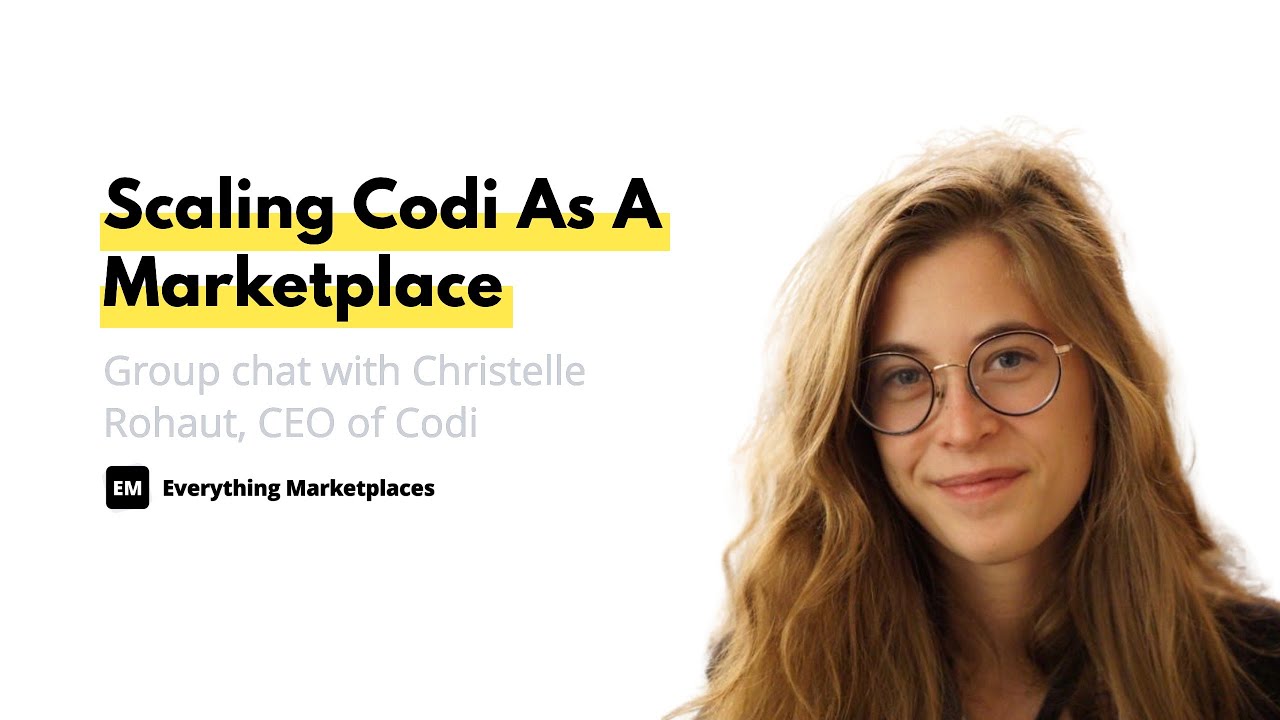
Christelle Rohaut, CEO of Codi, built a marketplace for flexible office spaces by pivoting from residential coworking to managed commercial offices. She raised $60 million from Andreessen Horowitz and focused on hyperlocal expansion in San Francisco, New York, Toronto, and Seattle, hiring operators from WeWork and Airbnb to scale the physical-space marketplace.
Chapters
So welcome back to Everything Marketplaces, where we talk with the founders and leaders from some of today's top marketplaces. So this is episode 127, which is a really great group chat that we just had with Christelle Rohat, who's the CEO of Codi. So Codi is a marketplace that allows companies to access private office spaces on more flexible lease terms. It's an earlier stage marketplace, but one that's fast growing. And they also recently announced their $60 million Series A round, which is led by Andreessen Horowitz. So this is a really great chat with Christelle where we got to learn more about the founding story of Codi, Did a deep dive into it as a marketplace that's helping reshape the future of work, the recent growth fundraising journey, and also had a really great group Q&A. So really enjoyed this conversation. You know, you're going to find it a great watch to the end. So Christelle, welcome to the group chat. You know, I've been following what you're building with Cody for a while now, so I'm really excited to have you join us here today. Would like to start off by saying, you know, huge thanks for taking the time to do so in advance. You know, before we jump into what you're building with Cody and more about it as a marketplace, I think it might be great if you can start off by sharing a little bit more on your background, though, for those that don't know you.
Hi, everybody. Pleasure to be here. Yeah, my background. So I'm French. You probably noticed my accent already. I'm an urban planner and environmental engineer by training. I've always been obsessed with building better cities, neighborhoods where it's a better place to work and live in. And that got me into building Cody over 4 years ago.
So what was the, you know, what was the initial kind of founding insight and founding story behind Cody?
Yeah, I started to work on Cody after I moved to the US for that master's program in city planning, and I think I got a cultural shock. And I found it like, you know, hard to like commute and go to work and like access the spaces that I needed to access, but at the same time We are surrounded with unutilized spaces. And so studying urban planning and living through those challenges, like, made me realize, like, I wanted to do something about it. And it was directly connected to what I believe are big urban challenges, like commute times, carbon emissions, utilization of space, and I wanted to make that more, more efficient.
So with that kind of insight and understanding, you know, the, the problem and challenges that, you know, a lot of people are facing, you know, what were the first steps that you actually took to starting Cody?
I was still at school. So what I did initially was took like the academic route of, I became a fellow at the Ellen MacArthur Foundation on circular economies, and I was trying to apply like the concept of circular economies on urban built environments. And that really actually got me into the co-DEE model of like, you know, kind of turning an unutilized space into a workspace. And initially we were using homes, we're turning homes into kind of a workspace during the day throughout the city. But before then it was very much like kind of academic, like more of a research project, but Berkeley is very entrepreneurial, so like I was pushed towards like getting more taking more classes with entrepreneurs. And I did that. And then so I bootstrapped the company before graduating and from that decided to like just do it.
That's really great. So I did wanna kind of go back to the early stages a little bit more, but I guess it'd be helpful. Can you give us kind of an overview maybe of Codia today as a marketplace and then we can kind of, you know, wind back a little bit more for some context?
Yeah, for sure. So Codia offers exclusively like private turnkey office space. with the most flexible terms on the market. So our platform is made so that it makes it very easy to find and manage physical workspace, just as easy as like any outsourced part of a company's tech stack. Like companies historically have outsourced payroll to Gusto, payments to Stripe, data centers to AWS. Now it's time that they outsource as well like the physical space. And we want to be that partner for those companies. So from a marketplace standpoint, we are a managed marketplace. So once the company is matched with a space that offers flexible terms, then our concierge-style services come into play, and we handle the end-to-end office management experience.
Now we're getting into the, to the fun marketplace topics of the managed marketplaces. So I guess to, you know, go back to the earlier days, did you start out as a managed marketplace or?
No, initially we had hosts who were just like running their own homes, right? So we were helping them kind of turn their homes into kind of a workspace, a coworking space during the day. But our marketplace evolved quite a bit over the past 3, 4 years. And then as we changed our supply from residential to commercial, commercial, you don't have hosts. Like we had to kind of control the space and create that experience ourselves. And so we took over kind of like the management piece of the space and setting up the space. So from an operations standpoint, it's a lot heavier than it used to be. But at the same time, that's where we got product-market fit. Like the companies wanted that privacy and like having something easy plug and play. And at the same time, like that consistent, you know, good experience when you walk in the space, you know, it's a cozy space. It's always kind of— Consistent.
Yeah, certainly. Yeah, I believe I was doing a little bit of research, and I believe you guys were referred to as kind of the Airbnb kind of meets WeWork, you know, in the earlier stages. So could you maybe walk us through, though, like what that kind of like insights or learnings were that kind of led to, you know, moving from more of like the peer-to-peer to more kind of, I would say, I guess, is it in commercial spaces or?
Yeah, these are commercial spaces. I mean, the thesis is still the same on, we have plenty of empty spaces across the city. Can we turn them into a flexible office hub that aligns with how companies work today? That means like hybrid work, flexible work, something turnkey. You don't want to hire like a full-time office manager. You don't want to commute downtown. So all these values to the customers remain the same. But we realized like with COVID like it was a massive impact on our company in the sense of, well, people know like now work from home a lot more. So our supply size shrunk quite a bit. And then there was fear of having the virus for a little while. And as we got into B2B, like serving companies, like they had a better experience with our commercial space. And so that triggered our shift towards more commercial, more like managed space directly by us.
How did you think through that at the time? Like what were all the considerations, you know, from a business side, just thinking about, you know, the potential kind of pivot in the B2B?
I think the key metric was vacancy rate. When you look at real estate, 2019 and 2022 looks nothing alike. In 2019, during the day, residential spaces were sitting empty, commercial spaces were pretty, full, and 2, 3 years later it's completely the opposite. Residential spaces are pretty full during the day, like there's at least one person working from home, and commercial spaces have never seen that high of a vacancy rate. And that's across neighborhoods. Like, it's— of course downtown is heavily impacted, but you always had these little shops and, you know, office spaces across neighborhoods that were vacant on a, on a regular base because of turnover. Like, the, the small business would fail, then after 1 year or 2, and then a new business would come in at some point. So, um, but I think now that we are into that hybrid work moment, uh, which is not going away, um, it's, it's time to kind of really reinvent commercial real estate and break that old school dilemma of the 5-year lease. And so, yeah, so initially that got us into commercial space, and then I learned a ton about what commercial real estate is all about, and hopefully we're doing a much better job than the traditional world.
Yeah, and I can only imagine that was a kind of crash course into learning about the commercial markets. So that's on the kind of the supply side, but from the demand side, so we've seen quite the shift, I would say, with remote work. and kind of reorgs too lately. So how has that kind of impacted Codie and, you know, what are some of the kind of considerations from that?
I think it's always been super exciting because we've always served like remote-first companies or hybrid-first companies who wanted to have a more flexible and decentralized model. So that, that helped us. Short term, it was difficult because of COVID so shutting down locations and things like that. But longer term, I think it was just a jump in the future of like 5, 10 years. And it's very exciting to be in commercial real estate right now because there's a lot to do. And we can be very creative and innovative because the people's behavior and company behavior keeps evolving. And so we're trying to stay very tuned with that. For instance, we launched a time trial office model so that Company A can have a space Monday, Tuesday, and Company B can have a space Wednesday to Friday, right? Like the other days. And so that's kind of like a co-tenancy model that never existed before, but I think that's actually going to be the future. And so we can be very creative into like, what are the use cases that actually fit that new demand?
Yeah, that's, that's really interesting. So, you know, I'm interested to learn more about, are you, are you, is the end user going to be, you know, an individual employee, or are you marketing more towards and acquiring kind of a company? know, from the organization level?
We're B2B, so we acquire companies.
Yeah, yeah. And then how individualized are their needs? Is it, is it like, you know, Company A could be, you know, drastically different than Company B? Or is there some kind of standardization that you're kind of seeing and kind of building that into the experience?
It's all about the space, right? So we deliver always the same experience regardless of the space, you know, you're gonna have, you know, once a week cleaning and the coffee and tea and like maybe your logo on the door, and then the standard Kudi furniture. So it's plug and play and you don't have to worry about anything. If you're sharing a space with another company on different days, then there's just like storage available for people to like share that space. From a marketplace standpoint, like it is tricky and it is, it has to be kind of a tech innovation of like matching companies and then matching them with space. Because if you match one company with a space but there's no other match, then it doesn't work because the landlord has to be paid a certain amount, right? So there's a lot of really cool innovation happening there to like make sure that we can match as much, as many companies as possible together and then with the right space.
Yeah, matching's always, it's always a fun topic to chat through as marketplaces here. So yeah, so I guess on the note of too, you mentioned, you know, the Codia experience and I know a lot of marketplaces that are a little bit more managed kind of focus on that and, you know, making this kind of like a magical experience. So could you kind of describe, you know, what that Codia experience is like?
Well, my background kind of tells you a little bit about this, but yeah, so it's, we, the experience, like first, like the number one value is flexibility, but you know, you're gonna commit to a space for like 6 months, maybe a year, and then be able to like flex up or down within our network. So that's the first like big value of you know, the Cody experience is like the flexibility and knowing that you have a growth partner that got you like that. No startups, we start up and we know like you can't know 3 years in advance where you're gonna be and how much space you need. So we're here to kind of help them flex up or down and stay within the same network of spaces. The second one is, I think, well, the in-person experience, it's very simple. There's is, you know, nothing crazy. It's literally just like good basic furniture. We have a workplace design team that like worked to like make it inspiring and comfortable and cozy and warm. And at the same time, like it's not a row of desks. Like people now, they want to collaborate more. So you have like a lounge area that is more prominent than it used to be probably a couple of years ago and things like that. But Nothing crazy. I think what the value really kicks in is that you outsource the office piece. Like, we want them to think as little as possible on, oh, I'm running out of coffee, and all these little things that just detract you from building your business. And then help them build their actual culture. So, you know, having your first space is a really cool milestone in a company's lifetime, and it really helps kind of like grow your culture and We try to be like thought partners to them for that. And yeah, and then I think managed marketplace always like emphasize the brand. The brand is very important. Ultimately, like you want to be seen as a partner, but also like have a delightful brand that really aligns with your values. And so I think we're known for being like super friendly. and available, you know, and fast. And so I want to maintain that brand as we scale.
Yeah, certainly. And then on the note of scale, so, you know, how many markets do you operate in?
We decided to remain pretty focused on the SF Bay Area and New York City. These are really big markets, especially New York City, it's the number one office market. So first, gaining density in those markets is more important than Spreading too fast. We do allow our clients to expand with us. So if they are committed to expansion with Cody, then we can open a space for them wherever. So we did that in Toronto, we did that in Seattle, we're doing that right now in LA. We did that in Austin as well. But that's, that's been our strategy so far.
Yeah, that's actually very interesting. So I'm assuming you're, as far as on the client side, you know, the demand could actually kind of help you lead with the expansion, then I guess, in new markets.
We are kind of a hyperlocal marketplace. You need the demand and the supply to be in the same spot, right? Otherwise it doesn't work. So density really helps because unit economics get a lot better over time when you get density, word of mouth, referrals, and it gets a lot easier to acquire supply and to acquire demand basically. And then expansion with our clients makes it completely de-risked. We know they committed. It's not kind of like launching a new market without knowing if you have the supply and demand, which is a lot harder.
Yeah, certainly. The chicken and the egg or the cold start problem always comes up, you know, not only in the initial stages, but also with, you know, a new market launch and expansion here. So glad we kind of touched on that a little bit. But, you know, you did mention as far as being like a hyperlocal marketplace and also managed, right? So what are some of the maybe specific challenges with that that you've, you know, recently seen?
Probably expansion, because you always have expansion in the back of your head, right? Like, You want to make sure that you're strategically increasing density in the right market. So I think that's always something that I want to make sure we're not missing. Are we dumb not to go to Austin right now, or is it smart? So just keep questioning yourself on when is the right time to actually open another market and kind of understanding what is that threshold. that we're waiting for to then be like, okay, we're good in New York City, now let's move on. I think we are there in San Francisco. It's hard yet to define exactly how to understand when we hit that threshold that makes me say, okay, we're good in San Francisco, now it's just going by itself, we can focus on another market. I think that's the biggest challenge, is understanding that threshold.
Yeah, so to learn a little bit more about that, how have you kind of thought about that? Is it like defining some kind of liquidity or kind of fill rate, or?
Yeah, match rate is good, um, making like— but also volume. I think we— it's kind of like we're Series A company, so going from Series A to Series B is kind of a volume game. Like, can we get to like this 1 to 10 now, like a 1 to 5? Um, so I think right now the focus is like brand awareness, making sure we become part of the solution. Like when people think about space, typically they think about WeWork if they want something easy. We want them to think about Cody as well, right? And so can we be in that place at the end of the year where in New York City, whenever a company wants to get space, they think about, okay, what about WeWork? What about Cody? If we can be that conversation, I think we, we did a big step. So it's, it's a bit less quantitative than what you asked for, but I think Brand awareness is, is what we really focus on.
Yeah. So on the note of fundraising, so, you know, you got some pretty awesome investors on board, like, you know, Andreessen Horowitz, and I believe Jeff Jordan's a board member too.
That's correct.
So yeah, so could you kind of, you know, take us back to the beginning and maybe kind of walk us through what the fundraising journey has been like and, you know, maybe some of the kind of early challenges with that?
So Series A, we were kind of lucky on timing. It was right before things went south in the market. last year in Q1. So between February and March, we raised. Fundraising process, I would say, like, is I typically just like delegate everything to my team and just focus on fundraising. I consider that like the CEO job and the number one priority whenever they start like, you know, acknowledging that this is the time, okay? Then the whole team should be aware of that and the whole team should like just like run the company. so that I can focus on like pitching as many people as possible as fast as possible.
Um, the—
for the fundraising process, I also like to kind of start with, uh, not the best investors. So like, I, I did a 16D towards the end, uh, of like the, the pitching kind of cohort. Um, so I— with the investor cohort, um, and I think my first pitch like lasted around like 3 weeks. So I, I tried to like hit the top investors within the first like, um, 2 weeks to 3 weeks, um, in order of like difficulty. And, um, received like massive help from our current investors for introductions. It's always good to have a warm intro. Um, and then, um, yeah, and then the team has been amazing internally. They kept like selling, selling, selling, which was great during the friend raise because you can keep updating your graph and show that you are on that curve and you're growing fast. So I think they were super motivated and it was really good for investors to see that, to see that the company has not stopped because it's fundraising, it's actually kept growing. I think that played a big part in the fundraising.
Yeah, yeah, it's gonna certainly relate as far as fundraising being a full-time job. So you get a lot of head nods from founders here when you mentioned that. part specifically. So if we do kind of go back to the earliest stages of fundraising, seeing it was such a big opportunity, right? And early on, kind of, I would say, being the more the peer-to-peer kind of model, you know, what was that kind of initial, what were those first rounds like maybe?
Yeah, this is awful. Like fundraising, I'm sure, like is difficult for everybody mentally speaking. And I have a lot of empathy for anybody else who goes through this. But pre-seed, I think what helped us was like we proved product-market fit on the supply side, not yet on the demand side, but like there was such a strong belief in coworking at the time in 2019 that it was okay. And so that we kind of raised our pre-seed like that. Um, and, and then for the seed, so a year later We're still doing the residential model and still peer-to-peer, like some more of a coworking marketplace. That's when WeWork crashed, and Adam Neumann was hosted of WeWork and everything, and that was exactly the time I was trying to raise things. So it was super difficult. Like all the investors were like, "We're not investing in coworking," blah blah blah. And so it's it's really ideally you find the perfect. Time window, you know, to raise where your industry is really hot and trendy because it makes your life like a ton easier. Somehow I always find the worst time windows to raise, and, and the 2019 at that moment was pretty tough. Um, but we were lucky to find investors who believe in the longer-term vision of like, we, you know, we have nothing to do with WeWork. Like, we are a marketplace, we're not a— we don't take 20-year leases. Like, it was It was very like now you can see similarities, but at the time it was so different. Like it was crazy that people were shutting down their doors because of that, you know. So I think just like focusing early on really on the vision, pitching like the why you care, why you're gonna fight for this for the next decades. If you get investors to like believe in you, then I think you can you can get the first. Few rounds of funding. Series A is a different animal. Like, Series A, you need to like have the numbers also and have a bigger team than yourself, um, to, you know, to be— for investors to believe in and vouch for. Um, and I think from seed to Series A, I did a lot of mistakes, but like the, the hiring has been, I think, our biggest strength. Um, and building a really strong team of people who know what they do and they've been in a similar space, um, in the vertical that was really nailed by that company, I think Helped us also build a strong team and like, you know, do the Series A.
So on that note, as far as the team, it definitely sounds like you have an awesome team. So could you maybe share a little bit more about what the team is like and kind of like the, maybe even like the org structure a little bit?
Our VP of Growth is actually, was at WeWork for a couple of years, still leading sales. So he led sales at Twilio and he's still leading sales, I guess. But he, you know, I think WeWork was really good at selling. There was a lot of other drawbacks, but like they were really good at one thing. And so I really wanted like a leader who like learned directly that like how to like sell those companies and how to like position the product and things like that. So I was very fortunate to have our current VP of Growth to join us very early on. He was number 4 in the company. Our head of product at Lyft for a long time, he was employee number 12, I think, at Lyft, and he stayed for 7 years. So he saw the entire kind of lifecycle of a marketplace, you know, but with a physical component. Like Lyft have cars and drivers, and it's very similar to, I think, what we do, but like we have physical spaces and landlords and brokers. And so he's been amazing in like thinking through how product can Scale, something that is operationally difficult. Our head of operations now, our COO, she was at Chariot and Postmates, like heavily operationally driven companies as well. Our head of marketing was from Airbnb. Massive fan of Airbnb for the brand and the marketing. So basically, like kind of the org was composed like who to lead kind of the different departments, like were specifically chosen to, like, based on their experience and based on, like, other companies that have done what we're gonna ask them to do, like, right? Um, and then people that are entrepreneurial enough, obviously, to, like, join a company within the first, like, 10 employees.
Yeah, definitely, uh, want to touch on the team because it sounds like there's a lot of, uh, kind of moving pieces, you know, in, uh, in each market, and, uh, you know, operationally kind of intense marketplaces. So we're gonna jump into questions right here in a second, 'cause we have a few that actually wanna come on. But, you know, you have some pretty awesome experience, you know, building and scaling Codian, you know, through an interesting kind of time period here too. So do you have any tips maybe for earlier stage marketplace founders here that you might wanna share?
Honestly, I think like people talk a lot about supply and demand, what's the hardest. I would recommend to like, Pick investors who know what's your easy, what's what's the hardest part. We we keep running into investors who think supply is the hardest part, and it really is not and has never been. And so I think it's it's um it is something to keep in mind is like when you surround yourself with like your board and investors like. Make sure they fully understand like what's the hardest thing for you to scale. And if they get it wrong, like if they push you on like the wrong side of the marketplace, the side that's like actually not like what you're focusing on, I would recommend to just like choose somebody else, like go with somebody who like actually can help you solve the challenges that you're facing.
Yeah, that's really helpful. You got a few reactions too from founders here. So hey, Lakshana, do you, uh, do you want to jump on?
Sure, thanks. Uh, thanks for taking the time to talk to us. It is interesting that you talk about that supply is easier for your side. Uh, we see the same. We are a peer-to-peer carpooling platform where people are sharing the seats of their cars. So where drivers or car owners who are professionals like us going to work, they obviously have no other choice of sharing the seats. So we see that, yeah, they are more open while the demand On the demand side, we are kind of competing with, you could say, public transportation and the Ubers of the world. So definitely on our, you know, in our marketplace also we see that. When I jumped on the call, I took like a minute or 2 to look at the onboarding experience. I live in Hoboken, New Jersey, very far away from where you are. And I put like a seat, one person, Hoboken. And I'm actually very excited about the onboarding process that you have, very simple. And then I immediately got an email from Anna. with a very, you know, cool, you know, cool subject saying invite only open house. So which made me open the email while I was also, you know, normally when I'm listening to these, I don't go, but it seemed, you know, very cool to say, okay, who's sending me this open house invite? And then there is an RSVP link. And it's very interesting to see because I, I'm assuming that, you know, one of your hardest things is to get the demand to sign the first contract, and after that, the retention would be much easier because, you know, if people are happy, they would stay. And I, you know, and I was trying to get a space with Regis in Hoboken. So I've had that experience where, you know, a person was kind of going back and forth on the text while I thought this experience was great. So do you want to talk a little bit about, you know, what, what, how, how you're trying to get the demand to come and do the first interaction and, you know, do the first contract? You know, what is working for you there?
Yeah, thanks a lot. I'm impressed that you went through the onboarding process during the call. That's awesome. Thank you for doing that. For the marketplace, actually, it's a really great question because oftentimes you hear, oh, just put more supply and you're gonna get more demand. And it's just like a big map with like a lot of supply and then automatically you're gonna get more demand. That was not really true for us. us. I think it's overwhelming customers to like show them like thousands of options. So it's actually not helping them too much. So what we decided to do instead, and we heard like great companies were looking at Cody, but did not necessarily find the right space right away. And so they were churning, and we were not even collecting that data. So when we realized that, we were like, okay, like, because we can get space, There's a lot of spaces everywhere and we have a lot of partners who can just like onboard the right space if we know we have the demand. So we very much like a demand-driven marketplace, not a supply-driven marketplace. Supply is out there. And so what we decided to do is gate our marketplace. So instead of like, you know, throwing you on a map where you can see all our supply and request like a specific space, It's a form that actually asks you what you want. So we ask like the person, what are you looking for? Like when, how big, and how many days a week? What's your max budget? And then we show them like kind of a portal where we're gonna drop like just pre-created spaces that match their request. And if there's none, then we tell them we're looking for it. And that really helps respond. because now we have a lot more data first, which is very important. So we understand a lot better the prospect and we can actually kind of fulfill those requests if we don't have right away the right space.
Sorry, I'm gonna send you, if it's fine with you, the email that first came so people on the call can learn from the email, if that's fine with you.
Yeah, of course. Yeah.
On that note too, you'll probably have some founders here in the community kind of coming your way to use Cody. So that'll be cool. So we are almost out of time here, but, you know, this is a really great chat. So, you know, thanks. Thank you so much for taking the time to join us here today. This is, you know, great to learn more about, you know, your background and awesome experience building Cody and more about it as a marketplace, you know. So I did have kind of one last question for you though, before you wrap things up, which is if you could, you know, go right back to before you started Cody, you know, what would you tell yourself about marketplaces specifically?
That's a tough one. I think If I could go back in time, what I would have done differently for marketplaces. Well, I think I wasted a lot of time trying to build supply. Think what I just said, like, right? Like thinking that's what will attract the demand, but it was not really true. It's not proportional. Yes, you need a threshold, but like after such a threshold, like stop. You need to optimize for customers. And what do they want and things like that. So we wasted probably years with that model of just like just throwing supply and focusing on supply. And when the issue was never supply, it's always like, no, deliver the best experience for the customer and do something different from everybody else. Because if you go on any other kind of aggregator, like it's throwing you on a map, it's a very difficult experience, and we're supposed to be the easiest brand. So I think that's what I would tell myself is focus on the customer, on who's the hardest side, not just supply too much. Supply is a necessity, but it's not what's going to make you win. What's going to make you win is the customer. Get them to love you and to stay with you and build experience for them.
Yeah, that's a, that's a really great point. So a great way to wrap things up. And then last but not least, time for a quick plug. Where can we keep up with you and also check more out about Codi?
Yeah, codi.com, pretty straightforward. C-O-D-I. I'm on LinkedIn a lot, so you can DM me if you want. I'm happy to chat. If you're a founder, like, I love talking to founders. I'm happy to like have a follow-up one-on-one if you want to kind of bounce ideas off me or talk through your, your own marketplace, I'll be happy to do so.
Awesome. Well, thank you again. This is a really fun chat. We really appreciate, you know, taking the time to join us here today.
So.
Thank you. Thank you, everybody. Good luck.
More from Max




B2B Marketplaces In The Age Of AI With Sonia Nagar From SNAK Venture Partners | EM Group Chat #216

Insights From Investing In DoorDash With Saar Gur From CRV | EM Group Chat #215

Starting & Scaling Fora As A Leading Travel Marketplace With Evan Frank | EM Group Chat #214

Marketplace Investor Insights With Andrew Blachman From Marketplace Capital | EM Group Chat #213


Deep Dive Into ResortPass As A Leading Marketplace With Michael Wolf | EM Group Chat #211


Masterclass On Marketplaces In The Age Of AI With Fabrice Grinda From FJ Labs | EM Group Chat #209