How Thumbtack Is Leveraging AI With Vijay Raghavan | EM Group Chat #187
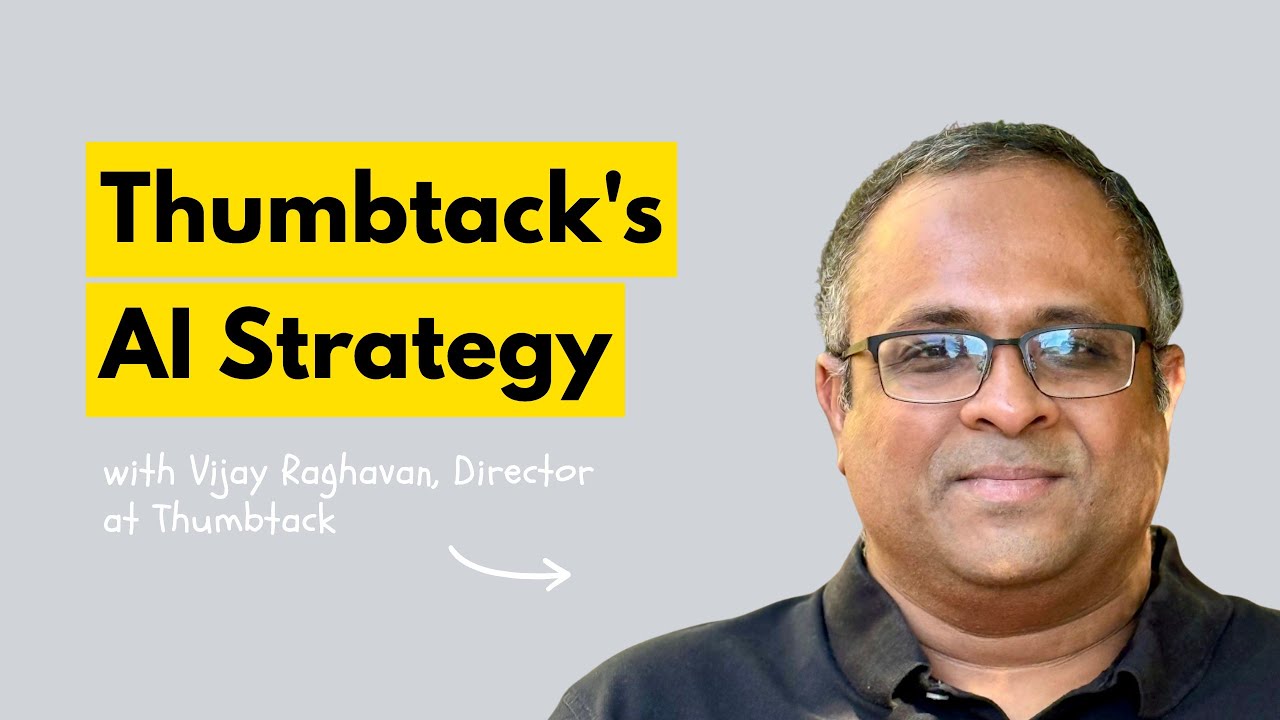
Vijay Raghavan, head of AI at Thumbtack, explains how marketplaces use generative AI for matching buyers and sellers, conversational search, and policy review. He advises founders to reduce onboarding friction with AI-generated profiles and use lightweight cloud tools like AWS to experiment fast.
Chapters
Welcome back to Everything Marketplaces, where we talk with founders and leaders from some of today's top marketplaces. So this is episode 187, which is a really great group chat that we just had with Vijay Raghavan, who's a leading mind when it comes to AI for marketplaces. Vijay is currently the Senior Director of Applied Science and Machine Learning at Thumbtack, which is one of the largest marketplaces for home services. Prior to Thumbtack, Vijay also led the AI and ML team at Chewy. So this is a great chat with Vijay where he started off by sharing his experience leading the AI and ML team at Chewy and now at Thumbtack. He'll to walk us through where we're at with AI right now, how marketplaces are uniquely positioned to leverage it. We did a deep dive into Thumbtack's GenAI strategy. Vijay shared lots of examples of how Thumbtack is leveraging AI as a marketplace, tips for founders and teams on how to approach creating an AI strategy, what the future marketplaces might look like with AI. We also had a great group Q&A. I really enjoyed this conversation. You're going to find it a great watch to the end. So Vijay, you have some really incredible experience with AI and marketplaces, which is of course something that we're all focused on today. You know, so I'm really excited to have you join us here. I wanna start off by saying huge thanks for taking the time to do so in advance. We have a lot that we're going to dive into, but I thought it'd be great if you can start off by briefly sharing your background for those here that might not know you.
Excellent. Hey, thanks for the invitation and thanks for everybody who is here. So my journey to AI is slightly an interesting one. Back when I was in grad school, mean, now this is going to reveal my age. It was quite a long time ago. The Human Genome Project was just getting wrapped up, and I was absolutely fascinated by it. In my head, I was thinking, how can we make sense of all this massive genomic data? And that is what led me to the AI path. You know what is really interesting is that the algorithms that kind of track viruses how viruses spread in the human body, they have such a big similarity, for example, on how recommender systems work in Netflix or YouTube, for example, or even your TikTok feed. The underlying principles are exactly the same. The thing about generative AI is that the theory behind it has been around there forever. And what has changed recently, when I say recently, in the last 5 to 10 years or so, is our ability to process massive amounts of data combined with the compute power we have developed over the last decade or so, especially on the GPU side of things. We have made huge strides in language understanding and multimodal systems as well that can handle text, images, video, and audio all at once. It was not possible, for example, 10 years ago that you can do all of these multimodalities in one go. But there are some challenges as well, right? Reasoning capabilities aren't quite there yet. For example, ChatGPT does not do a good job of answering questions like, you know, what is a formula for a good tariff between countries should be and things like that. It's still not there quite there yet. So the reasoning capabilities are, in my opinion, are not there yet. Energy consumption is also a real concern. These models are very, very power hungry. And there is this whole hallucination issue as well. Also, handling complex, nuanced situations can still be pretty tough. But in general, when I think about where we are with generative AI, I tell people we are not even in the first innings yet. We are still very much in the warm-up phase, and we are just scratching the surface with things like personal assistants that actually understand what you need and help boost your productivity, creative tools that are transforming how we approach marketing, design, and education, for example. And the data analysis part has come a long way. With regards to how LLMs can answer data analysis types of questions if there is a RAG system, if there is a good RAG system behind it. What gets excited— what gets me excited every morning is, at least from my perspective, what I'm seeing is we had this for the longest time, we had this AI that is kind of one size fits all. kind of approach. But now we are getting to a more specialized system where these things can learn and adapt to a specific situation, specific context, and specific industry. So it's like shifting from like a Swiss Army knife approach to much more of a precision instrument. So that's when things get really interesting.
Yeah, no, that's a really great background. And thanks for also, you know, kind of walking us through as far as getting us up to speed on where we're at today. And so, you know, when it comes to AI though, you know, how do you think marketplaces are kind of uniquely positioned to leverage it?
So, one thing, you know, the way I think about marketplaces is marketplaces are essentially massive data hubs, in my opinion. They are these incredible ecosystems where buyers and sellers interact, professionals and customers interact, basically 2 parties interacting. They tend to create a rich pattern of behavior when it comes to user preferences, transactions, and whatnot. The wealth of this data is exactly what makes them perfect candidate for AI in general. What really sets marketplaces apart is the two-sided nature. You got both the supply and demand constantly trying to find the optimal matches. And one thing that AI really excels in is this type of a matching problem. It can simultaneously understand the seller capabilities and also what the buyer needs in a way that traditional methods, your traditional statistical methods probably cannot do a great job of these things. So in my opinion, almost all types of marketplaces can leverage AI, even in highly specialized service marketplaces, for example, consulting. AI can play a huge role with discovery, pricing, and matching. And for me personally, what is fascinating is how AI can actually expand the marketplace functionality. For example, a clothing marketplace that previously just connected buyers and sellers, now you can offer AI-powered add-ons like virtual fitting rooms, style recommendations, or even like, you know, custom design services. The marketplaces isn't just facilitating transactions anymore. You're creating an entirely new value chain from my perspective, at least. I would argue that marketplaces that embrace this type of AI transformation Not just about— it's not about efficiency. It's also about fundamentally reimagining what services you can offer and how competitive you can be in that space. The most successful marketplaces will be those that view AI as just not an optimization method, but actually as an opportunity to completely rethink the value chain and also the business model and value proposition in general.
Yeah, you mentioned lots of great examples that we'll probably get into in more detail. But, you know, transitioning into Thumbtack and how you're specifically leveraging AI, that's something I wanted to spend some time on here today. And I know I also mentioned to you right before we started recording that, you know, previous posts on the Thumbtack engineering blog, you know, sharing your generative AI strategy has come up a few times in the community with founders. So I guess as a starting point, could you kind of, you know, walk us through your initial approach with AI at Thumbtack and maybe, you know, the post covering your generative AI strategy in more detail?
Sure. The article is actually, you know, whatever I tell here won't do any justice to the article. It is much more nuanced. It's a very, very good write-up written by my coworkers and then a lot of my team members as well. So I would highly encourage you to go and read it. And in general, the Thumbtack blog engineering blog, and then the others that we concentrate in on our marketing functionality and things like that are a great way to understand what Thumbtack is doing as a marketplace in this area. So absolutely, Mike, I'll try my best to do some justice to the blog. So by summer of 2023, that is when OpenAI released GPT-4, I believe. And that is also the same time when Meta released its Llama 2. And what we realized was rather pretty quickly that these LLMs are not just cool innovations. They're going to fundamentally transform the whole tech landscape and then how we can add value to both pros and customers from our perspective. Even before that point in time, we were already using LLMs for search, for example, to understand customer queries and match them with the right professionals. But as time went on, it became very clear that we needed a much more comprehensive type of GenAI strategy. We started concentrating, or at least thinking about our AI strategy by asking 3 key questions. The first big question was, how could we leverage AI to build a better product for our customers. Thumbtack, as everybody here probably knows, connects millions of customers with professionals across the US. And we have been using ML/AI for a very, very long time for our search, ranking, recommendation, and lots of more functionality, both within and outside. So we wanted to explore where generative AI could be truly transformative A prime example is our search experience. Now customers can describe their projects in everyday conversational language, and our AI helps them match with the perfect pro for their needs. Homes don't come with a user manual, so sometimes it's very hard for me even to explain, even my own house where I've lived for a very long time, it is very hard for me to explain what exactly is going wrong. Second, the second question we were asking ourselves was how GenAI could change our operations as a tech company. We identified a couple of bottlenecks for adoption and created infrastructure that gave the teams the flexibility to work with both open source and then external proprietary models such as OpenAI. We also look for proof points around the business processes, like using GenAI to review potential policy violations, which significantly reduce the need for manual interventions from our point of view. The third and then the most important question that we are kind of asking is how can GenAI could— how GenAI could in general improve employee productivity within Thumbtack. We started with the GitHub Copilot initiative to measure adoption and productivity improvements. We also invested in AI-powered tooling for our support teams, as well, that provide basically real-time assistance and automated quality assurance, which helps us deliver better experiences both for both for our customers and then professionals. What has been fascinating about this journey is seeing how different parts of the organizations have adopted GenAI over a period of time. Some of our earliest wins came from augmenting business processes. For example, like I told earlier, using GenAI to detect policy violations. they provided immediate efficiency gains that are measurable, and then they are rather impactful from a business point of view. That being said, humans were still in the review loop, but for this particular thing, we weren't as concerned about hallucinations or false positives just because of the nature of the problem. For us, Another big, I would say, another big milestone was the amount of insights that you can kind of gather from unstructured data. Basically, that made our data science team very productive in how they kind of mine, for example, product reviews for customer pro interactions much more efficiently than before. Traditional NLP algorithms, they have their own issues. And then when you use LLMs, either open source or things like OpenAI, it made mining for certain things much, much more efficient from a purely Product data science point of view.
That was a great overview, so I appreciate you know sharing it with us. And you mentioned lots of examples, but you know one specifically that's come up a few times more recently with with founders in the community as far as search and matching. So could you maybe share a little bit more about how you're specifically leveraging you know AI for that search and kind of matching experience at Thumbtack?
As you mentioned, I'll give you an example. Now, I live in San Jose, but a long time ago, I used to live in Boston. When I say a long time ago, it was like 3 years ago. We used to live in Boston forever, for a very, very long time. If anybody has experience living in Boston area, the houses are much, much, much old. So, this is an actual experience. We bought our house. The house was built in 1887. So, you can imagine how old it is. The actual foundations are from 1887. Actually, it's in a You can go and see the foundation and then you can see how old it is. The first day we went there and then I'm in our bedroom. Boston houses usually are double-deckers or triple-deckers. So we are in a traditional triple-decker. We were in the third floor. And then I noticed this strange smell and I'm looking at my wife and my wife is looking at me. And then, we couldn't figure out where this smell is coming from. Before buying that house, we used to live in Austin, Texas, where our house was built like 5 years ago. So, brand new. And then, at least we didn't have these types of issues. We had different types of issues, but not these types of issues. So, I'm looking at my wife and then she's looking at me and then my kids are coming in. My kids are much younger than— they were also kind of saying, this smells like poop. So, I'm like, what's happening? In my head, I cannot figure out what's happening. So, I go, this is the first night in our house, so I don't know where the utility room is, or at least I don't know what the panel is telling me and what different pipes are kind of like, what are those for? And then, what they're trying to do. All I know is the biggest pipe had a leak and then something brown was oozing out of it. So, I immediately know that something bad is really, really happening. But the problem is, it was when I was on the phone with a plumbing company, I couldn't explain the situation. It was very, very hard, me trying to tell them something and then they trying to understand. This is also off hours, so there is some poor soul who is kind of taking my call at 12 o'clock in the night. And this is a universal problem. Like I said before, homes don't come with a user manual. And whenever something happens in your house, our houses can be located right next to each other. And then my house would've been badly maintained and your house, you might have done a great job of maintaining your house. So for example, things as simple as a leak in the foundation or leak in the basement could be completely from, would be coming from different For different reasons, could be happening for different reasons. If you see a leak in San Jose, it's the leak for— the foundation leak is probably for a different reason. Maybe there was a small earthquake and then something moved, the pipes moved, and then there is a leak coming in. But if a leak is coming in Boston from a house that was built in 1887, something different is happening altogether. So the first problem I, as a homeowner, and then millions of homeowners like me experience all the time is even describing what the problem is becomes a very, very hard thing. You know, without understanding the problem, forget searching for a good solution for it, or even going to a place like Thumbtack to find out the good— a good kind of professionals who can kind of fix it. fix this. So on the pro side also, uh, this has a— this, this has an impact. For example, what I learned from my experience in Boston is plumbers and rooters, basically 2 different certifications, uh, from the state. They do 2 slightly different things, but you cannot just call a plumber, uh, to figure out, let's say, a backed-up drain. Um, it's something that a rooter does. So I do not know all that, and I'm— I, I promise you Millions of homeowners would not know the difference between these 2 things. So the reason I'm telling you all this is from a pro side also, this is a problem. Let's say you are calling a plumber for a rotor problem. You're kind of wasting 30 minutes of their time, which is quite valuable as well. You're talking about people who are one-man shops or 2-people places, and you're also taking a bunch of their time. So understanding user expression in two-sided marketplaces, in my opinion, is very, very valuable. And just because of my personal experience in this area and also the data that we had, we focused on improving our search experience as one of the first 2 or 3 things that did with GenAI. So the beauty of LLM is it is good at these types of applications. As you're kind of typing something, it can understand the intent better because statistically speaking, it has learned from a corpora of couple of million documents. So it kind of knows like, okay, Vijay is having a septic issue, probably there is a router that needs to be called and so on and so forth. So it can kind of connect a lot of data points for you, and user expression becomes a much, much more powerful thing. That is why it can be a great, great— it can lead to a great, great search experience. So that was one of the first things that we focused on.
That's a really good example. So you got some of my head nods here. I'm sure it's relatable with many, and I'm sure there's lots of early learnings, but if you were to summarize, what are some of your I would say, like, the biggest learnings from implementing AI at Thumbtack so far?
I would say at Thumbtack, Thumbtack has always been an AI/ML native company. I would strongly urge you to listen to Marco. Marco is our founder. And if you listen to him, from the very beginning, he kind of structured Thumbtack. He knew the power of AI and ML from the beginning. So from the beginning, we were an AI/ML native company, so to speak. The technology that we use is slightly different these days, but at heart, we are an AI company. That being said, if I were to share 3 big learnings, I would say executive sponsorship matters enormously to any type of initiative. Having the leadership that pushed us to think holistically about GenAI, not just for product features, but also from transformative business processes was very, very crucial. So that was, you know, when we were kind of talking this back and forth with Marco about this, he pushed us to think about transformation, not just like simple gimmicks. So, executive sponsorship from Marco was really, really, really useful in its initial time. And also our chief product officer, chief financial officer, our CMO, everybody were very, very supportive because you are taking a risk and you want to make sure that people understand the risk. And then you also have a reasonable strategy to pivot if some of the things that you try, if they're not successful, what do you do about it? The second thing after executive, these are not by any order. These are the things that come to my head automatically. The second most important thing, in my opinion, was building early wins. Building early wins builds momentum. We started with straightforward problems that were less sensitive to issues like hallucinations, like I was talking before, which helps us to build confidence in the approach. And also, it helped us build momentum for support for bigger investments around this type of problem domain. And third, grounding expectations. is also very, very important. If you go back in time, in 2023, early 2024, people rather underestimated how transformative GenAI could be. And then a few others also overestimated what could be achieved immediately. And then they were also worried, there are people who are worried too much about the adoption risk as well. So I would say these are the 3 things that kind of stand out. Number one is making sure your top leadership or everybody who is responsible for making ultimate decisions are kind of thinking about the same, They're thinking about GenAI the same way. And executive support is very important. The second thing is, like I said, building early wins leads to a good momentum, and then it leads to successful outcomes later on when the going gets a little bit tough. That is important. And number 3 is also being grounded about what is possible and what is not possible. is also important because the worst-case scenario is overpromising and underdelivering. So you need to be really, really careful about the promise that you make and what is really possible in the real world today. But from a Thumbtack perspective, if you kind of look back and then looking back and looking forward, GenAI is becoming very pervasive across the many parts of Thumbtack. LLMs now feel like a standard part of the toolkit for development across the teams. In fact, all our developers, all our engineers, everybody in Thumbtack has access to almost all LLMs and multimodal models by default. We don't restrict any access. Everybody has access to multiple tools when it comes to GenAI. But what is exciting is this type of democratization of access has enabled engineering teams, data scientists, applied scientists throughout the company to explore GenAI for many different purposes. This shift isn't just making our tech stack better, it also helps to transform home care for millions of homeowners. Across the US, which is what Thumbtack is all about. And I'm very, very proud of it.
Yeah, it's going to be a really helpful learning. So appreciate sharing with us on that. On that note, as far as Thumbtack, you know, you mentioned how transformational, you know, AI has been at Thumbtack. But, you know, when it comes to like the home services, you know, kind of market, how do you think it'll kind of, you know, potentially change home services?
That's a good question. So the way I think about it is one thing about Thumbtack, I keep saying this, but Thumbtack is rather a unique and special place because from the very beginning, we have kind of embraced AI and have been an AI company even before it was popular. For a long time, we have been AI native. But to come back to your question, I believe AI will fundamentally transform both both Thumbtack and then the entire home services category in 3 powerful ways from my perspective. Number one is AI is dramatically improving the matching process between the homeowners and professionals. This is not, you know, like I said, user expression, understanding what the user is trying to say is beneficial not just for the users, it is beneficial for the pro as well because it gives you a lot of rich information for the matching process. And you basically get much better leads through this type of AI-powered process. And then the other side, it also has powerful benefits for our professionals as well because now they're getting much more richer information. They can estimate the time that it takes to complete a job better. They can estimate the price of a job better because now you're getting much more richer data on the user problem, and you also have much better understanding of the context of the user problem, right? For example, based on what the user is saying, you can simply make out that this user, you know, they're just trying to replace a tank in their toilet versus replacing the whole thing. So you are much more prepared as a professional on what to expect when you actually go to the customer's place. And that also means that you can quote a much better price. And also for simple things, even like carrying the right pots to the place when you're kind of going there, it makes a world of difference. So that is the second thing. Third is both for Thumbtack and for home services industry in general, or you can kind of extrapolate this to any type of marketplace in general. You're creating an entirely new AI, you're creating an entirely new set of value propositions through AI that was simply not possible before. Um, I have seen this. Um, I, I'll give you another example. So the part that I come from India, um, it's southern India, and southern India is, uh, very well known for its textile business. Um, there is lots of people who exports textiles from southern India, and one of the biggest issues that people always had was language issues. Even though English is predominantly spoken in India There are different accents. Sometimes it's very hard to understand an accent. So people are now legitimately using LLM agents for, let's say, somebody who's in Japan to ask their questions in Japanese, and then that gets translated into the local language, Tamil. And then the person on the other side actually answers the question in Tamil, which is the local language, and then that gets translated into Japanese. And every time I visit India, I see the differences that LLMs can kind of make for even this simple type of transactions. Now merchants in India, the textile merchants have even gone multiple steps ahead. Now there are virtual fitting rooms and now there are ways for you to actually figure out the product mix better. You can actually even go and see what type of yarn is kind of used for what type of product and so on and so forth. So, beyond home services, beyond everything that we can think of, the universal truth is GenAI has unleashed a new wave of transformative business value. I think that is fundamentally here to stay.
Yeah, gonna lead to a lot of founders here, you know, going back to the drawing board and kind of rethinking things, you know. And we've covered lots of examples of some of the potential opportunities. And then, of course, later stage at Thumbtack as well as how you're leveraging it. But when it comes to earlier stage founders and teams, how do you suggest they approach AI and potentially creating an AI strategy?
Again, I would suggest a couple of things. And 3 things come to the top of my mind. So every weekend, I do teach 2 classes on GenAI. One is much more theoretical, another is much more applied. And basically all of them are kind of geared towards either a cohort of founders or people who are kind of creating disruption in the enterprise that they're currently working as well. So to my students, I say 3 things. Number one, especially when it comes to early-stage marketplaces, First, I would say focus on using AI to reduce the friction in the onboarding process of your customers, for example. One of the biggest challenges for new marketplaces is the cold start problem. Getting enough supply and demand to create meaningful matches is very hard when you don't have an initial set of data to begin with, to understand the behavior patterns both on the customer and then the pro side, for example. So AI can help really streamline profile creation for service providers by extracting relevant information from existing online presence. This is where AI agents can be powerful. Before even you meet a customer or before you even meet a client, you can create a 360-degree view of the client and their needs by, you know, setting up an agent to, to kind of go to the internet and then figure out, uh, the existing online presence of a particular group of people, their resumes or portfolios or whatnot. Uh, this reduces the effort required to join your platform for people who are kind of starting new because you already, uh, you're already kind of starting, um, at a place in which they have confidence in you that you have known them enough to kind of do that. And also it helps you to build supply if you're in two-sided marketplaces much more efficiently and rather quickly. The second thing is going back to what I was talking about, the expression part, customer expression part. The generic tooling that we have today can power effective NLP, natural language capabilities, for example, in search. So even before you have enough data for sophisticated matching algorithms, you can use AI to better understand your user queries based on what they're searching for and connect them with the right providers. Finally, I was kind of alluding to this earlier in terms of insights. Finally, AI can also help you identify patterns and insights from a rather limited data much more effectively than your traditional analytics in terms of the time that it takes to analyze this type of data. This definitely will accelerate your learning and also will help you to make much more stronger strategic decisions very much at the initial period where such decisions have very important bearing on how you're going to proceed as a marketplace or how successful as a marketplace you're going to be as time goes by. So, 3 things. Number one, focus on reducing the friction either between the pro and the customer or pro and you or customer or you. Make some concrete use cases that can kind of help you there. Number 2 is the traditional world of search has been upended completely through GenAI right now. So search is one of the great places to start today if you're starting with GenAI. Number 3 is the power of GenAI is also in analyzing insights from the data that you have. And then, you know, it doesn't have to be a huge amount of data. Even from a small amount of data, you can identify a lot of patterns that will have a huge bearing on how you kind of build yourself as a marketplace.
It's gonna be super helpful tips. I feel like we're all probably taking notes over here and have a, you know, a to-do list after this group chat. So this is great. So we're gonna get into the group Q&A because I had a few founders that sent me a message and some hands raised here. And hey, Danny, do you wanna help us kind of kick things off?
Vijay, super interesting to learn from your experiences. So one of the things that you mentioned at kind of the beginning of the talk that I found really interesting was that kind of the founders thought about the AI from the very beginning and kind of how they set up the infrastructure. And I'm kind of wondering how that's translated into the team and the engineers that have been hired. One of the things that I've noticed quite recently is I feel like we went through the trend of like, Companies hiring product engineers, now it's AI engineers. Is that something that Thumbtack was early to, or is it something that Thumbtack thinks about in current times? So, love to learn a bit more.
If you think about product management/engineering teams in general, their world is also changing and evolving, right? So, it's not a fixed thing. Things are kind of changing as you go. But there is one fundamental truth. So, a long time ago, I used to work for a company called Chewy. I don't know how many of you have pets. Chewy, when I started, was a much, much smaller place. And then, when I left, Chewy was about close to $10 billion in terms of revenue. I started with the original founders, Ryan Cohen and Blake, back in the day. And this is universal, not just because of GenAI or other things. When you are building engineering teams and when you're building product teams, one thing that has always helped me is focus on the concrete benefits that your customer— anybody can be a customer, right? So focus on the concrete benefits that you want to offer your customers, not the technical features part, because the technical features is going to be ethereal, right? So today you might be typing something in a search box, tomorrow you might be speaking over a microphone, and then search might be slightly different. So I don't, I mean, my personal experience is, If you put the tech first and then the customer experience later, it's always a no-win situation. In any type of buildup, any type of building teams, in any type of product/engineering strategy, I would always say, put your customers first. Think about concrete benefits and not technical features. And this is what, if you go back to Chewy, this is how they grew. Chewy, for a long time, The matches, the way that it kind of personalized and did things have evolved over a period of time. The technology has evolved over a period of time. But at Chewy, the customer always came first. It was never about a particular technical feature that wanted to be— that we wanted to kind of put it out there. It was always about what is the customer problem we are trying to solve? And we always went for the for what type of concrete benefits will our customers have if we solve this problem this way. So it still is a universal thing, GenAI or traditional AI or whatever you want to call. I would say start with the customer is good advice.
Awesome.
That's a great question. Appreciate it. Hey, Dmitry, do you want to come on?
Thanks, Mike. I have a question about how do you rank or prioritize potential AI ideas before investing in building them? So how do you kind of, let's say, weigh the benefits from reducing a particular kind of friction and sort of balance that with the cost of the technological solution for that reduction? And how do you pick, you know, which hill to climb?
I would say 3 things. Number one, cost should be a concern, but not the only concern. The reason I'm saying that is, The reason I'm kind of talking about cost is, cost is like, you know, as an entrepreneur, sometimes that is the first thing that, I mean, not sometimes, all the time, that is the first thing that always comes to mind. But remember, these things are also kind of coming down in terms of cost. I would say the cost of running an LLM model today is like 1/5 of what it was even 6 months ago, 7 months ago. So remember to take that into consideration in any of your kind of calculations because tech tends to go down in terms of cost. And then, but the benefits of something goes up. So it's like an inverted curve. One is going down, which is the cost, and then this benefit is going up. So, you know, I would kind of argue to have that in perspective. That's number one. And number 2 is, again, this is not a GenAI thing in general. I do talk to a lot of entrepreneurs from my both Harvard and then Cornell networks. And one thing I always tell people is forget GenAI, forget AI, forget ML. In general, you need to have a value system in terms of you need to have some kind of framework to measure the value of some activity that you're doing that is going to help your customers, right? So you don't need to have like an AI-specific way of measuring things. You don't need to have like an ML way of measuring things or an engineering way of measuring things. In general, it is okay even to have a very simple framework that applies to all your initiatives, not just an AI initiative, not just engineering initiatives. It could be even as simple as partnerships. So, if you have some type of a generic mental model or a framework to kind of work through these things, it doesn't need to be a very sophisticated model. But if you have a general framework that can kind of apply for most of the things that you do, engineering, product partnerships, or whatnot, it'll help you to kind of crystallize a few things. Otherwise, you're like a kid in the candy store. There's multiple things going on. You'll never know which one to focus on. You'll be all over the place, which is also not good. not a great place to be in. So that is the second thing. And then the third thing is discipline. Once you have kind of like, you know, had some kind of framework to kind of prioritize your thing, just stick with it. Because if you're not going to stick with it, then the problem is going to be you can never make a decision. And then people around you also think about this is not you. You have an ecosystem around you, you know, early employees, product managers, early engineers, your early customers. If you flip-flop in your decisions, then it is going to affect their thinking as well. If there is a pivot, yeah, by all means, we should kind of pivot whenever something is not working, but that pivot should be transparent as well. So these are the 3 things I would kind of— that comes straight to my mind. Number one is cost versus benefits are sometimes completely different curves. One is going up, another is coming down. Iteratively, as you try, the benefits might be more, the cost might be coming down. The second thing is always be very clear about your decision-making framework in terms of how do you prioritize decisions. And then third, be transparent for all your partners and then people who work with you, around you, so that they're not confused. If there is a pivot, Be very transparent about why something is not working and then why you want to pivot to make it work better.
Thank you.
Cool. Hey, Anna, do you wanna come on? We'll try to get in one last question if we can here.
Yes, for sure. Thanks, Mike. Hey, Vijay, thanks so much for your talk so far. I'm building Roam, which is yard sharing built for dogs. We are working on our matching and using AI and generative AI to make that better. However, one of the things I struggle with is where do we actually start, right? Where we're— what is the data infrastructure tooling that we can use to capture the data and then actually take some action on top of it? Apologies if it's very low level.
Oh no, Anna, thanks for the question. I would say a couple of things. Number one, in my experience, There are things that I've done wrong and then I've learned from those mistakes. And then we have kind of pivoted. Where I kind of regret is not moving fast enough. Even when the tooling was at a very, not a sophisticated level, there are places in which I have hesitated in my past where I would say I could have risked a little bit and then moved with something. It doesn't matter what you kind of go in with, moving, going in with something rather than not going at all has its own advantages, number one. Number two, the power of AI comes from the velocity part. What I mean by velocity is, If you try 10 things in my business and then if 3 or 4 work out well, that is a good strike rate. So, you know, you could do one of two things. You could kind of wait for the perfect solution and then kind of like, you know, introduce it, learn from it, and then slowly iterate it. Or you can go with something that is not fully fleshed out, but it's a good start. Go and then, you know, put it out there. Understand how users are reacting and then iterate it well and then kind of move on. The power of AI comes from the iteration part. If you think about it, Tesla is a good example. I'm not saying like, do exactly what Tesla does, but all I'm trying to say is even when something is not fully cooked up, fully buttoned up, it is okay If it is not a life and death situation, it is okay to kind of release it in public, see how it works out. Worst case scenario, people are going to not like it, and then you can always pivot back, take it back. But your larger question is, where do I start? I would say, instead of building a huge infra, I would say go light as much as possible at the very initial phase. A lot of places, hyperscalers, AWS, for example, GCP, for example, have a lot of prebuilt solutions that don't need a lot of data for training so that you can kind of hook up with a simple API in terms of your search or matching or anything that you can kind of think of. And this was true even 5 years ago. And those types of tools have got much, much, much better. And one thing that I would say people sometimes don't use it as much as they could is the architecture services that are offered by AWS. So you can go to AWS today or GCP today and then say, hey, I'm starting a business, this is my problem, and this is what I'm trying to solve. I mean, either way, you're going to use one of the hyperscalers to to kind of go about your business anyhow. But sometimes these things are, sometimes we don't think about these things natively, so we don't take advantage of these. AWS and GCP, it is in their best interest to have you as their long-term customer, and then they do well as you're kind of doing well as well. So I would say, don't worry so much about the where do I start part, start somewhere, and then make sure that you talk to your AWS rep or GCP rep so that they can kind of help you as well. And remember, your success is their success as well. If you are going to become a Netflix tomorrow, then they have as much a stake in the game as you do.
I think those are going to be helpful tips for other founders as well. So I appreciate it. And Vijay, I actually had one question for you here that was added. And it's the last question I'm going to ask. And it was, you know, are there any big misconceptions that you see right now with AI in regards to a market Number one, AI could be a magic wand.
You just like, you know, wave this and then all your troubles go away. It doesn't work that way. So, you need to be very specific on a very— you need to be very careful about what is the exact thing you're trying to solve, and then you need to kind of build things around it. And most of the time when you think about it, AI is a workflow, and then you need to think end-to-end. For example, it is not just good to have a great algorithm, but how you expose it to your user, how transparent it is for the person on the other end. It is very important to make sure that people understand that you're not going to take their data and then sell it in another marketplace. You're not going to take some personal information and do something nefarious with it. So I would say think about it not as a magic wand, but something very specific and intentional that you do to solve a particular user problem. And think of it end-to-end. Start with what problem you're trying to solve and be very clear and transparent about how you're going to solve about it. And it's always nice to have the transparency built in. That's number one. And number two is this notion that, like, you know, back in the day, you have to be an Uber, you have to be somebody else to, for example, even Thumbtack. to have a huge amount of data for it to be useful to do any of the things that you do, matching, search, and whatnot. But there are amazing algorithms today that kind of address this cold start problem head-on. And you don't need a ton of data to kind of begin offering solutions. You can start with very, very small. And the way to kind of do that is you can start very, very small, And then I don't know how many of you have kind of used Bluesky or TikTok. So when you go to Bluesky or TikTok, based on your first 10 minutes of interaction, Bluesky was very intentional. It'll ask you, select 10 people that you want to follow and then select like 10 messages that you kind of like. Based on it, it kind of builds a profile rather immediately. So at that point in time, Remember, it has only 20 data points, but somehow it kind of tries to build a profile. And, you know, I would say it is doing an okay job. TikTok is on the other end where within first 10 minutes of your interaction, they can kind of understand what your intentions are and what you're trying to do. So even at the very beginning, when the data is very limited, don't hold that against you. Go full steam ahead. You can always gather data. The more the customer interacts with you, the more data you'll kind of get. So it's like a chicken and egg problem. You have to start somewhere. All I'm saying is start ASAP so you can start gathering that data. So those are the 2 misconceptions. Number one is it's like a magic wand, not thinking it through as an end-to-end system that solves a particular problem. And number 2, this notion that it is expensive or you need to have a ton of data for it to be successful. I mean, neither of that should hold you back in terms of coming up with an AI solution for anything that you're trying to do.
Awesome.
Well, that's a great way to wrap things up here. So I know we're almost out of time here, and I definitely want to be conscious of that. But we, you know, we really packed it in here, and I think you kind of opened up the world of opportunities for us here and our kind of imagination too, as well. So we, you know, we appreciate it. And then last but not least, I actually had one kind of closing question that I typically ask, and I'll kind of reframe it here, which is if you could go right back to before, you know, you entered the world of AI and marketplaces specifically, you know, what would you tell yourself?
don't worry too much about the recent developments. Things are always going to be changing. But I would say be bold and then start somewhere instead of being indecisive. So that's the advice I would give myself.
Well, that's great parting advice. And then last but not least, time for a quick plug. Where can we keep up with you at?
The best place is LinkedIn. And so basically, I do a ton of work and researching, especially on the experimental side of things and also on the GenAI math part. So usually I publish it on LinkedIn. Again, there is no IP, anybody can steal it. Also, you can look at my GitHub, all the code that I'm kind of publishing is there as well. So feel free, feel free to use them. And then if you have any questions, please connect with me on LinkedIn. I'll be more than happy to do my part.
Awesome.
We'll include our links and I'm sure you'll have lots of founders coming your way. So really appreciate, you know, taking the time to join us here today for the group chat. And thanks everyone for the great questions.
More from Max




B2B Marketplaces In The Age Of AI With Sonia Nagar From SNAK Venture Partners | EM Group Chat #216

Insights From Investing In DoorDash With Saar Gur From CRV | EM Group Chat #215

Starting & Scaling Fora As A Leading Travel Marketplace With Evan Frank | EM Group Chat #214

Marketplace Investor Insights With Andrew Blachman From Marketplace Capital | EM Group Chat #213


Deep Dive Into ResortPass As A Leading Marketplace With Michael Wolf | EM Group Chat #211


Masterclass On Marketplaces In The Age Of AI With Fabrice Grinda From FJ Labs | EM Group Chat #209