Investor Insights & How AI Is Impacting Marketplaces With Mike Ghaffary | EM Group Chat #192
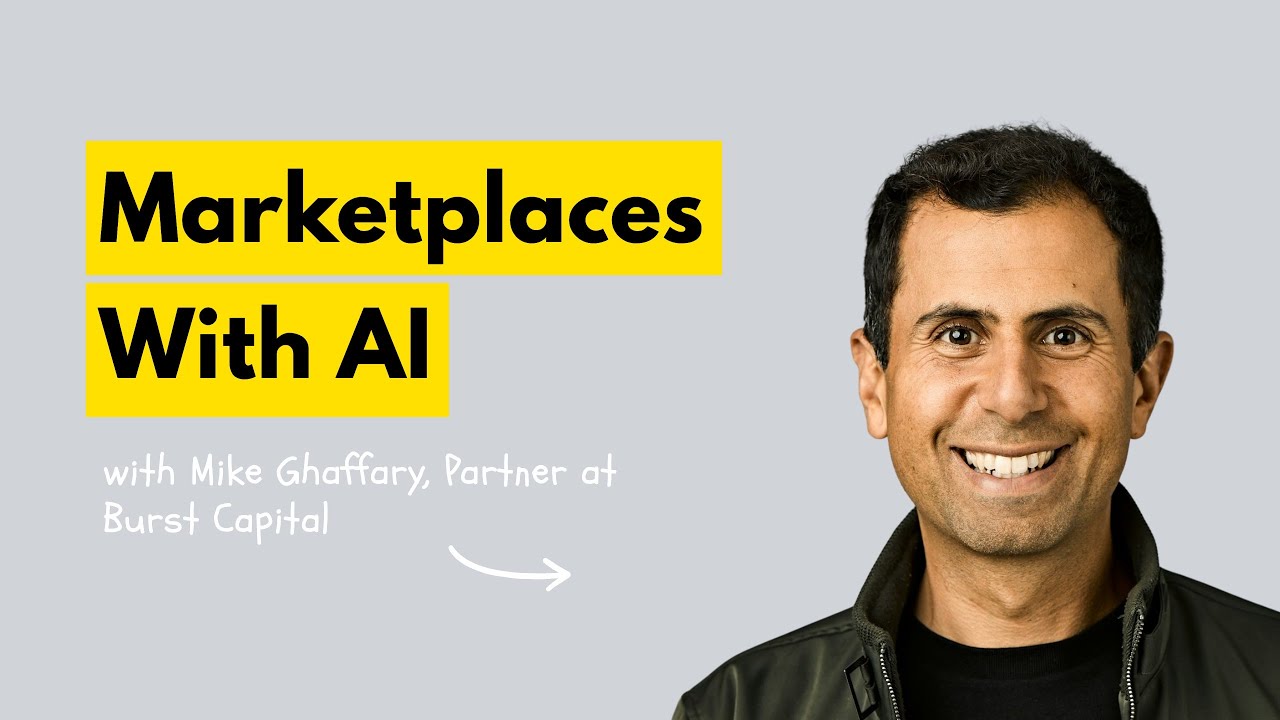
Mike Ghaffary, a general partner at Burst Capital and former Yelp VP, discusses how generative AI is reshaping marketplaces and what founders should know about fundraising. He covers benchmark metrics like ARR and take-rate for seed and Series A rounds, and explains how AI-driven agents are creating new labor-market opportunities.
Chapters
Welcome back to Everything Marketplaces, where we talk with founders and leaders from some of today's top marketplaces. So this is episode 192, which is a really great group chat I just had with Mike Ghafari, who's a general partner at Burst Capital. Burst Capital is a leading venture fund that's backed notable marketplaces like Fare, Hipcamp, Bounce, and more. Prior to joining Burst Capital, Mike was a general partner at Canvas Ventures. Before that, Mike was also VP at Yelp for over 7 years and the CEO of Eat24. So some really incredible experiences, both marketplace operator and investor. So it was a great chat with Mike where he started off by sharing some of his key learnings as marketplace operator. He's taken with him and now investing. He gave us an overview of Burst Capital, the leading venture fund, shared what they look for in investing in marketplaces. We discussed how AI is impacting marketplaces. Mike shared new opportunities that he sees with AI, lots of tips for founders on fundraising. We also had a great group Q&A. I really enjoyed this conversation. You're going to find it a great watch to the end. So Mike, as I mentioned to you right before we started recording, you know, you've been a highly requested group chat guest since your past chat a while back. So I'm really excited to have you join us here today for the follow-up and want to start off by saying huge thanks for taking the time to do so in advance. And we have a lot that we're going to dive into with all of your awesome marketplace operator investor experience, and of course now with the AI. But I thought it'd be great if you could start off by briefly sharing your background for those here that have just joined us.
Well, thanks everybody. Thanks for having me on. Mike Ghaffari. I started life, I'm from the Bay Area, started life as a computer science major, started doing coding when I was 13 and working in a software I think I was 17. So I got started very young on all this stuff, did my first startup in college. I did grad school, a JD/MBA. And when I was done with that, I got really excited in venture capital. So I started investing almost 20 years ago at Summit Partners, which is a later stage growth equity firm. But I decided, A, I wanted to invest earlier stage, you know, Series A, B, maybe even seed. And then I also wanted more operating and founding experience. I found that the best investors that I had, you know, met all had great operating experience to share with founders. So I went and did 10 more years of operating. I co-founded Stitcher, the first podcast app. I was at TrialPay and very important, you know, for this group is I spent 7 years as an executive at Yelp, VP of Business and Corporate Development, you know, so we, you know, some people consider it a marketplace and then we also partnered with a lot of marketplaces and we're kind of front row seat and working with You know, the launch of all these other marketplaces like DoorDash, Airbnb, Uber, Lyft that all came up right around that same time. And we even acquired a marketplace, Eat24, an online food delivery app. And the founders of that business asked me to be CEO after the acquisition. So I ran that, grew supply and demand, you know, grew to a 500-person team and $700 million in gross transaction volume. And then I came back into investing 7 years ago, First at Social Capital, then Canvas Ventures, and now at Burst Capital, which I can tell you a little more about if it's helpful.
Definitely. That's a really incredible background. A lot that we're going to get into here. But, you know, kind of going back to some of your operator experience, you know, what were some of your key learnings, you know, from marketplace operator, you know, at Yelp and then Eat24 that you've taken with you to investing?
I was really lucky in business school. You know, a lot of people say— I just saw some posts about this on social media of like entrepreneurship classes are not useful and stuff like that. But I got really lucky in business school. to have this network effects business class taught by one of the pioneer academics in this area, Tom Eisenman. And so we studied two-sided network, you know, one-sided networks and then two-sided networks, network effects. And I said, wow, this is like really interesting. There is real durability if you can build a strong two-sided network. So I kind of had a real interest in this from the beginning and I came up with this marketplace checklist. I have this up, it's like marketplacechecklist.com. That has a lot of the key questions I like to ask. For example, one is I found that sometimes startups, even when they've gotten a, you know, Series A or B, a couple million revenue, might not have a really good handle on which side of the network values the other side more. They might know which side is harder to acquire, but they don't really know like where they can kind of pour the fuel and get that network effect spinning better. So Those are one thing, you know, the other thing is just to really, since there is a bunch of this academic work, obviously academics aren't gonna magically solve your business, but it is worth it to just invest a few hours and really try to understand all of that. You know, marketplaces are hard. There's this, you know, the cold start, you know, challenge of how do you, when you don't have supply or demand, which one do you jumpstart? And it's kind of shifting back and forth between the two. So there's a lot of learning there. And then I would say a final thing is just, this is not unique to marketplaces, although there are some specifics, which is scaling humans and hiring people is the most important part for almost any startup, even with live coding. You know, ultimately it's the, for the foreseeable future, it's the humans and the business that matter. So really being thoughtful about who you hire, who you bring on, how they can build the business, and then For a marketplace, it's like, okay, who do you have on the supply side? Who do you have on the demand side? How is that continuing to evolve? Those are all important questions.
That's really a great learning. So you got a few head nods with some, and we'll probably jump into some a little bit here. But I did want to kind of learn a little bit more about joining Burst Capital. And so what led you to joining Burst? And can you give us an overview of it as a venture fund?
So Burst Capital is an early-stage seed fund, And actually all of my partners are former Yelp executives. So we all worked with each other for at least 7 years and have known each other for over a decade. It's the original COO of Yelp, Jeff Doniker. He took the company from $0 to $1 billion revenue. And we also have the original CFO and VP of Ops all as partners. And then I ran, you know, business development, corporate development. So we bring lots of different skills to the table, especially around go-to-market, ops, finance, those functions. You know, we're not gonna tell you how to build your product. even if a couple of us are engineers, we're hoping you know how to build the product and we can help you hire engineers, but we're gonna help you with how do you scale? How do you get revenue? If you're a marketplace, how do you think about supply and demand? And we've done a lot of marketplaces. So some folks we were just chatting about who's in this community are like Walker Druitt from Noonbreaks, Chris, the founder of Wonderschool, Cody, the founder of Bounce. These are all marketplace startups in portfolio in addition to like originally Indiegogo Fair, which we invested at the very earliest. kind of pre-seed stage when they were at Y Combinator. Now it's Fair Wholesale. They dropped the Indigo from the name and that's probably one of the largest recent marketplaces and ones we invested in and many others. So we do a lot of it. It's not exclusively marketplaces. We're looking at a lot of AI now. And Mike, you and I were chatting, I'd love to see more startups around the intersection of AI and marketplaces, but a lot of AI that may not be a marketplace and other kinds of software companies, but we still think marketplaces have powerful network effects, very interested. We generally come in at the seed stage, sometimes a little earlier, sometimes Series A or even a little later, but usually post-launch and post-traction. So not usually doing that very almost like -1 to 0 or 0 to 0.1, a little bit of early revenue for us to look at and really help you scale that go-to-market.
That's gonna be a helpful context for everyone. And, you know, how do you evaluate marketplaces when investing?
I look at supply, I look at demand. It depends on what stage they're at. If it's still very early, they probably don't have both sides figured out, but at least if they have one side figured out and they've got a lot of that, for example, they've got a lot of supply, it's just working, but they still have to figure out exactly how to sell into the demand side. And then maybe I'm gonna help them and we'll figure out how to scale different channels and, you know, iterate on those, you know, or the flip side, there's just so much demand. This was Uber's problem. Uber was just like, As soon as they had a little bit of supply, there was seemingly endless demand. But how do you get more supply? How do you convince all these drivers to be on their platform? And that took a lot of work, right? So you'd like to see one side figured out. You'd like to see promise in the other side of the network. You don't need someone to be a repeat marketplace founder or even a repeat founder at all. If they are, that's interesting because they understand the dynamics. And if they're a repeat founder, either way, you really need a level of vision, ambition, And just commitment to really build because startups, as everyone knows here, are hard and marketplaces may be double hard, right? It's almost like you're building these 2, selling into 2 things at once instead of just selling one thing to one customer. And so in addition to recruiting and fundraising, right, all your jobs as a CEO. And so the level of grit and determination is very— so if you look at like the FAIR Wholesale founders, like I mentioned, Or the other, these extremely gritty people who work kind of countless hours and, and are relentless even when it seems impossible.
That's definitely, definitely relatable to many here. So, yeah. And also too, so I wanted to, you know, spend a large majority of the time kind of discussing AI because, you know, as we briefly mentioned before we started recording, you know, it's definitely an exciting time in the world of marketplaces right now. And I feel like we're transitioning into the next era with AI. So could you maybe give us like a brief overview of, you know, where we're at today with marketplaces and how you think AI is gonna impact them going forward?
First, you can look at history, you know, rhymes, but it doesn't repeat. So you can look in the past and every major platform shift from kind of PC revolution, internet, you know, Web 1.0, 2.0, mobile, there are always a new kind of wave of marketplaces. The ones in recent memory are like the ones that really capitalize on the mobile thing because like Uber didn't even work without a mobile app, nor, you know, DoorDash didn't work because the couriers needed it. Yelp was pre-mobile, it was kind of Web 2.0, but then mobile was a huge accelerant. So usually when the platform comes, people start imagining the marketplaces that make more sense in the context of that platform. I would say now in the early days of the platform, right when it's coming out, there's a bunch of infrastructure plays, right? So in the early days of mobile, like even pre-mobile, it's like, oh, satellites and fiber optic cables for the internet and connecting all the wires and then server infrastructure, like everything to get off the ground. And then once that stuff is working, that application layer gets built out and the marketplaces get out. So we are just coming out of some of the early innings of AI, right? Where it's all about the LLMs and the infrastructure and vibe coding developer tools. Cursor is like the hottest company right now, right? But that stuff is always changing. But I think you're starting to see the early glimmers of, and it's, I think, an excellent time, like Okay, in this new world where you can take intelligence for granted and you have intelligence at your fingertips, PhD beyond level intelligence at pennies of cost, what kind of new marketplaces does that enable? And I think just like Uber and DoorDash, imagine these things that couldn't, and Yelp, that couldn't really have existed in a desktop computer world. What can you imagine in this post-intelligence world? Not just something that we could have already had if we had phones and And PCs and stuff like that. So there's, look, there's obvious ones now that people are doing like, oh, marketplace for AI development and a marketplace, there's, you know, marketplace for prompts, marketplace, there's stuff you can do that's kind of, and there might be successful businesses there, but I think there could be even next level really interesting things that we haven't thought of yet. And if people here have ideas, I know you said no pitches, but if someone has an idea, whether it's theirs or their own, Specifically, they think a new kind of marketplace could be enabled because of the existence of AI at reasonable cost. I'm very interested to hear.
Get ready for the questions and probably messages after this. So I guess, you know, related to that, are there any specific opportunities now that you see with marketplaces with AI?
There's the one opportunity I've talked with a lot that it's interesting. It's actually not, this one is not AI specific, but it's because of the AI trend. Which is everyone's so worried about AI job losses, which I think is a very real concern. I think there's a chance for tech and specifically marketplaces to be a big engine of AI, of job growth, you know, kind of incidental to this AI revolution because you have all this displacement. Marketplaces historically, you know, labor marketplaces can be very, a very good tool for a lot of this. You have to be careful because sometimes you build something that you think is a labor marketplace, but it essentially turns into like a staffing agency. Gets valued like that, isn't really tech-enabled and doesn't do as much. But if you could, for example, use AI, one example I give to teach people the skilled trades, because we're gonna have massive need for electricians and all the people keeping the lights on and all the infrastructure to get the AI humming. But we don't have enough blue-collar workers to do that. Like, can you use AI and software to train those people, certify them, right? And then, but then there is a marketplace element. Like, now you know who's got the different leveling, you verify that they've gone through your courses, you really know that they haven't faked it. Like there's interesting things there, you know, AI and education in general, I think has a lot of opportunities around marketplaces, you know, from in learning, right? Because there's, we have an investment in an English language learning company, Cambly, for example, right? And so there, of course, and others like them are reimagining that business with AI, but all kinds of learning, I think, has opportunity there. But I'm still, I do want to keep reminding people that I think there's things we haven't even really thought of yet. Just like people weren't talking about, hey, there's going to be an on-demand rideshare taxi service starting with black cars that will reinvent the way mobility works. I don't think anyone was even talking about that until Uber launched. It was actually not even that, it wasn't a hyped idea at first. And I'm curious, you know, to hear more of those.
It's definitely super early and it's exciting to think about, you know, what the possibilities could be. So, you know, you mentioned earlier as far as like your marketplace checklist and some of the 15 questions, you know, to ask building a marketplace. And I feel like with all the new opportunities, you know, it still makes sense to kind of, you know, think about the fundamentals when building a marketplace. But I guess, do you have any updates to that, you know, since you first shared it and maybe, you know, any specific questions that you might add with the recent advancements in AI and how that might apply?
The short answer is I recently actually did, I think, update it slightly, but I didn't update it Specifically with AI in mind. So short answer is no, but I should. But I think some of this stuff still holds. Which side of the network values the other side more? Do you have an effective proprietary method for distribution to each side, especially more highly valued side? Are there any same-side network effects? Switching costs, thinking about that and multi-tenanting, right? So Uber and Lyft, people were worried about them. They were like, oh, people are gonna have 10 rideshare apps. But you know what? It ended up just being 2, Uber and Lyft. Both on the demand and supply side. If it could just be one, that's even better for you, you know, as the business, obviously understanding your LTV and CAC, understanding what liquidity looks like, frequency of transactions, that stuff's all the same. One question I guess I would add is I'm seeing a lot of just posts on social media recently of like, here are 10 prompts that could replace a $20,000 a month growth consultant, right? And it could just help you supercharge your growth. And that's supposed to be for like, SaaS and consumer apps. But you can imagine taking that, like, can you build out what some of the entry or even medium-level supply and demand side analytical people would do for you just with a bunch of AI? Like, are you really using AI to turbocharge your supply and demand side acquisition? And how is it helping you? Because a lot of that is intelligence. I just said there's a lot of academic work on this. Well, can you put it to use for you? I think that's an interesting question.
Also, I guess, you know, related to that, are you seeing any kind of like new strategies that are being taken, you know, maybe taking like the kind of like agent-first approach or?
I think agents are obviously the super exciting area here. You know, we should, when we were talking about marketplaces, almost take them for granted because there's been so much agent hype. But, you know, in theory, if you could have the agents just working for you. So there are 2 elements to this. One, the agents are working for you on both sides of the marketplace, kind of building up your marketplace. There's an interesting, well, I'll come back. There's another interesting corollary to that. There's also just, are there gonna be marketplaces for agents? Like you think of these 2 sides, are one side or both sides of the marketplace gonna be a bunch of agents like, oh, this AI agent is better, that AI agent better. And that could be it. But like, what are those agents specifically? But maybe these growth marketers, right? Like maybe the supply side of a marketplace could be these growth marketers and prompts. And right now this, guys are just sharing it on social media claiming theirs is the best. But what if you actually had some real measures of like, this really is a better one and this works and, you know, it's all on there. Would people want to share that? Do people want their edge that they have being known? You know, these are all interesting questions. The corollary I alluded to earlier though, if you do have one side of the marketplace really gets replaced almost with AI, For example, you know, if you think of a labor marketplace, right, like an Upwork, and let's say you could just have AI agents be part of the labor. And so there's not even humans anymore. It's interesting. One challenge with that is, this is what scooter companies like Bird and Lime kind of said, hey, we'll be like the 2-sided Uber marketplace. They had some of the fastest growth ever. And since one side is machines, it's even easier. We don't need to worry about these human supply side. But you know what happened is the lock-in of the network actually didn't— when one side is kind of commoditized that way, you lose a lot of the lock-in and a lot of defensibility from the two-sided network in the first place. So one question is, you know, does the network effect depend on both sides being human or are AIs more like humans and less like scooters and robots? You know, so Anyway, we could go on a tangent there, but I think these are interesting questions.
We actually had a question that was out in advance around defensibility and how you think about that with AI on the group Q&A.
Yeah, we can double-click more, but that's a preview of that path of thinking.
Yeah. Yeah. And, you know, before we get into the group Q&A though, I did want to spend a little bit of time discussing the fundraising environment because I feel like a lot of times founders kind of hear about, you know, the almost like a tale of two stories, right? Like the really hot companies and then like, you know, it's a grind, you know, struggling to fundraise right now. So, you know, what are you seeing in like the current fundraising environment, the early stages?
Well, it's funny you mentioned, we just had our annual meeting with our investors and when we were talking about the fundraising environment, that's the exact analogy we gave, the Tale of Two Cities. I think if you are, especially if you're in AI and that could be AI at the intersection of marketplaces or not, but especially if you're in AI and/or an insider in a hot category, you know, really helps these days if you're in San Francisco, Silicon Valley, or, you know, maybe New York. Or LA, one of the markets, the core market especially. And if you have some, whether if you're not a founder who's like a repeat to tech, maybe you have someone on your team or you have some signal or you get into one of the top accelerators like Y Combinator or Pair or one of these. So if you can be that kind of in that hot category and there's something special about you and then either, you know, maybe you're pre-seed or seed or you launch and you get, you know, very fast growth and we could talk about what that like top of crop decile growth looks like, then the capital is pouring in maybe faster than ever. People said like, wow, it's starting to feel like 2019 again. And investors complain about it, of how the deal prices are getting out of hand and all this stuff. So the market's kind of revved up there. If you're not in that hot bucket though, I've seen for a lot of founders firsthand, say, you know, share privately and publicly that It could be more challenging than ever. And there is because a lot of venture firms are scaling back, like there's capital getting concentrated in the top venture firms, but then the smaller venture firms are going away. Everyone's getting a little more conservative around things that are not white hot. So I think you've got to decide. And my partner, Jeff Doniker, we have a great newsletter called Bursts of Color you can sign up for because he just wrote about this in one of the last 2 recently. It's like, decide, are you kind of going for, you know, that white hot thing? You can call it like going for the Ivy League top college, whatever it is. Or if that's not realistic, just be honest with yourself. Like, that's okay because plenty of great, you know, some of the most successful people obviously don't all go down that path. Your Series A or C does not need to be the gold-plated top investor easiest round. You could grind it out. But if you are in the grind path, do the grind things, which is like, Profitable growth. You can't just burn as much as the Cursor people did, you know, in their early years. That's not gonna work for you. You're not gonna get credit for eking out, let's say, 2.5 times growth, right? But at a burn multiple of 8 or whatever, you burn like crazy, but people aren't gonna respond to that. So you've gotta be able to show profitable growth, kind of slow and steady wins the race. Look for that moment where you can get a kink in the curve and you can try and accelerate and then maybe go for the hotter venture capital.
And you did mention as far as like, you know, the growth, right? And we're kind of hearing the crazy stories about growth right now. So what are some of like the early kind of, I would say like, you know, what's like great growth look like? And then what are some of those kind of like benchmarks maybe to raise like a seed round today?
So these are not benchmarks. I hesitate to mention it just because it's more like outlandish, but the outlandish stuff you're hearing of, someone was just referencing the gold standard of getting to $10 million ARR in 2 years, and there's a company that just beat that. And it's like, oh, companies these days are just built different. That's not gonna happen for 99%, even though some of the most successful companies today didn't hit $10 million in 2 years. So like, you don't need to do that, but that is out there. The old thing was like, get to $1 million in ARR or, you know, for a marketplace, maybe $1 million in net revenue to raise your Series A. That benchmark has moved and the goalpost has kind of shifted. And if for, especially for a non-AI software company, I'd say you're frequently seeing $2 or $3 million for the Series A and at least a few hundred thousand before the true seed round, like that last seed that you do before the A. Some are even coming with a million. Now to translate that into marketplace, marketplace data is more spotty. In the old world, people would just raise for marketplaces sometimes on a gross GMV, gross transaction volume with no net revenue. And this is where I said you have to decide this Ivy League thing, like, are you the next Square or whatever? that's just gonna raise on, hey, we have massive gross transaction volume, we're losing money on every transaction, break even, but it doesn't matter. It's so early, we're just gonna build. Or, you know, even in the white hot market of 2017, '19, whatever that timeframe, I remember there was a startup I talked to and they were able to raise seed A, B with all GMV, no net revenue. And he came to me, this founder, at every round and he was like, oh yeah, everyone's— and he got one or two hot funds even in there. And I just said, look, you keep kicking the can. Can you just do a little bit of net revenue? Just show me. So I always, and so long story short, and I won't, you know, ever name names or anything, the company collapsed at Series C because he was great at raising money and telling the story, you know, of the no net revenue and look at this. And as soon as I turn on the spigot of that revenue, but he was doing himself a disservice because that net revenue piece never came in. And it's, that's a big, so I encourage people to start the net revenue as soon as possible. Show that you have a real take rate. You know, another goal is what's your take rate? If your take rate, especially even in the early days, is under 5%, I'm like, man, that's what credit card companies are charging. So you're saying you're less useful than a credit card company or roughly equal to like MasterCard, but like that's not a lot of value if you're adding the same amount of value as MasterCard. Like how do you add enough value as, as much value as like DoorDash or Uber, which is like 15, 20%? You know, maybe more above 25-30% starts getting outlandish. So I don't know if it's like 10 to 30 maybe is a range, but show that the supply and/or demand are willing to pay you that much. That's how you prove that's your customer. That's how you prove you're actually worth something. Anyone can just get GMB by giving away the product for free or losing money on every transaction. So that's another kind of just important reminder for marketplace founders. And another thing is like, I would just try to get those metrics going. Off whatever little scrape of buys you can. You don't need to hire, especially now, you don't need to hire engineers even. You can just get it going. Try saying that you need to raise a lot of money just to jumpstart things is a harder pitch if you're not already a super insider repeat tech player.
No, I'm glad you mentioned, you know, take rates. That's something that we're always discussing, right? Yeah.
Community.
Well, cool. So that's, I know that's going to lead to some questions here, so we're going to make sure we can save time for that. But, you know, right before we jump into the group Q&A, I feel like we have a lot of like first-time founders now, you know, with the new kind of AI wave entering the world of marketplaces. So do you maybe have a few tips for first-time marketplace founders that you could share?
The one is if you look historically at first-time founders in general, they can be extremely successful, right? Like Jeff Bezos, Mark Zuckerberg, Larry and Sergey, like don't feel any sort of inferiority complex for being first-time founders. Like I love first-time founders and repeat founders both alike. I don't know if I've invested evenly, but maybe Evenly in both. I think both can do great things. So, A, know that, believe in yourself, you can do a great job just because you're not a repeat founder and you're not necessarily a tech insider. And at the same time, if you're thinking about being a founder, but you're not yet a first-time founder, I would do everything you can do to make yourself experienced, ready to be a founder and marketable to funders and investors if that's a path you're going down. So maybe if you're thinking about taking the leap, but you haven't done it yet, you're not sure if you're ready and you just have a couple of ideas, but not when you're like, you have an industry you like, go work in that industry, right? And go get some experience, maybe work for even just a year or 2 at a tech company. If you wanna do a marketplace, go work for one of the marketplaces, learn how they're doing it, learn what the state of the art is. Those experiences are incredible. You really, that, that, you know, gets you so far. Now, some people, You know, like Zuckerberg, we talked about, started a big network effects businesses when he was 18, 19. I don't know his exact age when he started. So if the idea hits you in the face and users are there, remember he was trying like 5 different things and this was the one that just like happened to take off. So he didn't even know. So if that happens to you, great, but trying to prepare yourself and then now let's say you've already taken the plunge and now you are a first-time founder and you're trying to maximize your success. Just really be humble and learn everything you can from what's out there. There's so much you can absorb now between AI, use AI to its fullest extent. You really have to show, I think every investor's gonna say, are you like completely leveraging AI both on the engineering and product side, on the growth side, everywhere you can, if you have interesting AI angles that are truly unique. And then you probably just You just have to, you know, it's always controversial. People get in these fights about how many hours a week people should work and things like that. But I can tell you, probably especially for first-time founders, like almost every founder, especially first-time founders, they are doing these ridiculous hours, like the Herculean crazy, you know, whatever schedule you wanna call it, whatever number I say, people will find a way to argue about it. So I won't get into specific numbers, but it's probably a lot more than what you're thinking. And you have to make those effective. You have to take care of yourself and try to eat healthy too and sleep a decent amount. You can't make 'em like bad wasted hours, but you're going to have to work around the clock, weekends and the whole nights and morning, everything, and outwork everyone else as part of it too. And that will be an advantage, especially if you can find other people and inspire them to do the same for you productively.
I feel like that's like a plug for the community, right?
Yeah.
Hey, Weston, I saw you raise your hand. Do you want to come on?
I've listened to previous podcasts of yours as well, and I see that you're huge on Main Street investment, like businesses on Main Street. I guess like with AI coming in, I guess, is there an update on your priors? Is there like a unique insight that really makes you double down into Main Street, or is it like, has your priors shifted a little bit? Main Street's about half of what we do, so it's a huge area for us. not the only area. And similar to like what I was saying about marketplaces, I think every platform shift you've seen, there's been a big rush of Main Street businesses. So a lot of those same, and in the last wave, the Main Street businesses tend to all be marketplaces, Yelp, Airbnb, Uber, DoorDash, Lyft, right? Some of the biggest businesses built in the mobile wave were all both Main Street and marketplaces. So they touched local businesses or SMBs, mom and pop, right? All these kind of labor marketplaces and on-demand marketplaces. Now with AI, I don't know exactly how it's gonna interact with Main Street. So we have this portfolio company, owner.com, for example, that's a Main Street business. They just raised at a billion-dollar valuation. They're not necessarily a marketplace, so it won't all be marketplaces per se. But I think with this big, you know, Main Street is about half of our economy. And so AI is going to end up having, like, there's going to be maybe half of the big public companies will come out of that, especially as we start to chew through this infrastructure and server layer and dev tools layer that we're, you know, digging through now. And, and a lot of the value has been there historically.
That's a great, great question. Hey, Molly, do you want to come on?
Hi, I'm Molly Morse, founder of Recess, which is a marketplace for kids' after-school activities and camps. I am, we're Going out to have seed conversations in September. So perennially curious about how investors view kind of success metrics at the seed round. A million GMV gets tossed around a lot, but obviously with marketplaces, a lot of the times network effects kind of reign supreme. Curious what that looks like for you. Cohort retention seems to stand out, but is there anything else that you're looking at that's real evidence of the flywheel?
So also taking a step back, I would say what's really important to show for, you know, a marketplace like this is what's really different right now, right? So we're in this age of AI, whether you have AI, first of all, for all of you, AI should be part of the story. You don't need to oversell it, but it should be that at the very least, hey, we would've needed to hire 5 engineers, but we only hired 2 because of AI or maybe just 1, right? And the same with product management and growth and like some of these functions and ops. So at the very least showing that you're using it on the backend. But beyond that, that's like table stakes. Beyond that, I think it's like, why wasn't this company started 10 years ago, right? Like if the tech was already here to start this a decade plus ago, what is it now that's happened? This why now I think is really important for a lot of market, non-AI kind of related marketplaces now. So more so than the metrics, keep in mind at seed, Actually more, and especially seed compared to Series A in the later rounds, it's much more about your story than it is the metrics. The metrics and these goalposts are part of it, but I'd hate for you to like chase a bunch of these metrics and optimize, but not take a step back and sell all kind of the vision of, hey, there's something really different here that we're doing. There's something special. And this is why other companies that might have tried this before, other tangential companies, maybe that didn't become as big. This is why we're gonna be this really massive business. But because keep in mind, almost any venture capitalist you talk to, seed or later stage, they're looking for companies that can get to $10 billion or more. They at a minimum wanna think it could be a billion-dollar outcome, but they wanna see the possibility of $10 billion. And we can walk through the math on the back end of why that works. You know, it's, people have written about this, but that's the reality. So you cannot play that game and just try to raise friends and family and angels and, Maybe some individual smaller investors who aren't formal seed funds. But if you're going after the seed funds, they need that big story. So the metrics at this point are so tiny that, yeah, look, if you can have amazing cohort retention and that's gonna look different for every business, that's great, especially if it's like accelerating like a smile curve kind of thing. That's sometimes interesting. If you can have a million or more in GMV, that helps. Like I said, I like the early take rate. Most people, They don't necessarily need it at the seed stage, right? If you can, and then just outlier growth. So we've danced around growth. I didn't give any growth numbers. I think 3x at a minimum, like at Series A, 3x is what gets you in that upper kind of ballpark. 4 or 5x is even better. At seed, the numbers are so small. So like, I'd want to see that, like, let's say you got to that million, like nobody cares if you grew 5x from $10K annualized GMV to $50K annualized GMV. The multiple is meaningless until you're talking about a real number. So the first real number is around like, let's say it's a million for GMV. So if you went from $200K to a million GMV on an annualized basis, or even better, let's say you went from like in 3 months, you went from $300K to a million, right? And so that's like, hey, in a quarter we're tripling. And if you, We're obviously not going to keep that up. Maybe we will, right? But most investors will not assume you could keep that up. But that's an amazing growth rate. So thinking about well over 3x annualized on a decent-sized base at the seed stage, that definitely helps your story. But that broader narrative around why this is different, I think is even more important.
Great question. Give me a helpful answer. Hey, Mike, I actually had a, I wanted to, you know, I guess kind of like double-click on the note about the why now, right? Now, how do you have a great example of like a very compelling why now at the very early stages for marketplace that's fundraising?
You take order.com is a simple one, right? And I know I don't want to, you know, why don't I give one AI example and non-AI example? Because it's so easy to use AI as a cop-out. Like order.com is really simple. Hey, starting with restaurants and all these SMBs, AI wasn't a thing and now it's a thing and they need to use, you know, so like that's part of it. And there's all this new software that they can use. So there's just this obvious story whenever it's like AI wasn't here and now it's here. That's the why now, problem solved. So that makes it really simple. But the question is, what are other why nows? And I'm trying to think of a good recent example in non-AI. You know, I gotta tell you that, you know, there's this thing called Weave out of the last YC class that we just invested in. It's almost like Gong. It's sales productivity or sorry, employee productivity on the engineering side. And again, the why now there is AI. There's Woz, a mobile app builder, like all our recent stuff. Honestly, the why now has been related to AI. The why now used to be something around mobile phones, but sometimes it could be, you know, Float Health is not necessarily an AI company marketplace that I'm invested in. That's a good example. Their why now is people are doing more infusion therapy than ever. Infusion therapy is booming, immunotherapy and infusion therapy. It's life-saving, important. and expensive and inconvenient. And so if you can have nurses come to people's homes and do it that way, then that really unlocks a lot. So that's a non-AI, very compelling why now. So if you're not going to be AI thing, it could be like there's a big market growth going on in your sector that's maybe not recognized.
I think we've seen some pretty compelling why nows with the unlocks in healthcare like you mentioned, and also too in B2B. So hey, Jacqueline, do you want to come on?
My name is Jacqueline. I'm the founder of Sustain. It's a non-toxic home goods marketplace. And I really am just curious about— so right now I'm learning a ton with AI and we're doing all kinds of stuff from content to— we have a Sustain Approved verification. So we're using AI to both source what chemicals are we excluding from our marketplace and also how to automate and check the ingredients on the products that we're adding. So we're doing all kinds of stuff, and I'm learning it mostly from founders, like other founders, um, in, you know, marketplace or e-commerce. But is there any other, like, specific AI, like, training resources or, um, communities or, um, even, like, media that you think, you know, we should all be checking out to learn more?
The short answer is I'll give you some, but I think this is a big opportunity area for a founder here or a friend of yours. Both someone could do a startup related to this. I actually thought about this, that the cold start AI problem is a real problem. Like if you wanted to, because I, you know, a couple years ago was like, you know, I'd love to spend a couple hours a week just sharpening AI skills doing that. There's no like app to, why isn't there an app you can just go into and just say, hey, you're my AI tutor, like coach me on specifically And, you know, OpenAI can do that. You can create a little— so probably my lowest-hanging fruit recommendation to you, honestly, and I did this, is use the O3 model of OpenAI. That's— there's a lot of great models, but I always remind people that the O3 reasoning model right now for me is working a lot better than the 4O model. It thinks and takes a little longer. It costs like maybe 10x for OpenAI on their backend, the servers. So they try and lead you away from it. But I would use the O3 model. Create a new little context window you can save to memory. and say, hey, you're my AI tutor, I want you to teach me, and just like pose this exact question. Uh, but the interesting thing is somebody can turn that into an app actually, um, and, and create a wrapper and I think create a compelling experience. But you can hack this together for now. Tell it what you're seeing, tell it what you're doing, tell it what you want to learn, where the state of art— and the nice thing about O3 is it's good at this, it will cite its sources. Like, tell it, hey, I want you to be searching the web every day, coming up with these new ideas for me, telling Giving me pointers of content resources I need to look at. So I would get that spinning for you on anything you want to learn. But specifically, just my own version of trying to pretend I'm O three and like what I've seen resources out there. I'll do you know there's a lot of great newsletters. So I'm biased, but my sister does the Bloomberg AI newsletter. So you can like go to Bloomberg and subscribe to their AI newsletter. There's all you know every. Tech publication, they probably have different ones. So that's a way to just get kind of daily news on what's going on. I'm trying to think what are other ways to read about various tools. I mean, honestly, if you haven't vibecoded yourself, like just using the tools, you learn a ton that way. So building stuff, going in, you know, whether it's Cursor or Claude or Replit or whatever your favorite one to try, actually publish something yourself without your tech team that you use. Right? So like go out and create it, you know, create the thing and actually access it. I think that could be really interesting. You know, the silly example I give people when this stuff first came out, I was like, I had always wondered why there's not good mobile apps that are typing tutors. So I made a mobile web app typing tutor in like, you know, less than an hour, the first version in 10 minutes. Like you can do that too. You can make mobile web apps. So using that, use Gamma to make a PowerPoint presentation. There's like, use this stuff. And you'll learn a lot that way as well. I think, I feel like some founders are still not actually vibe coding. They hand it to their technical co-founder and the business founder or CEO doesn't. You should just do that stuff yourself. That's another big way.
We got a request for startups in that too.
So, yeah, there you go.
Hey, uh, Dimitri, do you want to jump on?
I have a question for you about, uh, AI agents and kind of how that future may shake out. Um, so to me, kind of the main distinction seems to be between 2 types of agents. One is what I call a bowling shoe agent. So imagine you show up on a marketplace, the marketplace gives you an agent that, you know, figures out your preferences and tries to match you with the right inventory. The second type of agent is like the Hollywood agent. So this is an agent that's yours that has access to your Gmail, your credit card statement, and just sort of follows you around. So it knows a lot about your preferences. You could unleash them and they will search forever on your behalf. And so in the world where those 2 types of agents sort of coexist, How do you think that competition will shake out? And if you're sort of making investments right now, which of these 2 or both would you like, would you favor in your investment strategy?
I think a lot of it comes down to privacy. And so on the Hollywood agent, I think those can be incredibly powerful. But I also think people sometimes hesitate to give the keys to the kingdom to everything, right? So they'll, Like increasingly, maybe they'll trust OpenAI, although Meta just lost a lot of trust, for example, by making people's like AI search like that Hollywood agent. It gets very personal as well. Like it's part Hollywood agent, part, you know, therapist, who knows, maybe all your deepest dark and like your whole Google search queries if you think about that. So that's gonna be one challenge for non-incumbents and startups because, you know, like Google ran away with the search market after A lot of competition, but then they got it. And people trust Google with their search history and then their email and their calendar and all this other stuff. So that will be a challenge if the Hollywood agents, if like Meta, there's more blunders where stuff people thought the Hollywood agent would keep private all of a sudden gets on, you know, to use the Hollywood analogy further, gets on the COVID of Page Six, right? And the gossip and TMZ. If your agent's leaking your darkest secrets to TMZ, like you're not, you're going to fire that agent. Right. And if a lot of agents have that issue, but if they can do a good job, I think there's a big opportunity there. And I think both this bowling shoe stuff will also continue to exist for that reason.
Well, that's a great way to wrap things up here. And we're definitely out of time here, but really appreciate you taking the time to join us here today for the follow-up group chat. This is a real treat, and I know we packed it in here. And actually, I have one last question for you before we wrap things up. And this is my usual parting question, and I'll slightly reframe it this time since I asked it before. But, you know, if you could go right back to before, you know, I would say like 2025, and I know this is relatively new in the kind of new AI era, you know, what would you tell yourself about marketplaces?
So a couple things. One, there's a lot of investors who wish they kind of waited in the 2021, '22 period because this big, you know, wave is coming that AI really is, you know, the story and just spend, However much time I thought I was spending on it, it's like even more going all in on it is probably important. It feels like the early days of the internet. So, and it can be tricky. I could see people in this community being tempted to paint themselves a narrative. I'm a marketplace founder. I'm not in the AI bucket. I shouldn't worry about that. Oh, that's just an overhyped. I can tell you however much it's just, I don't think it is overhyped. I think it's appropriate. There are overhyped individual names and companies. But overall, just like with the internet, there's Webvan and Pets.com that went under. Sure, that's going to happen. But look at the lasting impact the internet had, even despite the overhyped, you know, individuals. So it was underhyped in the end. And AI, for better or worse, I think is in that same bucket. So just understanding that everything's been reinvented and spending as much time on it as you can, that's probably the biggest advice.
Give me a good parting advice for us all here and a kind of thought to leave us with. And then last but not least, time for Quick plug, where can we all keep up with you at?
So you can follow me on Twitter @NewMike, and then you can also follow me on LinkedIn. Just search my name.
More from Max




B2B Marketplaces In The Age Of AI With Sonia Nagar From SNAK Venture Partners | EM Group Chat #216

Insights From Investing In DoorDash With Saar Gur From CRV | EM Group Chat #215

Starting & Scaling Fora As A Leading Travel Marketplace With Evan Frank | EM Group Chat #214

Marketplace Investor Insights With Andrew Blachman From Marketplace Capital | EM Group Chat #213


Deep Dive Into ResortPass As A Leading Marketplace With Michael Wolf | EM Group Chat #211


Masterclass On Marketplaces In The Age Of AI With Fabrice Grinda From FJ Labs | EM Group Chat #209