Marketplace Learnings From StubHub With Akshay Khanna | EM Group Chat #198
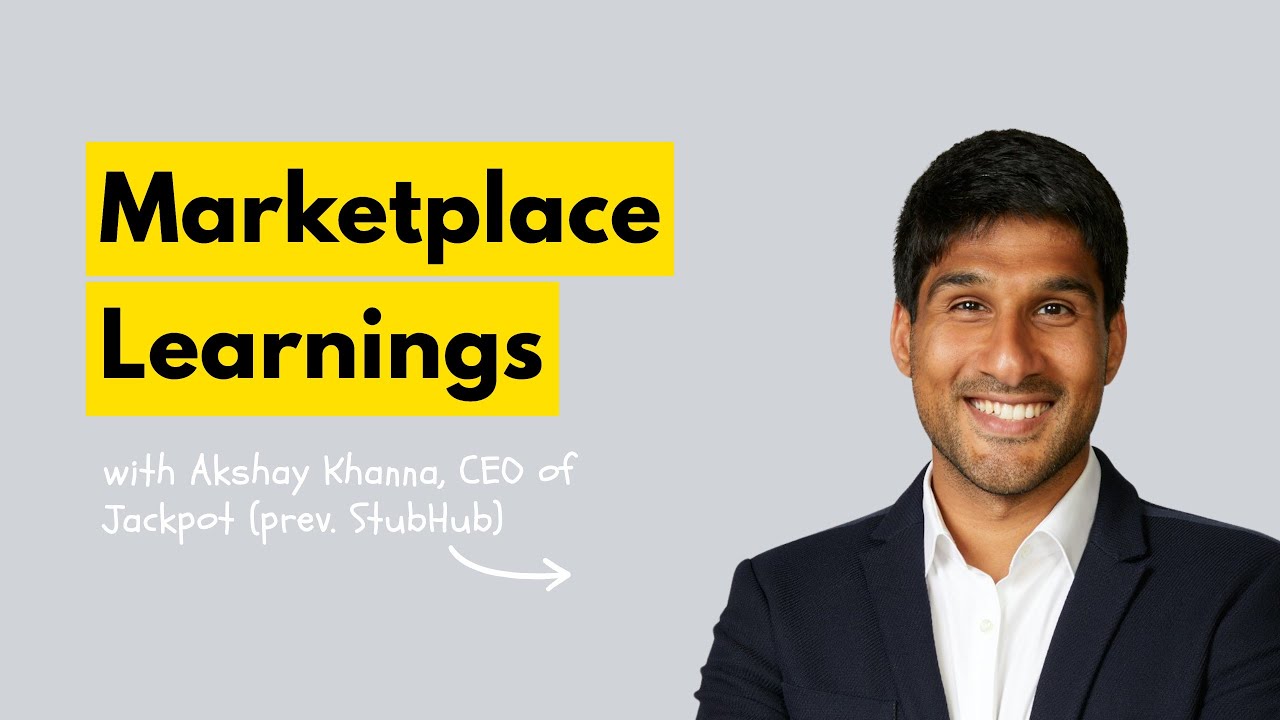
This content was created by Max Brun. This content was uploaded by Max Brun. This is a YouTube group‑chat/interview (Everything Marketplaces — Group Chat #198) titled "Marketplace Learnings From StubHub With Akshay Khanna | EM Group Chat #198" (published 2025‑10‑13). The episode features a conversation led by the show host (Speaker A) with Akshay Khanna (co‑founder & CEO of Jackpot and former GM North America at StubHub), includes audience Q&A (e.g., a question from Dimitri), and covers Akshay's background, his StubHub experience (organizational structure, partnerships, pricing/fee dynamics, COVID impact, first‑party inventory experiment, lessons learned), the origins and operation of Jackpot (moving state lotteries online, regulatory and operational challenges such as printing/scanning tickets, fundraising and unit economics), and practical tips for founders building marketplaces. Platform: YOUTUBE; context: EM group chat / founder marketplace discussion.
Chapters
Welcome back to Everything Marketplaces, where we talk about founders and leaders from some of today's top marketplaces. So this is episode 198, which is a really great group chat we just had with Akshay Khanna. Akshay is the CEO of Jackpot, which is reinventing the lottery experience and bringing it online. It's often referenced as a fast-growing startup and one that's building in more regulated markets. Akshay was also previously the GM of North America at StubHub and was there for over 4 years, so some really great marketplace experience. So this is a really awesome chat with Akshay. We went back to his experience at StubHub. He walked us through what he is working on as a GM in North America and some of the biggest marketplace challenges as they scaled, shared some of his key learnings. We got to learn more about what he's building with Jackpot now. We discussed lots of topics like building in regulated markets, balancing growth with capital efficiency. We also had a great group Q&A. I really enjoyed this conversation. You're going to find it a great watch to the end. So actually, of course, after my really great marketplace experience, you know, I enjoyed our brief conversation. We first connected a while back, so I'm really excited to have you join us for a group chat today. Wanted to start off by saying huge thanks for taking the time to do so in advance. We have a lot that we're going to dive into with all of your experience at StubHub and also building Jackpot, but I thought it'd be great if you can start off by briefly sharing your background for those here that might not know you.
Thank you so much for having me. Super excited to do this. Glad that there are enough people that are actually interested in this very esoteric topic. So for background, I graduated from college in 2009, went to a small liberal arts school in Vermont called Middlebury College, spent 4 years Working in financial services, mostly focused on consumer retail private equity. Then went to business school, not because I particularly had like any real career path in mind, but just that's what everyone around me was doing. Went to business school at Wharton and I would say that was really the first time that I came into contact with the concept of like doing what you were passionate about. And I knew that my passion lay somewhere in the intersection of sports media and entertainment. I had no idea what that meant. I was probably among the very small group of kids who come into Wharton who like truly have no idea what it is that they want to do beyond, hey, there's this industry that I'm somewhat interested in. I was very fortunate to get introduced to lots of people who worked in particularly the sporting part of this ecosystem. And I ended up interning with the ownership group of the Philadelphia 76ers. At the time, they just owned the singular team. It was 2 former Penn grads themselves, Wharton grads, Josh Harris and David Blitzer. I interned there during school, spent 2 and a half years there after I graduated running corporate strategy and M&A for them. We went on to acquire the New Jersey Devils, the Prudential Center, Crystal Palace in London. Eventually, they went on to acquire the Washington Commanders as well as a bunch of esports assets. Other sports media entertainment, concert venues, all kinds of stuff. And all of it was bucketed under what's now known as Harris Blitz or Sports and Entertainment. From there, I went on to my role that's probably most relevant to this conversation, which is 4.5 years at StubHub. StubHub, for those of you that may not know, is the leading ticket online ticketing marketplace in the world, and had a variety of different roles initially partnerships. Then kind of moving up the corporate chain to where I was running the entire North America business on the eve of COVID took the business through COVID. As you can imagine, one of the most, and we probably will talk more about this over the course of this conversation, one of the most traumatic potential possible outcomes for a company that thrives on live events. And when there are no more live events, what do you do as a marketplace? Went through an acquisition. So we were sold by eBay to a private equity-backed consortium, including one of the initial founders, and then left to start my own business, which is what I do currently. So I'm co-founder and CEO of a business called jackpot.com. For those of you living in New York, Colorado, Arizona, Arkansas, New Jersey, Ohio, Massachusetts, you can download our app, play around with the features, Essentially, we allow you to buy lottery tickets from the comfort of your own home on your phone. So think of us as DraftKings or Uber Eats, but instead of sports betting or lunch, we are delivering lottery tickets to your phone. And we've been doing this for 3 and a half years now. We've raised a bunch of capital. It's not a traditional marketplace, but it is predicated on the same general philosophy that StubHub was predicated on that There's a very analog way of shopping in the lottery space today, and presumably over the course of time that is going to move over to the internet. And we want to be at the forefront of facilitating the move of people purchasing lottery tickets instead of doing it physically in person at a gas station, convenience store, grocery store, doing it from the comfort of their homes on their phones. And so that's what we do. We're currently in the 7 states that I mentioned, with the goal being to expand to every state in the US that has a state lottery.
That's a really great background. Sounds like that's such a cool journey as well. So a lot that we're going to get into here. But, you know, I did want to go back to StubHub. You know, you mentioned you were there for a little bit over 4 years. So what initially kind of led you to joining StubHub? And can you walk us through your experience there?
Sure. So while I was at Harris Blitzer Sports and Entertainment, one of the projects that I helped oversee was a partnership. StubHub and the Sixers were the first partnership to be announced when the NBA approved a sale of that real estate. In conjunction with that sponsorship partnership, we also at the Sixers created a ticketing partnership with StubHub that was a first of its kind where a team was directly selling inventory through StubHub, which had historically been a secondary-only platform. And it was intended to herald in the launch of direct listing on the StubHub platform, which did happen to a substantial degree. And what a lot of people don't know about StubHub is, particularly prior to COVID, StubHub invested heavily in a transition from simply being a third-party marketplace to also being a first-party marketplace where the company took its own inventory risk, actually went out and acquired tickets and competed against the sellers that were listing on its platform. Extremely controversial move that again, happy to talk more about. Unfortunately, a lot of that, you know, was lost with COVID and sort of the collapse of the company that happened in COVID. Coming out of COVID we know that, you know, from everything that I hear, the company is looking to reenter that space. But through that partnership that the Sixers had with StubHub, I got to know the StubHub folks really well and they had an opening for a really interesting role and decided that I was the right fit for it. I was particularly interested because it maintained a presence in sports media entertainment in an industry that I was extremely passionate about, live events, while at the same time giving me the opportunity to understand how a tech company is built. During my time at the Sixers, I had never interacted with product managers or engineers. I'd never thought about what a product roadmap was. I never really understood the concept of tech debt or how to go about, you know, launching, releasing coding products because that's just not the business of what a sports team does. And so this exposed me to a much wider set of functional areas that are needed for a company of StubHub scale, you know, which by the time I left coming out of COVID was back to being sort of the billion-dollar revenue, billion-plus-dollar revenue business that it was heading into COVID.
Yeah, you mentioned lots of topics that we're always kind of learning, learning on the fly as founders, right? So when it comes to something I actually wanted to discuss here a little bit more in detail is as far as like when it comes to like the categories for StubHub, right? So just, you know, how did you think about kind of managing categories and, you know, maybe specific to like North American market?
Yeah. So we— the company was split into 2 verticals. So at the very top, it was split into 2 verticals. It was North America and international. North America was about 95% of the business. International was 5%. Our international business was based out of Spain. Because we acquired a Spanish ticketing company that was headquartered in Bilbao. International was largely focused on Western Europe and the UK was the bulk of the international business. The US business is sort of the traditional StubHub business that most people think about that was broken down into 3 verticals. Well, let me rephrase. It was broken into 2 verticals and then one of those verticals was further broken down into 2 verticals. So we had sports which was about 2/3 of the business. And then, I'm sorry, which is about 55% of the business. And then music and theater, which was about 45% of the business. Sports was then further broken down into what we call the 3 Ms, which is NFL, NBA, NHL, and then Major League Baseball, college sports, and everything else. The reason for that breakdown was when the verticality was created, the music versus sports is sort of obvious, but the sports vertical was so big that we needed to hire 2 GMs to look after each part of it. And the rationale behind the breakdown was StubHub had massive partnership spend with Major League Baseball and college sports. So that was its own vertical. And then NFL, NBA, NHL was a place that StubHub was very much sort of an emerging player. Ticketmaster had the bulk of the market share. And so you could think of it as like growth vertical and optimization vertical, which is sort of why it was broken down. And so by the end of my time there, I was overseeing the entirety of that North America business, you know, with obviously all the P&L responsibility that came with it, which for a couple of months was, as I mentioned, $1.25 billion, then very quickly was $0 for 2.5 years. And then kind of moved its way back up to $1.25 billion once we emerged from COVID Yeah, that's really interesting to learn about.
And actually had a question that was added for the Q&A, but you mentioned it here, which is partnerships. And so what role ultimately did partnerships play for StubHub?
Yeah, so StubHub had a multi-hundred million dollar per year spend on partnerships and we viewed it as a marketing channel. We were the official ticketing partner of Major League Baseball. We were the official ticketing partner of 45 of the 50 biggest colleges across America. College sports obviously being a huge business. We were for a while the official secondary ticketing partner along with AEG Presents, which is the second largest music promoter in the country behind Live Nation. And so those partnerships really help drive awareness. They help drive direct response. You would walk into any baseball stadium in America, you would see StubHub signage everywhere. If you were a season ticket holder to any baseball team, the easiest place for you to resell your tickets was at StubHub. And so it was sort of a multifaceted, multi-step approach to a differentiated marketing channel in addition to the other ways in which we acquired customers, which is more traditional or not traditional, I guess, more digital-focused channels like Facebook, Google, et cetera. And so we spent, you know, I think it's publicly available data now, almost half a billion dollars a year on customer acquisition. About half of that was partnership spend and the other half was largely paid search, but some paid social, some programmatic, and then a handful of other kind of smaller channels.
Yeah, that's really interesting to hear about, you know, partnerships and what it sounds like, you know, how key they were as well. And another topic that I did want to talk about is pricing, since this is something that always comes up, you know, when we're discussing ticketing marketplaces. So could you share about, you know, how you thought about pricing at StubHub and also fees?
So I get asked about this more than anything else. And, and I will repeat, I feel like my media training from those years of StubHub are like now coming back to focus. So I'll start by saying StubHub does not set prices. This is like the thing that we would scream from the rooftops. Obviously, no one cares. No one listens. StubHub does not set prices. StubHub, with a very small exception, which again we could talk about, which was the direct listings piece that StubHub entered in a major way starting in 2018, really. But putting that piece aside, which represented, you know, less than 10% of the inventory on our platform, the bulk of the inventory on our platform, the pricing was set by the sellers. What we did set was the fee. Right? The fee, the take rate, both on the seller side and on the buyer side. And so if a seller who typically were ticket brokers, or in some cases were, you know, Joe or Jane, the season ticket holder, decided they wanted to price a ticket for $100 or $1,000, we could guide them by showing them what the clearing price historically had been. So if the clearing price for this exact seat for the last 5 games had been 110, 120, 110, 120, 115, 118, whatever it might be, and you price it at $1,000, odds are you're not gonna sell your ticket. So we would guide them towards what the clearing price likely was, but we didn't set the price, right? The seller set the price. The buyer then chose to transact at that price or not, and we charged a fee from both sides of the marketplace. Incredibly profitable business model. We would dynamically price that fee depending on a whole bunch of things, time to Time to event, what type of event it was, demand for the event, relative lack of supply for the event. As you can imagine, dynamic fee pricing also was extremely controversial because people don't want to pay fees and particularly don't want to pay sliding scale fees, right? And so a 20% fee on a $10,000 Super Bowl ticket, all of a sudden you're paying 12 grand for your Super Bowl ticket. that you thought you were paying 10 grand for, people get mad. And so really what we controlled was the buy side and the sell side fees. But oftentimes we would, you know, what would happen is there would be an event that would blow up. The example that I will never forget is Kobe Bryant dies in a helicopter accident. There's a Kobe remembrance night at the Lakers, right? And all of a sudden, the prices for this random Tuesday night basketball game in January go completely bananas, right? The prices spike. And we're obviously in the news saying StubHub is profiting off of Kobe's death. How dare they? Shameful. And of course, we're saying, look, we don't set the prices, right? Like, the sellers realized that this was a massive opportunity to jack up prices. because people were willing to pay elevated prices to show up to this game because it meant something to them. And so this would happen from time to time where we would be in the national news media for prices for events that truthfully we hadn't had the opportunity to set. Now, I will say we would be extra cautious around fees and particularly dynamically pricing fees when we knew that events like this were going to get us in the national spotlight anyway. But that was kind of the challenge and the misunderstandings, I would say, around pricing at StubHub.
Definitely worth noting that you don't set pricing there, right? So I think from the outside looking in, a lot of times that's misunderstood.
So totally.
Yeah, we could probably go a little bit deeper on fees too. So I definitely want to make sure we can, you know, jump over to what you're building with Jackpot though. But, you know, right before we do, if you were to kind of like look back, you know, what are some of your key learnings from StubHub that you've taken with you to starting Jackpot?
It's hard to reflect on StubHub days without thinking about COVID because You know, we went from selling tickets for 45,000 events. We had 45,000 events on our website and on March 7th we had zero, right? And so we went from 45,000 events to zero events. And the level of uncertainty that we faced, like I actually maintain this to today and no one has proven me wrong yet. Maybe one of you will. I think live event ticketing was more impacted by COVID, negatively impacted by COVID than any other industry that I know of. Cruise lines came back before hotels came back before airlines came back before all of the things that people traditionally think of came back before live events and were at least happening to some extent because how we interacted with COVID at least in the US, was so state-by-state dependent. I live in San Francisco. My COVID experience was fundamentally different than the experience that one of my really close friends who lives in Nashville had. I wasn't able to leave my home. my friend in Nashville was going for hot yoga in July of 2020, right? Like a completely different experience based on the rules and regulations that each state set in place. Those rules and regulations trickle down to things like hotels and airlines and cruises, et cetera. But for live events, those rules and regulations tended to be set by the governing body, the NBA, the NHL, you know, the artists, unions. And those industries, rightly or wrongly, and I'm not here to discuss whether that was right or wrong, but certainly at least in the interest of both crowd safety and people's safety, essentially decided that 2020 to 2021 was going to be a complete zero. So for those of you that are basketball fans, you remember the NBA playing in a bubble. I was one of, I think, 6,000 or 8,000 people at the Super Bowl in 2021. It was one of the most bizarre experiences I've ever had in my entire life where they had fillers in between people in the seats at the Super Bowl in Tampa. It was a completely insane experience. And so, you know, I think COVID so impacted that business that a lot of the learnings that I got were actually from COVID and they were about how to manage in crisis, right? How to manage with empathy, how to deal with the fact that we laid off 70%, 75% of our company in April because we went from being a company that had a multi-hundred million dollar cost basis with a multi-billion dollar revenue to a multi-hundred million dollar cost basis with zero revenue and no balance sheet from which to draw down cash to pay people because we had just been sold by eBay to a private equity-based consortium that wasn't able to capitalize us because a deal hadn't gone through the regulatory requirements. And so we were stuck in this sort of limbo And there's a story of how StubHub almost didn't survive COVID. But I would say there are a lot of those learnings. I think specific to the marketplace piece, one of the most interesting things that we did, I alluded to earlier, one of the most interesting things that we did was we decided to attempt to become a first-party marketplace as well. We decided we would compete with ticket brokers and we went directly to sports teams and sports owners and promoters and said, We will buy the inventory and resell it on our platform because no one knows pricing better than us. We hired an entire team of former commodities traders to go and price this inventory accurately, to go and buy it. And the risk of that action was so substantial, right? And there's so few examples of third-party marketplaces transitioning to also becoming a first-party marketplace. Amazon's probably the only one that I can think of off the top of my head. That's been able to do it successfully. And they did it because they had the market power to be able to tell their sellers, too bad, you know, like we're gonna sell toilet paper, you sell toilet paper, whoever's toilet paper wins, great. But if you have a, you know, a philosophical disagreement with our ability to sell toilet paper, our own toilet paper on our platform, stuff it. And Amazon was so big that most sellers were like, well, we kind of have to take it. will compete with Amazon's toilet paper. StubHub did not have anywhere near Amazon scale, but it was actually an incredibly successful venture. And we'll never know the true scale of the impact that it would've had on the business because right as we were getting going, COVID happened and it shut the whole thing down. But I would say it was a really interesting learning in terms of risk awareness, risk tolerance, and experimentation that you can do at a certain level of scale In a marketplace that could have had massive implications. I will also say one additional thing, not even from my time, but something that got talked about a lot, which is a classic example of your customers may tell you one thing, but what they really want is a different thing. So the number one complaint about StubHub and other ticketing platforms and other companies is the concept of drip fees, drip pricing. You know, the lack of all-in pricing, meaning you show up, you click on a ticket, it looks like it's $100, you click next, you click next, and then finally at checkout, it's $120 because you haven't seen the fees until the end. It's a controversial practice. I'm not here to opine on right or wrong. What we do know, right, is that it massively— what we know is 2 things. One, people hate it and they say they hate it and they scream about it all the time. And 2, It definitely juices profits for these companies because a lot of people get to the checkout page and they say, screw it, I didn't plan on paying this $20, but I'm already here. I'm pot committed. I'm going to make the transaction. Last year, the Biden administration invoked legislation that has now forced all marketplaces to, by default, display all-in prices. But in 2015, before my time, StubHub did a little bit of user research from what I understand, not a whole lot of user research, and determined that consumers were clamoring for this transparency. And StubHub made the move to unilaterally move to all-in pricing with the belief that because people were clamoring for this, they would recognize StubHub for their transparency, for being a market leader. And would reward them as such. And of course, the opposite happened where StubHub lost almost half of its market share overnight because what people said they wanted was all-in pricing at display. What they actually did was compare StubHub's price to Ticketmaster's price, see the difference in prices, say, screw it, I don't want StubHub, even though the ticket at the end of the process would be the same. And then remember at the end of the transaction, oh right, the fees show up here. But by then they were pot committed and they'd buy the ticket on Ticketmaster. So it was a really interesting learning in that, especially as a third-party marketplace, you want to be very careful about listening to your consumers. You know, there's like the Henry Ford, if I listened to my consumers, I would have gotten a faster horse. And yeah, I think we learned a lot through that process about making unilateral moves and listening to our our customers and in determining whether what the customers say they wanted was actually the way that they were going to act.
Those are all really great learnings. Definitely can— you got some head nods here because a lot of us can relate, you know, that are building consumer marketplaces when it comes to that last kind of mentioned. Yeah. And also too, as far as, you know, when it comes to some of the challenges marketplaces face, it's, you know, definitely interesting to hear about, you know, the extent of some of the challenges within the live events kind of space and ticketing marketplaces. So So you mentioned 2 different things that are going to kind of continue and kind of transition into Jackpot, which is, you know, the mention of regulation and then also, you know, risk as well, which are relevant there. So, you know, could you share a little bit more about, you know, what led you to starting Jackpot and kind of give us a brief overview of it today?
So I'd been at StubHub 4 and a half years. As I mentioned, we were sold by eBay. The bulk of the leadership team left during COVID And so it was tasked to me and one of my other folks on the leadership team to essentially steer the ship, hand it over to new ownership. And I had the option to stick around and basically rebuild the business because it had been burned to the— burned to its ashes at that point because of COVID And I knew that that was gonna be another 4 to 5 year journey, which is really what it's proven to be. So I left in 2022. StubHub is maybe gonna go public this year. So call it a 3 and a half, almost 4 year journey is what it's taken to rebuild it. I also realized that I'd been there for 4 and a half years and I just didn't have another 4 years to give. COVID was the most mentally exhausting, just like soul sucking experience, frankly, to be there. I learned a lot. I'm eternally grateful for what I learned, but it was horrible, right? Like we had to lay off 70% of our company, almost didn't make payroll, struggling and scrapping for every dollar. Like, and got a bunch of you know, death threats because we weren't returning, we weren't being able to return money to customers who bought tickets for events that got canceled because we had that money sitting with our sellers who weren't returning the money to us for those cancellations because they'd already paid it out. And so it was just, it was a lot. And I realized that I didn't have it in me to do another 4 years and to rebuild this from scratch. And I, at no point in my life wanted to be an entrepreneur. I see people around me who, you know, they had the lemonade stand when they were 2 and they started the leaf blowing business when they were 9 and like by 15 they'd invented Facebook or whatever it might be. That was not me. Like, that's not me at all. I was introduced to my co-founders through a mutual connection who basically said, hey, I know these 2 guys, they have a great idea. They're based in Israel. They want to bring this idea to the US. I think you'd be a great fit. You should talk to them. And when I asked, I was like, okay, you know, how much money have they raised? What's the product? How big is their customer base? How big is the employee base in the US? The answer was zero to everything. And I was just like, hey, thanks. Not for me. I'm good. I am gonna go do something, you know, much later stage. And this guy basically just said, that's totally fine. You know, you, you, you don't need to evaluate the opportunity. Just do me a solid, speak to them. You might know the right people for them to connect with. And I said, sure. And he was like, look, you'll owe, you know, I'll owe you one. Just spend 30 minutes with them. And at the end of 30 minutes, I was like, wow, this sounds like kind of an interesting idea. So then I spoke to them again and 3 years later, 3 and a half years later, here we are. You know, they had the idea. The idea was not mine. They had the URL. Our URL is jackpot.com. You can imagine that domain's worth a lot. And they had been experimenting with this business and had built a business at small scale in the UK with this concept, but realized that the real opportunity lay in the US. And similar to StubHub, you know, here this business wouldn't exist if COVID hadn't happened, at least not to the scale, because what happened was During COVID people were buying copious amounts of all kinds of stuff, most notably toilet paper when they were hoarding that, but like buying, you know, all kinds of stuff. The one thing they weren't buying was lottery tickets because lottery tickets still required you to physically go in somewhere. They required you to hand over dollar bills. They required you to then get a piece of paper back. If it was a scratcher, you would get a scratcher back. We didn't want to touch anything at the time. And so there was a push by one of our competitors, the largest company in the space, a company called Jackpocket, which was recently acquired for $750 million by DraftKings. They made a push to go to regulators to say, look, if you don't allow lottery tickets to be sold online, like not only are you not keeping up with the times of what's happening with e-commerce, but COVID is going to kill your business. And the fact about lottery tickets is the money goes to great causes, right? It fills in budget gaps for public education, veterans affairs, public health. And so if you're not selling as many lottery tickets as you'd budgeted, the headlines are not great because all of a sudden there's a gap in things that really need the money and it's not a great look. And so slowly but surely, states started opening up to the idea of letting people buy lottery tickets online. My co-founder saw that opportunity. We got introduced, we raised our Series A, we raised $40+ million in a Series A from some of the best investors in sports media entertainment and real money gaming and built out a team. We're now about 150 people. Our tech team is in Belgrade. My co-founders are in Israel. I'm here in San Francisco. We've got people all over the States. We're live in 7 states. We'll do, you know, double-digit millions of revenue this year. And It's been a slog.
As you mentioned, you know, it's a slog and there's a lot of challenges, you know, with the business. But, you know, what are some of those maybe, you know, unique to Jackpot as far as like, you know, bringing an offline kind of industry online?
So I would say 2 things. One is on the regulated side. So my wife is also a founder and CEO, which also I don't recommend. 0 out of 10, do not recommend 2 people being married, both being founders. The only way this works is we don't have kids. And so she, her business operates in an unregulated industry and the crazy things that we have to deal with, I have not seen, you know, anywhere else. So I'm around founders all the time. So for example, one day, so we got 40% of our customers are acquired through Facebook. And one day someone at Facebook woke up and said, hmm, don't know about this online lottery thing. Let's go investigate whether it's real or not. In the interim, just shut them off. And so that was it. For one day, someone woke up, closed our Facebook accounts, and 40% of our customers we weren't able to acquire anymore. That almost never happens in an unregulated industry because in an unregulated industry, they have no reason to conduct any kind of investigation. Now, over the course of 6 months, we were able to provide the documentation in conjunction with the lottery commissions. To go and get Facebook to allow us to start advertising again. We were like, hey, we want, we're begging you to take our money. Please take our money so that we can acquire these customers. But it took 6 months and for 6 months our most important acquisition channel was turned off. Another example, we were kicked out of Texas this year. Texas represented 40% of our revenue. 40% of our revenue shut down in one day. The reason being that the lieutenant governor in Texas is an extremely conservative politician who decided that any expansion of any vice industry— so Texas has had a big battle with the hemp industry this year. For those of you that haven't read, it's a fascinating read. No casinos in Texas, no online gaming in Texas. And Texas is becoming more conservative by the day. And the lieutenant governor, who has the bulk of the political power in the state, basically said, I don't like that the ability to buy lottery tickets is expanding the accessibility to gaming. So we're going to shut them down. Like these kinds of things don't happen in unregulated industries because politicians and regulators don't have the power to shut you down. They can't, right? And so that has been a challenge unlike one that I've ever experienced. I would say from the offline to online piece, I view that more as an opportunity than a challenge, truthfully. I have to believe I was very close with a couple, with one of the, in particular, one of the StubHub founders. And he always said like that people would tell him the company was founded in 2000, that in 2002 and 2003, people would tell him, listen, maybe you get 10% of people who buy their tickets at the box office or buy their tickets from a scalper to buy tickets on your platform, maybe. So if you get 10%, like, is that really that big of a business? I'm guessing you've probably not been to a box office in the last 5 years, 7 years. If you've been to a live event, you've bought your tickets from StubHub, Ticketmaster, Vivid Seats, Gametime, SeatGeek, et cetera. Close to 100% of all live event tickets are now purchased digitally. So we hear the same thing, right? People will always buy lottery tickets in person. Maybe you get 10% of them. To buy them online. And to which I tell people, well, $120 billion was spent on lottery tickets in the US alone last year. So even if we only get 10% to buy them online, that's a $12 billion TAM market right there. But I don't buy the 10% number anyway. I think that 10% number is at least 30, maybe 50, maybe as much as 70%. And so to me, that's really the greatest opportunity here is we're taking something I think the hardest thing to do and frankly, the most respect that I have for founders, I have respect for all founders and I have more respect for founders than I've ever had before because I know how hard it is. But the respect, like the highest level of kind of respect that I reserve for founders is for people who are building something that we don't know that we want, right? Like I had no idea that I wanted like this tethered to me, for the rest of my life. I had no idea. It's what makes it probably, certainly in my lifetime, the greatest invention, you know, that I can think of. I had no idea I wanted to sit in a car that didn't have a driver. I had no idea that I wanted to stay in someone's home when they weren't there instead of a hotel, right? Like tons of respect for people who do that. We're not doing that. We're doing something much easier. We're taking a thing that we know people want because $120 billion were spent on it. And we're giving it to people in a way that we know they want to buy it because this thing is so ubiquitous. And so what we're doing is a lot easier. The regulatory part of it makes it a lot more challenging. But, you know, if you believe that that offline to online conversion is going to happen, then it's only a matter of time.
No, definitely. And yes, some unique challenges, you know, with regulatory, as you mentioned. So, you know, with it being like such a large opportunity, a lot of, a lot of times a topic that we're kind of discussing here in the, in the community is, you know, managing growth with capital efficiency and especially like when there's a very compelling like why now. So how have you thought about that with Jackpot?
So a few different ways. One, we've raised a lot of capital. We've raised almost $90 million. You have to do that in regulated industries. For those of you that watched the sports betting wars of 2015 and 2016, you saw how much capital FanDuel, DraftKings, and the rest of them raised. It's a function of payback periods. It's a function of relatively high acquisition costs. It's a function of having to build a proprietary backend that allows us to print and scan. I don't know if you guys know this, every ticket that we sell, and we sell tens of thousands, in some cases hundreds of thousands of lottery tickets a day, every single ticket has to be printed and a scanned copy of it has to be uploaded to your digital account. That is a wildly capital-intensive build. And so We've tried to be as efficient as possible on the one-time uses of capital, the capitalized use of capital. And what we believe that we're building is a capital-intensive, you know, sub-12-month CAC to LTV payback period by creating LTV-driven products that we think our customers are interested in. Having said that, fundraising is going to be a part of this business. It's the nature of what we're building. It's the nature of dealing with a regulated industry. It's really hard to account for 40% of your customers walking out the door one fine day through no choice of theirs or no choice of yours and having to plug that hole. And that is just what happens in this space. But it is certainly a challenge that we deal with on a daily basis, especially because of the cost of what it takes to build on the backend what we've had to build.
Yeah, certainly sounds like it. So So I wanna make sure we can save time for the group Q&A because I promised our founders that we would, you know, save some time for that. But, you know, right before we jump into it, do you have a few tips maybe that you could share here for founders that are looking to start a marketplace?
So I've never started a marketplace. So take this at face value. But again, I've spent a lot of time with Jeff and Eric who founded StubHub. And what they'll tell you is a couple of things. One, lock up supply faster than you need to worry about demand, right? You're faced The hard thing about building a marketplace is you have a choice. You either bring eyeballs and the shelves are empty, or you fill the shelves and you don't have the eyeballs to buy them, right? And it's a really, really hard choice. Which one do you do first? Because it's really hard to do it in conjunction, right? And what they will tell you and what Travis at Uber has said publicly a few times is build the product, Stock the shelves and then go and acquire the eyeballs because the worst thing you could do is get the eyeballs. If you have a truly great idea and you get the eyeballs, it's really hard to get them back. But if you stock the shelves and the inventory expires, you can go and get more inventory. And I find this to be a particularly interesting kind of, as I think about marketplaces and there's a podcast, I'm sorry, I can't for the life of me remember which podcast it is, but it's a Podcast from a very long time ago, maybe 2014, with Travis Kalanick, in which they asked him the chicken and the egg story. And obviously Travis has dealt with his own demons, but at the time he was sort of the hero of the startup world. And he said, I would rather have drive— I would rather pay drivers to drive around with no passengers than have a single passenger call a car and it not show up. Because once you have a passenger call a car and not show up, the passenger is going to tell all of their friends that there will be a network effect of passengers everywhere telling all their friends, don't use this stupid product because I waited for 8 minutes and no car showed up. Whereas if a driver drives around, one, you can, if you have the funding, which they had raised a lot of, you can subsidize their time. But it's also a lot easier to find typically the supply of a product than it is to find the demand. So for me, I think that's a really interesting aspect of it. That's probably like the thing that I've heard from the most founders of marketplaces that potentially will resonate with the folks on this call.
That's gonna be a helpful tip and a great example as well. So cool. We're gonna get into the group Q&A. Hey, Dimitri, saw you raise your hand. Why don't you jump on?
I have a question for you about this common pattern I see across a lot of industries. So sports events, tickets, restaurant reservations, you know, high-end sneakers, about why does the primary kind of marketplace not get the price discovery right? The 2 things that maybe I know the most about in the world are sneakers and tickets. So I love this topic. I own a shockingly large number of sneakers. I'm embarrassed to even count. And for a long time, my former boss ran StockX, which is the StubHub of the sneaker world. So a few things. One, and they are different. So there are only 2 businesses that I can think of off the top of my head that are built and predicated upon the inability to return the product. And those are high-end sneakers and tickets. So the reason why there's a secondary market in tickets, right? People don't often stop to think about like, why is there a secondary market in tickets? And not in washing machines or jeans or t-shirts, right? And the answer is because when I go and buy a washing machine, if I buy the wrong size or it doesn't work, or I just don't like the color, or I don't like whatever, I just call Home Depot and they come and they take it back. And maybe I have to pay some kind of fee, but like I get my money back, right? And the same with a pair of jeans. I go into a Levi's store, I buy the jeans, I don't like them, I just return them. Right? It's a business model that, you know, if you've read Delivering Happiness by Tony Hsieh, Zappos like really just found a way to kill it. The online business model of returns and exchanges. The second an event starts, a ticket is completely useless, right? It was worth zero. And so because of that, the initial ticketing industry essentially said, we don't want to deal with returns because if you return this thing to me an hour before the event, like, what am I supposed to do with this, right? And so that created the secondary market. Now, onto your specific question, Dimitri, with ticketing and with sneakers, it's different reasons. With sneakers, Nike in particular, because Nike dominates the high-end sneaker market, Nike realized that there was a really interesting business model here in bifurcating what they sell. Mass market shoes that are produced at unlimited quantity where supply of shoe is not a restriction, and a very small subsegment of high-end, kind of cool collab type shoes that they would drip out into the market 100 at a time only through their app called SNKRS, Sneakers App, and they would get a rabid following of people like me who were anyway buying the, you know, the Nike Frees or the Pegasus Zooms or the things that you can buy at any Foot Locker or any Nike store or their website. But we would wait for the drop of that shoe and the publicity that that would bring was worth not having unlimited supply. And yes, they would lose some of the value on the secondary market, but then the publicity that the StockX sale would bring was worth not having unlimited supply and unlimited sales. And so Nike decided it was an amazing marketing tool to have this limited drop concept and to take that limited drop and publicize it. That coincided with COVID and stimulus checks and people sitting at home with more money than they had historically had and not knowing what to do with it. And all of a sudden that business model explodes. Ticketing is a little different. In that ticketing is the only product that I know of where the people setting the ticket do not want to price the inventory at the market clearing price. And I'll give you a clear example of that. Dimitri, where do you live?
Oakland, California.
Perfect. You live right across the bridge from me. Actually, the single best place to live for this example. I truly did plant Dimitri. So the Golden State Warriors, when they were in Oakland at the Oakland Coliseum, were shit for the most part. And then they got very good very quickly. Now, the Warriors know that the market clearing price for an individual ticket in— on— for the NBA Finals is potentially $4,000. They also know that if they price that ticket at $4,000, it will effectively kill the secondary market because generally speaking, No one would buy a ticket and not go to an NBA Finals game unless there's like a death in the family, right? Like you're going. And so that would kill the concept of brokers and it would kill the secondary market if they priced that tomorrow. The owner of the Golden State Warriors also knows that there will be people with pitchforks outside of his house if he prices that ticket at $4,000. There is an emotional connection that people have with live event ticketing that doesn't exist with washing machines or jeans or even sneakers. That prevents artists and sports teams from pricing tickets, particularly high-demand tickets, at the market clearing price. And that creates the cascading effect of having ticket brokers and resale marketplaces and all of this other stuff. And so there's a great Freakonomics podcast about why Ticketmaster, which is a forbidden word in my household, but why Ticketmaster takes a lot of punches on behalf of artists like Taylor Swift. It's an awesome listen on this exact topic and it does a much better job of explaining this concept than I will. But why Ticketmaster takes a lot of punches on behalf of artists like Taylor Swift, on behalf of sports teams like the Golden State Warriors, so that they don't have to be the bad guys in pricing to a point that will make them look like the bad guys. And all of that is driven by this emotional attachment where if you see a pair of jeans that's $1,000 and you're used to paying $100 for a pair of jeans, You just shrug your shoulders and say, I'm not buying that jean, that pair of jeans for $1,000. You're used to paying $100 for a ticket. You see it's for $1,000, you're ready to go and buy it. And that emotional attachment is unique to live event tickets. I've never seen that anywhere else. And that really is what cascades down to creating this weird secondary dynamic of a massive difference between the market clearing price and what the secondary price becomes. And you don't think pushing it off onto an auction Rather than a price setting algorithm that's administered by data scientists at a marketplace is sufficient. So we had a product at StubHub called Sell It Now and Sell It Now or SNOW as we called it was essentially an auction-based system where we, StubHub, would bid on people's inventory. And the problem that we realized is that the vast, I don't know if you do fantasy football leagues, but for those of you that do fantasy football leagues, there's sort of 2 ways to draft, right? There are auction drafts and there are snake drafts. And the bulk of fantasy football leagues are snake drafts because generally speaking, people are just not conditioned to understand auctions well enough to deal with them. And so what we found was that the bulk of our customer base just could not comprehend the inner workings of an auction. And so it was much easier to have set prices that people could comprehend rather than sit and, and, and, and have a sort of demand-based auction system where people were spending a bunch of money Not really realizing that there could have been a much lower market fair price.
Awesome. We're going to try to get in one last question because I— hey, Kenton, I know you sent me a message. Do you want to try to jump on here really quick?
Yes. So how do you compete with Jackpocket? Seems like it's a very similar product service. Identical. Worried about first mover advantage, about like breaking ground with all these states to be able to get through the regulators just for somebody else to come in with a newer, shinier toy? Ken and I worry about it all the time. So I hearken back to what Jeff told me. So Jeff Fleur, one of the founders of StubHub, and I hearken back to what he told me back in the day, which is he said for the first 13 years of their existence, including after he left, right after he sold the business to eBay, StubHub refused to acknowledge that Ticketmaster or Vivid Seats or SeatGeek were their competitors, probably too long, frankly, and allowed those companies to eat into their market share. But they had only one competitor and their one competitor was a scalper who stands on the corner of the street selling tickets in analog. I will tell you the same thing. Our competitors right now are not really jackpocket. The world is big enough. $120 billion were spent on lottery tickets last year. The world is big enough not only for 2 companies to do this, but I would make the argument for 5 companies. To sell lottery tickets online. Our competitor right now is the brick-and-mortar store, right? We have a sizable chunk of customers who've never bought lottery tickets before because they find the brick-and-mortar experience so cumbersome. They tend to be younger. They tend to be, you know, credit card natives, not cash natives, and they tend to not have any reason to go to a 7-Eleven, but maybe they want to buy a lottery ticket. But there's also the group of people that currently buy tickets in person, and some portion of those either no longer want to buy in person or they want to buy in person when they're there, but then when they're home, they want to buy another ticket and they want to be able to buy that without having to go back in person. And so I would say that's really where our competition lies. The advantage from a regulatory standpoint thus far is any state that us or Jackpocket has been able to leverage to allow us to sell lottery tickets, the other one has the ability to enter. So there's no monopoly on state regulatory licenses. Look, truthfully, I will tell you, like, I know the Jackpotly guys extremely well, as you can imagine. I'm very grateful for what they've done for the industry. They've created the industry. A lot of credit goes to them. They and Pete in particular, who's the founder and CEO there, they bulldozed their way in and they made it easier for us to enter this space. And they got their rewards by being acquired in a, you know, for a big price by DraftKings. And that's created a really nice halo effect and a spotlight on this industry, you know, for how big it can be and for how interesting it can be, particularly for other gaming companies.
Well, that's a great way to wrap things up here. So I know we're out of time here, but, you know, actually, I really appreciate you taking time to join us today for the group chat. This is definitely, you know, great to hear about all of your experience. you know, learnings along the way. And I appreciate also too, you know, going super deep in some of the, you know, your answers to the questions that we had here for you today. And actually, I had one last question for you before we wrap things up here, and that's my usual kind of parting question, which is if you could go right back to before you joined StubHub and entered the world of marketplaces, you know, what would you tell yourself about them?
Working in marketplaces has been probably the biggest learning for me because I never really appreciated, like when you think about traditional consumer transactions, you think about customers in one way and one way only. And it's the people that are buying your product, right? And what market, what StubHub introduced me to was the concept of having 2 sets of customers. We had our sellers who are our customers and we had our ticket buyers who are our customers. And oftentimes those lines blurred because our ticket buyers would then turn around and sell tickets. And so the product offerings that we had to give, the approach that we had to treat both sides of customers with, was a fascinating learning experience. And I think every aspect of what I learned at StubHub, whether it was on product and eng, on how to acquire customers, how to think about retaining customers, which we didn't really talk about, all of those would not have happened at any other type of company. So I am a passionate supporter of marketplaces, obviously a passionate user, whether as a seller or as a buyer, whether that's StockX, Uber, StubHub, you know, I get food every— I'll give a shout out to one of my favorite marketplaces. I get food every week from a company called CookUnity that I don't know if you're familiar with, but, you know, essentially people cook food in their kitchens and I want food cooked in people's kitchens rather than at a restaurant. And it brings us together. What marketplaces do in terms of connecting a demand with the supply for that demand is truly magical. So I am a big fan Really grateful to have had 4 and a half years to learn from that experience. And I'm sure down the road, we'll probably interact with marketplaces a bunch in the future. I advise startups that are entering into the marketplace space. So I keep myself current in this space, you know, even after long after having left Stoa.
Yeah, no, that's great. It's definitely clear how passionate you are. So we once again, you know, really appreciate, you know, paying it forward and kind of giving back here to kind of help other founders here. And then last but not least, time for a quick plug. Where can we keep up with you at?
So I'm on LinkedIn. If you want to email me, I'm ak@jackpot.com. Very easy to find. And of course, like I said, please, you know, I know we're not supposed to plug things, but use our product. I'm always happy to get product feedback. If you live in one of those states that I mentioned earlier, I would love to hear more. But we're pretty active on LinkedIn. You'll see lots of updates from us as we enter new markets, new partnerships, new states, etc.
Awesome. Well, you probably have lots of founders coming your way, and I'll be sure to include links in the, in the recording for this and a recap post. So, you know, once again, really appreciate taking the time to join us today. And thanks everyone for the great questions.
More from Max




B2B Marketplaces In The Age Of AI With Sonia Nagar From SNAK Venture Partners | EM Group Chat #216

Insights From Investing In DoorDash With Saar Gur From CRV | EM Group Chat #215

Starting & Scaling Fora As A Leading Travel Marketplace With Evan Frank | EM Group Chat #214

Marketplace Investor Insights With Andrew Blachman From Marketplace Capital | EM Group Chat #213


Deep Dive Into ResortPass As A Leading Marketplace With Michael Wolf | EM Group Chat #211


Masterclass On Marketplaces In The Age Of AI With Fabrice Grinda From FJ Labs | EM Group Chat #209