Scaling HopSkipDrive As A Transportation Marketplace With Joanna McFarland | EM Group Chat #169
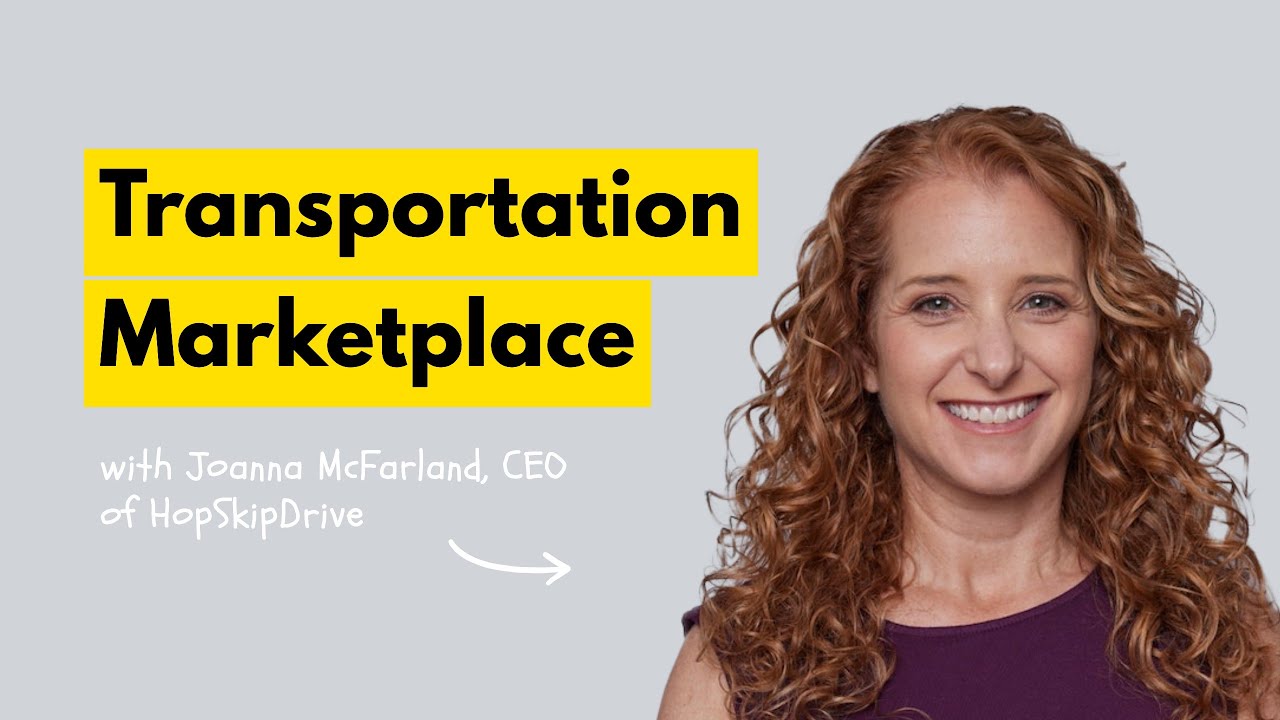
Joanna McFarland, co-founder and CEO of HopSkipDrive, discusses how the transportation marketplace pivoted from consumer service to B2B contracts with school districts. The company grew to 500 employees, developed a 15-point driver certification process, and built SafeRide monitoring to handle trust and safety in the marketplace.
Chapters
Welcome back to Everything Marketplaces, where we talk with founders and leaders from some of today's top marketplaces. So this is episode 169, which is a really great group chat that we just had with Joanna McFarland, who's the co-founder and CEO of Hop Skip Drive. Hop Skip Drive is a transportation service for kids that's used by over 10,000 schools and has scaled to being nationwide. They've also raised over $100 million in capital from top investors. So Joanna was an early group chat guest. This is great to welcome her back on. We started off with a quick refresher on the founding story and first steps for starting HopSkipDrive, what some early challenges were. We did an overview as a leading transportation service and marketplace today, got to learn more about how it's evolved, their recent growth, what the fundraising journey has been like, and we also had a great group Q&A. I really enjoyed this conversation and you're going to find it a great watch to the end. So Joanna, welcome back. And I believe it's been a while, almost 3 years since your past group chat. So, you know, I'm really excited to have you join us here today and would like to start off with saying huge thanks for taking the time to do so in advance. So we have a lot that we're going to chat about with HopSkipDrive and all of your recent growth. But before we do, I think it might be great if you can start off with a quick refresher on your background for those that have just joined us here and might not know you.
Yeah, absolutely. First of all, thank you for having me. It's great to be back. I'm Joanna McFarland. I'm the co-founder and CEO of HopSkipDrive. Before starting HopSkipDrive, you know, I started my career in investment banking and private equity. And then moved into finance and did product management for several years at, at a few different tech companies here in LA before starting, before starting Hop Skip Drive.
That's a great background. Thanks for sharing with us on that. You know, so I wanted to go back to the, you know, the very beginning with Hop Skip Drive. And so what was the founding story for Hop Skip Drive? And what were the first steps that you took to start it as a marketplace at the time?
Yeah. So we Yeah. So we started Hop Skip Drive about 10 years ago. And, you know, I'll tell the story. We're really kind of a 4-year-old company that's really a 10-year-old company. But we started the company about 10 years ago. And really, you know, as a busy parent myself, really struggling with getting my kids where they needed to go as a full-time working mom, was, you know, really struggling with that, figured there had to be a better way. And so there's 3 of us that started the company. We're all moms. We have 8 kids between us. And we built Hop Skip Drive to solve that problem and to create a trusted, safe marketplace that we as parents would feel comfortable using to get our kids to school and afterschool activities. So it really started as a consumer business. What you will, you know, as I tell the story, there were some twists and turns along the way, namely COVID, which nearly killed the business. And coming out of that really took it to, you know, we realized this was a huge problem for parents. But along the way, we realized this was an even bigger problem for school transportation, which is a $30 billion industry and is very broken. And so really morphed the marketplace from a B2C marketplace to a B2B marketplace. And, and that has been what we've been doing for the last 4 years coming out of COVID Yeah.
So you mentioned as far as, you know, the, the pivot from a consumer to a B2B. So could you share, you know, what led to this and at what point in time of the business this was?
That was really, it was a little bit before COVID but it was really coming out of COVID You know, we were growing very quickly as a marketplace. We had found product market fit and then COVID happened and we really screeched. I mean, when I say we screeched to a grinding halt, like we fell off a cliff and went to zero overnight and really stayed that way until schools reopened. But what we realized during that period, kind of '20 to early '21, was that there had been trends in student transportation that were only exacerbated by COVID. Namely, there, there had been a school bus driver shortage for over a decade. Many school bus drivers retired or left because of COVID and, and the truth is they're not coming back. This is a systemic decline in the industry. And what we realized was that the marketplace that we had built provided a very unique value proposition for school districts. We were creating supply that had never existed and bringing new drivers and new vehicles to a marketplace or to a market that was severely supply constrained at a point in time where they really needed a solution to this problem. And so what we had built before for consumers was very extensible to this B2B space. Now we're contracting with school districts, it's B2B demand, it's highly predictive demand, which may Makes the chicken and egg problem a lot easier to solve. And, and so I'm a huge fan of, of B2B. I think that is, if you can, if you can build a B2B marketplace, I think it's a much better, you're not dealing with customer acquisition in the same way on both sides of the marketplace.
Yeah, you mentioned a lot of great points specific to marketplaces here that we'll probably get, you know, get into in more detail. But I guess for a little bit of context, can you, could you give us a, you know, brief overview of Hopscotch Drive today? Before we do.
Yeah, so HopSkipDrive today, we operate in about 13 states. We work with about 600 school districts, so that's almost 10,000 schools that we cover. And what we do is we contract directly with school districts, so directly with school district departments of transportation, and we are solving school transportation in 2 ways. One is through our care-centered transportation marketplace where we help school districts supplement school buses. So we're not replacing school buses, but there's a lot of transportation where you really don't need a school bus. You have a very small group of kids, 1 kid, 2 kids. These kids might have very specific needs. They are experiencing homelessness, they have special needs, and so they're not necessarily going to their home school or they're moving around a lot. They're hard to route on a school bus. We also supplement in cases where there are driver shortages and we're helping with general education transportation because districts are just really struggling. And, and this comes up in the national news at this time of year every year as it's back to school, as districts across the country start to, to really face, uh, transportation shortages. So that's one way we solve it. The other way we solve school transportation is through software that we have built that really takes a very unique student-centered, uh, approach to routing solutions and, and creates multimodal solutions for schools. So really looks at each student and says, this the right vehicle, the right bus, the right, uh, or the right vehicle, the right route, the right stop for that student. So combining buses, sedans, and other modes of transportation to meet every student where they are.
Now that's really interesting. Sounds like, uh, you know, as far as, you know, the tool for routing kind of helps solve a lot of the, uh, kind of coordination and kind of the complexities that come with that on, on the school's end. You know, so how are you, uh, you know, reaching schools or kind of selling into schools?
So, you know, unlike a B2C marketplace, your approach on the demand side looks a little different. So we have a sales team that is focused on reaching out directly to departments of transportation as well as other departments within a district, right? We might be talking to the special needs department or other departments, and we are reaching out to them directly. We are contracting through direct procurement. We are contracting through RFP procurement. But once you like, you know, the way that our business works, it is very much you get in, you earn trust, you earn the right to continue to win. And we see districts continue to add rides and add use cases. So we may start small with a district and grow over time, but we know that their needs are only going to get bigger as we develop a deeper relationship with them.
Yeah. And you, you mentioned as far as trust, and I'm sure that'll kind of come up during the Q&A. But as far as, you know, for the school districts, you know, you mentioned like kind of starting with like a, I guess, like a kind of smaller segment, you know, as far as that. But like, you know, on a market level, like how big are the school districts? And like, it sounds like it's such a hyperlocal marketplace.
Well, it is and it isn't. So it's very much a geographic marketplace. But we work with, you know, districts as small as 2,000 students to districts like Los Angeles Unified that have as many as 400,000 students to, you know, Cypress Fairbanks in Houston has a little bit under that. You know, so it's, it's not so much about the size of the district, and there's multiple districts in a market. So we don't think about the size of a district so much as we think about the overall size of, you know, what is Kansas City, Missouri, and how many districts are in Kansas City, Missouri? How many districts are in Orange County? And how do we service those? Because what is unique to us that is different from other you know, school bus providers or other— is a Care driver could drive for District A and District B and District C all on the same day, right? And so that's actually part of our value proposition that we bring, but that's sort of new in the school transportation space. They're not really used to that concept. And so we think about densification at a city level or a market level. But it is very different. You know, it is very hyperlocal. And we think about each market specifically and what is LA looking like versus Denver versus Seattle and what are our needs in each market and how do we, you know, we are constantly looking at, you know, supply and demand balancing in each market.
No, it's always interesting to, you know, learn more about as far as, you know, the markets and as you mentioned, kind of balancing supply and demand, right? on a market level. So I guess, you know, what all goes into, you know, launching or kind of opening a new market?
So once we identify a new market, you know, and decide that we want to go there, we start building pipeline, we start building demand, we sign contracts. So we have a little bit of a sense of what demand is going to look like. And at that point, we can start onboarding Care Drivers. Care Drivers, you know, we talked about trust. Obviously, this is trust and safety is a huge part of our marketplace. It has been since the beginning, just like parents need to really trust and have confidence and believe in this, school districts do as well. And so it really starts with care drivers going through our 15-point certification process. That includes fingerprint-based background checks, that includes car driving record checks, that includes having 5 years of caregiving experience. And so once they go through that, They are on the platform. They can, you know, book rides. They can claim rides. Our marketplace is a prearranged marketplace. It's not, it's not on demand like Uber and Lyft. It's for schools. It's 8 hours notice. And so to them, that is very much on demand. That is kind of a response time that is unheard of in the school transportation space. But what that means is Care drivers can go into the app and see what rides are available and choose which rides they want. So it gives them a much deeper sense of control over their their schedule, when they're driving, where they're driving, how much money they're going to make. And so, you know, I think I talked about the value proposition on the school side of really bringing new supply to a very supply-constrained marketplace. The value proposition on the supply side is that we are really creating opportunities for flexible, safe income opportunities. Care drivers are not driving late at night. They're not driving drunk people in many ways. They see this as a very mission-based opportunity where they can make money while giving back in a way that really fits their schedule.
I'm glad we jumped over to the supply side now, right? So as you mentioned, it's a supply-constrained marketplace. So how are you reaching some of the care drivers and potentially unlocking new supply here?
Yeah, I think we're reaching them through pretty traditional channels. We're reaching them through social channels, through Google, through online and offline media. Referrals are a huge source of acquisition opportunities for us, and that starts to build over time. And then, you know, but I think it's really about awareness. And what we see as we get more dense in markets, the number of organic referrals and organic acquisition increases. And so that's something that we look at as we are looking at marketing mix and marketing channels. And we look, you know, our marketplace is interesting because it is very hard to get onto our platform by design, right? And so it's this tight conflicting, we want to get as many drivers as possible through that funnel and we wanna make that funnel really hard and we want to dissuade the wrong people from getting into that funnel. And so we are constantly trading off that tension and making sure that we are bringing the right care drivers onto the platform. But it takes a couple of things. couple of weeks to get through our platform. So it is not easy. So you need to really want to do this and go through all the hurdles. And we, you know, we want people who want to go through those hurdles because they understand that that's what it takes to be working with our audiences.
Got it.
Yeah, that definitely makes sense. So, you know, one of the topics that I wanted to chat about a little bit, you know, as far as, you know, building in more kind of regulated markets. So, you know, so what have been some of the biggest challenges maybe building in with, you know, building HopSkipDrive in probably more regulated markets compared to other marketplaces and some, some of the recent learnings around that?
Yeah, it's a great question. We are a very regulated marketplace and, and, you know, Uber and Lyft are obviously very regulated marketplaces. So like Uber and Lyft, we are regulated as a transportation network company. We have the same, with some modifications, we have the same license they do in many places. We've actually taken it a step further and worked with regulators in a couple of markets to get it So it's a TNC specifically for kids or specifically for schools. In addition to that, you know, departments of education have their own regulations around who can drive students and what that looks like. And for us, you know, a lot of those regulations were written 50 years ago and were written for a yellow school bus and a commercially licensed driver. And so a big part of our work is to create awareness and education for policymakers to get regulations changed. Part of the reason that we have such a driver shortage and we have so many struggles in school transportation is because of outdated regulations that don't reflect the reality of today and the reality of how kids are getting to school today. So we spend a lot of our time and have really invested in our policy and regulatory teams just educating legislators and regulators and working with them to get regulations changed. proud to say we've, we've had a number of successful states where we have changed regulations and, and have paved the way. And it's super meaningful because that's access to education for kids. Yeah.
So I've actually seen where you recently shared about it on social. So that was really cool. And congrats on that, by the way. So yeah, you mentioned as far as like the team for, you know, trust and safety, but, you know, I would say just like, you know, overall, you know, what is the Hop Skip Drive team like today?
Yes, our team has grown dramatically. We are approaching about 500 employees. And that's really across the organization, across engineering, across sales and marketing, across Care Driver operations, and trust and safety, and legal and policy. I mean, it's where we've got our— everybody's very— we're now at the stage, I think, where you're not generalists anymore. You're really specializing and hiring specialists who are experts in what they're doing. So that we can further our goals.
Oh, definitely. And as far as, you know, when it comes to like team building and hiring, do you have any tips maybe for, you know, earlier stage founders?
Definitely hire slow, fire fast. Nobody ever regrets letting the wrong person go, but you absolutely regret keeping them on too long. And that's such a hard rule to follow, and I'm guilty of not following it. But every time you do it, like, you very quickly realize that that was absolutely the right decision. You know, also we talk a lot at Hopscape Drive about hiring for culture add, not necessarily culture fit. And we talk a lot, you know, we are a very mission-driven company and we talk a lot about our values and hiring for our values and making sure people are aligned with those values. There's a lot of ways to achieve your goals and your mission and be very ambitious. And like, we just, we don't have time for that. Like, we're spending too much time here working on this to work with people who, it's just not that hard to be nice. And so we have a very strong, so I think that attracts a lot of people and makes people want to come and work here. And I think we've created a culture and an environment that feeds upon that and becomes a self, you know, a self-fulfilling prophecy and a network effect, a flywheel. And so, you know, I think we also have very strong retention. Like, people want to work here, they want to be here, they want to stay here.
Those are going to be great tips. And you got a few head nods as well. So we're actually going to just jump into questions here in a little bit because I'm getting some messages. But, you know, one of the other kind of topics that I wanted to chat about briefly is as far as fundraising. And I believe you've raised a little bit over $100 million from some pretty awesome investors. You know, so what has the more recent kind of fundraising journey been like? And, you know, what are some of your biggest learnings around fundraising?
So I'm actually excited to share that we have not raised since '22. We raised our Series D in '22 and fortunately have grown into profitability. And so we are in the wonderful position of not needing to raise again, which is great. It's a great place to be because it really gives you control over your own destiny. You know, fundraising is hard. Fundraising is brutal, especially in those early days, because, you know, it is a full-time job. It is more than a full-time job. It is 3 full-time jobs in and of itself. And in those early stages, you don't have other people to shift the rest of your work to. And so it becomes 5 full-time jobs. But I think it's really about— I think when we have been successful in fundraising, it has been about really creating a compelling story, a compelling reason why, a compelling reason why you, um, and, and why now, and then metrics to back that up. I think that, you know, while we haven't been in that fundraising space for a while, I think more in this environment, metrics and traction are, are more important than ever. And being able to show what those metrics are and why those metrics matter and why that traction is going to lead to the next set of milestones. But it is, it is, people don't realize what I would say about fundraising is, you know, you read TechCrunch and all these things and it looks like term sheets are falling out of the sky. That is like less than 1% of companies. The rest of companies, all it takes is one and it might take 400 pitches before that happens. And that's okay. Like the founder who gets up there and is like, oh, it was so hard. I had to pitch 30 people before I got my term sheet. Like, That is, I was like, that was like a Tuesday before lunch. Like, that's the reality. And what you see and read in the press is not reality. And so just ignore it.
I actually had a question that a founder sent me in advance, and it was around fundraising, and it was around objection handling from investors. And I know on your past group chat, it came from your past group chat, I believe, where it's mentioning, you know, that you're not like an Uber for kids or like a Just a Lyft for kids. And I'm sure you got that a lot when fundraising at the earlier stages. So, you know, how did you, you know, I would say, like, think about, you know, objection handling with investors? And do you have any tips for founders on that?
Yeah, I would say, you know, definitely practice with a few people who you don't intend to take money from. Do a couple of pitches out the gate with people because you'll hear the questions, and those are the questions that you're going to get over and over and over again. And so, In our very early stages, you know, we got, why isn't Uber going to do this? Or why isn't Lyft going to do this? And, you know, our answer was, it was a couple of things. We really believe that kids need transportation that is specifically designed for kids, that is not something that is an add-on to an existing service, because kids are different. They have different needs. So we talked about that when it comes to school transportation, that the amount of requirements that school districts have in terms of driver certification. Fingerprinting is table stakes, and that's just the beginning. There's a whole host of other rules that you need to follow and things that you need to do that would be very hard, if not impossible, for Uber or Lyft to try to do without the contagion of needing to do that with the rest of their driver pool. And so that's going to keep them out of space. So it was all about, this is how we are differentiated. And this is why that differentiation is important. And this is not just a niche. This is a, you know, school transportation is a $30 billion market. And that's just the school transportation part. That's not all the parents driving their kids around. So this is a massive market opportunity that requires very different and specific design and product. And that And that's really hard to do as like an add-on.
That's going to be super helpful. So we're going to get to the actual questions.
Yeah.
Is it Bertrand? Did you want to come on?
My question is that, is it seasonal when you are doing the agreements with the schools and the districts? And what is your answer when investors ask you that, oh, it's a seasonal business? I want to learn that. I'm going to take the second part of that question first. What would investors ask you if it's seasonal? I think as long as you can explain seasonality, I think that's totally fine, and investors understand that. You know, I was talking to somebody, they said, look, Intel— not Intel, Intuit, the tax, TurboTax— they make like 90% of their profit in like one month. That is as seasonal as it gets, and that's a very successful company, and investors understand that. And so, you know, we explain the same thing to investors. Look, summer there is volume, but it is much lower than what you're going to see through the rest of the year. And as long as you can point to that and explain it and show it, I think that's okay. Because then it becomes predictable, right? What they're looking for is predictability. And so you can say, look, yeah, the 3rd quarter is always going to look like this because there's no school in June and July. And I think with school districts, yes, our contracts are consumption-based. So they use us when they need us. And so that is very much kind of throughout the school year. What is interesting is more and more with a lot of the populations we serve, they're doing extended school year. So there is actually summer volume. As they're, they're taking, you know, they're, they're making sure that those kids are continuing on in their, their learning journey is, does June look anything like October? No. But as long as we can explain that, I think that's, that works. It's all about, you know, at this stage, it's all about getting very predictable.
Seasonality is always a great topic to, to chat through here. So cool. Hey, Dennis, do you want to come on?
Yeah. Joanna, thanks again. Super interesting, super impressive to hear what you've built. I've got sort of a question on the recruitment process. So for a little context, we actually partner with one of the largest substitute teacher agencies in the country. And so very familiar with the process in the districts. And, you know, we'd love to jam in sort of maybe in a different forum on Is there a way that substitute teachers could also be HopSkipDrive drivers? Because they're looking for ways, like they want to get involved, they believe in, they have passion in the space, but unfortunately there's not as much money in that. So if you could pair on, like you teach for the day and then you give rides home at the end, thought that'd be interesting.
Yeah.
But wanted to hear a little bit more about your recruitment process. Is it self-service? Is there a person in the loop? And like, what does that look like to become a driver?
We do have a lot of substitute teachers in our Care Driver network. So the recruitment process is a little bit of everything. It is self-serve, but there are humans. We have a very large Care Driver operations team that is managing things throughout the process. And then there's also a lot of AI in there as we're scanning. You know, we used to have people scanning documents and looking at each thing to make sure that the insurance was up to date and the driver's license was valid. And, you know, you can also have machines do that and do that a lot faster. So we automate every part of the process that we can that doesn't impact safety and doesn't impact our ability to evaluate whether this is the right kind of person for our platform. And then we have a team who is reviewing and meeting and talking and looking at every single driver. Care drivers are submitting videos of themselves. We ask them questions that are childcare-related to see how they would respond to those. And so there are humans involved. We're constantly tinkering with the funnel and the funnel looks very different in every single market. Another area where it's very hyperlocal because that's dependent on both the particular requirements of a market and also what's going to make the, you know, in some places fingerprinting comes first, in other places it comes last. So we're constantly A/B testing that and tweaking it and working with it to to maximize opportunity to get through the funnel.
Thank you. I appreciate the context.
Awesome. Thanks. Hey, Mason, do you want to jump on?
Thanks, Mike and Joanna. Thank you very much. Congratulations on scaling such an impressive business, and thanks for sharing that with all of us. My question's about how you earn trust, and I think you called it the right to win with school districts, with policymakers, And with the public, to the extent that that's applicable, I imagine there's something there. You had mentioned the 15-point certification process and a few things within that. I also imagine there's, you know, more beyond that in conversation with regulators, in mass communications, et cetera.
Yes. I mean, I think safety is in the DNA of literally everything that we do, right? When we first started, because trust is an outflow of safety, right? And so when we first started this, we designed everything, that 15-point certification process, which really hasn't changed. We designed that with the question, what would it take for me to put Jackson or Sam in a Hop Skip Drive, right? What would I as a parent want to see? And that's really what guided the initial conversations. And then it was also, I came from a tech background. How can we use data and technology to continuously innovate on safety? How can we design something? It goes back to being specifically designed for kids. What does this need to look like when the person who is in the vehicle didn't arrange the ride, may or may not have a cell phone, and may or may not be able to say like, hey, I don't— I think we're going the wrong way, or I'm not comfortable with this, I'm just going to get out and, you know, get into a different car. Like, you can't do that. A 7-year-old can't do that, right? And so how do we design this so it resolves Our whole Safe Ride technology platform, where we are—we've created a series of proactive and proprietary alerts. We have a team that is a Safe Ride support team that is monitoring every ride live in real time, in addition to the full transparency that parents and schools have. And we're constantly innovating on that and using using telematics to track driving behavior. We publish. So I think it's all about. The brand and how you, you have to have a very authentic brand that talks about your safety and transparency in a very authentic way. And I always tell the story, our very first ride, right? It was my co-founder's son going to gymnastics. We had built this whole thing. We had, it was a Care Driver that we had all 3 personally met. And we were watching on the computer as Gus was going to gymnastics. And we were also watching Janelle and she was really nervous. And she'd been a whole part of this thing. So it was like, if she's nervous, this is, you know, it just was such a clarifying moment for us of how much empathy had to go into the brand. And so you see it everywhere. And it's why transparency is so important to us. We publish a safety report. No one's making us do that. We don't have to. No one in school transportation actually does that. We do it every single year because we believe that you can't measure, you can't manage it if you're not measuring it. And we believe that if we're transparent, then hopefully others in the industry will be transparent as well. So far they haven't been, but we're hoping that that will change because we believe there's a lot of room to improve. And so I think that transparency speaks for itself as well as the constant innovations. Every year we publish that safety report, it's like, here are the 5 new products and features we're releasing this year that are going to improve on safety. So we view safety as we're never done. It's also about culture. You have to build that into your culture. And I remember somebody asked me once, you know, how do you think about the trade-off between growth and safety? And I said, there's no such thing because if we're not safe, we don't grow. And so, there will never be such a thing at PopScoop Drive as a trade-off between growth versus safety. And so, we talk about that here a lot, right? So, it's about, you have to build it into the culture. You have to be very authentic about, you know, you can say, oh yeah, we're safe, we're safe, we're safe. But if you're not authentic, it's very obvious. And then you have to make sure that you're building behind that to continue to innovate on that.
That's amazing. I can feel it and hear it from you. So thank you. It's both a really helpful combination of the softer empathetic and like the data-driven AI technical parts of mine.
So I'm very passionate about safety and using data to actually determine whether something makes— there's a lot in the school transportation industry that it's just about checking boxes. I'm just going to check this off the checklist. I've done that. We're safe. And so I'm very passionate about data when it comes to safety.
I know. Thank you very much.
I think that was also a great example of kind of going back to the early days too, as well, as far as like monitoring the rides as a founder yourself. And then, you know, if you kind of like fast forward to today, how that actually led led to, you know, having that actual kind of, you know, SafeRide support and kind of safety team there. So it can be super helpful. Hey, Jill, do you have a question? Do you want to come on?
Sure. Thanks. Thanks for being here, Joanna. My question's about achieving product market fit. How did you— what were some of those strategies that you used? And was it before or after you pivoted to B2B? Yeah, I— so I think we did have product market fit on the consumer side. And, you know, we looked at a number of things. You know, we just looked at, I think in the very early days, you know, just literally how many people were booking, how many people were coming on, how many consumers were signing up. And we— and how many then were repeat users. And, and so we found like we could, we could acquire families, and then we would keep those families. And we would see, you know, families were using us for one kid a couple times a week, and then like, oh, look, now their other kid is doing this activity. And so you started to see that kind of thing building, we were looking at care driver retention. Are care drivers sticking around? Are we offering them enough value once they go through that really hard funnel? Are we offering them enough value where they're staying? And we have care drivers who've been with us since 2015. You know, they really love this, this work that they're doing. So I think we found product-market fit, but it's kind of, you're, you are looking on both sides of the marketplace, right? I think as a marketplace, you always have to think about about who is your user and is your user coming back and is your user showing signs of they would be gutted if this wasn't in their lives. When we got to the school side, I think we hit, we had already built this product, this system, the marketplace. So we had supply, we had drivers, and I think we very quickly hit product market fit in a few very specific use cases. Particularly if you think about students who are experiencing homelessness or who are in the foster system, they move around a lot, right? These kids might move— an average child in foster care might move 4 times a year, and they're moving far. They have the federally mandated right to stay at their school of origin regardless of their housing situation. Transportation is one of the biggest blockers to that. If a kid moves at 10:30 at night, you can't reroute a school bus to get them to school the next day, and actually it takes like 2 to 3 weeks to reroute a school bus. out a school bus, if there's one even available, HopSkipDrive could get them to school the next day. So that was a huge unlock for transportation departments, for social workers. And so we hit product market fit very quickly. I think what we realized pretty quickly there is the number of users exploded, right? Now we've got a transportation department who is booking the ride, a kid who is in the ride, their parent or caregiver who was not really part of the buying decision, the Care Driver, the school secretary who's at the school waiting for this kid to show up. Like, there's just, there's a lot of different people that are users that our product touches. Not all of them are making the buying decision, but they all have to be kind of satisfied. We look at customer satisfaction across all those user groups because if you have an unsatisfied user, that's going to impact your relationship with the school and impact their wanting to use the service, right? So We think about all of those users all the time. And are we achieving product market fit with kind of each of those user groups? And we're building product for all of those user groups all the time.
Hey, Joanna, I actually had a related question from a founder that sent me a message earlier, which is going to be on like on the B2B side. So, you know, are there any like initial kind of learnings from, you know, selling into those kind of first kind of school districts or maybe kind of government agencies? That would be helpful for us as early stage kind of founders here selling into B2B.
So I think starting B2B and going B2C, every system you have doesn't work anymore, right? And you're literally building the plane while flying it. So, you know, as a B2C marketplace, you just, you know, credit users put in their credit card and you process payments via Stripe. Well, a school district's not going to hand you a credit card. So now you need a way to bill them. You need a way to create an invoice. Right? Like we didn't have that. We need a we needed a accounts receivable team to make sure that we were collecting that payment. You need you know it's one thing to book a ride on us on a phone app if you're a parent and you have maybe two or three kids. Maybe you're really ambitious and have four kids. It's another thing for a school district to book hundreds of rides for thousands of kids. You know they're not going to do that on a phone. So now you need a dashboard that they can you know specifically. So the needs of the user are different. The sales cycle is very different. And so it can be a lot longer than you think it can be. Sometimes it requires an RFP process, sometimes it can be direct procurement. So it can be really tricky to get into it, but once you're in it, it's great.
So always a topic kind of coming up is, you know, starting, starting with it since it is, can be so hard to break into, as you mentioned. So, well, cool. So we're almost out of time here, but, you know, this is such a great chat. So I appreciate, you know, taking the time to join us again. And I know we bounce around, But I covered lots of ground here. So this is, this is really helpful. So we appreciate it. Then actually, I had one last question for you before we wrap things up. And that's, if you could go right back to before you, you know, you started Hop Skip Drive, what would you tell yourself about marketplaces?
I would tell myself this is so much harder than I thought it was going to be, but so much more rewarding. And that, you know, every day is A roller coaster. I, you know, every single day I want to dance and I want to cry, often within the same five minutes. And that's, you know, still to this day. Like there's just no such thing as a normal Tuesday. And I would tell myself, you know, be prepared. Your own job is going to change every six months as the business progresses and as what you're doing progresses. What you need to do changes, right? I am not as in the weeds building. As I was back when we were trying to get product market fit or selling our first few customers. My job is very different now and to be prepared for that and to try to, you know, it usually, I usually realize that my 6 months are up about 3 months too late. And so have to kind of pivot, you're constantly pivoting. But to kind of be aware of that and try to try as much as you can to get ahead of that because that's how you're gonna continue to grow and scale. But it's way more fun than I thought it was ever going to be, and I'm completely unemployable now. So here we are. I love it.
That's a great way to wrap things up, and that's going to be a great parting advice for us. And then last but not least, time for a quick plug.
Where can we keep up with you at? hopscapedrive.com. We're on, you know, we're on all of the socials, probably in a slightly different way than a B2C marketplace. You're not actually— you're going to find us maybe advertising on TikTok, but you're not going to find a huge corporate presence on TikTok. But we are We are on all of the socials and constantly announcing all of the things that we're up to. We're just, we're in the middle of back to school right now. We just launched that, or in the process of launching 5 new markets for back to school. And so you're going to see a lot of exciting things from us this school year.
Awesome. Well, yeah, congrats on all the recent progress as well. So, and I can only imagine how busy you are. So once again, I appreciate, you know, taking the time to join us and I'll include our links in the recording as well. So thanks again for joining us as a guest today, and thanks everyone for the great questions.
More from Max




B2B Marketplaces In The Age Of AI With Sonia Nagar From SNAK Venture Partners | EM Group Chat #216

Insights From Investing In DoorDash With Saar Gur From CRV | EM Group Chat #215

Starting & Scaling Fora As A Leading Travel Marketplace With Evan Frank | EM Group Chat #214

Marketplace Investor Insights With Andrew Blachman From Marketplace Capital | EM Group Chat #213


Deep Dive Into ResortPass As A Leading Marketplace With Michael Wolf | EM Group Chat #211


Masterclass On Marketplaces In The Age Of AI With Fabrice Grinda From FJ Labs | EM Group Chat #209