Starting & Scaling Outschool With Amir Nathoo | EM Group Chat #178
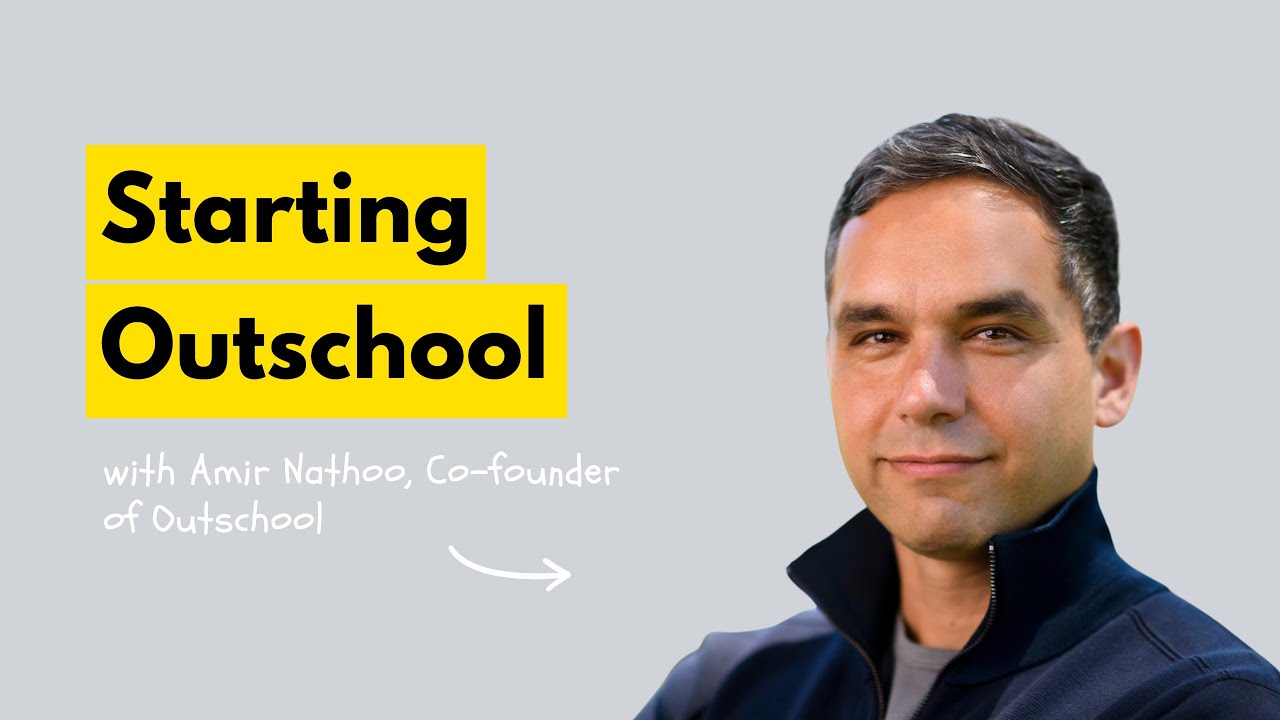
This content was created by Max Brun. This content was uploaded by Max Brun. This is a YouTube group-chat episode (Everything Marketplaces, EM Group Chat #178) created on 2024-12-22 featuring host Mike interviewing Amir Nathoo (co-founder & CEO of Outschool) with audience Q&A from participants like Dimitri and Lee. The conversation covers Outschool’s founding story, how they solved the marketplace “cold start,” the pivot from in-person to live online classes (pre-pandemic), growth strategies and COVID tailwinds, fundraising decisions and metrics, category and go-to-market choices, impacts of AI on edtech, and early liquidity/operational lessons. The format is an interview/panel-style discussion aimed at founders and marketplace operators.
Chapters
Welcome back to Everything Marketplaces, where we talk with founders and leaders from some of today's top marketplaces. So this is episode 178, which is really great group chat that we just had with Amir and Athu, who's a co-founder of Outschool. Outschool is a leading online marketplace for kids to access education and learning through virtual classes. Outschool has been listed on A16D's Marketplace 100 list. It's one of the fastest growing marketplaces the past few years. They've also raised over $190 million in capital from top investors like Lightspeed Ventures, Union Square Ventures. So this is a great chat with Amir. We went back to the founding story for Outschool, what the first steps were that they took to start as a marketplace, how they initially solved the cold start problem, how it's evolved and scaled. Amir gave us an overview of it as a leading online education marketplace today. We got to learn more about the recent growth, what the fundraising journey has been like, and we also had a great group Q&A. I really enjoyed this conversation and you're going to find it a great watch to the end. So Amir, I know I mentioned it to you right before we started recording, but Outschool has come up lots of times in the community and you've been a highly requested group chat guest. So I'm really excited to have you join us here today and wanted to start off by saying a huge thanks for taking the time to do so in advance. So before we dive into Outschool as a marketplace, I think it might be good if you can start off by briefly sharing your background for those here that might not know you.
Yeah, happy to and a pleasure to be here. Yeah, I hope this is helpful and interesting. Looking forward to questions as well. So, yeah, my background, I'm co-founder and CEO of Outschool. We founded the company in 2015, and I can go into the founding story. But in terms of my personal background, I grew up in the UK, started my career at IBM, always wanted to be a software entrepreneur and in software, started my first company in 2008. I went through Y Combinator, back in the day before it was the massively well-known accelerator it is today. So, very grateful to be part of that in the early days. Was acquihired by Square after many twists and turns with my first startup. Spent a couple of years at Square as a product leader building their Square payroll products, and then founded— left Square to found Outschool. And, yeah, that's a little bit about me. I live in San Francisco. I have a couple of kids who are now heavy users of of my own platform, which is wonderful.
Yeah, that's awesome. And thanks for sharing more with us. So a lot that we're gonna get into here, but if we go back to the very beginning, you know, what was the founding story for Outschool and what were the first steps that you took to start as a marketplace?
Well, I was very interested in education when thinking about my next steps after Square and potential projects I could work on. And the reason was that I wanted to have kids, but I didn't have kids yet. And I knew if I wanted to start something again, I was gonna have kids during the starting journey. And that got me thinking, well, it'd be nice if, like, what I was building was gonna be relevant to my future family. So, very personal kind of motivation to think about the space. But then I started realizing this is a really, really interesting space because it was one that wasn't hot at all from a tech perspective. It had not been transformed by technology in the same way others had and was in fact regarded as kind of a not great venture capital proposition or startup proposition because business models selling into the school systems were regarded as, yes, you can create businesses there, but there hadn't been breakout success. There hadn't been breakout transformation. But I looked at this more and more and I started to realize, well, hang on, there's something very interesting happening here because I personally had grown up through the internet. You know, the mobile phones were not— not everyone had mobile phones when I entered college. By the time I left college, everyone had mobile phones. Generally, people did not have computers in their rooms when I was in college. You queued up for the, you know, to access your email in the computer rooms. And, but then, you know, throughout my professional career, I'd grown up with this thing called the internet. I realized that that changed significantly how I thought kids should learn and what they might need to know in the future. I started to think there's probably gonna be other people about my age thinking about having young kids today who are gonna think in the same way. And yet the school system hadn't transformed. And then I also started thinking, well, fundamentally, people really, really care about their kids. And yet there was this perceived wisdom that, oh, you know, kind of education is a good market. But if you look at the fundamental emotional drivers under it, it's like, hmm, that's interesting. And the thesis started to form that maybe this was a space that was on the cusp of major transformation. But it just hadn't been the right company, the right way to engage parents in education. Hadn't been developed yet. So that was one set of influences. And then the marketplace model, you know, I was so influenced by, you know, how Lyft and Uber had transformed the, you know, right with, you know, taxi marketplace and turned it into a massively more interesting category than the taxi scene, similar with Airbnb and hotels. And so the thesis started to form of what if we could affect a similar transformation within education by applying a marketplace model direct to consumer. And so that was the initial conception of Outschool. Let's create a consumer marketplace for learning experiences outside of regular school.
That's a really cool founding story. So, you know, when we're starting a marketplace, of course, you know, face the chicken and the egg or that kind of cold start problem, right? So, you know, how did you initially solve for this with Outschool?
So many different tactics, but they all boil down to what Paul Graham calls do things that don't scale, but to an extreme level, because, you know, in consumer, you always worry about this, like, like, If it seems too kind of hands-on, you worry about scaling. But we recruited like the first customers, like the first 10 consumer customers, like manually, like literally networking into initially secular homeschooling groups in the Bay Area. That was our initial target audience. So, you know, I guess like recruiting initial customers both on the supply and the demand side, as if you were a B2B startup. So not worrying about scale, like literally going and selling, um, so things that look nothing like what people usually regard as consumer activities. And, um, having a business model before we had a product. So you can kind of fake your products, um, as an email list. It was like literally like a craigslist. I'd send out these, you know, network into these homeschooling groups, find, find teachers who were already are trying to offer their services to the group and then just send out an email and manually create it before even having a product and charging, even charging and testing the business model before having a product. The product's an email. And then because so many things had to work in order for the marketplace to be successful, we kind of had to build it a piece at a time while faking most of it. So for the longest time, it was not possible for a teacher to sign up for Outschool self-serve. You would literally hand recruit them and then you put, you know, get all their materials from them, manually post on the site. But while we're building out the demand side sites, the listings, the ability to search, the ability to see a class listing, and then, you know, for the longest time when you hit enroll, um, on the site, it would, it would be hooked up via Zapier to PagerDuty and I'd literally receive a page that someone had enrolled and put in their details, and I would then send them a Square invoice in order to effect payments until we built payments into the site. And then it was a big hurrah moment when it finally was possible for a parent to enroll and pay. And it was an even bigger hurrah moment when someone did that and we didn't really know where they were from. Like, they hadn't been kind of manually kind of walked through the process. And then we started building out the teacher side, saying, okay, can we get to the point where teachers can self-serve? And then we built the product out to the point that teachers could technically kind of, you know, come to the site and post their class, having gone through the application process. And again, it was another hurrah moment after we built that functionality when people did that without how— yeah, where we, again, we didn't know where they came from. And so it was a, you know, that real kind of detailed sequence of blocking and tackling. I think the final thing I'd say that people ask, like, how do you find the people? Who do you target on the demand and supply side? And I think it's important to start with the right niche. In our case, it was secular homeschoolers in the Bay Area. So, very narrow niche to go after. And then you have to build concentration within that niche, by which I mean, if you're gonna appeal, if you're gonna target those customers on the demand side at first, you have to get exactly the right supply to appeal to them, not general supply. I think people, think about like trying to blow it up too early on each side. So we'd ask the initial customers like, who do you work with already, um, in terms of teachers? And we'd also ask them, what are you missing? And we'd ask a bunch of parents that. And then we discovered that parents already— other parents already had resources that would be useful to other parents. So we targeted those specific like 10 teachers, not teachers generally who are looking to appeal to homeschoolers. And so you build this concentration on the demand and supply side, and then you get to a particular scale, you could start using more general and scalable marketing techniques. But that's the kind of things we did in the early days to solve the chicken and egg problem.
Yeah, those are lots of great examples of doing the things that don't scale, as you mentioned as well. So it sounds like you constrained— did you initially constrain markets to the Bay Area?
I mean, initially we actually offered in-person classes. Now we're fully online. But yeah, we didn't have a thesis about what kind of learning options. We just said, okay, we're gonna do— we have an interesting early adopter audience. They do these in-person things. Let's just start doing those in-person things. It was really learning, iterating with them that we figured out the pivot into live online learning, which has proven so valuable for our school.
Yeah. And can you all walk us through, you know, that pivot to online?
Yeah. So we were busy doing everything I just said and building the marketplace, you know, successfully, it seemed like it was growing and, and this was working and we were doing in-person classes, we were doing field trips. Uh, so we'd like book out field trips at museums and offer it to homeschoolers. They loved that because they couldn't get access to it because that's the kind of thing that schools did, blah, blah, blah. And then we, we started to realize, okay, well, this is working, but in order to really grow faster, we're going to need to figure out how to geographically expand. So we started dipping our toes into, into the LA market. Um, but, you know, it was hard. It was hard, especially when we're not local in LA. Um, And at the same time, we were noticing, you know, we're working very closely with these customers. We would go to these field trips, we'd go to these classes and see what they were doing, talk to them. And we noticed that a lot of these homeschoolers were also spending time getting together with their friends and hiring a teacher to do an online class, like over Skype or Zoom. And that seemed like interesting, but also like weird. Like, this is now a niche within a niche, like a tiny percentage of the activity of these people. But it seemed interesting because the, you know, the video technology was only being used in this way, which seemed really unusual to us. You know, everyone knew about like FaceTime with grandparents or, you know, using videos in a work setting like this. It was like, oh, that's interesting. This is like technology just being applied in an interesting way. So we thought there was something interesting there, even though it was a niche within a niche. We said, okay, well, let's try offering some classes on Zoom. And we tried it. And what we found was that quite quickly, like in a matter of like 3 to 6 months, those online classes kind of ate up the marketplace and it was becoming, it was growing faster than the core. And we started to realize that these classes had enormous benefits for customers on both sides of the marketplace as well as business benefits. Because from a business perspective, they released a constraint of growth. Like, how do you get concentration? Because these are live classes, you've got a group class, super hard logistical problem. You've got to get a group together at exactly the right time and exactly the right location around exactly the interest. That's a really hard matching problem. And by making, putting them live online, you release the constraint so that it makes sense that it could grow faster. And we also started to realize that Yeah, we'd be skeptical at first about online learning being good enough, but this live online learning was different and substantially from like MOOCs or content. The problem with MOOCs and content, as we were seeing from companies like, you know, Udemy and others at the time, was that, you know, they're very not engaging. People would start them, but like very few would finish, whereas these live classes, like 80% completion rate. And he started to realize that this format had the combined elements of the best of in-person, namely being interactive and much more engaging for kids with the benefits online, like releasing this business constraints and giving access to teachers and content that wouldn't necessarily be available locally. And even more than that, tremendous economic advantages. Parents could pay less than one-on-one tutoring or in-person classes. Because you didn't have the costs of the physical location and the group classes. The cost of teachers' time was split between families and teachers could earn more. So parents pay less, teachers earn more, engaging, more convenient than in-person classes because you don't have to travel, almost as engaging as in-person, engaging enough compared with alternatives. And what's more, no one had scaled this format to, um, in any way in, in education. And the technology, we, we thought, oh, we're gonna get loads of support requests, people aren't gonna be able to figure out how to use this stuff. No, kids found it easy. And, and the market was ready because everyone who used video conferencing at work or FaceTime. And so it had this real— and so it gave us this real strong why now, a technical advantage, a real strong differentiator compared with other education options. The only thing we then needed to do was to scale live online learning to many people, which is of course extremely hard in and of itself, but at least that the fundamentals were there in terms of the value proposition and differentiation.
Now we're gonna get into a little bit more detail here. And I can imagine though, you know, with like the offline classes, how much coordination and probably operational complexity went into that as well. So, and, you know, it's worth noting too, I guess, at what point in time the pandemic kind of played part of the story. So Was this, you know, prior to the shift to or pivot to online or?
Oh, so we pivoted to online in January 2018. Oh no, sorry, January 2017. And we launched, you know, we'd been kind of iterating the marketplace very scrappy, not really launching, but we kind of launched and announced a previously raised seed round in summer 2017. That's where we really found product market fit. This was well before the pandemic. And then based off, you know, finding that product-market fit, the metrics growing, and us finding channels to scale, we raised our Series A in 2018. And, you know, additional more investors came into our Series A in 2019. And by the time the pandemic hit, we were at about a scale of about 70,000-ish learners on the demand side, around approaching 1,000 teachers on the supply side. about $6 million top line bookings, GMV in 2019. And our take rate is 30%. So our revenue was about $1.5 million. So we'd found initial product market fit, got to initial scale. And our big strategic effort as a company was to say, okay, now we found product market fit with homeschoolers. Can we show that Outschool can be used to supplement kids' education more broadly, like as tutoring or weekend classes after school, summer. And we'd just gotten to the point where about 50% of our business was from schoolers and 50% from homeschoolers. And then the pandemic hit and things completely changed at that point, as it did for many companies and many people.
Yeah, I can imagine. And you mentioned a few topics that we're gonna get into, but I guess it might be helpful though, you know, for those that don't know about Outschool, You know, could you give us an overview of it as a marketplace today?
Yeah. So it's a marketplace of live online classes for kids. So kids meet in small groups over video chat, much like this. And they meet with a teacher and the teacher offers classes that are everything you can imagine, everything from like core math and reading to crossover classes like learn math through Minecraft, to pure enrichment or interest-based or career-based learning, like learn cat anatomy from a vet, or, you know, stock market trading from a finance expert. Anything you can imagine. We have over 100,000 classes. We've served over a million learners worldwide. We have about 10,000 teachers on the platform. And we're the market leader in live online learning. Now we offer both small group classes as well as one-on-one tutoring in academics and enrichment. And this is almost all direct to consumer. We also have a nascent public funding business where school choice programs in various states allow parents to spend public funds without school as a core provider. So that's a real quick overview of business. And this is K-12 education. So for kids, between the ages of 3 to 18.
Got it. And then how have you, you mentioned a lot of different categories that you serve. So how have you approached, you know, category expansion?
So there are many different ways to slice categories in Outschool. We went broad initially by both subjects and age because that gave us the broadest possible surface area to serve our initial audience of homeschoolers because one challenge was, is every every kid is different, so their needs change with time. And so being too narrow would have meant that much harder to build marketplace liquidity. So we decided to pivot around a particular kind of user persona at first and focus on homeschoolers while remaining broad when it comes to subjects and when it comes to time. And like the decisions about where to focus and where to be broad are critical to marketplaces and a bit counterintuitive compared with other businesses. You can't be too narrow in too many dimensions, otherwise you'll stifle liquidity. So you have to choose where to be broad. And wherever you do choose to be broad, that's where you'll get constant questions from investors or others. Oh, you look not focused. But it's actually important to be broad in certain areas. That's one of the distinctions of operating and starting a marketplace compared to starting a regular business. Wherever it is you, from a design perspective, you choose to be broad, that's where you're gonna get constant questions and criticism whether that's the right decision. But it's extremely important to make those decisions. But while we're on the topic, the other thing that's counterintuitive about building marketplaces is usually for most product developments, you focus on creating a really lovable experience and really focus on retention before you put the turn on the gas on growth. You can't do that in a marketplace because liquidity is a core part of your product proposition, the fact that you have supply. So you have to do both in parallel and you have to both be growing both supply, demand, and improving the experience in parallel. And getting to greater scale is a path to getting retention. So again, it's another way in which marketplaces are tough and you look unfocused because you're like constantly flitting between the demand side, supply side, trying to trying to improve the products and why often marketplaces in the early days can look too scrappy and low quality from a, from a disinterested observer because they're not putting themselves in the feet of the, in the shoes of the customer where it doesn't matter if the product's a bit janky, if the supply is great. And so again, it's easy to misinterpret or misuse regular startup advice or regular company building advice with marketplaces. Generally, startup building is quite a misunderstood area, even amongst people who are allegedly experienced and close to it, like many investors. Marketplaces are at the next level in terms of complexity. And so I think, you know, trusting in your own insights into your market is even more critical when it comes to building marketplaces than other kinds of business, in my opinion.
Certainly. So, so you've also been mentioned on A16z's Marketplace 100 as one of the fastest growing marketplaces in the past few years. So I wanted to, you know, talk about growth and, you know, so how have you approached growth at Outschool?
So I think of growth as at the highest level, I think there are 2 techniques to grow. One is you— and I think of it like a boat. I don't sail, but this is just my analogy, so bear with me. It's like a boat. You have a sail and you try and position your sail and you design your sail and kind of weigh your broads, kind of affects the shape of the sail. And you sit there in the market and you try and build a sail that's gonna be positioned to receive wind, like trends in the market. That's one way to grow. The more common thing that's talked about when you listen to Reforge or growth is building a growth engine. So that's like repeatable motions, like SEO growth loops or viral growth loops or paid growth loops, that kind of thing, or sales growth loops. And that's building a growth engine. And you've got to kind of have, or you'll benefit the most if you have both. And, you know, to make this real, for example, in 2018, after we'd found initial product-market fit with Secular Homeschoolers, we found our first growth engine, which was actually a paid growth loop. Back in those days, paid was actually much more attractive because you could, once you get to a certain scale, like 1,000 customers, you could upload your customer list to Facebook and do a lookalike audience, say, find me more people like these first 1,000. You need a minimum of 1,000 before it became effective. And it'd be really effective. And then on the Splice side, we had all these interesting classes, which turned out made great space for create Facebook ads. We didn't need to design ads. We just, you know, uploaded a feed and we discovered that, you know, we were able to buy customers with like a 3 to 6 month payback period. So we were able to scale our revenue pretty rapidly and then put the revenue back into scaling this paid growth loop. And that allowed us to grow our business like 4 or 5x in 2018, which is by far our fastest growth rate at that point. So that's an example of discovering a growth loop and then putting your foot to the gas to really kind of make that scale. Another example of growth was obviously COVID. Now COVID was the most enormous gust of wind in the market towards online learning, but we grew 15x in 2020. Most edtech startups grew about 3x. So why was this gust of wind so effective for us? Part of it was just structural positioning, like we were live online learning, which everyone wanted versus other types of online learning. But other key attributes of Marketplace that enabled us to scale very rapidly within the gust of wind was the fact that we were so broad with the age ranges and the subject areas. And so every part of our market, you know, we had built this big sail that, and every part of it was capturing wind. And then we positioned it right. So, even before COVID shut schools down, we started to realize that this might be really big for our business. We did 2 things that are completely separate to building our products. We started doing webinars for teachers and administrators because we started realizing that probably of any organization in the world, we were the most experienced at running these live online classes. And that suddenly all these schools were gonna try and do the same. So, we didn't try and make money out of it. We just, like I said, shit, well, we better, we don't really know what to do.
So, what we're gonna do is just we're gonna try and help.
And we have this expertise. We just start running these webinars. They became hugely popular. Thousands and thousands of teachers and administrators joined. And then through that, we realized this is a drop in the ocean. This is gonna be an absolute shit show in the school system in general. And no matter how much we quickly, we try and transmit this knowledge, like, you can't just take a system and put it online overnight. It's gonna be an absolute shit show. And then we started to think, well, what's gonna happen? Well, families with means are going to come to Outschool and other sites to try and fill in the gaps and supplement education while the school system attempted to adapt. And secondly, families without means were gonna be left out hanging. And so we span up a nonprofit arm and we said, what we're gonna do is we're gonna offer free classes for parents in need because that's gonna be a critical need during this pandemic. And we Funded initially from the company. We did a partnership with Zoom. We funded to like $50K. We're gonna offer $50K free classes. And we launched this program on Friday the 13th, 2020, which happened to be the day that mass school shutdowns happened. And at that point, like, growth didn't look like exponential. It looked like going up a cliff. And we ran out of that initial $50K at 2 AM on the Saturday morning. We funded it more. We raised external funding. But then the for-profit elements of the business just started rocket shipping. So we realized we could fund this free class program for an extended period and we ended up putting like $3 million into the free class program and raising $3 million externally just to provide these free classes for kids. So that was an example of the wind and positioning. It's an extreme example. You can't usually, we didn't build this company expecting there to be a global pandemic, right? So you can't rely on it to the extreme degree. that we did. But that's an example of how building a sail, experiencing a massive upshot of wind and correct positioning can also be a driver. And so those 2 tactics, find growth loops and position your company for market tailwinds.
That's pretty incredible growth. And, you know, something we're also talking about here in the community is, you know, how big of an advantage it can be kind of having those tailwinds, right? And then at the same time, you know, how hard it can be kind of, you know, facing headwinds. Yeah.
And, you know, we experienced the reverse coming out of COVID right? Because, and it's not that we experienced, it's not the reverse in the sense that it's headwinds. Like, it's more like, you know, when you experience those tailwinds and then the tailwind drops back to kind of normal levels, the massive danger for a marketplace is, you know, your demand's gonna drop. So even if you're positioned very well for the long term and it's just a natural resetting, Your demand drops. Now, what happens when your demand drops? You risk losing your supply. What happens if you risk losing supply? Well, then your product becomes less attractive and maybe retention goes down. So there's a big danger that you get into death spirals the other way around. It's incredibly strong when you're growing both sides because you're getting more scale advantages. So momentum is particularly important to startups. But then it's never a kind of a smooth road. So then what's the playbook? And this is something I've kind of learned the hard way over the last couple of years. And now we're out the other end, fortunately. But what's the playbook when you are or do face that declining tailwind and you've got to worry about retention? I think the playbook is focus on providing a real quality experience for your supply side and your, well, both sides, but it's really, really important to retain your supply side. Number 2, you have to invest enough. So, even if you've got, you know, all these, you know, declining tailwinds, that's the time, you know, that can be a time when, oh, I've got to be efficient, right? I've got to cut costs. Yes, to an extent. But, you know, what we did was we invested enough to hold our top line flat despite those tailwinds that allowed us to not get in that spiral. And this is a really tough conversation from an investor point of view, because investors, by and large, are used to, oh, when things are going well, you invest more. When things are going badly, you kind of take your time to figure it out. And for most businesses, I think that's exactly right. For marketplaces, it can be death. And what you have to do is make sure in the good times, you raise sufficient money, and then don't spend it. And then in the bad times, you kind of soften the, um, soften the, um, uh, the blow by, by continuing to invest and making in, in growth and making sure that even though you're not growing your top line, you're still investing to, to smooth that over. And, um, again, this is something that really most investors, even if they understand intellectually, it feels really hard and risky to do because it goes against our instincts, you know, of hunkering down when things are going not so great and, and real, and then, you know, being overly enthusiastic when things are good. And as a founder, marketplace founder, you've got to kind of dampen Both of those instincts.
Certainly, that's a great transition actually into fundraising because that was a topic I wanted to discuss a little bit. And I believe you've raised whatever, $190 million from some pretty awesome investors like Lightspeed Ventures and Union Square Ventures. So what has the fundraising journey been like and what are some of your key learnings from fundraising?
So in the earliest days, we decided we weren't going to raise very much funding, only from true believers, because marketplaces tend to either work or they don't. And so we believed it would generally be hard to show kind of the quality experience, the quality of metrics needed to raise large amounts of money in the early days. And secondly, that's doubly the case in edtech, which wasn't regarded as a hot investment area. So we designed the company to be very patient and scrappy in the early days. There was 4 of us for like 3 years. So very, very scrappy, almost to a kind of extreme. extreme degree. We did raise seed funding, but we were very, very careful with it. And our focus was, you know, long runway in order to figure out the initial kind of chicken and egg problem. Then, you know, we started putting our foot on the gas after it was clear that we had product market fit. And the clear signs of that were flattening retention curve, not as high as we would like, but the retention curve did flatten after about 6 months. Good CAC LTV characteristics as we found that paid growth loop in 2018 and a chart that looked like that in terms of top line GMV. And that gave us power with Series A investors. Oh, and also, you know, being around a million dollar revenue run rate. And then of course, when COVID hits and we experience those tailwinds, Um, you know, we took advantage. You know, some companies held back, not wanting to kind of set expectations too high by raising too much or driving the valuation too high. We did the exact opposite, lent in, raised a ton of money at a very high valuation, um, with the belief that that, um, bank balance was gonna be incredibly important when the tailwinds subsided. And that's proven to be the, absolutely to be, to be the case. So I think the idea that you have to be scrappy in the early stages of marketplace, I think is right. It's very, very tough to raise a marketplace business, particularly until you've got the metrics. But I would also say you can't, you've got to, I think Bill Gurley has an expression, you've gotta dance when the music's playing. You know, there are big downsides to raising a lot of money. There are big downsides to driving your valuation up. You know what, a lot of the time, the downsides to not doing that when the time is right are worse. And you have to be conscious of the risks, and I can go into what the risks are. But generally, you have to raise when you're in a position of power. You have to raise when the markets are good.
Those are really great points that you mentioned. So we're gonna go ahead and get into the group Q&A because I'm getting some messages. Hey, Dimitri, saw you raise your hand. You wanna help us kick things off here?
Thanks, Mike. I have a question about how you're thinking about some of the developments in AI that we're seeing in edtech. And sort of a lot of the promise that I hear from folks building these tools is that the future is basically personalized one-on-one tutoring with unlimited questions. And so like even in my own field economics, there's now something called All Day TA where you upload your course materials and you have Unlimited EA 24 hours a day, and your physical TAs can, like, focus on students that are struggling. Are these tools kind of complementary to your approach? Are they competing with what you're offering? And in particular, like, are you worried about, like, a superstar dynamic where there's only, you know, a handful of really awesome math teachers that are all sort of AI augmented that kind of capture a large share of the education market and obviously changes their bargaining power with your platform and kind of how do you think about all this?
Yeah, great question. I think my answer differs in the short, in the short term compared to the long term. In the short term, I think we benefit quite significantly from these trends because the initial use cases for AI that have been widely adopted are things like saving teachers time and kids cheating on homework. Well, guess what? If teachers can save time, they can spend more time teaching on Outschool. If kids are cheating on homework, it's disruptive to traditional education. And generally, anything that disrupts traditional education is going to benefit benefit our platform. And similarly, I think, you know, the other thing from a societal perspective is that, you know, one of the reasons why anxiety has been increasing with traditional education and people are searching for alternatives like Outschool is because people sense that how the world is changing and what they're experiencing as parents in their everyday lives is diverging from how school is operating. And that sense of, you know, the incongruence between traditional schooling and where the world is going is gonna increase with AI. And so benefits our business. I think the challenge will come with if this idea, this vision of the all-encompassing AI tutor can actually be made real, because it's a lot more than demos. And B, is actually appealing to kids and parents, which I think is the bigger risk. That's the key question. Our bet is that there is enduring value in humans in education. And parents, even if that amazing tutor, automated tutor is possible, and I think there's still big questions about that, parents are not going to want their kids to spend all of their time in front of a computer interacting with an AI tutor. They are going to want a human education. Now, what the humans do is an open question. What if the AI thing is better at teaching math, better at doing the majority of what we consider kind of current core education? It'll have to evolve. But as a parent myself, I think I want my kid talking to humans as part of their kid's education. So we're going to focus on that part and use AI to make the human interaction better, whether it's everything from discovering the right humans to put together to have a really great learning experience, to reducing kind of teacher workloads to like AI teaching assistants, superpower teachers, personalize. All of those are within scope. But I think the idea of completely replacing humans in K-12 education is wrong.
Thank you.
And not because, not because it's ethically wrong, but because people don't want it.
Awesome.
That's a great question. Hey, Lee, do you want to come on?
Yeah.
Hey, thank you. Wanted to learn a little bit more about the pre-tipping point experiences on go-to-market. You mentioned that you had a period of 4 to 5x growth, generally driven by paid. I was curious, was that the member side or the teacher side? And really specifically, like, what was your approach for when you didn't get a class to critical mass? I'm an Outschool parent and I know that one of my classes didn't move forward. I have to imagine that was happening all the time in the early days. So if you could kind of combine those 2 questions, I'd really appreciate it.
Great, great questions. I'll actually, you asked about the paid growth loop, but that came in 2018. So 3 years beforehand when we were scaling to get the parents parent side to above 1,000 and the teacher side into the thousands of teachers, like 100, which, which had nothing to do with paid. And I think it'd be, it'd be wrong to use paid too early. In the early days, the first kind of methods to kind of scale were basically, I'd call it community growth, like meeting influential parents within the homeschool community who ran Facebook groups and Yahoo groups, getting them on side, getting either the ability to post those groups ourselves, or, you know, get the organizers to post on our behalf, or even at one point we paid a consultant who was like a very connected homeschool mom to kind of, you know, promote us in these groups. So it's community-based. And in the early days on the teacher side, it was similar, but it was very kind of like, go ask parents who they like to work with and then recruit those teachers. And then Through that process, we realized a couple of things. At a certain point, we didn't need to worry about teacher growth because there's sufficient overlap between the parents and teachers in this community. So we could basically focus almost all our efforts on the demand side. And secondly, because of the nature of the products, group classes, there was almost always flex on the demand side to add a few more spots to a popular class. So again, we didn't have to worry about supply constraints like some marketplaces might. So It's important to understand those, and this will vary by domain. What's the limiting factor? And it's very, very specific. But these are the things we discovered about ours. Don't take these as general lessons. It's more like just the process of discovering those limiting factors and those simplifying factors are incredibly important. So we figured out we could, we only really need to support, focus on the demand side in terms of growth. And then secondly, you asked about kind of the liquidity issue, like what happens when there's not critical mass? And this was the cool thing we discovered, particularly with the homeschool community, is they weren't bothered. Teachers were prepared to put sections up, like specific schedule for classes speculatively and see. And if they didn't get any enrollments, fine. They're just, if they got only 50% of the sections went ahead, that was a key discovery that they were willing to do that. They just wanted to fill their time. And moreover, they'd set a minimum group size and price per class. But if they only got one enrollment, most of the time they were happy to proceed. Because they were looking for the extra income. They were setting certain parameters, but they were more flexible. It would have been a mistake if early on we'd built too many features into our product. For example, auto-cancel classes if they didn't hit a minimum. We kind of just let it break a bit. And this is kind of part of the jank that you kind of need to introduce to marketplace in order to make sure it's flexible enough to deal. So you actually learn what people want rather than assuming it and building features too preemptively. And it's still a bad parent experience when it gets canceled. But again, it was happening less frequently than we expected. I think the other critical piece was a tolerant early adopter audience who was into experimentation, who was so underserved that they were willing to tolerate jank that, you know, later customers wouldn't. But then later, you're at scale, so you can make the experience better. So, so it's really important to kind of, for us in this domain and probably marketplace in general, to in the early days be serving people who are so underserved, they'll tolerate things like that. Then the paid loop came later once we'd already at sufficient scale where we're really trying to put our foot on the gas and find more scalable methods than the, than the early methods that we used. So—
Tell me what that scale was like when you turned that on.
So, I mean, I think paid in general is, it's a bad idea to use paid. Well, Okay, I'll carry this. It was thousands of families on the demand side, hundreds of teachers on the supply side, and we had the signals of product market fit. There might, I was about to say, it's probably a bad idea to use a paid loop specifically until you've hit product market fit or at least have strong unit economics. There might be some arguments that in order to bootstrap in certain markets that some selective use of paid earlier might make sense. But I'd generally be very, very wary of using paid techniques until, until you've found product-market fit with a strong business model.
Awesome. Those are great questions. Appreciate it. Hey, Amir, I actually want to jump in here and ask a question that a founder wanted to ask me in advance and sent me, but it's around, you know, the role that trust and safety plays with Outschool and maybe some of the measures that you're taking with potentially like vetting teachers. So could you share more about that?
That's a great question because it's a core design question for a marketplace. Are you a completely open marketplace? Are you managed? Are you somewhat managed? Are you fully managed? Especially with marketplaces involving labor, then there's a question of, you know, are you a platform serving kind of independent businesses on the supply side or are you ultimately kind of a W-2 employer? Lots of issues around that. We learned, well, at first we created the marketplace as open with kind of vetting after the fact. So in the very earliest stages, you know, with, you know, the first version of the self-serve supply side was you could put a class up and then we'd kind of check after the fact whether it was rubbish. But because it's such a small community, an insular community, that, you know, in itself kind of provided some reassurance. But we very quickly, but we always thought that in education, this couldn't be completely open. This just couldn't be completely open. This can't be a Wild West like YouTube. We wouldn't be able to retain parent trust if we did it. So we always intended to manage it, but the question was how much. And What we landed on was we have to be more open than the school system. But honestly, that's not hard. It's really not hard. But we actually wanna go quite a lot further than being— so tend towards openness, but that encourages experimentation, learning, and liquidity. And it's also a design feature based on our thesis about demand. This is a market where we believe personalization is extremely important. The best teacher for one kid is not the best teacher for another. And we'd also have to check ourselves. We watched some of these class videos from the early classes and we see this teaching, oh, this, I'm not sure this is good. The kids loved it. And so you, as an adult, you've also gotta be kind of, be a bit humble that there's the good fit for kids and you might not think it's good, but, but if it, you know, as long as it meets certain criteria and the kids love it, then you should let it go. So we opted to be managed but be very liberal. Now, how do we manage? Well, safety. We can't have predators on the platform. We can't have bad actors on the platform. So we need background checks. We need a teacher application process. And then content policies. So while we don't want to set curriculum and we want to enable experimentation for teachers to teach classes on what they want to teach, we need to put some limits in place. And the limits we put in place are, we need— our content policy is that classes must be secular, objective, and age-appropriate. Um, and by objective, we— by secular, we mean you can teach a class on religion, you just can't do religious instruction. Um, uh, by objective, um, we mean the majority of experts in this field would agree that this is a reasonable way for the class to be taught. And age-appropriate is, you know, following guidelines from the World Health Organization and other international institutions that this is appropriate content for this age or not appropriate content for For this age. We set those, but those are very specific to our domain and also kind of specific to some of the challenges of our domain. So, so if you're thinking about these design choices for your marketplace, it's very domain-specific. Why those particular ones? Why secular? Well, our early adopter audience was homeschoolers, and a lot of people have a preconception that homeschooling is done for very kind of extreme religious reasons. We were worried about being tarred with that brush when we went to a wider audience. And our early adopter audience were hypersensitive to having religion stuffed down their throats. They insisted that we have a secular policy, but they didn't want religious curriculum. So it was driven by customers and driven by strategy, not ideology. And then objectives. Similarly, like, we kind of want to go for the widest, widest audience and eliminate sources of distraction and controversy. And so by having kind of some light guidelines around like how social studies should be, Should we talk? Like in the early days, we had like a history class, and it was the most jingoistic. It was like a brief history of America. It's the most jingoistic crap you could ever imagine. Like you know, like everything from like you know scare stories about Islamic terrorism to to like to complete whitewashing of history. It was the most biased thing in the world ever. It's like we there's no way we can have this on a learning platform. History be taught this way. We have to. put some limits in here. And, you know, that led to the objective policy. And then, and, you know, age appropriate is kind of obvious when it comes to domain. But so if you're gonna manage, then manage in a way that's very, very appropriate to domain, I think is the only generalization to make here.
That's gonna be really helpful. So I appreciate it. So cool. Hey, Molly, do you wanna come on? We'll try to squeeze in one last question here.
Yeah, I had a question about personalization. So how you foster that kind of in a community like this where, Taste is subjective and kind of your 5-star is not my 5-star, right? It's not just the subject matter, but it's perhaps how the teacher teaches the class, their particular approach. Is there a way that you're fostering that on your platform?
There's a couple of different ways. One is just the way we guide the supply side by telling them to teach the classes they've always wanted to teach and teach subjects that they're enthusiastic about, trusting that that enthusiasm is gonna translate into a good experience for kids who are equally enthusiastic. The other is simple search and discovery tools. So enable people to search for what they want. So, and the other that we're working on now is things like better using reviews to use AI to pull out tags and to pull out summaries so that families can find exactly what they want. But I would say that this is like, this is core We'll always be working on this at Outschool. We haven't figured it out yet. You know, we did certain things in the early days to enable this, but this is the forever challenge for Outschool and I think for many marketplaces. One of the challenges of marketplaces is, in theory, having all this variety of supply provides tremendous value for demand, but it's actually a scale disadvantage because the more you scale, the more overwhelming your supply gets unless you provide better and better tools for personalization. So that's why it's a forever problem for a marketplace like us.
It's a good last question to wrap things up. So we're out of time here, Amir, but I really appreciate taking the time to join us here today. This is really cool to hear about all your experience and learnings and insights here from building Outschool. And it's really incredible to see what you built with it as a marketplace too. So big congrats on that as well. So actually, I had one last question before we wrap things up, and that's kind of my My closing question, which is that if you could go right back to before you started Outschool, you know, what would you tell yourself about marketplaces specifically?
That's a great question. Be ready for a long, difficult road. But if it works, it works. If it works, it works and stick to your guns. There's a lot that's counterintuitive about marketplaces. I hadn't fully appreciated that. You've got to stick to your guns and trust your instincts and trust your insights into your own market.
That's gonna be great parting advice for us all here. And last but not least, time for a quick plug. Where can we keep up with you at?
Amir@outschool.com. Would love to hear from you. Love startups, love marketplaces. Feel free to get in touch. LinkedIn. I'm very active on LinkedIn. Feel free to follow or connect. Would love to hear from you.
Awesome. I'll include links in the recording and I'm sure you'll have lots of marketplace founders coming your way. So we really appreciate, you know, taking the time to join us here again and thank Thanks everyone for the great questions.
More from Max




B2B Marketplaces In The Age Of AI With Sonia Nagar From SNAK Venture Partners | EM Group Chat #216

Insights From Investing In DoorDash With Saar Gur From CRV | EM Group Chat #215

Starting & Scaling Fora As A Leading Travel Marketplace With Evan Frank | EM Group Chat #214

Marketplace Investor Insights With Andrew Blachman From Marketplace Capital | EM Group Chat #213


Deep Dive Into ResortPass As A Leading Marketplace With Michael Wolf | EM Group Chat #211


Masterclass On Marketplaces In The Age Of AI With Fabrice Grinda From FJ Labs | EM Group Chat #209