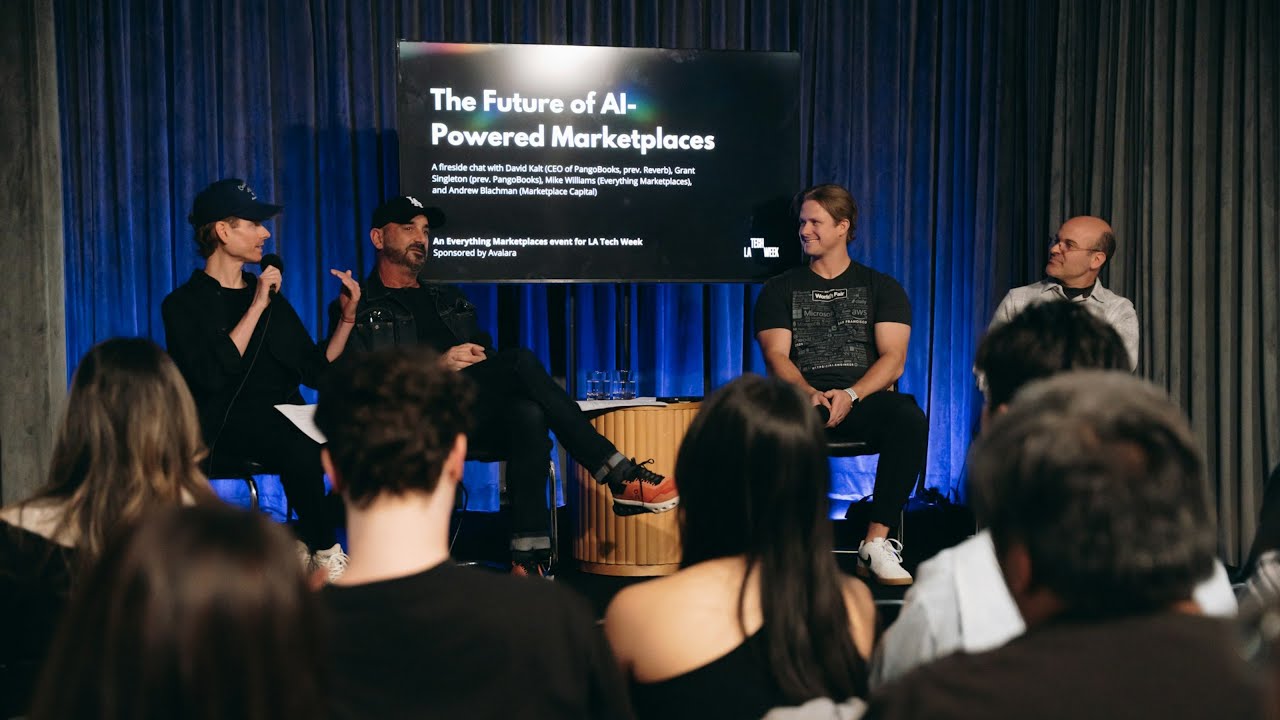
This content was created by Max Brun. This content was uploaded by Max Brun. This is a YouTube video titled "The Future of AI-Powered Marketplaces" (posted 2025-12-16). It is an English-format panel/fireside chat held for the Everything Marketplaces community (Tech Week) about how AI and LLMs are changing marketplaces. Participants include Mike (host), Grant (founder of Pango Books / technical founder), David Kalt (Reverb founder / former OptionsXpress), Andrew (investor, Marketplace Capital), and other community founders; they discuss marketplace evolution (1.0–3.0), concrete AI use cases (agentic coding, database building, AI shopping assistants, listing enrichment, SEO/AEO, fraud/content moderation, automated support), operational efficiency, and fundraising considerations. Metadata: contenttype=YOUTUBE, thumbnail=https://i.ytimg.com/vi/SstUIuApxhQ/maxresdefault.jpg, createdtime=2025-12-16T17:03:16Z.
Chapters
We're here for the Everything Marketplaces community. We did this event for Tech Week to bring everyone here together, and we thought that we would have a chat here on the topic of AI-powered marketplaces because of course we're in an exciting new era with marketplaces, with the recent advancements in AI and also LLMs specifically. So that's gonna be the nature of the conversation today, and it turned into a fireside chat, you know, from that into a panel pretty much. So we have some awesome guests here that'll be offering some perspective. David, so he's a Hash Group Jackass, and we previously started Reverb, which most of you probably know, which is an early marketplace and one of the probably more notable vertical marketplaces. We have Brent from Pindro Boots, and he's a technical founder and awesome. Most of you probably know from the community as well, some of his AI posts that he's shared there. And then my partner for Mark Close Capital, Andrew. So we're going to also have an investor kind of perspective here. So it should be a pretty good conversation here. And we'll kind of, you know, I guess to start things off, though, I did want to mention that, you know, we've seen the evolution of ports of marketplaces over the, you know, the past, I guess, decades now. And so, you know, starting with marketplaces we could call maybe 1.0, the early kind of wave, or David, you know this very well, but the more horizontal kind of aggregators, say, for instance, like the eBays and the Thumbtacks and then, and then the 2.0 sort of, you know, more managed and kind of standardizing with, say, for instance, like the Ubers and the Airbnb. And then the 3.0, which is gonna be like the more kind of vertical and adding more value as marketplaces, right? So like the StockX, the Fair, and so forth. And so we're in this new exciting wave right now. I'll say exciting because it's probably overlooked by many, and we've all kind of been discussing this, you know, in detail, but that, you know, marketplaces are able to do a lot more and a lot, you know, better and faster. And so that's what we're gonna be talking about here today.
So I'll put a pause at that.
Otherwise, you know, I get really excited talking about marketplaces. And so you guys don't have to kind of cut me off here, but maybe we'll just spend like a minute with just brief introductions. You know, start with you, David.
I launched Reverb in 2012 after buying a guitar store in Chicago, the Chicago Music Exchange. And before that, I had an online brokerage called OptionsXpress, competed with Charles Schwab and E-Trade, took that public, sold it, wanted to get back into music, bought a guitar store, got frustrated buying and selling guitars, started a marketplace. Called Reverb, sold it to Etsy, met Grant, got to Marketplace, introduced me to Pango, mentored me to start coding. I'm 58, I'm coding, I'm using AI like I was in my 20s. I've never had more fun. I'm doing Marketplace 'cause I love it, not for the money. That's Dave.
I started Pango Books, which I guess a little word of wisdom around that is sometimes, at least in my case, it can be a good idea to build a company that doesn't make a lot of business sense, but there's a strong demand for. Because I think that's, that's really the story of Pango. And a lot of investors hated it. Amazon's the elephant in the room, but there was a whole community on social media that I had seen that was completely obsessed with books and they found their home. And so just a little tip there. Look for those nuggets. But yeah, I'm Grant. Glad to be here.
Cool. My name is Andrew and I've been involved in marketplaces probably longer than Dave has. So a long time. I've actually, most of my career has been as an operator and founder like you guys. Only recently in the last couple years, Mike and I launched this fund called Marketplace Capital. But as an operator, most notably, I built a ticketing marketplace in the UK and Europe. We were called getmein.com because we got you into events. It was kind of like StubHub in the UK and Europe. And we grew that business and then sold it probably too early, but we sold it to Ticketmaster. And I ended up running Ticketmaster's resale marketplace internationally for a few years and just fell in love with network effects, marketplaces, dynamics, and just saw the power of marketplaces. When they work, they really, really work. But they're also, as I've learned myself, incredibly hard to build. And as you probably all know, incredibly hard to build. And so, you know, fast forward to 3, 4 years ago, I met Mike and I learned about the community, actually met Mike through a company I'd invested in as an angel that was in the community. And we shared this thesis that marketplaces, again, when they work, they really, really work, but they're hard to build. And if you had a fund that was focused entirely on marketplaces and connected to a community to support marketplace founders and also frankly spot the breakout marketplaces early, you would outperform. And so after doing about 20 angel investments, we raised this institutional fund. It's a small fund, it's a $10 million fund. We invest between $100,000 and $250,000 checks in pre-seed and seed rounds. And we've invested about 70% of this fund so far in about 30 different companies and it's really exciting and excited to keep going with it. So.
And some founders here. So I think Andy from Morty.
Andy was our first check actually.
And so David, I think it's, you know, while we kind of have you here, most here of course know about Reverb. So could you maybe give us like that kind of quick story on Reverb and then maybe share some of your key learnings as well?
Sure. So, Once again, I believe that a lot of great businesses come from pain, right? So, because in order to build a marketplace or any tech business, the amount of resilience you need to really stick with it, like you really have to believe in what you're doing because this is not trivial. I haven't met one successful marketplace or tech entrepreneur who hasn't really, really struggled and been challenged. and taken to like, what does it take to get over this hump? So you got to love what you're doing. So I bought a guitar store. I'm buying and selling, uh, instruments. It was a pretty— I, I had, I had a huge advantage. I took my company public for over a billion dollars. I had a lot of money. I bought a guitar store for $8 million. I'm not gonna like deny that I had some advantage. I have the coolest guitar store in the world, the Chicago Music Exchange. I'm sitting there. It was a lifestyle decision. I go there, I'm buying and selling guitars all day. I'm experiencing how bad eBay was. It was a similar experience I had trading options at Charles Schwab 10 years ago when I started Options Express, which I had no money then. I had lost all my money trading options. I started an online broker to make it easier for retail investors to trade options, kind of what Robinhood was trying to do like 20 years later. Which wouldn't have happened had we not sort of broken the ground for actually getting the exchanges and opening up those markets. But my point is, the pain in trading options. I started Options Express. I bought a guitar store. The market was so unfair for the musician. Musicians were getting screwed. I now owned a guitar store. My job was to screw musicians. And I'm like, this isn't sustainable. I need to create a fair market. And to me, the biggest driver of why I built Reverb was the bid-ask spread. The disparity between what the buy— what a musician got for their gear and what they sold it for was too wide. Most investors would have told you those are the businesses they want to go after because they like opaque markets and they want to make a lot of money. I took just the opposite approach. I'm like, I'm going to grow this market by tightening the market and making it more efficient. But at the time, that wasn't very popular with investors. So it was harder. It would have been harder to raise money. And try to make it more easy for musicians to buy and sell gear so they don't have to go to a dealer who's trying to make a lot of money off of them. That was my whole thesis— make buying and selling a guitar as easy as buying and selling stock. I think StockX kind of took the same approach with, with sneakers. And that was, that was kind of what drove me to do what I did. That included building a price guide, building tons of content, video content, building an entire web stack from scratch, building a full app functionality. This is 2012. It required a lot of, of investment if you could see that this was going to be a big market. Year 1, we did $2 million in GMS. Year 2, $35 million. Year 3, $110, $250, $500. 5 years, sold it to Etsy. I raised $40 million. That's the advantage I had. I would have never been able to raise $40 million had I not Had investors not made a ton of money on OptionsXpress. Investors made 100x their money on OptionsXpress. They wanted to throw money at me. That $40 million got me to a $300 million exit in 5 years. But I'm a huge believer in like return on capital. Like I'm not a believer in just throwing money at good ideas or businesses. Like my investors at Reverb made 10x their money in 5 years. That was a really good return. My investors in OptionsXpress made 100x. their money in 6 years. Now I have a book marketplace and no one's going to make 100x investing in Pango. And most of the marketplaces I look at today to co-invest, very few of them are going to make 100x. They might get 100x valuation because you can convince investors that you have this amazing growth velocity. But the reality is these businesses are ultimately going to be valued on unit economics and value. And Reverb sold for $300 million to Etsy, but Reverb was just bought from Etsy for under $100 million. It's doubled in size and it's profitable. So I'm just, I'm just like totally transparent. Like that's just the economic reality of this stuff. The marketplaces are no longer sexy like they were 10 years ago, but they're great businesses and these can be great businesses, but they just have different characteristics. I'm not even sure if I answered your question, and I'll shut up if you want to go on.
No, I think that's good. I think we're good. No, that's great. Where I was kind of, I think, you know, mentioning earlier prior to the chat is, you know, while marketplaces are of course so challenging, everyone here kind of knows that firsthand. I think it does make sense to kind of think about, you know, some of the challenges in the past historically and some of the key learnings and how those can kind of transfer over for today and, you know, the marketplaces that we're building. And that's probably a good actually kind of point to, you know, discuss Pango Books now, which is how you've been able to leverage AI and transform the business. So maybe, maybe, you know, David or Grant, this would be a good, good, good point to maybe speak about the business kind of pre-AI and then walk us through the transition and how that's transformed the business.
You want to start? Go ahead.
Okay. Well, I'll let Grant talk some more about the features, 'cause he's definitely spending a lot of time in the AI stack, both at Pango and post-Pango. Grant is amazing founder, one of the best tech founders I've worked with, and he was my mentor in investing in Pango. So I was not the first check, I was actually the second check, but I really was committed to it and learning from Grant because I decided after exiting Reverb, that I really wanted to get back into the engineering side and the coding side and the product side. As CEO fundraiser, you spend very little time in product, unfortunately. You spend most of your time hiring, recruiting, raising money. You guys all know that. I'm a product-driven CEO. I wanted to get back to product. That's kind of why I partnered with Grant. In terms of AI, to me, the biggest opportunity since, let's just say ChatGPT launched 2.5, 3 years ago, is in entrepreneurs being able to control their product like never before. I'm literally in Claude, like, reworking the app, improving the user interfaces, fixing backend infrastructure things. I do have an engineering background, but I just hired a designer. Instead of hiring a $120,000 a year UX designer, I hired a $60,000 out-of-college graphic designer She's in Cursor using Figma designs and updating sites and rolling them out to Google. That would've been weeks of time just 2 years ago. So my whole thesis is we do 2,500 orders a day, around, um, $40,000 in GMS a day, $1.2 million a month, blah, blah, blah, figured out that. And then we have a lot of orders and very low AOV, meaning we have to be really efficient because our business costs a lot. We have to store all those images, all those searches. We have to do all the checkout, all the customer service as if we were doing a $300 AOV order. Our order value is $10. So we have to be really efficient. What I'm excited about AI is to build this to a $100 million GMS business doing $20 million a year in revenue with 10 people. I had 300 people at Reverb on accident. doing $600 million in GMS and $50 million in revenue. It is going to make these businesses extremely efficient. If you're not focused on that, you're gonna miss it because the disruptors of tomorrow are figuring out how to do this extremely leanly, not raising a lot of money, and basically disrupting the, the, uh, the, the key players. That's my playbook. My playbook is to disrupt the key players with as few people as possible. You could talk more about some of the CX things and the chat things that we're doing, maybe. Grant?
Yeah, Grant, I know, I know you shared a post actually in the community, not to plug the community too much, but, you know, which is basically 10 examples of how you specifically leveraged AI and agents for Pango. So could you maybe kind of share a little bit more about that and walk us through some of the examples?
Absolutely. So yeah, I'm going to break down kind of how I think about using AI for specifically for marketplaces. This is not gonna be an exhaustive list. I know I don't even have to say that. But before I get started, quick show of hands, how many founders here would consider themselves technical? Okay, awesome. Yeah, that's actually a bit bigger percentage than I would've thought. I know a lot, most marketplace founders are non-technical. I think it's a strength and a weakness. The strength is that you can really focus on the business side, which as a technical, so I'm an engineer first, entrepreneur second. And as an engineer, I get really obsessed with the details of product, but even before product, the engineering, and it really, you get really zoomed in and you miss the big picture a lot of the times. And so your strength as a non-technical founder is that you see the big picture. And now more than ever, since as building product becomes easier, the real moat is around marketing. and distribution, which you non-tech people hopefully are good at. If you're not good at that, get good at being technical. But, and for the technical people, it's a huge strength and I'll talk why. So I broadly break down these AI use cases into 3 categories, building, growing and user experience, and then running. So building a marketplace, what can we do with AI there? Growing a marketplace, and the user experience, I'm looping that in there, and then running it. And I put it in those orders because that's loosely how I organize them in my own mind. And I think obviously if you don't have a marketplace, you gotta build one. And if you've built one but you don't have any people using it, you should grow it a little bit. And if you've grown it a little bit, you should figure out how to optimize running it. So I think that order is logical. So for building, I'll start with agentic coding. Agentic coding, since November 2022, the ChatGPT moment, has just gone so far. And if you're a technical person and you've not like rejected it completely like some have, you've seen how fast and how rapid the progress has been there. And in fact, I mean, coding is the thing that even the AI labs would claim that they have like won. This is the thing that they've done better at than anything else. And so as a technical person, you've actually seen AI develop more rapidly than mostly anybody else has, that you've seen it literally literally do your job within just a couple years. Like what I, to this day, I write about 90% of code that I ship. It could be 90, sorry, I do not write, AI writes 90% of the code that I ship. It could be more than that. The stuff that I do write is mainly because I'm wrestling with it and I'm very frustrated with it and I just decide I wanna do it myself and I'm not yet trusted it to make decisions that I—
I was gonna jump in here and say, it sounds like you're just now accepting that, right?
Yeah, so the, the argument here would be you should let AI do it its way, actually, uh, and not be so opinionated, but I'm not there yet. So agentic coding, and this is tools like, uh, Cursor, Claude Code. In other words, you can just build stuff so much faster, and non-technical people can build, technical people can build a lot faster. I will talk about the cons. The cons to, uh, because I've seen this question even on, on EM, the cons to building as a non-technical founder is you don't know when it writes terrible code and it does write terrible code and it does make bad decisions. And if you're technical, you can look at it and just scrap it. If you're non-technical, your code base grows a lot of tech debt really fast. Typically the way it pans out is you hit a wall where you're like, I gotta go hire somebody to figure this out now because it's gotten so bad. If you're technical, there's a process for it. There's a whole new way to code now. And I'll just wrap that up there because I want to move on and be quicker with this. The second one I would say is marketplace database building, product marketplace for service marketplaces. It's different, but every market, most, mostly every marketplace needs a proprietary database. And if you don't have an API, you know, you're usually— and I've talked to so many founders doing this— you're scraping data off the web, you're relying on UGC, which is how we started with Pango Books. We have like over 2 million titles in the database, thousands of authors. We have a huge database of books, all built most recently with AI, but originally it was UGC and it was really messy. So a great use case for AI is to build a database. And the way this looks is you have a bunch of products and you build an AI agent that uses Perplexity. You give it sources that you trust and it goes and gets the data and fills it out. It's like way better than web scraping. There's ways to do this. And I'll pause briefly and just say the way that most of these things work is you have an LLM that we're calling the AI agent. It has tools that it can use that you give it access to, whether through a platform or you doing the coding yourself, where it can search the web, use Perplexity, do some internal operation with your own API. They've gotten incredibly well These models are post-trained really well to use tools, and that's only going to get better. So you can plan on the trajectory of LLMs getting better and better at knowing what tool to use. And so I could really go on a tangent there, but I'm going to move into growing and user experience. So AI shopping assistance, this is one that everybody wants, and mostly every marketplace founder I've talked to has wanted this. We built one At Pango Books, it's a little pangolin and it helps you find books. So this is just like ChatGPT, but on your own site and it helps. It's essentially like the next gen of search. There's a lot of headwinds here because people are not used to using this. There's a lot of expectations when you go to search, you know what to expect. You expect there to be filters, you expect keyword match. And so I actually think AI shopping assistants are going to really grow in popularity over time as people get more and more used to using them in their daily lives. I put on here AI shopping agent. I'm just going to differentiate that a little bit from an assistant. The agent does the shopping for you. I've not seen this widely applied, but this is one of those first principles ideas that I think I'll talk to you a little bit later about thinking about first principles in terms of AI. But an AI shopping agent. Review summaries. This is something we did at Pango Books. So we have thousands and thousands of reviews of books on the site, and we have AI summarize those and give a bite-sized summary of what people are saying about this book. Listing data enrichment. This one's, this one's more, more or less important for some marketplaces over others, but you get new listings. The seller did a crappy job putting the data on there. You can have an AI agent go off, get better data, and add that to the database. And this is more scalable. The higher your AOV is. This is one that was tough for Pango Books because we get over 10,000 listings a day and running an AI agent that hits Perplexity for every one of those 10,000 actually gets quite costly. But so for a lot of these, depending on what type of marketplace you are, some will be more useful for you than others. The next one for growing SEO— this is a water hose, I realize that. I'm just gonna like breathe for a second. I'm probably over time.
No.
SEO and AEO. And this is, this is the prior ones I mentioned are primarily user experience. This is a great opportunity for how to grow, 'cause this is a question I get a lot is how do I use AI to grow? It's probably the thing you care about the most is how can I grow without capital? Maybe I don't have capital. I wanna use AI to grow my marketplace. How do I do that? SEO and AEO. And these, I put these together because One is foundational to the— the former is foundational to the latter, but the latter can be done without the former. And so if your site, if you have a low domain rating, we all know Google's punishing that now. It's hard to get SEO traffic if you just launched your site like 2 months ago, but there's opportunities for AEO. ChatGPT, all the AI engines primarily, a lot of them are using Reddit. as like their primary source. So there's things you can do. Some people call it piggyback or parasite SEO, but you can drop comments on Reddit threads and have immediate impact on showing up for AI search. So AO is a huge opportunity if you don't have a great domain rating. SEO, I feed that back a little bit into database building because we often hear that SEO is primarily around creating great quality content, and Google awards original content, which is terrible for AI-generated content because AI-generated content, unless you've given it a ton of context, is typically not original. In fact, it's designed to be the statistical average of all content. That's why if you just ask ChatGPT to write you a blog post off of a short prompt, it's likely not going to get much traffic and Google will probably punish it. My little quick tip there is the more context you add, the better it's going to be. Sometimes, you know, throw on Whisper or some voice thing, give it all the context you can. That's how it's going to get original content. There's some other tricks there too. But for the database building part, if you build a massive database, you can capture a lot of long-tail traffic where, so, What we did at Pango is, you know, we have like 2 million book pages and we've not looked at half of them because we can't, and AI has generated them. But some of them have very— there's a power law that happens where some of them get tons of traffic, most of them get no traffic. And so if you've built a comprehensive database with AI, you'll get the effects of casting a wide net Uh, with SEO, and you'll see the power law come into effect there. And also, I encourage you to work on SEO because SEO really is the foundation of AEO. You know, if you're not familiar with it, LLMs are using Google search or Bing search just like we do. They're typing in keywords— not typing, they're submitting keywords to Google search or Bing search. And so SEO matters, but they actually look deeper than humans do. So you can show up even if you're, if you're farther down. Last one for growing, agents for growth. This one's speculative. The way I think about this is audit what you currently do to get a user, audit what you currently do to get a seller or get a buyer, write it down as if you were making an algorithm for it, and create an AI agent to do that at scale. This is, I'm saying this like this broadly applies and it doesn't broadly apply to everybody, but you should definitely talk about that to yourself and ask yourself and write it down. This is what I do to, it'll be a good exercise whether you make an AI agent for it or not. This is what I do to acquire a seller. You know, if it's just Google paid, right? Like, well, you know, keep doing that. That's AI too. That's AI under the hood. Well, this is what I do to acquire a buyer. Okay. What if I had 1,000 of me Would that scale? And if the answer is yes, look at using AI to do that. And that's where you're gonna have to get quite creative, maybe build in-house. Yeah, moving on to running. Am I good on time, Mike?
We can keep going a little bit.
Yeah, we got a few minutes, 1 or 2 minutes. So running a marketplace, and this is more on how to run a marketplace efficiently that I am running. And this, this actually excites me a lot just because that's what we cared so much about at Pango Books is how, how do we build and scale a marketplace with a tiny team that does huge volume? And so we had to think about these things. Uh, number one, content moderation. So every time you get a listing, if you are spending a significant amount of your time or your team's time looking at listings, uh, applying your policies to them, you shouldn't be doing that. Replace yourself or your team that's doing that with AI. Fraud detection. We all know if you have any significant scale to your marketplace, you've been hit with fraud, and it changes so much, and the solutions are quite expensive. And so for a medium-sized marketplace that's not ready to take on a very expensive contract for a fraud prevention service, you know, it's very similar to content moderation. Run every order through Run every order through an LLM with your, the way that you would look at it. So a lot of the marketplaces I've talked to, they have a person dedicated to reviewing orders for fraud and just embed that into an AI and have the AI do that. Internal messaging spam prevention. This was a big one for us. Pango Books has 7,000-ish messages exchanged between buyers and sellers per day. And you got, you know, like men hitting on women at scale in the messages. You have phishing, you have people acting like they're Pango Books sending QR codes, and regex just doesn't catch it. And if you set a regex, you just don't know if you're missing things. And so having AI read every message, which is what we do, you'll catch actually everything and completely stop it. All right, last A couple I'm just gonna bundle together for the sake of time.
Well, CX too, customer service.
Yeah.
And support.
This, oh yeah, support. And that, that's it. That's one too. Like, how do I automate support with AI? Honestly, my recommendation for that is, is Intercom. I'm like totally unaffiliated, but if you try to build your own system, it's really hard. With Intercom, you give it all your data, it learns from your past conversations, and that's all I'll say 'cause they're not paying me. Uh, but there's some good AI solutions out there for support. So you should, you know, if you're doing support at scale, uh, you can definitely do that. Also, you know, last 2, Snowflake operations and seller profile building. Um, there are, if there are very specific tasks that your team is doing, and anyways, I'll just skip that and just say this. If you just, if you just audit what you're doing and what your team is spending a lot of time on, You should just be doing that frequently. My team spends a lot of time on this. Can this be done with AI? If so, how hard would it be to build it? And kind of have a decision matrix in your head to weigh the pros and cons. And that's how you're gonna be able to build an incredibly lean marketplace. And all of these work hand in hand. You can run more efficient than ever. You can grow in ways that were not previously possible. And you can build faster than you ever could before. And that's the good news, I think.
Thank you.
Those are lots of great examples. So thanks for walking us through those. And I think, yeah, I think lots of examples that will apply to founders here. And so, yes, I wanted to kind of switch gears a little bit because I know we've mentioned, you know, funding some and fundraising and probably a lot of founders at one point or another out here are going to be fundraising. So, you know, Andrew, I thought this would be a good point to maybe talk about the state of fundraising right now. specifically for marketplaces? And then I was going to say, you know, I guess, you know, what you or we look for when investing in AI-powered marketplaces. Sure, sure.
And I could also just kind of step back and give like the, the bull case for marketplaces, like why I think AI, especially now, is creating these massive opportunities for marketplaces. And if you kind of zoom way out and you think about what a marketplace really does and where the value gets created. It's in connecting people that wouldn't otherwise be connected either at the right time or the right place, whether it's physical geography, you know, the original, you know, eBay premise of like that one other person in the world that has that item that I wanna buy. Marketplaces thrive on their liquidity and on their ability to connect these players. And the bigger the marketplace gets, the more powerful it gets because it's kind of, you can think about it mathematically, it's kind of like the square of the size of the network. You know, if you have 2 people, you add another person, then yet another person, it gets more and more powerful in an exponential way. And that's what makes them so hard to disrupt. And so if you think about AI in general, all the tools that Grant just mentioned are amazing. I don't know half of them because I'm not building right now. And it's— I wish I was because now I feel like you could build so much faster. But a lot of companies out there, if you think about like the SaaS companies that have done really well in the last decade, they're I would say under, under threat because they don't have the same kind of network effect and liquidity that a marketplace does that defends them. And if you can come around with a product that costs you, you know, 10% to build, I mean, it's going to take some time, right? But you can imagine all of these businesses being displaced by a much, much cheaper version that probably does even more than the version that's out there today. And so those businesses, those traditional software businesses that have been so valuable, I would be a little bit more worried about. But marketplaces, It's almost like, and I don't, I hate to say this 'cause it's not entirely true, but it's almost like when they get big enough, they're impossible to kill and you can't destroy it. And one example is I mentioned that I built a ticketing marketplace, you know, StubHub, which launched in 2000, I think. They sold the company to eBay in 2006, 2007, somewhere around there for $300 million, similar to your deal size. And then eBay sat on that business for a decade and actually longer, 15, 14 years, and basically couldn't have run it worse. Made a bunch of changes that people hated. They— but they— because that marketplace had liquidity, they had all the sellers and they had all the buyers and they had the traffic, they had the demand. And you couldn't— you go somewhere else and get a slightly worse supply experience or a slightly worse demand experience. That was what made the difference. And even though they had a worse product than all of their competitors, And even though eBay again didn't support it, that business just went public last month at a $10 billion valuation. So just goes to show you that you, once you have liquidity, that's really what drives things. So that's why I'm very bullish on marketplaces in general. And when you think about AI, all of those advantages that Grant just mentioned that make things so much cheaper and quicker to build, that's one piece of it. The other piece of it is that it enables these kind of, experiences that would've before now been just too cumbersome to make work. And so you can imagine other kinds of marketplaces where you're connecting people in ways that you couldn't connect them before, or you're enabling transactions that are more complex than before. And you can do that now and create, if you can create the same liquidity, I believe, and we haven't seen this yet, but I believe we're gonna see this over the next few years, you're gonna create massive companies, you know, on the order of the Ubers and the Airbnbs of the last generation of marketplaces. Which again, those are the biggest IPOs in the last 5 years have been marketplaces. It's not surprising they create the largest businesses, again, have a really high failure rate. So there's also marketplaces that are subscale that can never get there. But I think we're going to see really big opportunities. Like one example that Mike and I invested in, I won't mention the specific company, but the category is lots of businesses are trading hands. You know, as M&A happens all the time, but especially SMBs, as more and more small business owners are starting to retire. And I think I've seen this pitch maybe 25 times over the last 10 years, which is we're going to create a marketplace that makes it really easy to sell your business and really easy for someone that wants to buy that guitar shop to come and buy that business. And it's a, it's a market that's dominated by brokers and it's really inefficient. Up until now, there's like no way those businesses, those businesses could have worked. But today we've seen a couple of companies, including one that we're investing in, really start to scale because they're automating through AI all of these trends, all of these sort of back and forth pieces that a broker might do, all of the diligence, all of the financial modeling, like the kind of stuff that you can't ever imagine a marketplace 10 years ago doing. So that's why I'm really bullish. And yeah, that's kind of the pitch for why marketplaces are different and can create massive opportunities. In terms of the fundraising world, I think Grant's right, and sorry, Dave is right as well, that marketplaces aren't like the, the sort of golden child today. So it's probably harder than ever to raise money. That being said, you need less money than ever. And so in terms of like some of the dynamics, I think, you know, in all the rounds that we've done and all the rounds that I've seen, it's actually kind of interesting. The amount of money, the size of the rounds really doesn't seem to me like it's changed at all in the last 3, 4 years. Like it's still the same, you know, here's a $1 to $3 million, you know, you know, pre-seed and here's like a $5 to $6 million, whatever it is. Like the size of the rounds haven't changed, but the traction of the companies at those rounds has changed dramatically. Like we invest, Mike and I invest mostly in pre-seed and it's very rare that we see a company that's pre-revenue. Like it just doesn't, we don't see it 'cause it's easy to get revenue right outta the gate. And it's almost, you almost never see like a pre-product. Like maybe there's like a founder that you know really well and they have a thesis and you want to back them on that. But it's pretty rare these days. So I think that the, the funding dynamic hasn't changed, just what's required to get the funding, like what the bar that you have to, you know, clear has. And obviously if you're an AI-like tech business, like if you're building foundational parts of that, that's a different landscape which we don't really participate in because those valuations are insane. And if you get any kind of traction, you can grow really quickly. But again, I get really scared when I see some of these AI SaaS businesses because I know their growth has come from disrupting, you know, the other incumbent, but they could just as easily be disrupted tomorrow by the next guy. And so I much prefer to see the businesses that have network effects where you bring— build the liquidity in and that keeps you defensible. And so, yeah, I mean, in terms of actually some of the tools you mentioned, those are all great tools. There's also— we're seeing more and more specialized tools for marketplaces. So you mentioned, I think, Intercom on the customer support side. We actually just invested in a customer support AI business that's only focused on marketplaces because marketplaces are different. You know, they have buyers and sellers and sometimes more than 2 parties, 3 parties you have to go back and forth with. So that's a, that's a really compelling value proposition to us, which is someone that's selling to marketplaces with a customized solution. So anyone that's building and wants an intro to them, I'll Gladly provided. It's called Ace Waves. But yeah, that's my pitch on marketplaces.
I think we can all believe in that and think that marketplaces are great businesses. So we're all here for that. I guess, you know, for founders here that are fundraising today or looking to fundraise, do you have a few maybe tips for fundraising at their earlier pre-seed, seed stage?
Tips for fundraising. Actually, at the pre-seed, Mike hates it when I say this, but I think the biggest tip at the pre-seed stage is to to decide whether you really wanna fundraise at all. And I think that especially in today's world where you can build so much for so little, it's really changed the dynamic. And I think it's really great for founders and really healthy. But the reason I say that is because once you do raise capital, whether it's, you know, from friends and family or from an institutional fund or whoever, the whole game changes really dramatically and the necessary outcomes change dramatically. So that's the first tip I would say is like, think about it long and hard. And in my business that I built as a, as a, as an operator, we ended up raising just a single round of capital, $3 million, and that was all we needed to get the business growing and scaling. And I think that was an advantage for us. So I would say that's the first thing I would say is be careful what you wish for, because the worst thing is not that you can't raise money. The worst thing is that you raise money for the wrong business or at the wrong time, because then you are stuck. Like, that's where you're spending the next decade of your life. And, you know, come hell or high water, you got to make it work. So that's the first advice. And I know that— I don't want to be discouraging, but that's the first advice I always give. And then in terms of, you know, the process, there's probably a ton of like content out there that can, that can help out. But I think what we see in general is that things move really, really quickly when there's, when there's traction. You know, you always want to be you know, raising from a position of strength. And so if you can show that you're— you've got momentum, you can show that you're even at a small scale, you can see the, the kernels of something that's going to get liquidity and work. Getting that momentum, getting that first true believer committed, then everything goes really quickly. So, you know, there's, there's all kinds of like tips out there in terms of how you run a process, what the, the, you know, the right dynamic is. But I won't, I won't spend too much time on that because I think that Most people don't. Maybe in the future it's gonna be all AI agents that are out there doing this work. Actually, there's a company that's now sending me, I don't know if you guys have seen this, but I get pitches all the time through this agent that says, I talked to these 4 companies and here's one that you might like. And I've actually responded to a couple, which is a huge mistake because now I get inundated. So I would maybe stay away from those. I would go for the personal connections instead of like the AI agents, but. In general, yeah, I don't have any real additional words of wisdom beyond like just getting the traction is gonna cure anything else in fundraising.
I think that's the reality. So I guess, you know, one other thing that I did wanna mention, and this is, you know, something Andrew, you and I discussed, is that what might be considered like tar pit ideas in the past for marketplaces now can not just be like decent or good businesses, but potentially great businesses, right? Because there is a more compelling why now. And I know that we've mentioned lots of examples of where something is now possible and feasible and maybe even from, you know, the unique economics of the marketplace. So could you maybe just kind of, you know, hit on, I guess, what, what that means and how it relates to founders out here today building marketplaces?
Sure.
Yeah.
I mean, I think that the one example I mentioned is art is a good one in terms of like just the B2B M&A transactions that we're seeing happen on marketplaces that Couldn't have happened before, but there's lots of these tar pit ideas that have been tried over and over again, and for whatever reason, people don't think they can ever work. Like one example actually that I'm seeing, I've seen a few pitches recently, and I've seen a couple companies get traction in is is an event discovery. I mean, based on my background of having been in ticketing, there's a classic kind of trope out there, which which is somewhat true that most events don't most events don't sell out. But what people don't realize is that like 50% of tickets. Never get sold. And that's just for like ticketed events. 50% of tickets never get sold. And if you ask the most fans and most kind of consumers why they don't go to more events, it's usually because they didn't know about it. And if they knew about it, they would have gone. I mean, you don't know how true all this data is, but there's— I've seen this pitch, you know, again, a dozen times over, over the last 10 years. Now, however, through AI and through some of these interfaces, the biggest problem with that pitch is that everyone is different. Everyone's interest is different. If you start serving up people events that they don't want to go to or events that aren't tailored to them, maybe they have a family, maybe they're going on a date, maybe they're, you know, going with friends. Like it's, they're all different use cases. It's an impossible problem to solve in one size fits all. But with AI today, you can actually figure out what someone wants to do. You can learn about them and you can serve up the exact content that they want to go to at the right time. And so there's a couple of businesses that we're seeing actually start to work in this space. And it's a great example of like connecting people to information they didn't know was out there. And it's a potentially huge marketplace because, again, 50% of tickets don't get sold. And so everyone's focused on this like top 1% that's super valuable. But the 50% that don't get sold is another huge, huge opportunity. And if you think about venues and you know, whether it's like a small venue or a large venue, most of their money comes in not from just the tickets, but from the value of the person being there. So there's a huge, a huge market there, marketplace there to be built. I think that's one. And it's a, it's a classic one because it's, I think it's on Paul Graham's list of like tar pits idea not to try. And I think someone's got to try this and make it work and it's going to work and we're going to see a big business built as a result of that.
Yeah, definitely. I think that's the cool thing is that, you know, we're all here or a lot of us here at the earlier stages going from 0 to 1. Right. And so that we're all kind of proving that out. Hopefully proving the why now and kind of creating these next, you know, playbooks that, you know, will be applied to marketplaces. So I feel like we could probably keep, you know, keep going on for quite some time. So we'll kind of wrap it up here. But I think, you know, I wanted to kind of go around and just do like a quickfire, maybe, you know, everyone sharing like a few tips here that are actionable for founders here at the earlier stages, you know, thinking about, you know, building the next kind of, I would say, generation of AI-powered marketplaces. Maybe start with you, David.
Yeah, I mean, Grant hit on a lot of them, but I do feel the getting out of your comfort zone. Like if you're a tech founder or you're not a tech founder or you're a designer, you're product heavy, you're finance heavy, wherever you are, like force yourself to go to where maybe you're not. Like force your curiosity outside of your comfort zone. I think that's where the greatest discovery is with AI and so far. instance today, like, I'm frustrated with one of my vendors, my CDN network Fastly, and I know that like Cloudflare could do it. In the past, I probably would have had someone go research it and go done a lot of stuff. I just go dig into like, you know, using AI to basically do discovery and analysis and try to find out, um, the types of things that I would typically say, ah, no, that would be too costly, or that would be too challenging. So, I'm looking at it from a real cost savings opportunity and not, not sticking with either vendors or approaches that I have done things in the past and forcing ourselves to like think about different things and using AI in the decision-making process, in the analysis process, instead of just sort of doing a lot of the sort of reading or research or going to events and things like that. I'm literally leaning on AI to find, to help me make better decisions. And you don't hear enough people talking about that relative to really like down the rabbit hole decisions, like, you know, comparing vendors and different approaches or performance metrics and things like that. So I would lean heavily into asking the questions about your stack, asking the questions about why is this being built this, asking your questions about Intercom versus other solutions and really making sure you're not getting too comfortable. I think the biggest transition, as me who's been building software for 30 years, is you get really stuck with vendor lock. And I think vendor lock not only can be very costly in terms of your thing, I think it can actually hurt innovation. And I think the biggest opportunity, we talk about disrupting SaaSes, is we are all in the software business now. And we can build our own software, but also the trust and safety. And I think that's the element that gets really, really hard to disrupt at scale. Whether it was StubHub, I still use StubHub. I used it in 2005. I've tried SeatGeek. Actually, I went to the Oasis concert. My SeatGeek tickets didn't work, and I'm a StubHub customer for life. But it was my cousin's SeatGeek tickets. They weren't mine, but I'm a StubHub customer for life. And I'm a, I'm an investor in SeatGeek, by the way.
Sorry about that.
Um, Point is the trust that a marketplace builds early on in terms of transactions and in terms of really getting buyers and sellers together, getting them to a happy transaction, facilitating that. To me, in an AI-driven world where there's a lot of distrust and there's a lot of players and a lot of fraud and a lot of fake transactions and a lot— like, our job as a marketplace, I think, is at the, like, core of that trust. And that core of that trust comes down to listing moderation, message moderation, all of those things that you're doing. There's like formulas now for this that just do them well and don't settle for mediocrity. Like really raise the bar of what message moderation should be like. Well, you know, how, you know, it's like if there's 7,000 messages a day, we've got to read them all and we've got to read them all in like 8 seconds because that we don't want that message being processed. It's a bad experience. Same thing with shipping data, same thing with everything. Like, to me, the bar of what a consumer should expect in terms of a peer-to-peer marketplace is really, really high and going to get higher. Your ability to build trust and build confidence between those transactions, to me, is the core value proposition that we're creating. And that's what I'm spending all my time on Pango now, is how do I instill trust. If the trust is there, the LOMs will find us and they'll recommend our transactions on our platform.
That's awesome, David.
Yeah.
My quick tip is mainly around how to think about AI, and there's really 2 ways to think about it, and most of us do the first way, and even was the dominant part of my list. You can think about AI in terms of how can it help me do my marketplace better or like do what I'm currently doing with my marketplace? Like, can I outsource X to AI? Can AI help me with this? And that's what, you know, I would think of like as like the metaphorical way to think about AI for your marketplace. And that is incredibly important. And that is by definition an AI-powered marketplace. But the second way to think about it, which I think all the greatest ideas, the great ideas of the next decade are gonna come from. And this is what I'm thinking about a lot in this transitional period that I'm in, is just to go back to first principles and think about what is the purpose of a marketplace? What problem does a marketplace solve? And go back to the first principles and think about, can this problem be solved in any different way now with the latest technology? And that's literally what Uber did. You know, when, as soon as GPS was in smartphones, there was now a new possibility that if you just thought the old way, you never would've come up with Uber. But if you thought like, how can I solve this problem with the latest technology? So I think it's good to just strip away everything and just think, how could I solve this marketplace problem with AI in a completely novel first principles way? And then my second, you know, more practical tip is, is try to get an advantage. Every marketplace to be successful has to have some sort of, of an advantage over the competition. And something I see a lot of marketplaces doing is copying listings like from eBay. And I think we've all done it. Somehow I didn't do it at Pango Books. I think it was because I just didn't think to do it. If you would have planted that seed in my brain, I probably would have done it. But I didn't ever do it. And we got a lot of unique inventory. We had a lot of stuff go viral on social. And I think the North Star metric for that is if people on social are saying, holy crap, look at this thing that I found on X marketplace, and that marketplace is yours, like you have won something. That is a huge win if you can do that. And so yeah, find a way to get unique inventory.
That's just my Yeah, I think those are good points. I think, you know, I would say, I would guess, and maybe this is not true, but I guess most people here are not like building AI, like technology that's novel on their own, but they're using AI inside their marketplace. And I think that that's a really important distinction when you go out to fundraise. Like a lot of people say, this is the first AI startup, and it's like, well, you're not the first AI startup. Version of whatever. And I think that the truth is, if you're not really— you're not going to get an AI premium or an AI multiple because you just say your marketplace has AI. However, I think there are so many experiences today that wouldn't be possible without AI. And so I would just really focus on that differentiator. How Mike put it was like the why now, like why this marketplace makes sense now that never would have made sense before. Or if in the case where you're attacking like an existing vertical that has— that people have tried out before, why this is going to be 10x better. A good example of that is there's a bunch of stuff happening in like the home services category. And you mentioned Thumbtack earlier and Yelp, and these businesses classically have extremely poor net promoter scores on both the buyer and seller side. So if you see that, you're like, well, wait a minute, why is that? It's because of the ad-driven model that they've been born in. If you can create a different dynamic through AI, you have a potential to build a really big marketplace. So I would focus more on how AI enables you to do something novel than how you're building this, you know, technology that didn't exist before. Leveraging other tools makes a ton of sense. I agree with the don't become locked into a vendor, but I also think that starting from the beginning, knowing that everything you build is going to be like looking first for AI solutions is going to give you an advantage over anyone that's been at this for, you know, more than 2 years. So that's my advice.
That's, uh, those are gonna be helpful tips for everyone here. And that's probably a great way to kind of wrap up the, uh, the chat here, 'cause I know, I know we're outta time. Um, but you know, I wanna say a big thanks, of course, everyone, you know, for, for being here for the, for the chat, but also to our, our guest speakers. So, um, you know, I think we, we all know, and as, as we mentioned, how challenging marketplaces are. I think it, you know, at large, they're somewhat overlooked right now. And I think it couldn't be a more exciting time. I think that kind of comes off as, you know, we go into detail about some of our answers here and You know, sharing about them. So I want to say a big thanks for everyone here paying it forward and ultimately helping support you all that are out there that are building the next generation of great marketplaces. And, you know, that's what we're here to kind of prove out and, you know, learn along the way from others and give back. So thanks again for, you know, everyone for joining here, our guest speakers. But I also appreciate incorporating Avalara. So I forgot to mention you guys in the very beginning as we're kicking things off, but, you know, huge thanks to them for being supportive of the community and founders here. Um, from the very beginning and, you know, making this event possible. So they'll, they'll be over here in the back and, uh, you can kind of go, go see them after. But yeah, thanks everyone, uh, for, of course, for joining us for the chat today. Thank you, Mike. Thank you.
More from Max




B2B Marketplaces In The Age Of AI With Sonia Nagar From SNAK Venture Partners | EM Group Chat #216

Insights From Investing In DoorDash With Saar Gur From CRV | EM Group Chat #215

Starting & Scaling Fora As A Leading Travel Marketplace With Evan Frank | EM Group Chat #214

Marketplace Investor Insights With Andrew Blachman From Marketplace Capital | EM Group Chat #213


Deep Dive Into ResortPass As A Leading Marketplace With Michael Wolf | EM Group Chat #211


Masterclass On Marketplaces In The Age Of AI With Fabrice Grinda From FJ Labs | EM Group Chat #209