Journey of Restoration Interfaith second call
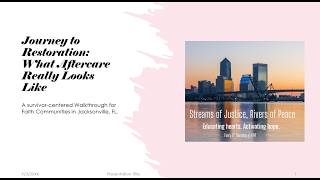
The recorded interfaith call, moderated by Melissa Pearson, guides faith communities in Jacksonville through the survivor‑centered journey of restoration for human‑trafficking victims. The session outlines the complex challenges survivors face—trauma, addiction, legal and financial barriers, and revictimization—while highlighting local partner organizations (Hubbard House, Hadassah’s Hope, Rethreaded, Arise Together, Her Song) that provide shelter, detox referrals, employment, mentorship, and housing. Melissa emphasizes that ordinary people, motivated by compassion, can create extraordinary change by offering consistent, non‑judgmental support such as meals, rides, childcare, and financial donations. The call discusses the importance of respecting survivors’ autonomy, the need for trauma‑informed, survivor‑centered care (respect, choice, safety, transparency, humility), and the role of faith groups in education, advocacy, and partnership without duplicating services. Legal aspects are covered, including the JSO’s victim‑first approach, a recent rescue story, and ongoing legislation to expunge criminal records that hinder survivors’ reintegration. Practical resources are shared: national hotlines, the Blue Campaign, social‑media channels, ambassador training, and opportunities for online trauma‑informed training. The session concludes with a prayer invoking divine support for the survivors and the community’s collective effort.
Chapters
Human trafficking back for doing what's right.
But you do.
That's good that you do that.
Hello.
I'm gonna mute there. Okay. All right, let me get going here. All right, so tonight we're going to be talking about the journey to restoration, what aftercare looks like. It's a survivor centered walkthrough for the faith communities here in Jacksonville. Our agenda tonight, there's like 13 things. But before we dive in, I just wanted to. I just wanted to begin the conversation as a walk through the journey of what restoration looks like. We talk about the challenges survivors. Survivors face. I want to highlight the incredible organizations that we have here in Jacksonville that are making a difference. We'll also explore what faith communities can do, how they can share like a real and we're going to share like a real life composite story. Unfortunately, our JSO officer that I had isn't going to be able to be on tonight, but he did send me a little story to read, so I'm excited to share that. And then we will just continue on with our theme about how ordinary people can do extraordinary things and make extraordinary change. So I want to talk about, like, why this matters and I want to thank you guys for being here tonight. It's just, this is what freedom's about. It's about the long road to restoration and how ordinary people, just like me and you can do extraordinary things just by showing up exploitation. You know, it doesn't just take away freedom. It breaks safety, it breaks identity, it breaks trust. And while rescue there is in the moment, the restoration is a journey. And so it takes patience, it's going to take time. And it takes like a loving community to surround these individuals for their healing. So as we were walking through this together, I just want you guys to keep this phrase in mind that ordinary people, when moved with compassion, can make extraordinary change. So healing is not a straight line. I think we can all say that in our personal lives with things that we've had going on. You know, it can be a spiral. There can be good days, There can be hard days. Sometimes progress looks just like having some stability. Other times it just looks like it's survivor survival. When we walk along survivors, like, we can't measure success by, like speed or milestones. We have to measure it by trust rebuilt about hope being restored. And like our role isn't to fix anything. Like, it's just to stay. It's just to be constant and just show extraordinary love that doesn't rush and it or quit. It just keeps showing up. That's the most important thing. So now this is not by any means exactly how it happens. I just wanted to kind of do a little bit of a timeline to kind of give you guys an idea because like I, I don't wear, I don't work in the survivor care continuum. I have a, you know, secular job, but I am learning as I go. And so this is definitely not a verbatim, but this is kind of what a journey will could look like from crisis to stability to restoration into thriving. Like each phrase is a different type of care. And thankfully here in Jacksonville we have some incredible organizations that are standing in the gap. And these are not all the organizations at all we have. This is just to highlight a few like the Hubbard House, you know, they provide like emergency shelter and safety when someone is escaping from violence. We have Hadassah's Hope that meets women like right on the streets offering like detox referrals, like housing, like Hope we have rethreaded which restores dignity through employment and community. And they even be. Are able to make products and that represent healing and they're able to have like dignified work and jobs Rise Together offers like a mentorship. They have life skills and like family support. And it's long term so there's not any like time limit on them coming in or out of their, of their.
Of.
Of their care. And then her song gives women, you know, like a home to rebuild after incarceration and exploitation. We also have Ruby, if you want to add some more that I'm kind of missing here.
Oh, well, these are kind of the heavy hitters. You've. You've hit all the big ones. We do have an entire sheet of members of the coalition who have something to do on any given time of the survivors path to restoration.
Hang on just a second. I've got a. I got somebody that's wanting to join real quick, Let me send them the link.
Hi, Melissa, thank you so much for having me. I didn't get to greet myself when I came in, but I am on the way back home with my daughter, so just wanted you guys to know I'm listening in.
Thank you. Okay, perfect. Thank you so much. And we're gonna.
Let's see.
Here we go.
Let me. Okay, perfect. Okay, I sent it over. Okay, so this is the headwinds survivors face. So they. It's like heavy. It's complex. They have like mental health challenges like trauma. There could be addiction, there could be some legal barriers, some financial instability. It's important to understand that relapse and Setbacks do not mean failure. It just means. It's just part of their healing story. Like, when faith communities understand these realities, like, we don't just respond with compassion and. Or we can respond with compassion and not judgment. And that's where extraordinary change begins. Just being able to offer, like, a safe place and understand that, you know, they're going to make a couple steps forward, and they may make a couple steps backwards, but the fact is that they're trying and they're still showing up. That's the most important thing. We just are loving them for where they're at. So you can look and see that there's, like, you know, with illegal. It could be they lost their id, you know, due to exploitation. They could have custody barriers. Like, they may have children that, you know, they lost during this, and so they're trying to get them back. We'll talk a little bit more about this in some other slides. So part of the journey that's really difficult from what I've been learning, is about prosecuting the trafficker. But you want to prosecute the trafficker because you don't want them to be able to traffic any more individuals. But some survivors just aren't ready to testify, and who can blame them for the things that they went through? Others, they kind of spend years navigating the painful legal process. It's kind of, you know, they're ripped open again and again, having to experience when they have to talk about stuff when they're not ready. So, like, our role isn't to pressure them into justice. Like, even though we would want, you know, we don't. We. I mean, like, we want justice for them, but, you know, it's got to be, like, on their terms and stuff. We need to be able to walk beside them. And that's what these organizations do in. In Jacksonville, like the ones that we mentioned. And they're able to walk alongside them and help them through this process. You know, that might mean that they're, you know, providing childcare or they're providing transportation or meals, or they're just simply being put. They decide they do want to go to court. It might just be them having somebody be there and be present with them during the court days, you know, just as it does. It takes time, but love can outlast the courtroom. And so that's like, the biggest thing. So as I was talking about revictimization and prevention, one of the hardest truths is that survivors are most vulnerable after they leave. So once they leave, like, that's like that, right? There is a miracle in itself. But, you know, they're in this transition process. You know, they might be moving homes. They may, you know, they had, you know, it was like a job loss, you know, like the holidays. Like can these things can trigger, you know, they might be in a, in a stable home, they may got a new job. But then ones that they lose their job, Bones, if they have to move, these things can bring up old fears and that can make them feel like they're in an unsafe situation. So what prevention looks like is looking like stability. You know, it's having those safe housings to where they can know that they're, you know, they're not going to have to move, they're not going to have to go anywhere else. You know, having consistent mentorship. You know, somebody constantly, you know, showing up, helping them learn how to rebuild trust again. You know, a caring community that helps them stay anchored in who they are in this new phase of life and stuff. So that's where we as faith communities, like we can shine because what we can become is like this calm place in the midst of a storm that they have going on. As long as we stay consistent, we stay steady and we keep things safe. Another part is there's a cost. You know, there's a cost to healing and stuff. Like in the tree restoration, it does take resources. So you, in order to have safe housing, therapy, legal aid, it's costly, but it's also critical when we invest in healing, we're sowing into futures. So I know personally when I first, as I shared in the last call, I was, you know, monthly partner with 821. I'm still a monthly partner with a 21, but now I've partnered locally to, where I give monthly to the organizations here in town and stuff because I've met them, I've seen what they're doing and I believe in what they're doing. And it may not seem like a lot. Like if it's 40 or 50 bucks, you're like, oh, that's what is that really going to do? Well, if 10 of us gave 40 or 50 bucks, you know, now look at it and stuff, it's like, it's like a, it's a building block and stuff. And now so every dollar does count. And you know, that's how, that's how, you know, maybe it's just not having a Starbucks once a week or something, you know, that we can cut back on and stuff. But this is a part where we can do that wholly investment, you know, that's not measured in dollars, but it's measured in dignity. And with every act of generosity, like you could donate a meal, you can help furnish a room, you can help pay for a month of rent. It's like becomes like this extraordinary seed of restoration. Like you have no idea what, how that could help just change the trajectory of someone's life. But also not just that. Like, just to know that someone cared enough to go out of their way, like, and to give to a complete stranger that can give nothing back to them and stuff. Like, I know personally I've had that happen before where people have come into my life and it's been such faith building moments. We have the opportunity as a faith community to do that for individuals here in multiple different ways with the organizations that serve our community. So let's talk about what survivor care centered looks like. So survivor centered care is built on respect. It's their choice, safety, transparency, humility. Sometimes the most extraordinary act is simply giving someone permission to take their time, like to make their own decisions again. Because for a very long time somebody made decisions for them. And so now they're learning how to make decisions on their own again. And when we treat survivors as experts of their own stories, we mirror the heart of God like we are. We're never forcing healing, but we're patiently allowing it to be restored. Like as they're on their personal journey and on their personal walk. So it can be slow because slow equals safe and safe equals sustainable. And that's something that they desperately need but they don't believe is possible until we show them in time with consistency with showing up and stuff. And so if we, and I just, I just love that quote. Like, I just, I saw it. I don't even know who said it. But it's like when we treat survivors as experts of their own story, we mirror the heart of God who never forces healing but patiently restores it. I just think that's, that's just great. And so faith communities like, this is what we can do, that's what we can't do. So I always like to put the can't do's on here. So, like this is where our, this is where we come in. And not as saviors, because we are not saviors. We are just supporters. We can partner with the experts. Okay, like we can with like Hubbard House, like Hadassah's Hope rethreaded Arise Together her song. These are just a couple practical ones you know, offering that practical help. Like we've said, you know, meals, child care, Rides, jobs, leads, like these things. Like we can partner with them, see what we can do, what they need. We create safe spaces for worship and rest without pressure, like a no performance. You know, like we educate our congregations. Like the places that we go to, our houses of worship on trauma, informed compassion and stuff. And we have great resources on the coalition that can help you. We have a lot of educated speakers through these different organizations that would love to come in and speak to your congregation and stuff like, and educate and what your needs are. So a lot of times, you know, the church is always out there and they're you know, doing, doing and giving and giving. Like this is a time where, you know, we can come to you and we can help educate and help, you know, just teach about like how if you want to get more involved, like what that could look like. So when churches and faith communities collaborate instead of compete, like we multiply our impact. You know, we have ordinary consistency. Like that's what changes lives we offer, you know, we build bridges and not silos and we don't duplicate. Like these organizations already have amazing things going on. We don't need to keep creating new wheels. Like we can just support what's already going on and that's a lot less stress because there's a, there's a lot of things going on. Okay, let's go on to the next one. So this is where I was going to have Lieutenant Napoleon. He's an amazing officer that serves on our jso. They kind of, they help like identify victims to the point of intake. They approach and like they prioritize victim care before prosecution. That's kind of how JSO operates now. You know, used to, from what I understand, it was just kind of like people were caught up in prostitution or something. They would automatically be like ticketed or arrested and stuff. You know, they weren't ever looked as like a potential victim. And I know you can share a lot, Ruby, just with you went to D.C. about what is the new legislator about getting rid of the like the non violent crimes records for.
Oh yes, so many, so many victims were either forced, forced to perform some kind of criminal act or if they, if, if they, some of them have, have a record. And so there's some current legislation that is, that is looking at how to expunge these women, mainly women, but some men too, how to expunge their records because that can hold them back from custody of their children. It can hold them back from renting spaces, it can hold them back from job placements. So expungement of record is super important if it can be done.
Yeah. And so he gave me a story of something just recently, this month that I can share with the public. So I'm just going to read it for you guys. It says they were. So JSO was notified by a non profit partner that a trafficking victim and their young child needed assistance in getting out of Jacksonville area. So the human trafficking detectives, they met them, they met with the victim, they provided security and they escorted them and their child to a safe place around the city. Eventually, the nonprofits were able to remove the victim and her child from the city and their protection and our detectives helped with that escort. So the nonprofits were very appreciative of the JSO support to assist in this operation. So that just kind of just shows you like the team and the collaboration that happens between our nonprofits and our, and our law enforcement and stuff. They're very actively involved and you know, it's. And it's all about safety and stuff. So I'm hoping that during these calls, these once a month calls, we'll have somebody be able to come on and we'll highlight like an organization or you know, somebody that's actively involved and we'll have these little highlights as ordinary people doing extraordinary things because, and changing lives. So how, as, like how as an interfaith community, can we help? And we've kind of been talking about this a lot, but I want to make sure that we're not feeling overwhelmed because this can be a very overwhelming topic and stuff and really that we can take it down in bite sized pieces. You know, each of us has a lane that we can work with and stuff. Like we can pray with intention. Do not negate the power of prayer like you. It is not, oh, we can pray. It's literally like praying moves mountains. Like we serve a God that is like that created the universe. He can make all things possible. You know, we get to advocate for people that we don't even know. We get to cover survivors, we get to cover the advocates, we get to cover organizations like that is such an honor to partner with our creator. We can, we can also partner and come alongside existing nonprofits. I think that's kind of something I will say and I will keep saying like man, like research the nonprofit people that we have in here and you know, pray about it. Really become involved being a volunteer, being a financial monthly partner, whatever it may look like for you and the capacity that you have in the season. Like, I mean it's such an, it's so Moving. Whenever you get to get outside yourself and help other people, it really helps change your life, too. Like, you're. You will get something out of this. Like, trust me, you can, you know, provide help. You know, again, like, that's, you know, like, I know that Hadassah's Hope looks for, like, Uber gift cards and stuff like that, for rides for their women and stuff. You know, you can talk to them about maybe if you. If you like to cook and want to provide a meal or something. Like, you can talk to the organization, see how you can orchestrate that. You know, you can protect confidentiality because that's sacred. You know, a lot of the stuff that, you know, we share in our meetings, you know, isn't something that we can share with the public. There's a lot going on that is happening behind the scenes that we, as a public entity, we can't share because it would be a harm. Right? So whenever you do get involved and maybe you do come into contact with information, you know, making sure that you keep confidentially everything that's confidential, sacred, and stuff, because that's how we build trust. You know, you've got to be persistent, too. You know, don't grow weary when progress is slow. Sometimes it takes time. It's just like building this community and stuff. You know, you got to start somewhere and stuff. And it may. It may take a while for this to pick up, but I have the faith and the heart that, you know, the people here in Jacksonville, they're hungry, they want to help, they want to be involved. And I know that, you know, as we go, you can invite someone to the monthly meeting. You know, that's something else that you can do. So this is how ordinary people can build extraordinary restoration. And we can do all this together. So there are some resources that I wanted to give you guys. You can have, like, the National Human Trafficking hotline. We have the Florida Safe Line again, mentioning the local partners. Like, you know, I've been learning a lot about social media lately, and there's algorithms and stuff. And so the one thing that you can do that doesn't cost anything is if you have social media. Follow them, follow them. Give them more likes, give them more shares. Look at the events that they have going on. They have galas, they have barbecues, they have bonfires. I mean, come on. Like, that's some fun stuff that you can invite your friends to. You guys can go out, have a great time, great night. And then your ticket that you bought to get to that event is helping restoration. It's Helping redemption and stuff. So, I mean, it doesn't have to always look like, you know, like, physically going somewhere and doing something all the time. So these again, I just, you know, and again, I'm gonna go back to praying, like, every prayer and active service and every dollar, like, it really counts. And you can see that we have our. We started social media, too. So it's up there in the right hand corner. That is the Instagram. We have it on Facebook. And we're just trying to grow the community because the more people that know about it, you know, the more people that have the option to kind of come together. So restoration, it's sacred work. It's definitely not quick, and it's definitely not easy. But when we as a faith community, like, when we come together, you know, ordinary people decide to love in extraordinary ways, and we see miracles happen. We can see women regain their voices. We can see families restored. Like, we can. We can see hope resurrected. Like, we can keep walking and we can keep praying and partnering with every survivor in Jacksonville, and that they not only just escape the situation, but they flourish afterwards. So that's all I have. And I wanted to remind everyone we do have ambassador training, so if you are interested in getting involved, you can become an ambassador. It's October 25th at 9:00am at the Centurion Parkway, and Ms. Ruby Peters, that's been helping me this evening, she is the one who leads that up. She is our committee chair of education on the coalition, and she does. Does an amazing job. So I. That's how I got involved. As I went to ambassador training, I met with Ruby, and then Ruby was like, hey, like, there's this interfaith committee chair that's vacant, and she's kind of telling me about it. And then here I am, you know, like, it's just, you know, like, here I am.
And so there was some divine intervention,
I think, you know, and, you know, I shared my story last. Last call and stuff. You know, there's nothing special about me, and there's nothing special about Ruby. We're just two people that we love. We love the Lord. We have the means and to, like, volunteer our time, you know, Ruby's definitely educated, but she spent the time, you know, going to conferences, getting involved, you know. You work with the Catholic diocese, right? Do you want to kind of tell a little bit about what you do?
I still do. I still work for The Diocese of St. Augustine for Catholic Charities, and all I do is human trafficking, education. It got it. It was the Holy Spirit that kind of Kept bopping me over the head because the subject kept coming up. And so I'd learn a little and a little more and a little more. And I give the Holy Spirit either entirely the blame or the credit or both.
I love that.
So it's just. And it is showing up. A lot of times it's showing up. I don't know. I kept seeing stickers on stall doors in airports and I mentioned it to somebody and then I applied for a grant and then we got a grant to produce these stickers, which have now become a reality. So I'm. I'm hoping to bring those to the meeting next week and let them go out into the world because they're doing nobody any good in my closet. So we've got a lot of. It's just an awareness thing to educate the general population who, who are thinking of it like the movie Taken and somebody's been snatched or they're thinking of it as somebody being, you know, abducted out of a Kmart. Well, I don't think there are Kmarts out of a Target parking lot or some, some kind of situation like that. But it's. I. We talked to a couple hundred people last week at the Malvi Washington Kids Foundation. They have an after school program and it's about grooming, it's about telling kids about online enticement. It's about letting them know that, that they all have a target on their back. But they don't need to be afraid. They need to be educated. So we're just, we're just out here trying to educate some people.
Yeah. And you're doing a great job at that. A great job.
Thank you.
You're welcome. Does anybody have any questions or any comments that they want to add?
I'm glad you mentioned how. Oh, go ahead. Hello, Global Kids. Go ahead and speak.
Hello, I'm Andrea Adams. I met melissa at the 821 Walk for Freedom. I have been on the go because I was expecting to be back home to sit in and listen. So I might have missed a few things. But I will connect with Melissa just to see exactly how I can assist in any way possible and to maybe get a recap. So I just wanted. Wanted to share that. Thank you.
You're welcome. Yeah. And these calls are recorded, so I'll post them afterwards so you can go back and you can share or you can relisten to them.
Perfect. Thank you.
And I'm so glad that you were able to make it today. She is actually the one that I found out that I didn't have the zoom link connected to the invite on Facebook. I'm such a millennial, so I'm just like, I'm, I'm learning this technology. It's really funny. You know, 37's hitting different this year. But if, if we don't have anything else, I'd like to pray us out and we'll. Until next month. Okay.
There's already 10 people signed up for the ambassador training, but there's plenty of room if you've got the time. We've got the availability for sure.
And it's.
Would I be able to ask something really quick?
Yeah, for sure. Go ahead.
How do you get trauma informed, like training wise? Because I would love to do that and I realize there may be an issue since I'm not local to you guys, but do you guys know of anything like that, even online?
That is a good question. And I can say not particularly. We should ask either the people at Rethreaded or her song what, what they do about that. So it's just really a psychological mindset that is going to remember that these people are coming from a place of trauma and that our care can't assume that they would react like we would react because we didn't have their trauma. So it's. It. But that is a very poor explanation. But.
Oh, no, no, that's good, Ruby. Yes. And you know, and I will look up some things because I do know that we have. There's seminars at times that are online that are free to sign up for and you can sign up for them. And then you. And there's. It's like a training. So I know that the Blue campaign does some online. Yeah. And it's free. So I would look at the, the Blue Campaign and look at their events that they're doing. And then we'll. We have our meeting next Tuesday. This is something that we can bring up and we can ask if anybody offers online trauma informed care because I know you're in the Midwest. But also there are people that travel for work that are really busy and sometimes can't physically be somewhere. But they could make themselves available online. So they, this may be something that they already have, it may be something they don't. It may be something we can put, you know, and say, hey, you want to think about it? Like they need one more thing to do. But, you know, who knows if the community needs it. The community needs it. Right. So it'd be good.
Well, thank you so much.
You're welcome. And just wanted to reiterate, you know, if anybody has congregations and stuff that want someone to come and educate, like I said earlier in the presentation, you know, like we do, we are offering that to capacity. Would love to have a conversation about it. So I know that this is going to be replayed, so you never know who's going to watch it. So I just want to, like, put that plug in there. All right, so let's pray out. Father God, I just thank you so much, Lord. I thank you for this opportunity. Just to be your vessel, Lord, and to be able to speak about these things, Lord, just to be able to be a voice for the voiceless and to be able to activate people and human hearts, Lord God, just with mercy and compassion for one another, Lord. We see everything that's going on in this world, Lord God, and we need unity more than ever, Father. And so I just pray that your spirit of peace, your spirit of unity just permeate this call. But also for those that are on the replay, Lord God, I just pray that they're touched, that they're moved. Lord, you created us all on purpose, for purpose, Lord. You gifted our hands, our feet to bless one another. You called us to serve the least of these, Father. And so this is a segment of people that are the least of these. These are the ones that feel like they have been forgotten, that feel like they are not seen, that they are not loved, that they were a mistake. And Father God, we want to be the people that say no, you are seen, seen, you are loved. You are chosen, Father, and we want to be able to help these organizations here. So we lift up every single nonprofit in our city and we ask that you bless them tenfold, Lord God, that you are the father that owns a cattle on a thousand hills. All resources that they need. Lord, I just pray that you just make a way and you make it happen, Lord, so that they can be your hands and feet in this time. So, Father, we just thank you and I ask that you bless each and every individual on this call call and on this replay, Lord, that. That they would be blessed just for giving their time, just for being able to be leaning in, Lord God, to the things that you have going on in the city. So, Lord, we honor you, we bless you in Jesus name. Amen.
Amen.
All right, guys, so until next month. I'll talk to you guys later.
Thank you. Take care.
Bye for now.
More from Melissa
Life After Human Trafficking: Why Restoration Matters | Survivor Support (8/9)