FORGET Google, I Used Perplexity for 7 Days & it Blew My Mind!
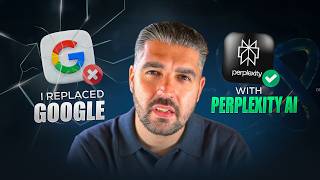
Someone ditched Google for a week and used Perplexity AI instead for shopping, recipes, coding, and research. Perplexity gave better summaries with multiple sources and follow-up questions, but Google was still faster for local searches. The verdict: Perplexity wins for deep dives, though it doesn't replace Google entirely.
For the last seven days, I did something that would have felt illegal in 2024 and that's I stopped using Google search. No more traditional search bar, no more googling it. I switched my entire digital life over to this Perplexity AI. The Internet claims that this is Google's gravestone. Well, is it just hype? I ran it through the ultimate test. From simple questions to planning my next business move. By the end of this video you will see every everything exactly as it happened. And the results, well, they completely shocked me. So day one is here. I start using Perplexity AI instead of Google search to see which one is best for business owners and entrepreneurs. And what, what I find is that there's a complete difference between the two. I'm keeping it simple for the sake of this video. But I was stuck. I didn't ju all in straight away to Perplexity AI. I started by just using it for generalized questions. My day to day stuff. Things I might buy, things I want to watch on tv. Things about the NBA season starting. I started with all of these things. Now I've done a search for how tall is the Eiffel Tower? And when I've done the search for how tall is the Eiffel Tower? You can see here, this gives me the exacts, I'm assuming that they're right. 330 meters. Wikipedia's underneath. Then there's some links to like to rifle to rifle, which is exactly what these use, which Perplexity AI uses as its data. But look at the information that I get provided with. So this gives me a better summary than this. It also links directly to the sources where it got the information from, starts with the sources and gives me follow up answers and other questions that are related to it. What modifications have been made to its height. And then it will go away and it will answer that question too and it will do the same thing with, with sources. So straight away it wins. Perplexity AI wins. Just off the bat, when I start using it for general stuff, I'm like whoa, okay this is this. Like I should be using this more. Then I started thinking, well what about shopping? Because that's, that's an everyday question. You know, you'd ask what's the best price for this or best TV or whatever it is that you're looking for for your house, new laptop, as an entrepreneur, whatever. So I then start doing searches for like what are best, the best noise canceling headphones. And remember we're just using basic search here for Perplexity AI. We're not using Deep Research Perplexity, we're not using AI mode for Google search. We're strictly using just the normal search engines. And if I ask Google the same thing, this is mode. What I get back from Google with this answer is a list of sponsored results that come from their own paid advertisements and then links to their organic rankings which have good questions like where historically I would probably go have a look at Reddit, see what people are saying. But on the right hand side, although taking a little bit longer to run, is reviewing 17 sources of information to find what it thinks is the best solution for my question. And that is something that I really appreciated because it meant that I have the actual information. Here you can see the review stars several excellent noise canceling headphones. Here are some standout options across leading brands and price points. Sony's wireless models are widely praised for comfort. It gives me some background into it. Would I dig deeper if I wanted to? Probably. But it gives me all of the sources that I want and a summary of what it considers to be best next steps. So for me again Perplexity AI wins. It doesn't favor anything in particular like it doesn't. So the final general question on day one that I would ask it like as these are examples of course but like how to properly brewer pour over coffee. So we do a search on Google search and we do a search on Perplexity for that. Now AI Google gives me its AI overview and it's AI overview then gives me a YouTube link to a Starbucks coffee. When it comes down to Perplexity it gives me step by step guides very similarly to what this gives you. But this is, you know, this is a little bit more generic than what you see from Perplexity. When it comes to Perplexity it showcases to you the example amounts of coffee and then a source. It then it gives you this then a source here you can see that it's pulling information from a multitude of individual areas. Do they flow properly together? Is it the right coffee mix? Are you giving me different videos for every single one because they don't match? I'm assuming so. Whereas Perplexity AI when I searched it on there actually gives me further questions. I can, you know, share the answers. I can do other individual things. I can, you know, like the comments of it, view the sources on their own. It just feels like a lot of a stronger approach. So day one, straight away I was thinking Perplexity AI is on something. So throughout days one to three I'm impressed. I'm Using it generically for all of my generic phrases and things and like recipes and stuff. And I'm just finding perplexity is better, right? I'm just finding the information it gives me is better. But then I wanted to start challenging it because I was like right, well Google search has been the way that I've always done things. Okay, I've always done it. Now then let's do a search. I want practical, actual, realistic use cases. So I want to start a YouTube channel about AI automation for small businesses. Right? Create a content and strategy for my first five videos. I stick that inside of Perplexity. Google gives me this with some target keywords. Video 2 Never miss another customer message. They're not exactly poor but they're not when it comes down to perplexity you can see here it pulls from different sources which so does Google search but these it's basically pulling examples and trying to copy and basically copy them from from that it doesn't really give me any feedback. VIDEO 3 VIDEO 4 VIDEO 5 these topics are designed to be search friendly tutorial and then if you go through and look at these individual chip like action checklists starting your YouTube channel so it pulls this information defining your niche and audience it gives me this, this context channel branding and setup etc real results. My first 30 days with AI business automation complete guide automating social media posts with AI they're pretty similar. I still think Perplexity wins because of the Sources it's used 20 sources to find to find that this is just pulled from. It's pulled from Quora. So pretty similar. Much better layout in Perplexity time stamps given in Google. So I still think Perplexity wins because of the sources that he get that he gives me and where it pulled the information from but there are because things like this Reddit and stuff there they are a little bit. They're a little bit loose. Maybe this pulled from Reddit too. It did so running from a YouTube system. So let's call that one a draw right? We've gone for the content strategy. That's a. That's a draw. Now let's do another search for find me free high protein vegetarian recipes for dinner this week that take less than 30 minutes to make it create a shopping list for all three. So let's do that here. Real life use case examples have done this See this three day meal plan gives me links to the individual locations dinner this is it. Ingredients chickpea quick instructions add curry powder tomatoes significantly more detail Produce pantry two bags tells me the Number just answers significantly better. This is a beautifully formatted output that actually gives me a real understanding about how I can use, how I can go and create these meals and how I can go and take it. Yeah, this gives me the, the information. It's not specific at all. It doesn't give me anything. It literally just says it takes 3:30 minutes to make pulls from free sources and that's it. This gives me the full list. And not only that, it tells me how much I actually need for each one. Right. In terms of volume. So Perplexity AI once again comes out as a winner in my opinion. Okay, so Perplexity is winning like 80 of the wars and even when the other 20's a draw. So Google Search has not been anywhere near. It's not one once out of any example that I've given it. And when I was doing it in real life, I did a lot more than just these generic searches. So then we're going to do something that Google Search is not historically made for. Let me get rid of that quote mark and I want the boilerplate. Give me the boilerplate code for a simple react component component that fetches data from an API and displays it in a list. And we're going to use Google Search for this. Now this is the information that it, that it gives me. Now it also says something went wrong. Let's see what this does in terms of the AI solution. I'm putting business practice in it now where you probably wouldn't normally see Google Search used. But I'm thinking about where I can live, where can I stay like my one stop shop for, for what I'm trying to do. And this is where Google Search falls down because I can't have a conversation with it. It's an AI overview, feedback. You know how search works. Like this generated this, like how do I add. I can't add anything to it. Like I can't. This is giving me the boilerplate using AI. But this has given me this. And when it comes down to this, the template covers state management for items load and error. Gives me the brief, gives me the insert where I should insert my API endpoint. If I then say like now add an error handling and loading state component. Now add error handling and loading state to that component. It already included error handling and loading state. Here's a clear breakdown of those parts. Inside of the, inside of the, the. The. The list. So it already gave me that throw an error. So if we do a search for the Google Search section, did it, did it do that? It did throw an error. So they both covered the error situation. But the point is, is that you can expand on what you actually have it deliver and as you can see, you can manipulate it. The specific prompt I gave it it had already done because it's that good. So at Google. But when it comes down to pushing these to the test like and the items, let's try. I'm writing a paper. So I'm writing a paper on the economic impact of the Roman Empire. Can you give me five academic sources and provide one sentence summary for each? Let's do that and let's hit this here. I'm going to hit a new chatting here just to clean it up a little bit. Let's fire that off. Drawing on recent scholarship for economic historians, Roman specialists. Here are five academic sources that cover this Gives me the five links. Gives them me down the side here. There's more than five, ask for five. I don't know where it's pulled that from. Gives me the individual links to them. Oxford Research Encyclopedias. Good, good sources. Tim and Peter. There is a crossover of some of these, some of them aren't. This gives me the exact information and the summary. And I just find that pulling up of 20 sources, looking at the steps that it went through, look at what it searched for, it went through significantly more detailed information. And I think perplexity is king. Like perplexity gave me everything that it wanted. It also gave me further related questions that I could ask. Analyze the role of agriculture in the Roman economy. If you were doing a paper on it and you wanted to go deeper into this, you would do that, you would have this information, it would dig deeper, it would give you information. It would also list its sources once it's done. And I just found myself gravitating more towards using perplexity because I can do deeper complex tasks with authority. And this is just the search, not deep research. This is just the search on both. And perplexity was coming out on top every time. So after seven days is Perplexity Google's AI killer. What shocked me the most is for that any question that required any sort of elaboration, Perplexity smashed it out of the park. Perplexity completely smashed it out of the park with no deep research. I wasn't in AI mode for Google either. It was typical search that I wanted to test the amount of time that I saved not having to click 55 blue links before I found the source that I wanted or. Or take an AI summary that was of lesser quality than what Perplexity was was frightening, but it's not a like for like replacement. Google is still excellent as a phone book. Finding your local pizza place, finding your local store, whatever. Its widgets are still faster. It's very good for those use cases. When it comes down to anything that's Deep Research, you effectively have Perplexity in your pocket just by using the search engine, not by using the deep research option. Inside of Perplexity, that's another video. So that's the real conclusion. You still need to have the phone book from a Google perspective, but you'd be silly not to have the librarian in your pocket given the fact that it's available and is exactly the same. So this is a tool that every developer, creator, entrepreneur, business owner needs to try and they need to try it today. I've put a link in the description below. It won't be new news Perplexity, but the comparisons are frightening. I want to know what you think because is this the future, the way that search is going to evolve? We find information online, we, you know, we drop something into Perplexity and boom, we drop. Like this is the expectation now that we should get as an answer. Drop your comments below and let me know what you think. If Perplexity is going to take over or maybe even another AI tool, I'd love to get your thoughts on this. A like and a subscribe would be amazing. Thank you for watching. I'll see you in the next one and I hope that you've enjoyed it.









