I Just Got A Bad Upwork Review £500K Earned, Job Success Score Dropped
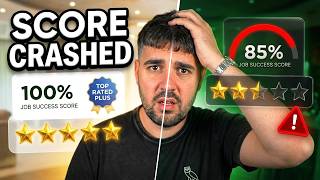
Michael Elliott, an Upwork freelancer with $500K earned and top-1% status, got a surprise 3-star review on a dormant contract and watched his Job Success Score drop. He explains why one bad rating barely matters statistically, why he didn't contact the client, and how two new 5-star projects restored his score. The real fix: keep working, stay silent, let fresh contracts dilute the damage.
Chapters
A bad Upwork review has just landed in my inbox. $500,000 earned on the platform, plus I've expert vetted top 1%, and I've just been given 3 stars from a client that I'd forgotten even existed. The review was from a contract that is 2 years old. 2 years! And it dropped my job success score in the time it took me to finish the sentence that I was recording. And here's exactly what happened. I was in my office filming, phone face down on the desk. I always put it face down when I record because like if notifications happen mid-take, they're enemy of a clean cut because I'd not— my eyes move, whatever. Halfway through a line, I'd moved my hand across the desk and the phone fell off the desk. I heard the thud, and then just after the thud— this is really weird— I heard the notification sound of an email. But something in that second little sound, the one after the thud, got lodged somewhere in the back of my head and my stomach. I canceled the section because I obviously couldn't use the clip, walked over, picked my phone up off the carpet, and what I saw was an Upwork email at the top of the inbox. 'Your contract with client has ended.' Now here's the bit that made my stomach turn a little bit. I hadn't worked with that client in 2 years. I'd assumed it was closed long ago, but it wasn't. Below that email, quickly after, another notification: 'You've received a new review.' Upwork letting me know that feedback's been left, and it's my turn. After I left my feedback, 3 stars. The client was in healthcare, health insurance, enterprise side. Wanted more handholding than scope covered, that sort of vibe. We'd canceled after a month amicably enough, at least I thought so, but he didn't want to stick for the longevity. I always tell clients 90 days, etc. He went against that in that case, but I'm not digging him out, I'm just saying. And then they just, you know, sat on an open contract for 2 years. So here's the first lesson, and it's free: close your contracts when they end from your side. Don't wait for the client. Don't assume the platform sees the relationship the same way that you see it, because a client can close a dormant contract whenever they want and leave a review 2 years later, 5 years later, whenever. A ghost walking back into the room with a bad word for you. Think about it. He can't possibly remember what happened 2 years ago. It's impossible. We only worked together for 30 days. It's impossible. And he left me that review. And by the time you see the review, the review has already landed. There's nothing you can do about it. And guys, this video is a little bit different to the majority of the other videos that I make because I wanted to be honest about the 72 hours that followed that. It's been a very long time since I got a bad review. Like, I work with clients very well, very closely. I do a very good job because Every other Upwork creator basically skips over this, and that's where the real story is. So I've been doing this for 14 years, walked away from clients that couldn't pay, handled difficult conversations in almost every direction you could possibly think of. And a 3-star review from a client that I hadn't thought about in 24 months made me feel a little bit defeated, which is a difficult thing to do. That's the honest word— defeated. I wasn't angry. I'm still not angry now. I'm not— I wasn't defensive. I was just kind of a bit flat. It was a grounding, if you like. I drafted a reply to the client at about 11 PM that night. I read it back and deleted it because I realized that emotions were taking over. In the morning, drafted another, deleted that one too. And I was just like, you know what, forget it, I'm going to bed. I didn't like— I slept okay, I slept fine, but it was on the back of my mind as I was trying to fall asleep. The next morning, I was back at my desk, and the first thing I did was open my Upwork profile, and there it was, sitting underneath my other reviews like a missing tooth. It felt like an L. It felt like I took a loss. It felt like a war that I'd lost without realizing that I was in one. A bad review feels like losing the war. And guess what? It isn't. It's one battle in a war that's been going on for a decade and a half in my case, and we'll keep going on for another decade and a half. The mistake most freelancers make is treating the battle like the war. They quit, they stop bidding, they go quiet, they question whether they should be doing it at all. That's how a 3-star review can end careers. It's not the stars, it's the retreat that it puts inside of your body. Now here's what nobody explains about the job success score. It's not a verdict, it's not a final judgment in court, it's an average. Every review that you've ever had ever closed on Upwork, Upwork takes them all and runs them through a rolling calculation. Most rated work weighted the heaviest, yes, oldest work fades gradually, which means one bad review in a single data point against hundreds in my case, statistically it's a rounding error, but it's a rounding error that feels like a funeral when it lands. The mathematics are on your side. It's just that the emotions aren't. So here's the part where most Upwork videos teach you the tactical playbook, teach you everything about how you go about this— the clever private message, the measured private feedback, the 5-step negotiation that gets the rating changed. And I'm not going to teach you any of that. Do you know why? Because I didn't do it. And here's what actually happened. Upwork has a mechanic that most freelancers don't know about. When a contract ends, both sides can leave feedback. But you can't see what the client wrote until you've submitted your own first. It's reciprocal system. You give and then you see. My natural tactical instinct wanted me to play that game. It wanted me to start communicating with the client, something diplomatic, something that unlocked visibility so I could see exactly what had happened and try and coerce the client into fixing something. And I didn't. Not out of strategy, but out of how I was raised. If you haven't got anything nice to say, don't say anything at all. My mum's line, delivered a thousand times, 10,000 times across my 33, nearly 34 years on planet Earth. And that line hit me at 11 PM that night that that review landed. Sat there with a draft open on screen, about to message the client, frustrated, emotional, and with my own agenda to try and get him to change it. I closed the draft, I closed the laptop, I went to bed. I didn't message the client, just nothing. I did nothing. And look, I can already hear half of the comments: you should have played it, you should have tried to do that, you should have tried to manipulate this, protect the profile, you should have got the visibility, you should have responded to try and protect Maybe, but character isn't flexible. Not for me. If I'd have written messages to that client just to game the algorithm, or whatever you want to call it, I'd have been a different freelancer to the one that I've been for the last decade and a half. You don't get to pick and choose when your values apply. So I sat with it, said nothing, and I moved on. And here's the thing— silence didn't save me. More work did. You don't fix a bad review, you bury it. Job Success Score runs on a rolling window. Your most recent contracts carry the most weight, which means the single fastest way to repair you pay your JSS isn't to obsess over a bad review. It's to win the next 5 jobs as fast as you physically possibly can. So I used it to light a fire inside of me and win more projects. If you've got one bad review and you stop sending proposals, you've just given the review permanent weight. The less activity you have, the more that review matters. The more activity that you have, the less that it matters. Movement is the medicine, not silence, not defeat, not suffering. So the morning after, I opened the laptop, opened up Work, back to bidding, and I've never been as aggressive in my entire life. I'm I'm grateful for that review. It lit the fire inside of me. Tuesday, Wednesday, Thursday, Sunday, the same calendar as every other week, as I've explained in videos. Two contracts closed in the weeks that followed, both 5-star or will be 5-star, both genuinely happy clients. I had a consultation for $250, that was for half an hour's worth of my time. JSS recovered, not because I defeated the review, not because I wrote a clever response, not because I tried to play the reciprocal feedback game or try and get him to change his review of me, because I kept kept going. And the mathematics of averages did what the mathematics of averages always does— buried a single data point under a pile of better ones. So here's where I am now. That review is still on my profile. It has 3 stars. Sometimes I go and check it out just for more motivation from a client that I hadn't spoken to in 2 years. He didn't message me and let me know. He didn't speak to me prior. And I genuinely don't give a shit anymore. Because here's the thing about a bad review: it's proof. It's proof you've done enough work to be exposed to bad luck. Proof you kept going after one client had a bad experience. Proof your profile isn't a manicured fiction of endless 5-star reviews. Every client I pitch from here on reads it. It's not the only bad review I've ever got on my profile. There's a couple of other 3-star reviews too, um, from way back when. I've been on the platform for years, but they get to make their own mind up. Most do in my favor. The ones who don't, I probably wouldn't have wanted to work with anyway. I choose never to read the full reviews. I could have— 10 minutes of writing feedback I didn't mean, messages that I didn't mean, and the reciprocal lock would have opened and it would have been bad energy around me. I decided that I didn't need to know. I didn't need more information. I just wanted to let it go because reading it and trying to fix it, it would have changed how I behave next. And what I did next was the only thing that was ever going to save it. The battle was lost the moment that the notification sound hit my phone, when the phone fell off the desk. The war's still going on, and the war is won by the freelancers who keep showing up. You don't need advice from people who are less successful than you, and it's not about some sort of Richter scale of who you should listen to and where. But don't allow one unreasonable client's feelings and emotion step in the way of your greatness. Don't do it. I'm telling you that you're good enough. If you offer a good service, you're gonna kiss a few frogs, as they say, along the way. And if you're watching this because it just happened to you, close the laptop for the night. Don't type anything. Do not get emotional. Don't send anything. Definitely don't message the client from your phone at midnight or whatever. Tomorrow morning, first thing you'll do is read it again It'll hurt less. You'll see it more clearly. And then you've got a choice to make. You can play the reciprocal feedback game, trying to speak to the client, unlock the text again, right? Get them to measure, write a measured public response. Or you can do what a real man or woman would do in a professional environment. Stay quiet, let the review sit, and get back to work. Neither of them are technically wrong, but what's wrong is doing nothing, going quiet, retreating. Because the only mechanism that moves JSS back is more data, good data produced by you next week, next month. A rolling average only knows what you feed it. So feed it. Keep bidding, keep applying the proposal structure, keep producing 5-star closeouts, because averages are the only thing that bury bad numbers. And averages are on your side if you don't stop. That's the whole playbook when you get a bad review. And the part that nobody prepared me for, or probably not prepared you for— this is what I've learned in 14 years— you'll feel defeated for about 72 hours. And that's fine, that's human. When somebody says something bad about you, it's water off a duck's back. But anybody would be lying to you if your whole career is based around a certain system and somebody tries to, you know, put a hole in it. You haven't lost the war because you've lost the battle to a freelancer that I don't even remember. That— well, I didn't remember, but when my thoughts came back to me, I remembered that we only worked together for a month. It was $3,500. You know, keep going. If you want more of this type of content, I'd mix it up. I talk about various topics and I'm very honest and transparent, like in this video. No filler, no fluff. Just what, 14 and half a million dollars on Upwork earned, millions across other businesses, and multiple 7-figure business owner. You know, a 1-star review, does it actually have any impact on my life? No. Are my children good? Yes. Is my life any different with the 3-star review? No. May a new client see it? Yes. If they do, I'll just tell them, what do you want me to do? You can't please everybody. Like, it is what it is. It's a mediocre review. There you go. My name's Michael Elliott. This one was a weird one from the heart. I'll catch you in the next one. If you've enjoyed this, go and check this one out. But don't let a bad review get you down, guys. You're better than that. Forget it.









