The Only Upwork Course You Need in 2026 (I Made $500K on This Platform)
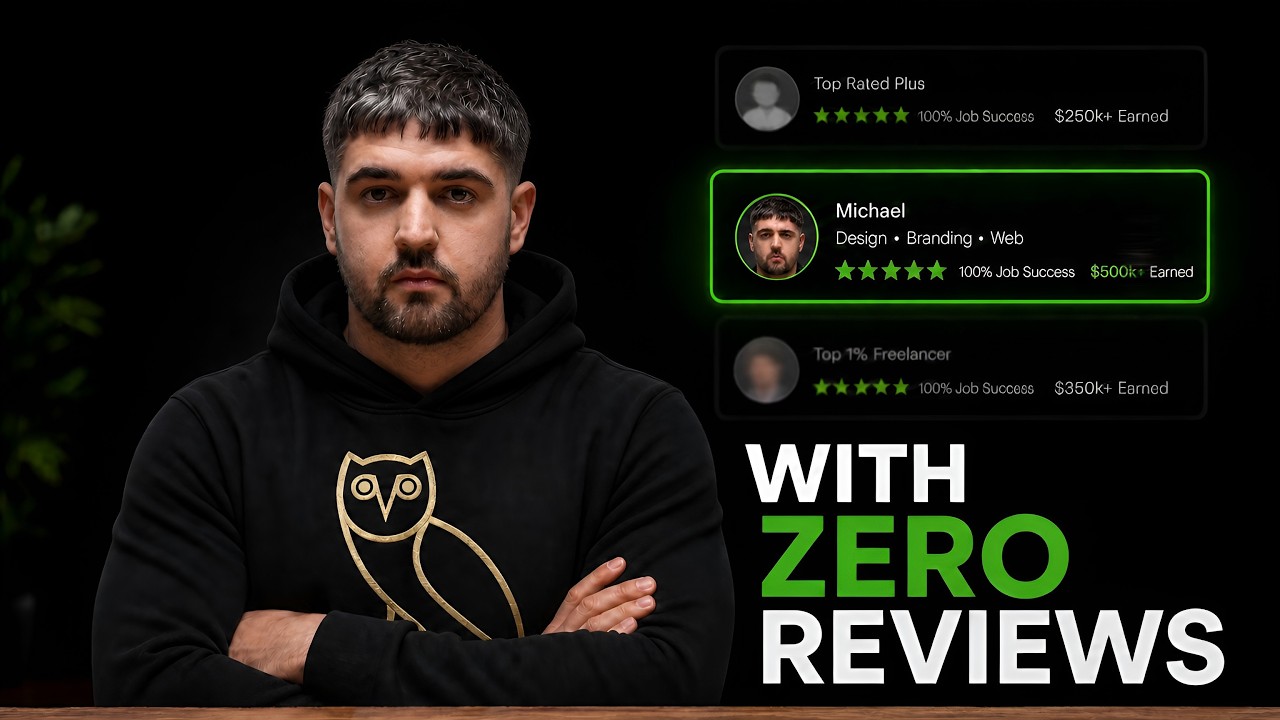
Michael Elliott, who earned $500K on Upwork, explains why clients hire the safest freelancer, not the most skilled. He walks through ten stages: nailing your value proposition, optimizing your profile, building case studies, creating recurring revenue, mastering the Connect economy, targeting low-competition clients, writing proposals that mirror their problems, using AI tools, overdelivering for reviews, and treating rejection as data.
Chapters
Tonight, somewhere, a freelancer will delete their Upwork account, convinced that the platform is rigged against them. And they're right, but just not in the way that they think they are. Because the rig is not a country, it's not a rate, it's this: on Upwork, the best freelancer doesn't win the job. The safest ones, they win the job. And once you understand that, everything that's been happening to you starts to make sense. The silence after the proposals, the connects draining with nothing coming back, The job's going to freelancers you know you're better than, while every job post drowns in AI applications that sound exactly the same. None of that means you're not good enough. It means that you look like a risk. And in the next 40 minutes, on my real account, I'm going to give you the complete Upwork course. How to become the safest choice on Upwork in 2026. Every screen, every step, in the order that actually works. But first, the receipts. So I've got over half a million dollars earned on Upwork. I'm Expert Vetted, which puts me in the top 1% of freelancers globally. But none of that helps you, I understand. However, it does mean that unless you've earned over half a million dollars on Upwork, that I'm qualified to give you information, and it's worth your time watching the entirety of this video because I'm going to give away all— I'm making the same mistakes every day that you're making right now. The difference is that I have a backlog of $500K of earnings that shows me exactly what works and what doesn't. I don't always get it right, but I have done more often than not. And when it comes down to the projects, yeah, that means that my profile comes with some big projects, 6 figures plus. I've got a lot of mid-range 5-figure projects that have come through. My account is literally littered with them. However, I also have the battle scars, which you'll probably know all too well. I've also been through the winning your first project on Upwork scenario, let's call it. So I'm in a position where all of that plus more is given away in this video and is designed to be your concrete one-stop shop for winning your first project on Upwork, delivering clients consistently, building monthly recurring revenue, and turning Upwork into the powerhouse of business lead generation that it can be. All of that is designed to do nothing more than showcase to you that I've sat in your exact seat. I have been there. I have won my first Upwork project. I have fought for months to try and win that. So I could get some reviews. If we take a look at my profile here, you can see $374.40. This was the second project I ever won for an orthodontist on Upwork. It was a 5-star review, but it took me months to get to that position. This was the very first project that I got hired for. You know, I got a great review, but $542. This though was the most important period of my Upwork career because this is an example of something not working and then it happening all at once. Because if you look at the dates that these were won, these were all in the space of a week. I must have spent 3 months trying to win these Upwork projects. There's been a lot of things changed between now and then. You know, the Connect platform, the bidding can actually boost your profile, et cetera. But everything between that number that I've just shown you, the $374, and the half a million dollars is this one decision made in the right order. Today you get all of them. 2 promises before we deep dive. Somewhere in this video I'll show you the part of this platform that is properly pay-to-play, my real spend when paying wins, and when it's a bonfire as well. And I'll hand you one move that costs nothing and roughly tripled my replies. Both are coming. Now look at this. This project in my industry that was posted 5 hours ago already has 20 to 50 proposals. If you remember my opening line of this video, it was that safest wins, not best. And this is proven. Because this client— let's look through their lens for a minute. They now have 50 applicants, up to 50 applicants applying for this job. They don't have— well, they can't judge skill because they're hiring for the project in the first place. They only can judge who looks safest to them, and no reviews is the most unsafe option that you could possibly pick. But Upwork is not a skills marketplace, it's a trust marketplace. Everything in this video is designed to make you the safe choice. If you get the order right and each step feeds the next one, you've got a system going. But if you get it wrong, you'll sit in silence wondering why for months. At least I did. So let's build it properly. And step 1 has nothing to do with Upwork at all. Before you build a profile, before you spend a single connect, you need one sentence. And this sentence decides everything that comes after it. Here it is: I help this type of client get this result. That's it. That's the sentence. I help e-commerce stores fix the checkout pages that are losing them sales. I help coaches write emails that fill their programs. I help local businesses manage Google Ads campaigns that actually make the phone ring. One type of client, one result. And I know what you're thinking, because everybody thinks it. I did. But I can do loads of things. My service expands. If I narrow it down, I'm turning work away. Listen carefully. On this platform, the generalists, they fight over scraps. Not because they lack skill, but because of that client that I just showed you. They're scrolling 50 proposals looking for safe. I do web design, logos, and video editing. It reads like a gamble. I rebuild Shopify checkouts. If it's obviously a Shopify job, reads as the exact person for the project. A client cannot verify that you're brilliant, but they can absolutely verify that you're the specialist for their specific problem. Specific feels safe, and safe gets hired. When I came onto the platform, I wasn't a digital marketer. I'd been running Google Ads for years. That was the lane. So that was the sentence. And every single thing that I built afterwards— the profile, the portfolio, the searches, the proposals, the reviews— inherited it. That's why this comes first. If you get the sentence wrong, everything downstream, well, it fights you. But if you get it right, everything clicks together like Lego. Now, how do you actually pick? Because this is where people freeze. And the mistake almost everyone makes is hunting for the shiny new object, the lane that everybody's shouting about this month. That's the wrong test. The right test is 3 questions. Can I deliver this consistently to a high standard? Do I actually enjoy delivering it? And do I get satisfaction from watching it work for someone else? Find the thing where all 3 are a yes and do it to the highest standard that you're capable of, and you will get paid handsomely for it. That's not motivational talk. Boring lanes delivered brilliantly outearn exciting lanes delivered poorly every single day of the week. And if you're still frozen on this decision, then ask yourself a question. Is what I'm doing right now moving me towards my goal? Because if you're stuck at this point, this step, the honest answer is no. And staying frozen is the only choice that guarantees it stays no. So give this 1 day maximum. Not a month. Write the sentence and move on. You can widen out later once the reviews exist, but you cannot start wide. Wide is invisible. It's darkness. One last thing on this, and it matters more than people realise. Whatever lane you pick, You have to believe in it because if you don't believe in what you're selling, why on earth would the client that you want to believe in it pay enough for it? Conviction travels through a screen. So does doubt, and doubt travels faster. Right, you've got your sentence. Now we build the thing that sells it while you sleep. Let me show you my actual profile and we'll go through it line by line because every piece of it is doing a specific job. And once you see the jobs, you can copy the machine. Upwork profile optimization is the number one thing that I get asked about in my LinkedIn DMs, in my Instagram DMs, and it's for good reason. It's because this is the most significant impact you can control for, and for the percentage of the times that you show that actually receives an invitation. Those things are critical to your success on Upwork, along with everything else that goes on a profile, but the headline is the number one factor. You should focus on the client's outcome, not a job title. I have number one ranked Google Ads expert, technically a job title, you could argue it's 50/50. Um, I'd get creative here. This works for me and has done for a little while because of this. You likely don't have this, and if you, if you don't have that, claiming you're the number one ranked anything is not going to go well from the trust perspective. Go back to the generalist discussion that we had earlier. Copywriter versus email killer email copy to increase e-com sales. You could write something better than that, but it's a great example of the difference. Well, one of them is clearly an email copywriter for e-commerce businesses, and the other one is just a copywriter. So which one is it? You're gonna go with the latter. Then you have the first 2 lines. Mine is, I've managed $130 million in Google Ads spend and generated $1.1 billion in revenue using my services. This immediately grows their trust in me because of what I'm explaining that I've done. These, these are true numbers. This is higher now, and so is this, but these, these are true numbers. I've achieved these. But the key for me is this bit: if your campaign performance is decreasing— this, since implementing this, this has seen a significant increase. And I know I'm going deep on this, but when it comes down to the decreasing element of this, why do I say Your campaign performance is decreasing because that is their exact pain point. If they're looking for a Google Ads manager, it's not because performance is incredible; it's because their performance is on the decline. So I say it straight back to them. When they read that, they immediately invite me. If they get to this stage, they're in a position where the percentage chance of them inviting me to the project is really, really high. The rest of your profile doesn't matter as much, but is important for rankability and giving if. In the rare case somebody does read your entire profile. So keep it condensed, don't go too crazy, but make sure you give enough context to ensure that you actually rank for the terms and industry that you want to rank for. We've then got the portfolio. I'll show you an example. Obviously on here we've got these green click here buttons, test the call to action. But this is a good way to build trust because if you've got a catalog of work— and again, this doesn't need to be Upwork projects, so you can use things you've worked on historically and create a case study that showcases to that user how you've helped people just like them. That will give you a leg up. I have some reviews inside of here. I have the client information, I have the brief, and then I have the results. I have that in every single one of my portfolio pieces. And finally, I have a— I say finally, this is the catalog. If you do anything for free or paid, it needs to be inside of your catalog. I don't have a set price for management because it changes based off a project size, so I can't add all of my Google Ads management inside of here. But I do have the free Google Ads audit and I charge $5 for it, so it's not free, but $5 is a nominal figure. Why do I put this on the catalog? Well, it's similar to the restaurant. You may have heard this before. When it comes down to restaurant visitors, if somebody visits a restaurant, the same restaurant, 3 times, they are like 83% or something. The probability is 83% that they're gonna return. If they only visit once, it's like 30%. So restaurants do clever things, and watch this next time you're out. They put different color napkins down if you're somewhere decent. They put different color napkins down if you're a first-time visitor. They'll ask during the booking process and you won't even know. So keep an eye out if it ever happens to you. But the point is, they make an effort whilst you're there because they know if they get you to come back 3 times, that will give you an opportunity to capture that customer and have them come basically forever. So get a client to transact with you. If it's $5 and that's it, you get the review. If it's $5 and they go on to become a service, you've already opened the barriers to them working with you. There is no downside of doing it, and it's such a nominal figure that nobody will ever complain about it if you're doing high-quality work. And finally, sounds basic, but look like somebody who answers emails, like professional. You know, don't have an incorrect image on here. I've got the Google Ads color so somebody knows exactly what I do the minute that they see me. This overview here, this image is, is really important because they do see it before they invite you. Make sure you've got a clean picture, professional-looking picture that is going to showcase to that client that you are serious about what you do, even if your profile is unseasoned. Do all these optimizations to your profile and keep them under review, and it will increase the amount of invitations and projects that you ultimately close. Now you need proof, and before I show you how to build it, let me tell you exactly how I got this Completely wrong because it cost me months of silence. I firmly believe it. When I landed on this platform, my portfolio was empty. Years of results behind me, big accounts, big brands, real numbers, departments that had scaled, and not one bit of it was visible on here. I didn't understand how Upwork worked, so I turned up looking like a beginner while sitting on a decade of proof. Everything I was doing off the platform should have been the one feeding one place, making me look undeniable on Upwork, and it wasn't. Don't repeat that, but it wasn't. So step one, you have to raid what you've already got—the results from jobs that you've had, the businesses that you've worked for, the department that you led, what the position entailed, what it grew by while you're in it, the project that you quietly carried while someone else took the credit. Every single bit of it is a credential. Write each one up as a small case study like the one I just showed you—the situation, what you did, what happened—and load your portfolio with them. That way, you're not starting at zero; you're starting from everything that you have ever done. Most people just never write it down, and I know what you're. Head's saying right now, because I felt the same way. That stuff's too small. Anyone can do what I do. I had that feeling, and look me in the eyes when I say this— they can't. It only feels ordinary to you and to me because you're the one who can do it. To the client, it's the exact thing that they can't do, and that is literally why they're hiring. I guarantee there is more inside of you than what you think. Undervaluing it isn't humility, it's the most expensive mistake on this platform. Then, if the cupboards are truly bare and you don't have experience— no jobs, no results, nothing to raid— make the proof from scratch. Real work done done properly for a client that doesn't exist yet. If you're a designer, find a real business with an ugly landing page, redesign it before and after, side by side. If you're a writer, pick a real brand and write 5 welcome emails that they should be sending. If you're a developer, build a small tool that your dream client always needs. Document it like you delivered it, because you did. Whatever your lane is, 3 pieces finished, specific, and the word that matters there is finished. One completed piece of work beats 10 screenshots of things that you half did. It does every time. Nobody's asking where the work came from, they're asking Can this person actually do the thing? 3 finished pieces answers it before you've even spoken to them. Present each one like a tiny case study. The brief, what you did, what it would achieve, because that's the exact format real client work takes. So before you've had a single client read something on your profile, and it already— and your profile already reads like someone who's delivered for clients, if you like. Do you see what's happening there? Every step so far is building the same thing. Safety brick by brick. So profile built, proof loaded. Now we get to the part of this platform nobody explains. The money machine that sits underneath it. And I told you at the start I'd show you the rigged part. This is it. Before I show you a single number, I need to rewire how you think about money on this platform, because most freelancers think like freelancers. Job lands, job ends, back to zero, start hunting again. Every month begins at zero. Nothing. That's not a business. That's a hamster wheel with invoices on it. Hear me when I say this: one-off projects are a black hole. They have exactly one purpose, and it's early doors— building your profile, banking reviews, getting proof. We've just built that phase together, and it matters. But the moment that your reviews exist, the game changes. You're not a freelancer picking up jobs anymore. You're running a business, and a business is measured on one thing: what's already coming in next month before you've even lifted a finger. Monthly recurring revenue. Clients who pay you every month, not once, every month. That is the whole aim. Because once you've got recurring income, you never start a month on zero again. And every new client, well, they stack on top of one another instead of replacing it. And before you tell me your services doesn't work that way, it almost certainly does. If you're a web developer, you create a website, then what? Well, websites need hosting, maintenance, updates forever. There's your monthly. You're a writer, brands need emails every single month, not once. You run ads like me, an account needs managing every day. It's switched on. If you truly cannot find the monthly version of what you do, that's not bad luck. That's a signal to take a long hard look at the service that you're offering. One more thing whilst we're here, because I'm seeing it everywhere right now: AI automation is the boom industry, and half the internet has decided it's the only way left to make money freelancing. It isn't. It's one way, and it's arguably right now the best way, but it's got a lifespan for how impactful it's going to be as tools evolve. You can see what Claude has done recently. The real rule is older and simpler: if your service makes people money or it saves them time, someone will pay you every single month for it. It's as simple as that. That's the test. You don't need to chase a shiny industry. You need a service that passes the test. The economics of boosting and connects on the Upwork platform— this is a critical piece in 2026 into 2027 that you need to understand if you're going to scale your business, which is what it is. Even if you're a freelancer, this is your business. That's how you you'd look at it. Businesses reinvest their profits to grow staff, buildings, marketing, all of these things. Well, this is your version of that, and there isn't a better way to win clients. Even though this is now pay-to-play effectively, in some cases at least, you are in a position where it's still the best and most viable way of generating business. And if you go without it, you can win projects, but you're not going to be in a position where you can capitalize in terms of how much money you actually make on a monthly basis, because you will never max out unless you do these things. When it Comes down to the connects that I bid. I bid 200, that's $30. Every application has a price tag now. If you want to be in the top positions, you have to bid. But with that, if you spray 50 lazy applications a week, no looms, etc., and again, we'll get to that, you're not just wasting time, you're now wasting money. You're paying to be ignored. So if we look at the individual connects here, 200 connects per click, 3,500 connects per day, that's 17 visitors. I'm probably looking at between 1 and 4 invitations a day, averaging 2 to 3. If you look at my transactions, it's the 8th of August today. I've spent $1,800 on connects so far. I have burnt thousands in individual weeks boosting my profile, applying for jobs. You're not buying a job, you're paying for a client who pays you every month. If you spent $30 on a one-off project that paid you $50, $100, then you'd be crazy. But if you spend it landing a recurring monthly income, you're just running a business like everybody else. You're actually running it properly. The key thing that I want you to understand about this is that connects are part of the game now, but I didn't start bidding 200 connects. Connects from day one. Connects launched, dry patches happened, others outbid me, and then I bid too much. I made the mistakes. Nobody should be bidding 200 connects in their first month. I like to operate around the beginner rule of 3, and this is it. If they're in your lane and the client checks out and they've only got a few proposals, say less than 20, boost small. If it's a crowded post in the wrong lane or an unchecked client, that's not marketing. That is literally a donation to Upwork. So pick your battles. But the fair game truth is this: some people, half the internet or half the Upwork users, are furious about pay-to-play. But most competition pays stupidly or not at all. Smart payers get seen first. That's not fair, but it is the game. Quick one, guys, before we go job hunting. Wake up, shake yourself out, 'cause there's a lot of really important content coming. But do me a favour. If you enjoy this content, hit the subscribe button because I'm gonna be doing a 10,000 Connect Challenge. I'm gonna buy 10,000 connects and I'm gonna spend them as fast as I can and let you know what the results are. No enquiries? I'll tell you. Loads of enquiries and closed jobs? I will tell you. Hit like, hit subscribe so you don't miss them, and drop the most connects that you've ever boosted or applied for a project with, because I wanna know if anybody is as crazy as me. Applying for jobs is one of the biggest cheat codes to growing your freelance business that exists, and there's a few things that you need to do in order for you to be successful at doing this. Now, if I was to just come and search whenever I wanted, I'd probably end up doing it in the evenings, but I've seen everything before people browse, and here's how. If you hit the little bell icon here and you go to see all notifications, you then hit job alerts, and then there's this little settings here, alert preferences. This gives you the ability to be able to choose how you get notified. Make sure that you turn email on. Frequency is instant, so as soon as a relevant job is posted, you get notified. You can't get any quicker than that. And then it also has the hourly jobs, so I can select it. Minimum hourly rate is $10, and then the fixed price project is $5. Why do I have such low projects on? Well, I, I once won a project that had $400K total spent, and they'd posted a job for $10. Their average hourly rate paid was $50 an hour and ended up closing them on thousands of dollars a month. So what they put in their job post is simply because they don't understand how it should be quoted. They don't know what the price should be. That will take you 2 minutes to set up. In the description, there's a video that I've created around a Claude routine. I give it away for free. Go and watch that in its entirety at the end of this training course and set that up so that your alerts that come to your inbox are automatically digested and fed back to you. That way you know exactly which ones you should apply for based off of your criteria area, and you can go after them straight away. But let's get back to searching for the projects, and I'll show you a few things around filters. So I'm going to search for Google Ads. Now ignore the categories, I keep it open. But if I select hourly jobs and then I set it at $5 an hour, $10 an hour, whichever one I want to choose— let's go with $10— then fixed price projects, and then just tick all of these, that's Fine. I'm not going to worry about the proposals. I want their payment to be verified. I want them to have hired before because there's 400 projects in here that haven't hired before. And then I'm going to set this to the United States. You can go through this. In fact, I'll show you because I don't want to skip anything expecting it to be common knowledge, but you can select multiple individual locations at once. So UK, United Kingdom, Canada, and Australia are the ones that I go for. You can go subregions to, which is a good way to approach it. But that'll do, that's more than enough. 4 countries, project length, leave that as it is. This is good enough for me. So when I'm looking through this, there's a few things that you really want to look at. You want to make sure that anybody with these like fixed price of what they've got set up, you can ignore it. Just select them all, you want to get them, right? It don't matter how. But when you scroll through and you look at the individual job types, the first thing, bit of advice I would give you is anything related to an agency, this screams an agency. Yeah, I don't like— you see this? This is one way you can tell generally. Like, I don't know, but it could be AI, but it says manage and optimize paid search campaigns for a growing healthcare practice. A growing healthcare practice, not mine or our. Like, it's, it's a— these things, you just get a spidey sense about what is actually happening when you see anything like that. And you see that it's related to an agency and you're 3 rungs down on the ladder. You're being— your quote's being forexed and you're going to be expected to deliver a service that goes at the price that they're charging, not the one that you're being paid for, run a mile. Stop reading the job post, start reading the client, and start to understand exactly who you're going to be working with. If we go through and we look at this, see, digital team, skip. Like, you're trying to grow your own business, not do this. This also looks like an agency. Yeah, look at asking about time zones and stuff. Our care company, this looks good. United Kingdom, you see, $40K spent, $100 project. The average hourly rate paid will be low. They obviously— I knew that was going to be the case because of what, what's inside of there. But to be honest with you here, that is a decent job, but I'm not going to waste— I would apply for that generally with a lower amount of connects, but I want to get something that's really tasty for us. Laundry delivery company, they're going to be small too. Australia, restricted ad account, run a mile. In order to help me with this, what I'm going to do here is I'm going to change this to most recent because this gives us obviously the actual order that these jobs have been posted in, and you get the best chance to get into somebody. So this could be a great opportunity for us— Meta ads for a software company. This is one of those cases where my profile touches on this, but I offer holistic marketing strategies. So this is a decent project with a reasonably hourly rate paid. They'd be willing to pay $50 an hour or whatever. Avoid the hourly rate conversation anyway. But yeah, this is it, and I have great experience in SaaS. So this is one of the projects that I'm gonna— well, this is a project that I'm gonna apply for with you at the moment. I've done that before with the client that I mentioned, $400K. If you go and wait till the evenings to apply for these jobs, you're going to be invisible to people who read like beginners. When it comes down to the red flag posts, skip them. Avoid them like the plague. Agencies, etc., you know, cheap labor, it just doesn't work. I've saved that project and we're going to do that together in a moment, but there are more good clients than you have connects, so spend them on the right ones. And now the part that everything's been building to— the proposal. This is where I show you the move that I promised at start. The free one that roughly tripled my replies. It's the first line. That's it. That's the whole secret. The first line of your proposal mirrors their exact problem in their words back to them. Not dear sir, not I'm excited to apply for this opportunity. Their problem in the first line. Because think about what the client is doing. They're scrolling a wall of 80 proposals, and in 2026, most of that written by AI. That wall of text is done in 4 seconds, and it reads like it. Same greeting, same waffle, same list of skills, same AI applying for them. And then yours. You mentioned your checkouts losing people on mobile. That's usually one of 3 things. 2 of them are a quick fix. Stop. Hear that difference? That's someone who actually read the post. Clients feel it instantly. They go warm, and it cannot be faked at scale, which is exactly why it's worth triple. The whole proposal is 3 beats: their problem, first line; their words; your proof, 1 or 2 lines, a result you've had or one of those portfolio pieces that you built; and the next step that's easy to say yes Do not give them an out. They have to answer yes or no, this time or that time, this today or tomorrow. These things, 4 to 5 lines, 6 maximum total. No life story. Nobody has ever hired the longer proposal. Then if you want the version of this that wins jobs everyone else is fighting for, you add the step that nobody's willing to do. You do 10 to 15 minutes of research before you apply. If they've named their company, look them up, look their competitors up, their industry, you know, what they've tried. With the AI tools that are available to you now, this takes minutes, not hours. And then you record a a 2-minute video walkthrough going through what you found. When a client watches that for the first time, they're amongst that wall that I just mentioned of AI applications. They're thinking one thing: this person knows my business, took time out of their day to apply for this job, and they're better than all of the agencies that I've paid combined. On a wall of robot proposals, you're not competing anymore. You're the only human in the room. And I'm not gonna just tell you about it. You're about to watch me do the whole thing in its entirety. from the first step on a real job. The research, the proposal, the first minute of an actual, or 2 minutes of an actual video recorded right in front of you. And then once you've seen the craft, I'll show you the tool that I built. You'll see it during the application. It's a free tool that does the heavy lifting on putting applications together properly. I'm deliberately not teaching the tool in this today because it has its own full video, and I'll link that in the description too, showing you exactly how to use it, where to grab it, and you you know, it's going to increase your, uh, application success rate drastically. The craft comes first because the tool only works in the hands of somebody who knows what good looks like. So watch. So I've opened the job post from earlier. I've identified the core issues that this client is worried about: creating content, monitoring the campaign results, and recommending improvements on an ongoing basis to increase efficiency. That's it. I put this in my tool and then I pasted the tool's output into here. It gave me a Loom script. I'm not going to use that today because I've got something a little bit better. That I didn't upload, and I want to freestyle it for you so you can see it. But this is the job post fully ready to copy and paste. The brackets there, make sure you delete them when you use it. But that video is at the— in the description and at the end of this video, so you'll be able to take it. Now, when it comes down to what I did, I literally just went to Perplexity. I voice noted this explaining that I'm applying for the Upwork job. I put the listing below. I've got 500K earnings on Upwork. There's nothing crazy inside of that. Pause it if you need it, but it isn't anything crazy. You can literally freestyle that. And then I pasted in the job post and it gave me this, which is a nice looking document created by Perplexity. They'll know it's AI, but we own it on the video. The fact is, is that we've done something that the majority of other people just simply will not do. 99% of other people will not put any more effort in. They think that they're entitled to that client's money without doing any work. And the fact is, is that you're not. So it took a couple of minutes for Perplexity to run and it took 30 seconds for to get that job post using the automated tool. So I don't have anything else left to do other than to create the application. If you need to follow the Loom script when you use my tool, do it. It writes the full script for you. You could do it full screen like this on Loom and have it that way. Obviously I need to make sure that I'm covering a few key and core points around this because I've got this document. So I'm gonna record this Loom right now. There isn't anything else to really wait for, so let's go. Hey Victor, Michael Elliott here. I've been scaling SaaS businesses on Meta for years. What caught my attention about this is I understand you're worried about creation of content, monitoring campaign results, and being proactive in giving you the efficiency increases that you need. Well, I did exactly that for Sales Flow. I took them from $20K to $60K a month in ad spend, just over, and I tripled their ROAS inside of 12 months. That's why I've applied for this. It's right in my wheelhouse. So if we look at what I've put together, I did some deep research with Perplexity to put together this document for you, but the experience here, 3 times ROAS increase, $20K to $60K monthly meta spend in terms of scalability. And the SaaS ICP sales automation, same buyer, you know, it's exactly the same sort of tool on the same platform. That cloud-based LinkedIn outreach platform is going to be extremely similar to the audience that you're targeting, even if the SaaS tool does something completely different. Getting people to sign up is a completely isolated process, and unless you've worked in SaaS, you don't really understand how to do it. So B2B SaaS meta ads, the benchmarks that I'll measure against— I've took the averages here— $2.52, $0. 0.78% link click-through rate. That's the average CTR in B2B and SaaS. The cost per lead should be $50 to $150, and a decent ROAS for funded SaaS is 3 to 5x. That could easily be achieved. When it comes down to the SaaS funnel, obviously one thing that you'll know is that the lifetime value of a customer is the important metric. Your average customer value is what makes up whether the strategies are working or not. It isn't by the, I don't know, the average value of the user's first payment being, you know, $20. It's the fact that if on average they stay for 10 months, that's $200. And I understand the logistics of how an individual cost per acquisition actually works. So, you know, you volume AI bidders, offshore agencies, and genuine specialists— these are the 3 individual types that you get on Upwork. I'm obviously the latter. The SaaS hiring and ad landscape that you're operating has 18 million active freelancers 4 billion annual client spend on Upwork, you know, plus 35% growth in this quarter and a 40% surge in AI category work on Upwork. So you're falling into a category here where you're gonna fall foul to some of those things unless you tackle this properly. I lead with proof, not promises. I can showcase anything you want to you, including a video testimonial from SalesFlow themselves, so let me know. I'll start with a clear 30-day plan, audit, creative testing, scaling One question that I'd want to align on early is lead qualification. Is it handled in-house or through a CRM stage? Because that's for the track— for tracking purposes. So I'm not gonna go through every single thing that I put together inside of this doc. I'll just fire it over. But your first 30 days with me start with a full account audit. So I'm not going to go to weeks 2, 3, and 4 because they don't matter unless we take care of that audit together. But if you're looking for a professional who wants to work with somebody on a part-time basis that actually understands your industry, what you're trying to achieve, and how money works, then I think you'll struggle to find somebody more suited than me. Victor, have a great weekend. Drop me a message. We'll speak when you can. Bye-bye. You'll see there, guys, I went through the individual audit phase, like the, the Loom phase. It wasn't that long, but it was longer than what I would like at 3 minutes. The document was a bit longer than I'd anticipated. You probably saw me skip for a few pages if you were paying attention closely there. But yeah, the tool took 20 seconds to give it to me. I use Perplexity in order to be able to go to the next step. Now I've got a full Loom that I can send to the client, and I literally just need to copy this link, paste that inside of the application that I just put together, which is here, and then remove this. And I've got a perfectly good— I'm going to attach a video testimonial to it that I've got, but that I've got a perfectly good application that gives me direct points that actually showcase how we can do this. And then the only thing left to do after I attach the video testimonial is decide how much we're going to boost. Well, to prove a point here, I'm actually going to boost 200 connects, and the reason is just simply that I want to be in the first position and be future-proof for bids that come in since then. Everyone will go underneath that, or somebody might come and blow me out, but the chances of 4 people doing that in the time it takes Victor to see it is quite slim. And that's pretty much it for this section. I'm going to fire this off and then I'll join you in the next bit. Let's reset. Now the machine's built the profile, proof, hunting proposals— all of that's taken care of. And now we hit the wall, the real one, the one that ends more freelancing careers than anything else, and it nearly beat me. It's your first job. Because here's the trap in full, and you'll feel this if you're in this situation. Because clients hire safe, safe means reviews, and you maybe you don't have any. You can't get hired without reviews, and you can't get reviews without getting hired. Round and round on the hamster wheel. That loop is where those Upwork careers get ended, and there's 2 ways to break it. I've used both, and they both work really well. The first is a tiny paid project. On my profile, right now, as you saw earlier, there's a $5 audit that anybody can book. When I was building this account up, you know, taking small projects like that were how I banked reviews. A strategy document, an audit, something real, competitor analysis in your lane, priced so low that saying yes cost the client nothing. But $5 is a symbol potentially for the relationship moving forward, but importantly to get a review on your profile. It doesn't pay your bills, but guess what? It's not We're building a future-proof profile here. It basically generates a review, and in month 1, a review is worth more than any money you could physically possibly earn. Every completed one makes you a safer bet, and safer gets hired. The second one is, if you're part of any community— Facebook groups, Reddit, forums in your niche— even do a defined piece of work in exchange for a video testimonial. That's not theory for me. When I quit my job with 3 grand in the bank and a 4-month-old baby, that was the entire plan: a laptop, a phone, and free work for testimonials in Facebook groups. It's how AdTrain started. Free work isn't charity, it's buying proof. And price your first real jobs to win, you know, $25, $35 an hour depending on your lane, where you are, what you're happy with. You could go lower, but write yourself a note that says this number expires in 90 days because your launch price, it's not your actual worth. Job 1's goal is not income, it's a 5-star review and 100% job success score. That is all that matters. It's the foundation that everything else in your career will stand on. Now the part that I need you to hear is this, because this is where you'll be tested. Even doing everything right, I sat through months of silence on this platform. Proposals into the void, and worse than silence, I was getting calls, getting all the way to the final conversation, and hearing, we really like you, but we've gone with someone with a bigger profile. Over and over. Losing to the seasoned freelancer, not because I was worse than they were, but it was because I looked riskier on paper. One of those was a private aviation company that they— he loved me. Like, it was a great relationship and conversation, Sam. They picked the established option anyway. A few months later, they came back. The safe pick had tanked their account, and they asked if I'd still take it on, and I did. That year, they had the best summer in their company's history. So hear me when I say this: losing is not final on this platform. It's actually a part of everyday life, and you need to get used to the feeling of losing projects because you're going to lose more than you win. The proposal that gets ignored today is still sitting in an inbox tomorrow. The client who says no in March might come back June. The silence that you're about to sit through is not the platform telling you it doesn't work, it's lag. And the only people who lose for good really are the ones who aren't there when it catches back up with them. So the replies are now coming, and there's a call in your calendar. Most freelancers, they get this wrong. They treat it like an audition. It is not an audition. Most freelancers, they completely blow this up because they go through this without looking at it as a diagnosis. The client isn't there to watch you perform. They've got a problem and it's costing them money. That's why they're reaching out to you. They want to feel like the person on is the one who makes it stop. So you ask about the problem, you ask what they've tried, you listen, and then you give them something— one small, specific, useful thing, just like I did with that individual presentation there— right there on the call. This is my 15-minute ritual, and clients mention it to me more than anything else that I do. Before any call, I take the job post, and if I know the company, their website, their industry, like I just showed you, I spend 15 to 20 minutes understanding their world, their competitors, their industry, their costs. Not even that. Some days days with AI, it takes 5 minutes to do. Then on the call, I hand them one insight from it, something small. It cost me a few minutes. If I've created a document like I have done today, I would share it with them. To them, it means the earth because every other freelancer turned up to talk about themselves, how much they're going to be paid, and I turned up already working on their problem. I was the safest option in the room every time. I am. Then you win the job, and this is where most freelancers make the mistake that caps their whole career. They think winning the project is the Listen, when you win a project, the project hasn't even started. The win bought you one thing, a chance to make an impression. And if you don't overdeliver on that chance, someone else is gonna come along and take that client off you. They will. I do it to people all the time. My dad's got a saying, it's quietly run my business since day one. It's not what you pay a man, it's what he costs you. And what that means is, think about it. From the client's side, the cheaper freelancer who delivers late, half right, full of surprises, it costs a fortune whatever the invoice says. The one who delivers early, communicates before being asked, and never leaves them wondering what's going on, costs Be the one who costs them nothing. That's what overdelivering actually means. It's not free extras, it's zero headaches for the client. And understand what's at stake here, because it's bigger than a review. Winning jobs is the engine of your business. Service is the chassis of it. It's the thing that holds your revenue together. If you're brilliant at winning work and average at delivering it, you've got a retention problem waiting to blow up. And a retention problem means that you spend every month chasing your tail, spending more connects, replacing the Clients leaking out of the back. That's the hamster wheel from the money section rebuilt by my own hand. Let me show you what the other road pays. Years ago, I looked after one client properly, someone I'd met in a Facebook group as it happens, because this rule doesn't care where the client came from. He pays me three and a half thousand dollars a month for Google Ads management. I've added three million to their pipeline off the back of that work. He introduced me to two more people. They each pay the same. That's over ten thousand dollars a month, one hundred and twenty thousand dollars a year from one relationship. Delivered properly. No proposals, no connects, no boosting, not a penny spent winning them. Overdeliver for one client and they start selling you to the next one. That is the highest paying marketing strategy on earth, and it costs nothing but doing your job and doing it brilliantly. So on Upwork, the rule is simple: your first three reviews are the foundation this entire account gets built on. If you fail at them, you're gonna really struggle. Treat job one like it pays ten times what it does. Deliver early, communicate more than feels natural, and make the review inevitable. And that's the whole machine for. From head to toe. When I started this profile, I had no reviews. I was in the exact same position as you. But guess what? Nobody came to save me, and nobody is coming to save you. So go and check out the application video and the tool that I mentioned. In the description will be the videos that I've mentioned throughout and a couple of others that I think are essential to anybody who's watched this video. If you've enjoyed it, hit like, hit subscribe. I'm debating running a free school community or some sort of training so that people can actually get this stuff wired into their brain. It's important. If you're interested in that, hit the like, hit subscribe button, drop a comment below. But listen, my name's Michael Elliott. Go crush it on Upwork. It's doable by anybody. I'll catch you in the next one.









