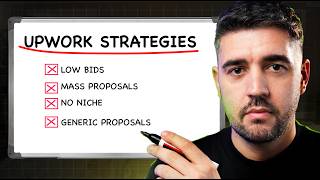
In this solo YouTube presentation, top‑earning Upwork freelancer Michael Elliott (over $500k earned, top 1%) reveals four systemic mistakes that keep freelancers financially stagnant on the platform and explains how to fix each. 1. Treating Upwork as a numbers game – sending high‑volume, copy‑paste proposals. Elliott shows that volume alone hurts the Upwork algorithm and win rates; instead, he advocates “quality at volume” by reading each brief, tailoring the first two lines, and adding a personalized Loom video. 2. Charging hourly instead of pricing by outcome – hourly rates cap earnings because time is finite. He contrasts his $45/hr rate with a $2,800 project that equated to $311/hr, illustrating how outcome‑based pricing can multiply income (he lost ~$400k over two years by staying hourly). 3. Leaving your profile dormant – a static profile is treated like a forgotten CV; the Upwork algorithm rewards regular activity. Elliott describes how updating one element every 30 days (title, skill tags, portfolio, keywords from recent high‑quality job posts) tripled his impressions within eight weeks. 4. Thinking like a supplier rather than a partner – delivering only the brief leads to one‑off payments and ghosting. By positioning himself as a partner who owns the outcome, pushes back on bad ideas, and offers strategic guidance, he turned one client into a multi‑year retainer and generated referrals. Elliott ties the four mistakes together, emphasizing that fixing them shifts a freelancer from a broke contractor to a sustainable business, and he points viewers to a companion video on optimal proposal timing.
Chapters
Upwork is set up to keep you broke. There are 4 mistakes baked into how the platform trains you to think, and they're killing your proposal win rate on Upwork. The one I'm most embarrassed about cost me over $400,000 a year for 2 years straight, and I wish I was joking, but I'm not. I made every single one of these. 2 of them are in your strategy right now, and this video is going to fix all 4. Mistake number 1: treating Upwork like it's a numbers game. Now listen, I'm not going to sit here and tell you to stop sending proposals. Proposals. That'd be crazy. But in peak periods, a new job post goes live on Upwork every 30 seconds, up to 25,000 a day at its peak. In the next 20 minutes, your biggest client ever could go live, and if you're not in the pipeline, someone else just steps in there casually and gets them. You have to show up, obviously. But the mistake isn't the volume. The mistake is lazy volume. The mistake is copy and paste proposals, spraying the same template at jobs that you haven't read. That doesn't train the Upwork algorithm to love you, it trains it to bury you. Response rate drops, win rate drops, premium clients stop seeing you because Upwork thinks that you're desperate. I did this for a full year. 70 proposals a week, all copy-paste, brutally low win rate, broke and exhausted. I'm Mike, by the way. Half a million earned on the Upwork platform, top 1%, 5,000 proposals sent in total. But back then, I was one of Upwork's worst offenders on the platform in general. Not because I was sending too many, but because I wasn't reading the job post properly before I hit send. But the week that I kept volume high, actually read every brief, tailored the first 2 lines, sent the Loom, and only applied for jobs that I genuinely fit, my win rate jumped through the roof. Same number of proposals, same skills, same profile. The only thing that changed was I stopped being lazy. Quality at volume, not quality— but fixing your volume is great, but it only matters if you're charging properly for the work that it wins you. And in mistake 2, that's the one that quietly capped my income for 2 years before I spotted it. Mistake 3 is wild, but first mistake 2: charging by the hour. When you charge hourly, the client is literally buying your time. And guess what? Your time is finite. Your income is mathematically locked to hours times rate. That's the with your name spray-painted all over it. But when you charge by the outcome, it's all— this all shifts. The client is buying the result. A landing page that makes them $50,000 is worth $5,000, whether it took you 40 hours to do it or it took you 4 hours to do it. There's no difference. The clock stops being the pricing unit. I charge $45 an hour for 2 years straight. Then I tried project pricing on one client. $2,800 for a campaign build that took me 9 hours to to do. That's $311 an hour. Same work, same client result, 7 times the rate. From that day, I never went back. And that's the $400 a year mistake that I told you that I'd made at the start of this video. The difference between charging hourly and charging by the outcome, multiplied across every billable hour that I work for 2 years straight. So guys, please avoid making the mistakes that I've just explained that I made. Instead, sell outcomes. The ceiling completely disappears then. But none of that really matters, does it, if the clients aren't seeing you in the first place, which I know is a lot of your issues. Which brings us to the third mistake that cut my impressions by 70% without me noticing. So mistake number 3, and it is scary how many freelancers I see making this mistake: setting your profile up once and never touching it again. Your profile isn't a CV that you just file away until you need another job. It's a live sales asset, and Upwork's algorithm rewards activity. Every portfolio update that you make, every refresh skill tag, every new line in your overview is a signal that you are in the game. Dormant profiles get buried fast. I didn't touch mine for 2 years. I literally left it exactly impressions collapsed 70%, and I had no clue why. I blamed the market, I blamed the platform, I blamed the algorithm— everything except the obvious thing. The month that I started updating it every 30 days, impressions tripled inside 8 weeks. Nothing else changed. And here's the tactical bit that nobody else is telling you: before you update, scan the last 30 to 50 high-quality job posts that are in your niche and pull the keywords that clients are actually using right now. The reason for that is because most proposals now are written by AI these days. They actually use the AI system to be able to post these job posts. The platform is flooded with the same recycled language, and it does change as the AI changes, which means freelancers who spot the live trends first get the impressions first. What worked 6 months ago is already dead. Your profile needs to sound like the jobs been posted today, not the jobs that you won last year. So what's the rule? Every 30 days, change one thing, one line, the title, the tag, an image, a portfolio piece pulled from live job posts, not from memory. The algorithm notices, the clients will follow. When did you last update your profile? Drop the month below. If it's older than 60 days, mistake 3 is live in your strategy right now. This is mistake 4, and you have to stick with me through this because this is the one that kept me broke for the longest period of time, and it's the one that I'm angriest about, if I'm honest. Thinking of yourself as a supplier, as a vendor. Here's what nobody tells you, right? Clients don't decide whether to rehire you at the end of the contract. They decide in the first week. They clock whether you're running the job like you care about the outcome or like you're watching the clock until the invoice clears. And they almost never say it out loud. They just politely never call you again. I spent 4 years as a supplier. I'd win a contract, deliver exactly what was asked for, collect the money, move on. I was polite, I was professional, I hit deadlines, and almost every single one of those clients ghosted me the moment that the project closed. I blamed them. I told myself clients on Upwork were transactional and nobody wanted long-term relationships, but that wasn't true. That it was the platform's fault, you know. It wasn't the platform's fault at all. It was mine. I was giving them exactly what they were asking for and nothing more, and they could feel the ceiling on me from week won. And guys, the day that this changed was the day that I stopped asking clients what they wanted and started telling them what was going to work. Same skills, same portfolio again, but a completely different energy in the room. You now look like a North Star. One of those clients is still with me nearly 4 years later. Another one referred me to his business partner, who referred me to his investor, who's now my biggest retainer on my books. And none of that happened because I sent a clever follow-up email. It happened because I stopped showing up as the guy who builds the thing and started showing up as the guy who owns whether the thing actually works or not. And the What's the difference between a supplier and a partner? A supplier delivers the brief. A partner protects the outcome. Clients will pay a supplier once. They'll pay a partner for a decade. Every freelancer listening to this is one conversation away from flipping that switch. Not on the next contract you win. On the one that you're already on. Go into your next client meeting and tell them what you actually think. Do some research analysis. Push back on the thing that you know isn't going to work, even though they're asking for it. The business owner will really, really respect you for disregarding their thoughts. It's crazy, but it does work. They trust you. Watch what happens when you do that. Obviously you do all of that with respect, due care, and attention, but you do it armed with information, experience, and the understanding around what is actually required. And when that happens, you would be arguably doing them a disservice by not telling them. That's mistake 4, and honestly, it's the only one of the 4 that will change your life rather than just your income. Volume, hourly, dormant profile, supplier thinking. 4 mistakes. I made every single one, and every single one cost me years of income that I should have been stacking. You know what they are now. Tomorrow morning, decides whether you're still a freelancer by Christmas or you're effectively a business. Guys, I've shared a lot of wisdom in this video. Please use it because trust me, it is true. If you've enjoyed it, go and check this video out here. It's all about the times, the days, etc., when you should be sending Upwork proposals to maximize your return on investment on Connex and ultimately scale your proposal win rate. Go and jump into that one and I'll see you there.