Why Worse Freelancers Are Stealing Your Upwork Jobs (3-Second Rule)
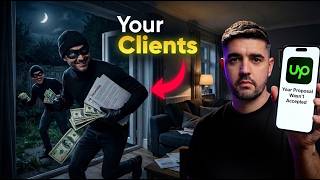
Michael Elliott explains why better freelancers lose Upwork jobs: clients decide in three seconds using gut feeling, not logic. They want safety. Mirror their language, lead with their problem instead of your CV, and offer a guarantee like a free rewrite. Then use the ACT framework: get them to describe success, give something free to trigger reciprocity, close with a yes-or-no choice.
Chapters
I want you to imagine that you've just posted a job on Upwork, and within an hour, 50 proposals have landed in your inbox. You open the first one, you read it for about 3 seconds, you feel something, you don't even know what that something is, but you feel it, and you close it. Next, 3 more seconds, close. Next, 3 more seconds, but this time you keep reading. You don't know why, you just keep reading. And the thing is, you'll tell yourself later it was because because they had good reviews, or the right price, or because they understood the brief. Absolutely none of that is true. Something happened in those 3 seconds that you can't explain. And until you understand that, you will keep losing Upwork jobs to freelancers who are objectively worse than you are. Because here's what nobody tells you. Clients aren't actually reading your proposal at all. They're scanning it in the same way that they scan Instagram. Emotionally, instinctively, in seconds. And they're looking for a feeling. If your proposal triggers it, you're in. And if it doesn't, the next freelancer gets the chance. There is brain science behind this. Nobel Prize-winning brain science, for that matter. And once you understand what's happening inside the client's head, you stop competing on price. You stop competing on your portfolio. It doesn't matter. And you start winning jobs that the rest of the platform don't know exist. Quick context, and I'll keep this short because you didn't click this video to hear about me. You clicked it because something on Upwork isn't working. The proposals just aren't landing. The replies are not coming. You're starting to wonder if it's you. It isn't. It's is that nobody has explained properly what's actually happening on the other side of the screen when a client reads your proposal. And once you know, you can't unknow it. I'm Mike, half a million earned on Upwork, top 1%, 5,000 proposals sent. The next 8 minutes is the thing that I wish someone had told me at proposal number 1 instead of proposal number 4,000. So guys, a famous psychologist called Daniel Kahneman won a Nobel Prize for proving that your brain runs on 2 systems at once. System 1 is fast, emotional, you know, automatic. The part that tells you that a dog might be dangerous before you've even thought about it. System 2 is slow, logical, and careful. That's what you use to do large maths equations, etc. But here's the catch. System 2 is exhausting. Most people spend their day with it switched off completely, making decisions emotionally and using logic afterwards to justify what they already felt. That's the difference. Now think back to that client at the start of the video. 50 proposals, tired, busy. System 2 is already completely depleted. They scan each one in seconds, looking for a gut feeling. When something feels right, they click, and only then they reach for logic to justify to hire it. Good reviews, reasonable rate, worked in my industry, etc. The reviews didn't win the job. The gut feeling did. The reviews just gave the client permission to act on it. So what is that gut feeling? What's the one thing the client's emotional brain is searching for in those 3 seconds? Safety. Clients aren't hiring you for your skill. They're hiring you because you make them feel safe. Safe their problem gets solved. Safe that their money isn't wasted. Safe they don't have to chase you. Micromanage you, or fire you in 3 weeks. Every tactic in this video is downstream of that one truth: stop selling skill, start selling safety. So how do you actually engineer safety into a proposal in 15 seconds or less? 3 things, and the reason most freelancers will never do them is they sound too simple to matter. They're not. They're the difference between a 7% win rate and the kind of win rate that changes your year or your life. First, Mirror their language. Your brain has cells called mirror neurons. They fire when you do something and when you watch someone else do it. It's the reason why you wince if somebody stubs their toe in front of you. Inside an Upwork proposal, that wiring gets weaponized. When a client reads their own words back to them, their brain labels the writer as one of us. Safe. Their post says, "I need a self-starter who handles fast-paced environments." Your proposal opens with, "I'm a self-starter who thrives in fast-paced environments." Their words back to them. You haven't said anything clever. You've held up a mirror, and that moves you from the skip pile to the read pile. Second, and this one is the one that most freelancers have been getting wrong for their entire career: lead with their problem, not your CV. The emotional brain is extremely selfish. I'm writing to express my interest in your project. It's a static skip. It's what the client thinks. Your main challenge is mobile conversion rates. Here's the 3-step plan that I'd run. Lights up the brain immediately. That sentence is about them. It proves you've been thinking about their problem before they hired you. Every time. Now stay with me for the third one, because this is the one that does more work than the first two combined, and almost no proposal on Upwork uses it. Remove the risk. More Nobel Peace Prize work: humans feel the pain of losing something twice as strongly as the pleasure of gaining something equivalent. Twice as strongly. So when a client is about to hire you, they're not thinking about how good it'll be if you nail the job. They're thinking about how bad it'll be if you don't. Wasted money, missed deadlines, the awkward conversation with their boss. That fear sits in their gut the entire time that they're reading your proposal. Take it off the table with one sentence: "If you're not happy with the first deliverable, I'll rewrite it at no charge." It costs you almost nothing. You'll rarely ever use it, but it removes the biggest emotional blocker between the client and the hire button. Once that fear is gone, the gut is free to say yes. So guys, mirror their language, lead with their problem, remove the risk. That's the 3 signals. 15 seconds. Repile, or skip pile. Guys, do yourself a favor, pull up the last proposal that you sent and didn't get a response to. Read the first 2 lines and be honest with yourself, 100% transparent with yourself. Did you mirror the client's language? Did you lead with their problem? Did you take the risk off the table? Or did you start with something extremely generic? Drop a comment below, let me know. Yes if it was generic, no if it wasn't. I want to see how many of you are getting this wrong, because what's coming next is the part that most freelancers never reach. All right, so your proposal works. The client replied, but now what? This is where most freelancers blow it, because even when they get a reply, they switch into pitch mode immediately, listing everything that they can do, dumping their portfolio, talking about themselves. The client goes quiet. Does that sound familiar? Here's the framework that you need to use. It's 3 steps, takes 10 minutes, and it improves your reply-to-contract rate significantly. The first step is align. Before you propose anything, get the client to say what success looks like in their own words. Success for you is your goal within your time frame without your concern, correct? That's it. You're not pitching, you're not confirming. And the moment that they say yes, their brain locks in. Because once a person articulates what they want out loud, they're committed to going after it. You just made them commit before you've sold them anything. And because you haven't tried to sell them anything, you action step 2. That's commit. Now you give them something for free. Not a discovery call unless they propose one. A call is always a great option, take it if you can, but don't— that's not what they're looking for. Don't give them that. Not a quote. Something tangible. A scope document for their project, a breakdown of what you do in week 1, a quick observation about their existing setup that they hadn't spotted. Something they can hold in their hand and read in their own time. It's never been easier with AI around now. The reason that this works is twofold. One, it's reciprocation. You've given them something valuable with no contract attached, and their brain creates an obligation to return the favor. And two, it makes you their freelancer before any money has exchanged hands. Once they've read your scope document, you're not a name on the list anymore. You're the person that's kind of already working on the Anyone else they hire now feels like starting again. This takes you 10 minutes, 5 to 10 minutes. It costs you nothing, and it converts at a rate that the rest of Upwork can't compete with. And step 3, the killer moment: transact. End with a binary question. Not let me know what you think, not happy to discuss further. There's a psychological thing that happens again when you give people a choice between two specific things or more. Do you want me to start with a lean version this week or go straight to the full scope? As an example. If you give people an option, you stop them looking at you against 3 other freelancers, and you start getting them to look at the 2 packages that you've offered them. Guys, let that land. Either answer is a yes. There is no 'I'll think about it.' There is no 'no.' You've removed the third door. You've just learned the ACT framework—align, commit, transact—and it is critical to Upwork success. 3 steps, 10 minutes maximum. The freelancers who know this close clients in a single conversation. The ones who don't spend 3 days messaging a client with no response and then watch the client hire somebody else. Guys, this is the critical thing, and most freelancers, because they've not been exposed in the business world in a lot of cases, if you're new to freelancing especially, winning the proposal is half the game, closing the reply is the other half, but keeping the client is where the real money lives. That's how you make residual income. Bain Company, one of the biggest consultancies in the world, found that increasing your client retention by 5% can boost profits by up to 95%. A 5% shift almost doubled the money. Because acquiring a new client costs 5 to 25 times more than keeping one. Every retained client is one that you didn't have to fight for. So how do you keep them? Not with consistent good work. Consistent good work is the baseline, obviously, but the baseline doesn't make people loyal. Surprise does. A famous study: restaurant waiters and tips. One sweet with the bill, tips up 3%. Two sweets, up 14%. But then when the waiter gave one sweet, walked away, then turned back like they just decided to give that customer something extra, tips up 23%. The amount didn't matter. The 'I picked you specifically' feeling mattered. Are you seeing the theme here, guys? That's reciprocation again. When somebody gives you something unexpected, your brain creates an obligation to return the favor. You have to give it back. You don't think about it, it's just an emotional feeling. You just feel pulled towards that person. So apply it on Upwork. On time is the baseline. Early is relief. Early plus an unrequested bonus— a strategy note. An observation, something that they didn't ask for. That's the 23% tips moment. That's what turns a one-off project into a retainer. And here's the bit that ties it back to the platform. Upwork's algorithm rewards exactly this. Every 90 days a contract stays active, it counts a positive signal towards your job success score, your JSS. Up to 8 separate signals from the same client. Your future proposals literally work harder because of the clients that you keep. So if you have a client base right now, stop chasing new clients. Make your existing ones feel surprised, seen, and safe first. Everything compounds from there. And here's the mindset shift that ties all of this together, everything you've just learned. Most freelancers think like vendors. A vendor delivers what was ordered, like a vending machine. They press the numbers, something comes out. That's what they ordered. Client says, I need a logo. The vendor goes through the vending machine, E3, Gets the logo. Relationship ends. Interchangeable. Competing on price because there's nothing else to compete on. Partners are different. A partner— I partner with my clients. Partners are different. A partner delivers what was ordered and notices what wasn't asked for. A partner says, I notice your checkout flow has a problem that's probably costing you sales. Happy to provide a solution for you next week if you want. The vendor sells the logo. The partner sells the safety of having someone in their corner. And System 1, the gut, the emotional brain, it doesn't remember vendors. It remembers partners. It remembers the freelancers who made them feel relief, surprise, or the rare experience of genuinely being understood. 6 months later, when that client's friend asks, "Do you know anyone good?" Your name is the one that comes out of their mouth. Not because of your portfolio, because of how you made them feel. That's the whole game. Clients aren't buying skill, they're buying the feeling of being safe with someone who actually sees them. That's half a million dollars of Upwork experience in one video. You stop opening proposals with, "I'm writing to express interest." You mirror the client's language instead. You lead with their problem. You take risk off the table with one sentence, which is incredibly easy, and you're never probably going to use it anyway. When they reply, you run the ACT framework. You align. You commit and give them something for free. You transact with a binary question, so don't give them the third door option. And once you've won the work, you stop being a vendor and start being a partner. Early delivery, surprise extras, observations that they didn't ask for. You're not selling a skill anymore, you are selling safety. Most freelancers will never figure this out. They'll keep tweaking their portfolios, they'll keep lowering their rates, they'll keep blaming the algorithm. You're not doing that anymore. You know what clients are actually buying and you know exactly how to sell it. In the next video, go and check this out, you'll absolutely love it. It's all about proposal structure. Go and catch you there. My name is Michael Elliott, thanks for watching.









