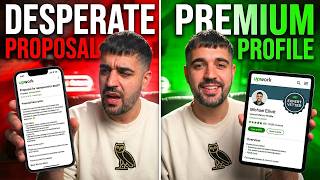
Michael Elliott went from $170 in his first month on Upwork to half a million dollars and Top 1% status. He breaks down five mistakes that make you look desperate: applying to everything, sending generic proposals, chasing crowded listings, underpricing out of fear, and ignoring private feedback that affects visibility. Fix it by being selective, personalizing every pitch, avoiding oversaturated jobs, pricing for value, and protecting your reputation.
Chapters
In my first month on Upwork, I sent 89 proposals. Do you know what I earned? $170. And I genuinely could not figure out what I was doing wrong. I had the skills, I was putting in the hours, I was applying for jobs every single day. What I didn't realise was that I was doing the 5 things that made me look like every other average freelancer that's desperate in the pile. And the clients can smell desperation from a mile away. I know that now because I went on to earn over half a million on the platform. Top 1%, Expert Vetted status, multiple 5-figure projects earned. And I can tell you exactly where it all changed. It wasn't my skills. These are the 5 things that I stopped doing, and if you're doing any of them right now, they are costing you far more than you realize. Listen closely, guys, because the first mistake is the one that sets the tone for everything else. I was applying to every single job that came up. It didn't matter where the client was based, It didn't matter what their history looked like. It didn't matter if the budget was $50 or $5,000. None of it mattered. I was available. I was accessible. I was online, refreshing and applying. And that energy comes through in every single proposal that you send. Here's what I didn't understand at the time. Being accessible is unattractive. And if you think about it, it is in real life in general. On Upwork, on any platform, in any sales context, in a personal relationship, somebody you might like. The person who will take anything looks like the person that nobody wants. The moment that I got selective, everything shifted for me. I stopped applying for jobs outside of my desired geography, unless the client had a really strong record, of course. I stopped touching anything under a certain budget threshold. I started treating my connects after they were implemented like actual money, because they are actual money. Before that change, I was invisible. After it, I started landing clients who respected the rate before we even had a conversation. Upwork is not a job board, it's a marketplace. And in a marketplace, you have to position yourself, because how you position yourself is everything. If you treat it like LinkedIn Jobs, you will get LinkedIn-level results. Guys, this is— don't— to come close for this because this one's important. It's the proposals themselves. And here's the test. Go and do it. Read your last proposal back to yourself. And now ask, "Could I send this exact message to a completely different job tomorrow without changing a single word?" If the answer is yes, it's not a proposal. It's spam with punctuation. I know what a tailored proposal looks like because I've sent 5,000 of them. And the ones that landed my biggest contracts, multiple 5-figure contracts, all had one thing in common. The client could tell within the first sentence that I had actually read their brief. Not skimmed it. I'd read it, referenced something specific, reflected their problem back to them in a way that proved that I understood what they actually needed. That is not complicated. It just takes an extra 3-4 minutes per application. And here's the trade-off. You send fewer proposals technically because each one takes longer. Your connects go further because you're applying only where you've done your homework, and your reply rate goes up because you no longer look like everyone else in the room. If I can copy and paste your proposal to a different job, it is trash. This third one is the one that nobody talks about, and it's critical. Before you write a single word of a proposal, look at how many proposals are already on the job. Because if there are 50 applications just literally sitting there waiting, You're not competing with 50 people. You're competing with 50 people, a recency bias that buries late applicants, a client who has probably already shortlisted somebody, and the big thing, a psychological reality that most clients stop reading after the first 3 or 4 that they actually like. Your connects are finite. Your time is finite, and there are new jobs on at work every single hour. Focus on those. You do not have to fight for a seat in every single crowded room. I have a hard filter on proposal count before I apply for anything. If the number is already high, I move on. There will be another job. They are always there. In my last video, I literally covered how speed is the key to success. So if you miss it, you have to just delay and wait. Before you hit submit, check that number. If it's already crowded, your energy is better spent on the next one. But here's the thing, even when you find the right job, you apply at exactly the right time, and write something tailored, there's one decision that you'll make before you even start writing that can disqualify you before the client reads a word. So don't fall. What is it? Well, it's your rate and pricing from fear. This is the trap that keeps the most capable freelancer stuck right at the bottom. Pricing from fear. You're scared, but you're new. You're trying to break into a new niche maybe, so you go low. You undercut the competition. You're trying to get a foot in the door, build your reputation, build your reviews, raise the rates later. I've heard it a thousand times, but here's what actually happens. The clients you attract at a low rate are disproportionately the ones who choose you because you were the cheapest option. You were the cheapest available option, and those clients more often than not are the ones who make the work the hardest. Trust me, feel the pain through the camera. Take the longest to deliver the results and leave you with the least to show for it. And now, worse, your account history is built around that rate, those clients, and that positioning. Other people see it. Getting out of that corner takes months. But what's an even harder truth than that is this: a suspiciously low rate doesn't make you look accessible. It makes you look either inexperienced or desperate. And neither of those is a reason for a serious client to hire you, is it? It makes you look either inexperienced or desperate. None of those are a reason for a serious client. Cheap tells clients you're either new, desperate, or both. Price at what your work is actually worth. Value proposition. Win fewer jobs at the start, make every single one of those jobs 5-star case studies. That is a faster path to where you wanna be than volume at the wrong rate would ever be. And the last one, don't 5. This is the one that silently ends careers on this platform. Most freelancers think their Upwork reputation is what's visible on their profile. The stars, the reviews, the job success score. It's not. Upwork has a private feedback system. After every single contract ends, clients fill in a separate set of ratings that you can never see. They rate things like whether they'd hire you again, where— how your skills matched up to what you promised, whether the working relationship was easy or not. None of that shows on your profile, but all of it affects whether Upwork surfaces you in search, whether clients see you, whether the algorithm treats you as a trusted freelancer. Or a liability? I've seen it play out in real time to people who I know, good freelancers as well in some cases. A freelancer who looked good, solid on paper, good reviews, decent score, quietly tanking in visibility, but the pattern underneath told a different story. Their contracts were abandoned, expectations managed poorly, communication that went quiet at the wrong moments. The platform saw it even when the profile didn't show it. Every contract is a two-part score— the one that you see and the one that you don't see. Protect both. A few tips early on: stay on platform for communication, set expectations clearly before the work starts, never ghost, obviously, never deliver something different to what you discussed and hope that it lands. The stuff you never see on your profile is what decides if clients ever see you again. Now, I'm just going to be honest, I've done every single one of these, some of them for longer than I'd like to admit, and looking back, the platform wasn't the problem at any point. My approach was, so that's why I'm sharing this experience. Here's what I want you to do right now. Go and look at your last 5 proposals. Not to cringe, to audit them. How many of them opened with your name and experience? How many reference something specific from the brief? Drop the answer in the comments, even just the number, because that one thing, the opener, is the fastest lever that you have. Fix it this week with something relevant to their brief, and you will feel a difference before the month is out. 5 things, all of them fixable today. None of them requiring you to be any more experienced or any more talented than you already are. Just sharper, more deliberate, less desperate. If you want to see exactly how I structure a proposal that lands with serious clients, that video is right here. Subscribe if you haven't. Tuesday and Thursdays every single week. No fluff, just what actually works after half a million earnings on the platform. I'll catch you in the next one.