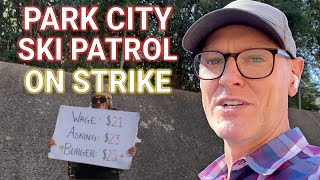
In this commentary, Michael, a veteran CEO, explains why many ski runs at Park City, Utah are closed due to a labor dispute between the ski‑patrol union and Vail Resorts, the corporate owner of the mountain. He outlines how Vail, after buying 42 premium ski resorts with private‑equity backing, created a subscription‑based pass that guarantees winter revenue and gives the company massive pricing power. The ski‑patrol workers, who earn $21 /hour, are striking for a modest $2 raise to $23 /hour and, more importantly, for full‑year health and retirement benefits. Michael connects the dispute to the broader U.S. problems of soaring healthcare costs, unchecked corporate consolidation, and weak regulatory oversight, arguing that Vail’s scale makes it both powerful and vulnerable—granting it leverage over consumers while exposing it to a domino effect if one union’s demands are met. He frames the union’s actions as a necessary pushback against a monopolistic corporation that has driven ski‑trip prices far above inflation, and calls for political action to curb such market concentration. Throughout, he expresses sympathy for the union and criticism of Vail’s practices, urging viewers to understand the deeper economic forces behind the headline‑grabbing strike.
Chapters
So pretty horrible news out today if you are a skier, especially a skier in Utah. There are social media pictures that look like this one. People have spent tens of thousands of dollars on once-in-a-lifetime vacations. They have flown out, rented places, gotten skis, set up, and walked out to the mountain at Park City outside of Utah, outside of Salt Lake City, only to discover that most of the mountain is closed. And the reason most of the mountain is closed is there is a labor dispute. And that labor dispute is between the union that represents the ski patrol, the the people that patrol the mountain and keep it safe and rescue injured skiers, and the big evil corporation that owns the mountain called Vail Corporation. And you're like, well, wait, this is only over $2 an hour? Like, how is that a deal? Why did they just cave instead of taking all this PR hit? Well, it turns out there's a story behind the story, and it ties into a lot of the things that are wrong with America right now, including our healthcare system, our screwed up lack of, uh, lack of monopoly and consumer protections, and it all ties back together. So that's what this video is about. Hi, I'm Michael. I'm a 20-year-plus CEO in business. I've hired hundreds of people, incubated and invested in dozens of companies, and I love talking about business and explaining the world of it. So if you like that, subscribe and stick around. So Park City Mountain is a unique mountain and also not unique. It is one of the 42 resorts that got bought up across the United States and the world by a company called Vail Resorts, named after the famous ski mountain in Utah— or in Colorado. And the way it went down was that some private equity guys, Apollo Global Management, saw an opportunity. And what they saw was an opportunity to go buy up a bunch of these premium ski resorts that controlled all of the good locations across the United States. Where skiing could happen. So the, the famous mountains where premium experiences could be had. So Vail, Breckenridge, Keystone, Whistler, and Park City. And they went and paid up and bought all of these ski resorts, 42 of them in fact, to create a massive chain of basically the premium resorts around the country. And so by buying up all of those, suddenly it gives you pricing power. You have a cornered resource where you own that thing, and it's hard for people to compete with you when you own all the premium kind of upscale resorts. And then secondarily, what they realized was when they got to a certain scale like that and made themselves pretty big, they could take a lot of the lumpiness out of the owning of ski resorts, right? So if you own a ski resort, it kind of sucks. When do you make money? In the winter. When do you not make money? In the summer. Well, the folks behind Vail had a pretty good idea. They went and turned it all into a subscription model in which people like you or me would pay in May for the ability to ski anywhere at any of their resorts in the winter. So basically, instead of maybe getting paid during the winter, they got guaranteed payments during the spring. And it turned out to be total genius. And the execution of all this is they really went and did two things. One is when they controlled all of these resources that were valued, these great ski resorts, they could raise prices. And they have like crazy. If you go look at some of the numbers, the cost to ski has outpaced inflation like crazy. And the other thing they did was they used their scale to go push back on costs. And the biggest costs for these mountains are kind of what you expect: running the ski lifts, repairing them, and all that kind of stuff. But the other big one is labor. And look, when you are like the Vail Corporation and you control Park City, which is the main source of skiing for the Park City area, that means you're also one of the few, if not the only, major employers in that area. So you can push to keep wages down. Well, that can only last for so long until you see what's happening now, which is the folks who work at these mountains have realized they have some power too. And over the past couple decades, as the mountains have consolidated under Vail, they— these folks have consolidated themselves into unions. And that leads us to where we are today, which is we have the ski patrol at Park City that is petitioning to try to get better wages and treatment by the big corporation that owns the mountain. So if you're not familiar with the ski patrol, um, and I'm an avid skier so I know, uh, they are the folks that basically ski around the mountain. They basically keep it safe. They rescue injured skiers. They check for avalanches. They're a pretty integral part of what makes a mountain work. Um, but where this all gets confusing is The ski patrol is asking for just a $2 raise. Most of these folks at Park City are making $21 an hour. And this has actually turned into a pretty genius PR move by the Park City ski patrol, which is they're out on the picket line and they have these signs, I'll put up one right here, where basically they're asking for a raise from $21 to $23 an hour. So what's genius to some extent about what the union is doing, right? They're asking for a raise from $21 to $23. And I put up the picture of the guy with the sign that says, "Hey, we wanna raise from $21 to $23 an hour. By the way, a burger costs $25 on the mountain when you buy it from Vail Corporation at one of their lodges," which is entirely true. These guys are totally not bashful about charging you the absolute maximum you can afford to pay when you go skiing. But this is $2 an hour. Like, why does this big corporation who's taking a huge social media hit right now and a huge perception hit. Like, why don't they just give in? Like, it's a 10% raise. Like, what's the big deal? Well, like most things in the media, you have to double-click and try to understand what's really going on, especially when something doesn't make sense. But the first reason here is that the union is not just asking for an increase in wages. They're asking for a massive improvement in their benefits. And the way it works right now for most of these seasonal jobs is the corporation is providing basically healthcare and retirement savings and all that kind of stuff, but not for the whole year. They're providing it for a part of the year, which makes sense. Like, the ski patrol doesn't work in the summer like they do in the winter. But at the other end of the spectrum, healthcare costs and benefit costs have gotten so out of control in this country that for, say, a $21 or $23 an hour employee, the cost to provide healthcare and benefits to somebody like that might be $10,000, $15,000, $20,000 a year. For a corporation like this. And if you're suddenly going to take it from being 6 months of the year to a full year worth of benefits for these workers, suddenly that goes hugely to the bottom line of a corporation like Vail. Now, is that right or wrong? That's to be argued. But the reality is there's a big story beside— behind the headlines here. So yeah, so not any of these headlines is the cause for the strike. The US's screwed up healthcare system. Pretty, pretty funny how oftentimes this thing just shows its head even where you don't want it. But the second thing to realize what's going on here is Vail Corporation is entirely vulnerable, right? They're a big chain and you have just one of the unions at one of the locations and they have 41 other ones to worry about. And then they have 41, 50, 100 other types of jobs that people are doing out on these individual you know, resorts, everybody from the people that run the lifts to the safety folks to the people that work at the restaurants. If they start giving in to one union's demands like this, it could start a domino and create massive increase in costs for them. So ironically, the thing that has turned Vail into such a behemoth and such a, well, cash printing machine for shareholders and for people in the stock market is the same thing that ironically is making it so vulnerable. And one of the things we've talked about a lot, and I talk about a lot on this channel, is this theme that many times the thing that creates your business and the thing that creates your opportunity is the same thing that comes along and kills it later. And this is no exception. And look, our government has been asleep at the wheel for the past 30 years, letting everything from defense contractors to airlines to grocery stores and ski resorts create too much power from the corporate perspective. There's been too much consolidation in these industries. And frankly, like, the ski industry is one that shows how much this has hurt consumers. It is just freaking a ripoff. And look, if the bureaucrats and politicians in Washington, D.C. are going to be asleep at the wheel and are going to let folks like Vail Corporation get this big and get this much power in the market, well, then hopefully the unions can stop that from happening if the politicians and bureaucrats aren't going to do their job. And for that, and especially somebody who's a skier, an avid skier at a lot of these places, I think Vail Corporation deserves all the knocks it can get. And I wish these union folks the best of luck. And I think what they're doing is great stuff. So kudos to them and godspeed.