Business Incubation Process Explained - HoldCo Lecture Series Ep. 1
Michael Girdley explains his incubation model: hire a salaried associate to find and lead a new company, then give them equity. He uses the effectuation framework and a checklist that screens for risk, market, and control. Four examples: Red Runner Coffee, Scalepath, Dura Software, and Near.
Chapters
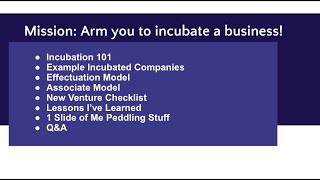
So the mission today is before this hour is up, you leave armed to incubate your own businesses. I'll talk about what incubation is here, this Incubation 101 thing. I'll talk through some example incubated companies. There's 4 of them that I'll kind of tell you the story of today through this presentation. And, you know, a benefit of my background is I'm pretty omnivorous in terms of the types of companies I get involved in. So I'll show you everything from like a drive-thru coffee chain that I incubated to basically a high-growth like software company and kind of everything in between. So I'll talk a bit about the effectuation model of entrepreneurship, and I think it's something very well suited for incubation. And there's other ways to do it, but it's the one I like the most. I'll talk about my associate model. That's how a contrary and I think way to think about how to find operators or what people call operators. So people to run the businesses. And a thing in incubation is you incubate a company and you don't plan on actually running it yourself. That's incubation versus just founding a company. So you have to figure out how to find the right people to build those businesses with you as partners or as employees. And the associate model is how I do that, and I like doing it. I'll talk about another tool I use called the New Venture Checklist. That is an idea of starting with the end in mind as you put together companies. And then I'll give you contrarian lessons I've learned. And that's about all this coming up. There's about 20 slides and then there's one slide where Ty makes me peddle some stuff to you so we can pay the bills. I have a team now of like, how many people do we have, Ty? Like 8 people putting together and like producing content that comes out of my brain and the vast majority of it is for free. There's some of it I'm going to ask you to like do some stuff. So whatever. So it's like, sit through it, please. And then we'll do all the Q&A and we'll finish on time. All right. All right, cool. Let's dig in. Okay, so let me just start with kind of the story of one of the companies I've incubated. This is an example of like an old school Main Street business. We incubated a business called Red Runner Coffee. If you know of Dutch Bros or anything like that here in the United States, they are drive-thru sugary coffee chains. We started that back in 2020 during COVID Frankly, I wanted to do it for two reasons. One was I wanted to really make sure that I had the skill set needed to do true incubation. And when I say true incubation, I mean I never take a job at the company no matter what. Like I'm not doing any operations other than getting it set up. And this was one of those things where I wanted to be like, okay, I think I know how to do all of this. I want to make sure I have a model down and all the skill sets that I need. And we started in 2020 and we sold it in 2023. We ended up with 60 or so employees. And then I have another thing here that I can't see below my notes there that— well, my camera's in the way of the slides, so I can't read the last bullet point. But like, this is an example where from the beginning, you know, we started this business by first hiring an operator around the concept. So we hired a GM and then later on we brought on a CEO, but we developed it without me ever really taking a job in the company. And so ended up being a relatively good success for us and we got out of it. But the way I ended up doing this was by starting with some partners who had other things that they could bring besides what I was bringing. I was bringing money and knowledge and my other partners were also bringing money and some knowledge in other areas that I wasn't good at. So this is an example of one that I've done, but just to show you how that kind of works. And then this will show up in the tool, you know, and as I explain some of the tools later on in the presentation. Oh, somebody asked, is the audio cutting in and out for anybody else? Ty, is it working for you?
It is very clear on my end.
So, okay, anonymous attendee, it is not cutting out for anybody else. Okay, so let's talk a bit about incubation. Um, what is it? Um, look, it's a flavor of entrepreneurship and investing, uh, and I would say it kind of meets at the middle of those two things, right? Entrepreneurship is where you start a company and you potentially run it. Investing is where you are passive in companies, and incubation is really a flavor of those things where you want to create businesses that are ultimately going to create wealth or income for you. And the key thing that I think defines it is you're founding or starting companies that you don't plan to run. And those can be ones that you don't plan to run long term, or it can be ones that you don't plan to run at all. And when I told the story of, of the Red Runner Coffee business, That was when— where I didn't want to have a job there at any point. I didn't want to work in it and I didn't want to be the CEO from the beginning. And that was by design as we started to think about it. And I was very transparent with my, my co-founders of that business that I didn't want to have an operating role in them. Question of will we get the slides later or do we need to take notes? We're recording this and the slides will be available for sure, but you're welcome to take notes. It'll make me feel good. So thank you, Daniel. So if you incubate a business, it could be anything. You know, I think it can be software, IP, it could be, you know, Main Street businesses, it could be services, it could be anything. I've done to some extent all three of those things. I told you about the Main Street case in terms of the coffee business. And, you know, there's other ones that I've done in software and services that I'll talk a little bit later on as we use those to illustrate some of the principles I'll talk to you about. I typically do incubation as a one-man show. Basically, I only have one employee right now, Robin, who is my chief of staff. And so she does a lot of operational things. And I did a thread the other day about how that situation works. But my incubations are typically a one-man show. There are versions of this where people will create things like a venture studio or have a team that is incubating things, or you'll see potentially partnerships where two people together are incubating companies. There are kind of variations in between. My flavor is very much kind of the one-man show approach. And yeah, I don't know why that is. I just like doing it by myself. So why do incubation? For me, it's a choice, right? Like most of my friends own one company and are CEO of one company and they're perfectly happy doing that. I am totally supportive of that. That is a lifestyle they want to live. For me, what I do is appropriate for the life I want to be living right now. I have a ton of fun incubating companies. If somebody said, Michael, you can only do one thing for the rest of your career, what would you do? I would just incubate companies. That's the whole thing. Like, I would just do that. It feels like a creative exercise to me. It feels inspiring, and I just have fun doing it. And, you know, it works for my style. You know, I'm relatively good at delegating, and also I don't feel the need to control like a lot of other folks do, and especially some of my friends who look at what I do incubating companies and are like, how do you, be okay with letting somebody else like, like have your control of your baby, right? And how do you let the CEO CEO? And I just, I don't have the problems with it that other people do. And I can focus on what I'm good at. Like, I love coaching people, I love having insights, and I love supporting and seeing other people succeed. I don't feel the need to control stuff. And along the way, like, one of the things I love about it is you get to partner with great people. You get to choose who you're going to work with. in terms of your approach to incubating. Like, there's other people that you bring in to build these businesses. And so, like, unlike being in a big corporation where sometimes they tell you you have to work, like, with some jerk that you don't like or have a boss you don't like, like, I get to choose my friends. So it's pretty terrific. Uh, question from Carlos: what is the difference between incubation and a holdco? So I would say that, uh, a holdco is an approach to wealth building, right, where you're going to have a corporation that owns other corporations or independent businesses that each have their own business model or unique set of assets, right? So in my case, I see what I do as being a holdco, albeit with a very small central staff and owning stakes in all of these businesses with, you know, with, with an intent to hold them for the long term. Incubation is a way to potentially grow your holdco. There's another way to grow your holdco, which is buying other companies that are already established. And incubation is just a way to potentially add more businesses to what, you know, what you own in a holdco. Cool. All right. Good question. And look, it can be— if you do incubation in a certain way, it can be a cash-light way to build businesses. And there's multiple ways to kind of get there. One can be build businesses that get to profitability quickly. I'll tell you about an example of some businesses I've incubated that are like that, where the, you know, the upfront investment by me is relatively small, you know, six figures or less. Then there's ways to build it where other people's money is involved. And those are for sure ways that can be cash light as well. Yeah. What is the range of initial— so Amir asked the question, what is the range of initial capital investment for the different businesses that you have incubated? Look, it can be the range of incubation that anybody does can be anywhere from $1 to multiple millions. Typically, my opinion, and I'll talk a little bit more about it later, is most businesses are healthier when they get started and they're capital constrained. You actually don't want to have too much capital. So I try to start stuff with a bare minimum of capital, but that tends to be kind of low six figures for me of where my incubation like level of investment is. So, you know, those are the kind of numbers where I tend to be these days. And like for me, it's also a lifestyle. Like I want to practice parallel entrepreneurship versus serial entrepreneurship. Serial entrepreneurship would be like owning one company and running that one company. I want to have, you know, I want to have the ability to be involved in multiple different things because I'm a really curious person and it's fun to me to be able to context switch between all these different things. And in my case, everything from, you know, fireworks to a software company to a coffee business to a staffing business and everything kind of in between. So Dan asked, do you have any partners in the companies you incubate that don't own equity? Rather, a profit sharing or bonus structure is in place. So by definition, I would consider somebody a partner, quote unquote, as somebody that owns equity in the business, meaning they have stock and shares and their ownership is kind of aligned with mine, right, in terms of us being partners in the whole thing. I do. I would consider anybody that just basically has like a, a different kind of incentive structure that goes away potentially when they leave the business as somebody that is more of an employee. And that's, you know, maybe just a semantic thing, but I tend to want to create things where my interests are aligned with other people. And the best way to do that is we all kind of get treated as, you know, peer owners and co-owners of the company.
Hey, Michael, real quick, just for sake of time, we're going to have a Q&A session at the end and we're going to block that off. I just want to make sure we're able to get through the chunk of the presentation as well. So I'll flag things, but keep throwing in your questions. But we've got a section dedicated.
Okay. Yeah, I think the two questions that are up there now, we can save them for later.
So awesome.
Okay. So look, I just want to give another example of an incubator company. So this was the first company. This was one of the first companies I did called Scalepath. It's an online community for small business CEOs. We launched it 16, 17 months ago, and this was one of the first ones I did where, where I used my associate model. And I'll talk about that. And that is part of the way where I think you solve the hardest thing in incubation, which is everybody thinks the hardest thing in incubation is to find the right idea. The actual hardest thing in incubation is to find the right person to be the leader and build the business alongside you. So, you know, we incubated this business and it was really one of the other first ones that I did using the new venture checklist that I'll show you a bit later where I define kind of what I want new incubations to look like and use that as kind of having the end in mind, like, okay, I'm going to only work on ideas like this. And this was also one where we use the effectuation model that I'll talk to you about here in a second. So this was great because it was profitable in month 2, like, so kind of an example of what I talked about. These can be cash light and my investment in this business is, is low six figures. Okay, so just to continue on a little bit, I just want to be totally upfront. There are multiple ways to incubate companies. And besides just listening to my way of doing it, I would encourage you to go out and study the other way that people do them. So sorry, this slide's a little bit dark, but there's everything from, you know, Kevin Rose's AlleyCorp located in New York and Boston to Bill Gross's like old school Idea Lab. These are a lot of the other examples of how people generate ideas. Out there and are generating incubating companies out there. And I would encourage you not only to look at my pretty hardcore and opinionated way of doing it, but also study the way other people are doing it, because there's multiple ways really to skin the cat here in terms of how to approach it. And this is just the, the, the scratching, you know, the tip of the iceberg in terms of the amount of ways that people are out there doing these types of different things. And again, mine is just an opinionated way that works for me. But these are two that have been very successful. AlliCorp and Idealab are pretty famous. Okay, so this is the process I use and the principles behind it. So I use a process called effectuation. So effectuation is something I've written a lot about online. It's basically a difference between if you've heard of Lean Startup and kind of the classical waterfall model that VCs and big, you know, Silicon Valley startups use. This is a process in the middle that I use to incubate companies. And I didn't make up the name. It actually comes from a professor whose name I butcher every time I try to pronounce it out of UVA. So mad credit to her, mad non-credit to me for being able to— not being able to pronounce her name. So I won't brutalize it here, but credit to them. I didn't invent this. I actually discovered later on that I was building companies using these effectuation principles, and I had not known the name of it. Like, you know, so anyway, I found it all afterwards, but it's been great to kind of articulate how we've done stuff. So, so, you know, I talked a bit about the Scalepath business, so I'll try to articulate— well, actually, I have another example after this one. So what I'm going to do is I'm going to show you these 3 principles of, of effectuation, and then I'm going to show you a business I built using these 3 principles that I haven't talked about so far. So principle number 1 is bird in hand. So a lot of other ways of building businesses. Like if you've done Lean Startup, it involves you going to ask people their problems and do customer discovery. The waterfall model has you coming up with a vision of what you want the future to be like, hey, we're going to build these instantly available universal taxis that are on everybody's phone. In other words, Uber, we're going to build towards that vision. There's this other thing where you start in the middle with first, what can you do and what are your strengths? And so this bird in the hand principle is when I incubate companies, I start to think about what are my unfair advantages And what do I have as resources that other people don't and how can I leverage those? And those are things like who I am, what I'm good at. You know, I've built up 200-whatever thousand followers on Twitter and as of yesterday, 2,100 followers on YouTube. Like, you know, what strengths do I have and how can I leverage those? What I know, education and skills. So one of the companies that I incubate is a software company. I have a background in enterprise software, like I understand it. I also know how to do M&A really well. Like what can I leverage in terms of my education skills and then who I know, like who's in my network, who has abilities, who would be potentially somebody to partner with, invest in deals and all that kind of stuff. And then I use that strength to go explore viable ideas starting with those strengths, right? Number 2 is this principle called affordable loss, where when you go build a startup or build a new business, each thing is building up conviction over time. So I start with small levels of bets. In terms of particular businesses. So before we went, for example, with the Scale Pass business, which is the, the CEO network, we started to make small bets to see if anybody cared, right? Before we invested six figures, we invested five figures, right, to go, hey, let's launch this and see if anybody signs up. And we launched it quietly and people started to sign up, which was great. And unlike kind of the all-or-nothing bets that you see in VC, right, you're either going to build the Uber vision or you're not. It's going to be a very binary outcome. You start running very— a lot of really small experiments. And what this causes you to do is you double down each time those experiments work out and you learn something about the market. But it's this affordable loss thing where I think somebody asked like, how much money are you putting in these businesses? Actually, a relatively small amount because it's all very affordable losses. Like, I want to put stuff to work and then quit it when it's not working. So I'm making lots of small bets rather than huge bets as we go forward. And then Lemonade, there's this idea of you want to make mistakes as quickly as possible as you're incubating a business. Each piece of bad news or failure like tells you like how you're going to be able to navigate kind of the idea maze. There's this idea of idea maze where you kind of navigate that to figure out how to do things the right way by doing lots of wrong things very quickly. And so you use that kind of process to see those as a benefit and then you know, turn, turn lemons into lemonade. So I'm going to talk now and I'm going to go back and forth between these two slides to talk about one of the companies I incubated called Dura. They're now the largest software company here in San Antonio. We co-founded in 2017. We started it as two of us with the idea of we could become a really good serial acquirer of software companies. So buy small software companies and put them into a bigger company. We raised $88 million. You know, it's 300-something million, 300-something people at this point. But when we first got started, it was very much an idea, right, of, okay, like, let's, let's go, let's go figure out if this will work, right? And like, why did I even look in this space? Well, bird-in-hand principle. Like, I've written books on computer science, on, on Java programming. I have a background in enterprise software. And I knew people that were former Rackspace folks here in San Antonio. I knew we, you know, I had all those strong advantages to be able to be somebody that could potentially build a serial acquirer. So what did we do from an affordable loss perspective? We didn't say, hey, let's go raise $500 million and start trying to buy a bunch of companies. We actually went out and said, let's go buy the first company ourselves and do it with our own money and have an affordable loss. Because I knew if we want to buy 50 companies or 70 companies or 10 companies someday, I'm never going to get there unless I buy one company and make sure that one works really well. And we did that, right? We did that and took that bet ourselves and eliminate— like, we want to make mistakes quickly. The company today is named Dura Software. The first company name was not Dura Software. And actually, we started going out immediately using that other name to potential people who would want to sell their business. And we learned they all hated the name. By the way, I invented both the Dura name and the previous name, so 50% success isn't bad, but that was eliminate principle. By going out and learning that that name wasn't working, we used that as a way to learn as quickly as possible and make mistakes. And since then, the business is, is killing it. It's doing really well. So yeah, pretty proud of that. Okay, so there's 3 more principles to incubating companies around effectuation. Crazy quilt. So we talked about this in some of the questions. You just work with people who are willing to put skin in the game when you start a company or you incubate incubate a company, you will see there are a lot of people who want to be involved. And if you want to use the breakfast metaphor, if you know, the breakfast metaphor is the chicken is involved, the pig is committed. Like, I want to work early on with lots of pigs, right? Like, how do I work with people? It's pigs because they're bacon, right? So like, they can only be bacon once. The chicken can lay another egg tomorrow. You'll see lots of chickens. And early on, I have very little time for those people. But as I start to incubate things, whether it's the coffee business, right, my first partner there was somebody He and I started the business together and his, his specialty was construction. I'm terrible at construction, but I knew with us together we would be able to incubate the company and have the skill set that we needed. I knew the strategy and concepts and all that kind of stuff, but he was there and that became part of this crazy quilt idea. And he and I, you know, were what I like to be, which is both, you know, equal partners in the business in terms of like, doesn't mean you're 50/50, but it just means like you all have the same kind of equity treatment. I'm just looking at time real fast. Okay, good. Pilot in the plane. Look, you only focus on activities you can control. You believe that the future is unknowable and you create tomorrow solely through entrepreneurial work. You know, it's the opposite of this idea that shows up in things like, you know, the Uber example that I gave you around VC. You don't start with a vision. You start with controlling what you can. And like in the Dura example, like I knew I could control, can we do one deal or not? and I just focused on that and made it happen. And then the effectual cycle. These principles all tie together in a cycle that is really backwards, right? Instead of starting with a vision, you start with the capabilities. Instead of starting with a big bucket of money, you start with a small set of experiments and you develop conviction over time. And then eventually goals for the business emerge. And if we go back to the Scalepath business that we talked about earlier, that business has pivoted numerous times over the past 15 months based on the effectual cycle. To a place now where I think they're doing incredibly well. But we only figured out those lessons by running lots of experiments along the way and then listening to the results of those things. All right. So this— I think I've talked about 3. I have 4 examples of companies I've incubated. This is the 4th one. This is a company called Near. It's a nearshore staffing company. It's doing incredibly well. Founded in 2022, it was the first one actually used this associate model, which is an operator-first model to incubate companies, and it's just doing incredibly well. We used all of those same effectuation principles to come up with the idea for this business. It is currently a staffing company. When we started out, we wanted to be a job board and we started building a job board for American companies to hire offshore. And discovered job boards are an okay business, but customers in the US are not ready for offshore job boards. So we pivoted over time based on that really fast learning and iteration around that. So yeah, I'm really proud of this one too. So I had two partners on this and they— we started it with the associate model and I don't— I've never had a job in this company and that they You don't want to hire me. Okay, cool. So that kind of illustrates the effectuation stuff. Here's what I prioritize in terms of incubation. I think a lot of people get it backwards. They think it's about the right idea and then you attract people to your idea. The reality is I have seen over and over again that you start with the right people first and something changes when you start with the right person and they're part of developing the idea with you, like they get a level of almost like religion or ownership that just totally changes things for them. Right. And I'll talk about it in the lessons learned later as I've tried to incubate companies. Like, people don't want to work on my shitty ideas. They will if they like. That's just how they see it. Like they don't have an emotional attachment to it like they do, which is why I start before I start with the right people and then I find the right idea with them. I always rush to sell first and build later. Too many people play house with their businesses. And if you see what I talk about through the pattern here, right, like Dura, for example, when we started that business, it was like, go do the first deal. Like, don't worry about all that stuff. Like, rush to action and try to sell somebody to see if they wanted to sell, sell us their business. And we bought their business and did it. And we did it all before we tried to sell future investors or any of that kind of stuff. Right near, near was the same way. Scalepad the same way. It's all about like, how do we sell? How do we sell? How do we sell? With the coffee business, before we opened 4 locations, we opened the first one to see if that one would work and we sold, you know, got, got to selling as quickly as possible. MVP, you make calculated investments in your business and incubation, you build along the way, you get, you just get started and launch as quickly as possible. Before, with the coffee business, before we opened up the 4th location, we got the first one going and we did it in a relatively low risk location because it was property that I already owned and controlled. So really straightforward there. So, and then number 4 was the— and then just adapt and iterate appropriately. And, you know, we'll talk a bit later about killing your darlings. That's one of the things I've learned a lot. Like, I quit stuff so much faster than I used to do as a younger man in terms of business incubation. So cool. I got on a roll there. Ty, is there anything that from the chat that I'm missing?
No, just some great questions for when we get to Q&A, I think.
Okay. Yeah, just, just incubate me if you think I need to, if something was confusing or whatever, and we'll come back to it on Q&A.
Yeah, got it.
Okay. So look, I put together some opinions about incubation. I talked about some of these. I think as I've incubated businesses, I believe— and this is the only curse word in the whole thing— nobody wants to work on my shitty ideas. Something changes when somebody is a partner with you in terms of doing market exploration to figure out if they want to be passionate about an idea or not. In the case of Scalepath, right, like Sam, who is my associate, he runs that business now. He and I are partners on it. I support him, but he runs the day to day and is driving the strategy and all that kind of stuff. Like I saw it change with him in an amazing way when he went out. As we started to develop that business, the first thing we did was do, you know, based around our thesis, we did customer interviews. He talked to about 30 people that are small business owners across the US, and then he came back and we talked to another 20 or so of them to do kind of idea validation. Would they sign up if we actually launched the network? And like something happened as he talked to those 50 people, like he just like it internalized in him that he had— he saw the vision and he had like a personal level of emotional ownership of it. Like if you leave with any one thing today, like you have an idea and trying to find somebody else to work on, like it just doesn't work, right? Like they don't have that level of emotional attachment to it that I think we all want that in a co-founder or somebody that's going to be, you know, part of putting something together. So, you know, nobody wants to work on my shitty ideas. But so that's number one. Number two, hired inflection points. I'm going to talk a little bit about my associate model and how I start with operators through that process. But I think a lot of times I see people make mistakes in incubation where they're trying to bring in somebody that's like a big company gray hair and expect them to be there at, you know, at the very startup. Up of a new thing or they hire somebody who is, you know, 35 and has 3 kids and a mortgage and you expect them to be able to take some risk alongside you. Like, that's just not going to happen, right? So you have to find those right inflection points in people's career where they're ready to make those transitions. And realistically, I mean, just another data point, there's a ton of people out there who say that they want to be entrepreneurs and startup folks and they say it, but they'll never do it, right? They just don't. It's this disconnect in terms of their actions. So you just have to watch out for those kind of people. I'll talk about the associate model with this next thing. As you find win-win partners that are entrepreneurs within, there are a lot of people out there that have grown up with parents that were in the military or were working jobs or whatever that have never been exposed to entrepreneurship. Like, I learned a lot about entrepreneurship because my parents were entrepreneurs and my grandparents were entrepreneurs. Like, like that was ingrained in me, like from like age 7, like we would go on vacation and my dad would like be breaking down like how the restaurant makes money for us like that. But there's people that don't have that kind of benefit of being exposed to it, but they want to. And to me, that's something I really focus on in incubation is how do I find people that are wired to do entrepreneurship but maybe haven't been given the opportunity yet? Look, I think most people get it backwards in terms of how they incubate companies. They start with the market and then maybe an idea and go from there. Like, I want to— I do it the opposite. Like, how do I put together the right superstar team? How do I find a growing, attractive market? And then how do I find a good idea around that? And if you look at the Near business, which is the nearshoring business that we, we have, like, right team. Like, we have one co-founder who is from Argentina and speaks fluent Spanish. We have another co-founder that is from Florida. He speaks fluent Spanish. He's an American. And you got me who's learning Spanish. But like, we started from that. Then we saw there was this massive offshoring trend. How do we build an idea around that? And our first idea sucked, but the market was still good. And then we moved on to a new idea. And that's this idea here in the middle of starting with trends. You know, I look at first order trends of, okay, like Labor is really tight in America and that's not changing because of demographics. Like what is happening because of that? Well, American companies don't know, need to hire someplace, so they're going to start looking globally. And COVID accelerated that. Like how do we ride one of those trends? And that's what, that's what Near really did. Make geography an asset. This is a mistake I made early in my career. I would try to start Silicon Valley style type businesses in San Antonio. Doesn't work, right? Like, like I need to start businesses that are going to work really well in San Antonio. And Dura is an example of that. Like, this is a place where we have a lot of Rackspace talent. We have a low-cost geography here that is really capable and we're close to Mexico, right? So all that put together makes the Dura idea of an aggregator that wouldn't work very well in Silicon Valley makes San Antonio a perfect place for it. And that's this other idea of playing to your strengths, right? Like incubate businesses around things that I'm really good at, like We talked about Dura as an example, right? I have a background in enterprise software. I've written, I've written businesses, I've written books on programming. Like, I know, I know how to do M&A and I know how to talk to investors. Like, that whole model can work really well because I played my strengths of what I'm doing good. I'm not a big fan of doing pure services businesses or selling just straight up human labor. I'm very scared of kind of those labor arbitrage businesses and to some extent Near is that, but like it's— there's a big value add because there's a level of service on top of that. So I tend to avoid things that are like, hey, we're just going to do Salesforce consulting, right? Like, just those are hard businesses. Incubation. Most people will go into it thinking it's going to be 1 or 2 year returns. You know, our outcome from the coffee business was actually really, really fast, 3 years. You know, if you look at Dura or some of these other businesses, we're in year 7. Right? You have to be super patient and think of decades. I do think too much capital is a curse. I like businesses to not be capital limited, but I like them to be capital constrained because you make better decisions, in my opinion, when you don't have too much money on the balance sheet. And it's easy to do too much. I used to try to incubate 2, 3, 4 companies a year. I discovered that what's important in actual incubation is focus and the amount of kind of time you spend in the shower thinking about hard problems. And you can only do that on a couple of ideas at a time. So that's why I've really scaled back to the speed at which I do it. And when I see people try to incubate 8 or 10 companies in a year, I'm like, yeah, let me know how that works out for you because it never does. Kill your darlings. Look, I think this is the idea that you fall in love with stuff emotionally and you want to kill it as, as early as possible if it's not working. And then the last thing I'll tell you is like, look, building life is hard. Entrepreneurship is hard. Incubation is also hard, right? Holdcoing is hard. All of this stuff is hard. Like, anybody that goes online and tells you they can make stuff super easy— by the way, that's all my TikTok now. It's like people like, let me show you how to wholesale houses. I'm like, oh God, there's no way this is easy. Anything done well, anything worth doing is going to be hard. And incubation is hard. Like, this, this has taken me, I think, 10 to 15 years to get good at. and I made a lot of mistakes along the way. Hopefully this saves a number of you guys from making the same mistakes, but like, I just want to be straight up with you. Like this, if I'm, if, if I tell you this, if you leave with the impression today that this is super easy, like this is super hard and it's a lot of work. Like I work my ass off and the people that do incubation and some of those other folks that I hinted about, like everybody's working hard. It is, is difficult. Okay, so I want to introduce you to this concept. Um, I have learned to start with the end in mind and also a set of criteria in terms of things that I'm going to get into. So I have this particular set of checklists that I use and then how I look at potential ideas or explore them. I'm in a situation where I can say like, I'm only going to work on these types of ideas in terms of incubation. So I won't read this whole thing, but like at this stage in my life, I want to work on big ideas. I want to do them I want to do things that I'm proud of. I want to do things that are not going to require me to have a job, and I want to do them in a way that has an appropriate level of risk for me. So there's things in here, for example, an appropriate level of risk, like I want it to be independent of another platform that can capture all the value. That is why you haven't seen me, for example, incubate an Amazon FBA business like not, you know, Amazon controls the customer relationship. Like I don't want to take on that level of risk over time. And you can see that on Twitter with all the Amazon FBA people complaining about their Lives because Amazon's killing. So, but anyway, I think this is a tool for you to think about, uh, as you start to incubate companies. Like, define what kind of companies you want to create and write down that criteria and then hold yourself to it. And, uh, I just say no to anything that doesn't apply to these things. Okay, um, so I talked about this idea that I like doing, which is starting with hiring people at the right inflection points. And one of those inflection points is I think there are people that want to be founders that aren't exposed to it, and they are typically folks in their mid-20s who are a couple of years out of school, usually on their second job, and they are ready to be an entrepreneur, but they just don't know how to get, get to it, get to it. And they need a mentor and a partner to help make it happen. So I typically, and I haven't done it since early '23, just because I've been really busy. I typically, when I incubate a new company, do it through this associate model. I hire people, I pay them a salary, and I make it their job to find their next job, right? And that next job can be, you know, looking for, looking for a new business to start, which is most of their goals, or they end up learning some stuff with me through searching for ideas and going through the idea maze of trying to find ideas, and they end up, you potentially going to take a job in one of my companies or going to do something without me. And, and I bring them in, I think, in a really good way, which is there's no strings attached. Like I don't say, hey, hey, you have to co-found a company for me, or hey, this is what the equity split is going to look like because I bring them in and I hire them and their whole job is to find a business for us to co-found together and they can go start it without me and just go like I could get nothing. But I like it because my job through all of that is to prove to them that I can add a ton of value and that they want me as a partner. And it makes me be a good coach for them as they go through this process of trying to find the right idea. So I tend to pay them a little bit below market salary because I don't want to make it a permanent thing. But yeah, this is a model to start with these kind of folks as operators first and then use that as a way to found companies. There are other ways to start operator first. For example, finding a senior partner. You know, my co-founder at Dura was somebody— he's about my age. He's a little bit older, actually, in the 50s, in his 50s, like he was much farther past this associate model and he brought more things than just kind of what an associate would use. But there's different ways to do it. But this is one of the ones that I find very creative and very fun, especially because I like working with younger folks.
And Michael, there's some specific associate questions that could be good to answer now. Claude asked, like, he knows you know about— or you love Culture Index. What archetype do you look for in associates or partners for an incubated business? Typically.
Yeah. So lots of trial and error around this. The associate— what I've learned— anyway, let me start at the beginning. So Culture Index, Predictive Index, all these different kind of personality assessments are ones that give you a shorthand, a short-circuit way to understand people using kind of the 4-dimensional, 5-dimensional personality models that the psychologists have. And one of those dimensions is typically somebody's level of, level of kind of future-oriented thinking and leadership characteristics. In Culture Index, it's, it's A. So I look for somebody with high A and it means that they are just self-driving, they're self-motivated, they're not passive. They will be active and strategic and go through that process. So because of that, like, I want to hire typically people with high A If you're familiar, particularly with Culture Index, I tend to hire Trailblazers or Architects. So those are high A, low B, low C. I'm sorry, I tend to hire Enterprises or Architects. Those are high A, low B, low C, and either high or low D. So anyway, if you don't know what Culture Index is, don't worry about it.
One other question just around the associate is somebody asked, how do you incentivize an associate for the vision? You kind of covered that on this slide, but any other detail you want to add there?
Yeah, I don't— they don't have any incentive other than a salary. The idea is once we get them on the cap table, their incentives are aligned with mine or mine and other partners that they are co-owners of the business and we all go from there. Sometimes they'll get a bonus plan, but typically they end up thinking like an owner-operator.
Yeah. And then kind of last question around this, Brian asked if you are funding it and the co-founder salary, Larry, how do you think about size of equity commit to your co-founder?
Yeah, I think it really ties back to what the opportunity is and the capital required and how much that is vis-à-vis their, their salary and what they need to live on. So it really varies personally. Like, I need to have enough equity in a deal to where I want it to be meaningful to me in terms of an outcome. At the same time, that needs to get balanced out with what the you know, the operator, uh, or the co-founder wants as well. Um, so obviously I can't end up with 2%, but I shouldn't end up with 92%, and there's usually someplace in the middle that we end up.
All right, that's it for now. We can go on.
Perfect. Um, so talked about, man, I think I did, did I duplicate these slides? So this is the same set of stuff I just did with the incubating companies. Okay. So, um, So yeah, so this is the one slide about, about the ask. So 3 asks and you could do any one of them that you want. We do have a course that we sell. If you want to buy it, that's great. There's information on my website. Come to our number 2, which is how do you get the money to sell a business or buy a business, how to finance a deal. And then if you don't want to do any of those things, just do me a favor and say something nice about this or say— don't say anything at all if you hated it. I tried to add some value to you guys. So yeah. All right. All right. So I have full disclosure. I drank some water before this. I really need to go to the bathroom. Can we take a 60-second break and we'll come back for Q&A?
Yeah, that's completely fine.
All right.
People that have questions, just go ahead and start throwing them in the chat. We're going to try to get through as many of them as possible in the next 15 minutes. Matt, I see your question in the follow-up. Email for this session that's going to have the recording, the slides, links to everything, we will send you a link for the next session. So that'll be on your way coming soon. And that is with Heather Anderson on the 22nd. Stephen, I think I just answered your question, but for Matt said this is going to be sent to a, to you via email, and there will be another sign-up for the next session coming your way.
All right. I have returned.
Okay, cool. So, Michael, I'm just going to throw these your way so you can focus on answering and I'll manage it. The first one's from Todd. He asked it at the beginning. He says, do you do slash can you incubate being a franchise?
Yeah, I think you definitely could incubate being a franchisee if you wanted to. You know, I think there's the kind of basic question of what, you know, what the franchise system will let you do. I actually have a buddy who is franchising a set of athletic, athletic facilities, micro gyms, and he's done basically the same model, right? He started with an operator. He's bringing capital and expertise and board membership. And then the operator is, is building out the business and the franchise system was totally fine with that. So yeah, that's totally a possibility of incubating. A business along that, that line if you want to.
Great. Tracy said basically, I'm trying to recruit a co-founder. He's in his late 30s, very well connected. He's sick of bug companies, just turned down a big wife job, but he does not know the startup world. So it's been hard to get to something concrete and is just kind of unfamiliar with the environment. How And he just asked for suggestions on recruiting a co-founder.
Yeah, look, I think there's a profile of people like that, that they've been in the corporate world for a while and kind of two things happen. One is they never really get exposed to what small-time entrepreneurship and small-scale entrepreneurship looks like. And they, they kind of don't even know what it really is. They conceptually have the idea, but they don't really truly understand it. And that's different than somebody who I think has worked in a small environment. and in the past and kind of understands it, whether that's a startup or they ran their own kind of business. One of my co-founders came from big corporation like that, and I was super worried, like when I talked to, talked to him through our incubation process and he had spent all these years at big corporations. And remember, when you work at a big corporation, like your chair just kind of like magically appears, like the chair fairy shows up and it happens, right? And the taxes get magically paid because just the corporations are really big. When you're in a small business, like that's really different. Like you're everything from the financial planning and analysis guy to like sometimes cleaning the bathrooms. And so big company people often just don't understand that and they don't understand that kind of attitude. And I knew this one co-founder was going to be amazing when we incubated the company because I found out earlier in his career he had run a restaurant for 2 years and it was just like, oh, okay, like if you run a restaurant, you understand how this is all going to work. So, you know, my, my initial feedback of thinking about in this case of the potential co-founder they may be, and highly likely based on what it sounds, they're one of those people who talks about wanting to be a startup person, but they never will just because they're too far along down the other path of being a big corporation person. And there is just nothing wrong with being a big corporation person. There's nothing wrong with having a W-2 job. There's nothing wrong with incubating companies. There's nothing wrong with being an entrepreneur. Like all of these lifestyles are totally fine. It's just for them to get to choose it. But I do worry that in this particular situation, you're, you're asking a cat to bark and you might as well move on and try to find somebody who's, you know, closer to the path that you want to want them to be rather than, you know, this big company kind of thing. Yeah.
So Thaddeus asked a few questions, but we'll pick one. He asked like during the, you know, incubation phase, how many ideas do you typically churn through to find the right one?
Oh, this is a great question. Okay. So one of the things I didn't talk about, which is I learned the hard way, don't pursue multiple ideas at once. Like what you want to do is if you have one team pursuing the— they need to pursue— go all in on ideas one at a time and kill them as quickly as possible. Because what you don't want to— what doesn't work is pursuing like a team, like say you and an associate or you and an operator, like pursuing 3 ideas at once intently, right? Like what you want to do is just like identify ideas worth exploring and then explore deeply one at a time and then kill them very quickly. So Kevin Rose, I think, is one of these as he incubates companies for AlleyCorp. Like they'll spend a maximum of 60 days. And if they don't have high conviction in 60 days on a particular idea, they like kill it. And they're doing VC-style high-growth startups. You know, for those of us doing Main Street businesses or like I did a drive-through coffee thing, like that's not, that's not the next Uber. You know, I think you can, you do a level of like inspection of those things, then you move on. My typical average is we will explore deeply 2 to 3 ideas before we find one worth going through. So, uh, Near, Scalepath, they were exactly that way. Um, you know, I think Dura— Dura, we pivoted a couple times, so I think you could count that as really the second or third idea as we went through it.
Yeah. Um, kind of in the similar vein, an anonymous attendee asks, do you have a framework to kill your darlings? When is too soon to quit?
Yeah, look, that tends not to ever be a problem. Like, like we always all in retrospect wait too long. And it's kind of like also your problem teammates who aren't a good fit for your company. Like nobody ever says I let somebody go too quickly. They never say that. Like they always, they always wait too long. So historically, I haven't had a problem with feeling like we killed anything too quickly. Yeah. So, so I think it's kind of a moot question. We tend to dig on too long before we kill stuff. I never, never have quit something too soon.
Sam asked kind of a more technical question around holdcos. What's the setup of the holdco and the companies within it? C-corps, LLCs, question mark.
Yeah. So first of all, I am not a lawyer and I'm not your tax attorney, so you should talk to them through this whole process. In the holdco course, we kind of talk about how you get all of the folks around the table and choose the right folks. You can have the right structure. Basically, the, the, the short answer to how are things structured in terms of incubation or holdco-ing, the short answer is there are many structures that can work, everything from a C corp to C corps underneath it to master limited partnerships to like LLCs. Ultimately, what your strategy is going to be and what quantum company you're building defines what makes sense from a structure standpoint. So there's not a single structure that works universally. For example, you know, Berkshire Hathaway is a C corp with mostly C corp subsidiaries. If you're familiar with Berkshire Hathaway as a kind of most famous holdco, but that's not right for everybody, right? In my case, like my at the top, I'm actually a weird hybrid of personal stuff and LLCs. So it all depends really upon what your overall strategy as a holdco is. And then secondarily, like how that fits into, you know, your opportunity. And how those kind of meld together and then what your advisors tell you to do. So the short answer is they can all work. It just really depends upon what your specific ideas and what your specific approach and sector.
Mark asked, what are your reasons for not incubating a professional services consulting company?
That is just— I would say that is very much a personal choice. You know, I think those tend to have some inherent problems with them. The most notable one is it's very difficult to have transferable value. Without, you know, you being an owner-operator and then being okay with signing up for somebody else. So signing up in another, you know, to work for somebody else when you get acquired. So, you know, obviously due to legal constraints, I can't really incubate things like a law firm in most states. And I don't know if there's any states where I could do that now, but like that's a classic example, right? Or a CPA firm or those sort of things or some of these consulting businesses or a marketing agency like a generic marketing agency, like, you know, it's just very hard for me to create transferable value and I just choose to focus on other ideas.
Nick asked, do you have a percentage success rate that you are targeting from doing incubations with associates? Seems like the effectuation model cuts down on absolute failure, but I'm curious if you could talk about that more.
Yeah, I think hit rate. I mean, I know I've had one associate that didn't work out at all. And, you know, that frankly was because, because he didn't match the profile. That's where I learned to hone on this kind of— that's where I learned the inflection point thing. You know, in terms of absolute kind of it just didn't work out at all, that seems to be about 40% of ideas we pursue and we kill those and then tend to go on to other other ideas. In terms of associates that don't work out, the hit rate's pretty, or the hit rate's pretty high. I feel like it's about 80% of folks end up turning out to be amazing. Cool.
Someone asked, what if you can't afford to pay a salary to the associate? Does that mean you need to build the company to an inflection point further down the line rather than just hiring someone?
Yeah, I think, well, the associate model really works well if you're going to hire somebody beforehand and make it their job to, to go search for something to start with you. So if you can't afford that, then probably there's an opportunity. A, either you need to start to build up, you know, a level of personal wealth by founding a company that cash flows or you exit early on to where you're able to do that. You know, or create a situation in which they're much more of kind of a co-founder rather than going through an associate model. In some of my early incubations, you know, I brought on somebody much more of a peer as a co-founder, and I wasn't paying them, but they were somebody who had already had enough savings to be able to work for a couple years without, you know, taking a salary.
Brian asked again another question: do you bring outside board members or people to the initial holdco, or is the board usually you and the co-founder?
I'm a big believer in boards should be as small as possible, but no smaller. And early on, we keep the boards incredibly small. The only one out of the whole bunch that has grown to have outside board members is Dura. Everything else is just me and insiders.
Patrick said, great session so far, thank you. And then asked, sounds like feedback loops are critical for success with the effectuation model, can you share some tips on what's worked well for you given you're not in the business, in the incubator role?
Yeah, look, number one, you have to make sure you have the right person in there doing those customer interviews or seeing the data and they're able to articulate it well to you. Right. You know, then, then how you act as an incubator in meeting and talking with the, the operator type person who's closer to the customer and asking really good questions is super important. Important. And then based on asking those good questions, being able to give them feedback about what you're hearing them saying or what your perspective is, is very, is very important. So there's kind of a 3-step thing, like get the right person, like ask them really good questions, and then be comfortable telling them what you think and understanding all of that together. But ultimately, like, none of that works unless you like have the right team on the field. And that's to some extent why the operator thing to me is so important. I think if somebody can't go in, for example, and talk to a customer and truly understand and read, you know, listen between the lines of what's going on there, there's no way they're going to articulate that well to me. And we're not going to have good insights into the market. So hiring that right person is the most important key to all of that. And you can tell that in the interviews, like, are they somebody that's perceptive or not? And if they're not, that's something you need to make sure you have in mind before you partner with them.
Yeah. Todd asked like, Where's the best place to find an associate and what does that job post look like?
If you go back through the Girdley Twitter, you will see where I've posted for it multiple times. I'll tend to get 300 or 400 applicants for that job. If you don't have like 220,000 Twitter followers or whatever, like ask around, like I guarantee your friends of friends and people on LinkedIn, there are dozens, if not hundreds of people that you know that know somebody who might want one of these jobs. So there are lots of people that want it.
I think we're right at time. So we've got a few more questions, but most of them I feel like were covered in the presentation. So Michael, if you want to close it out, we can wrap up.
Awesome. Please come and sign up for the next one of these. If you ever want to buy a business but you don't know where you're going to get the money for it, Heather and I are going to talk about that. And man, I really enjoyed doing this, so we'll keep doing them. And I feel like, well, at least I had fun doing it. Hopefully you guys had fun too. So, but yeah, show up next time. We'll, we'll promote the one with Heather and we'll keep doing these. So thanks for being here.










