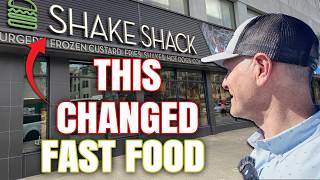
Shake Shack grew from a 2001 hot dog cart to a $6 billion company by combining fine-dining quality with casual burgers, choosing premium locations, and keeping the menu simple. Founder Danny Meyer's fine-dining background shaped every decision, and the brand scaled by learning through doing rather than planning.
Chapters
So we're in New York this weekend and everybody's tired. It's Saturday afternoon and they're taking naps. So I'm a business nerd, so I'm going to go on a field trip to another one of my favorite businesses. So today Shake Shack has about 600 locations globally, mostly in North America, and its business is publicly traded, worth just shy of $6 billion. Started out here back in 2001 and they didn't even sell burgers. They started out as a hot dog stand. Along the way, they made 3 incredibly smart decisions that have basically created an entirely new category and propelled them to this level of success. And in this video, I'll talk about them and go see the original. The key to our story is that Shake Shack wasn't started by a guy who knew anything about fast food. Actually, it was started by a guy who ran a chain of pretty high class, very fancy restaurants around this area. Most famous one being Union Square Cafe. And that guy's name is Danny Meyer. He's probably one of the most famous restaurateurs here in New York City. So the thing about Danny is being in the restaurant business for a long time, especially the fine dining end of restaurant, he learned about high quality food. He learned about customer service and he learned how to make an experience for customers when they would come to the restaurants. And in fact, he wrote kind of the seminal work on how to do customer service well and hospitality well. I'll put a link to it up here. Totally blanking on the name of the book, but it's great. I read it. And while today this part of Manhattan is really pretty bougie, I mean, you see all these fancy rich people and juice bars and plant burger type stuff. Back in 2001, this end of Manhattan here in kind of the 26th Street Broadway area was pretty seedy. It wasn't that great, and it got worse as we worked our way down south towards Madison Square. And since his restaurants were around here, Danny had really a vested interest in cleaning up and helping rejuvenate this kind of town. And so he came up with the idea, along with some partners, to go put a hot dog cart here in Madison Square Park and basically try to, you know, upscale the food service around here a bit. And this is where they started to make their very first kind of really good decision that propelled them to greatness. And that was they brought a lot of the things they had learned in the fine dining space to basically the casual space in terms of burgers and hot dogs. They brought in ingredients that were a cut above, buns that were better, fries that were better. And then along the way, they also brought in, well, basically the kind of customer service that made their other restaurants, the fine dining ones, basically really good. If you've been to a burger place, when was the last time somebody came in and gave you really good customer service at a McDonald's? Like, just doesn't happen. So immediately it was a huge differentiator. Originally, this location was supposed to just be an experiment. They didn't envision themselves being a chain. But after this one proved to be so successful, they started to realize, well, what had made it so successful? And part of it was, this is a pretty amazing location. And so as they went to go look for second and third locations, they tried to mimic the magic of what had happened here in the park. That meaning they paid up for incredibly good locations. If you go look at it and you go see a Shake Shack, it's a top-dollar place. Even if they're in the airport, right? They've got the very best location they could possibly get and they pay the money for it. Even outbidding Starbucks most times, who usually pays. And fast forward today and this location here is still thriving. This is the original one right here. Pretty cool. The same design is the same one you'll see everywhere in airports and all that kind of stuff. Man, look at this line. It's like 3 o'clock. There are reasons these people should be eating lunch. And the third and last kind of strategic genius that they've had is keeping the menu super simple. If you look at the really great fast food concepts that are killing it these days, Raising Cane's, Chick-fil-A, they keep their menu really basic. In-N-Out Burger is another example there. It's not like Dairy Queen where you have 14,000 different options. Really straightforward and really smart. The last thing I love about Shake Shack is they didn't really come into it expecting that they were going to have a big vision. It wasn't like we're going to open 14,000 of these Shake Shacks or even 600 of them. What they really did was just come and solve a problem that they saw right outside their front door. Along the way, just kind of backed into an idea that has turned into total genius and made them billionaires because of it, all because of some hamburgers and doing something in a space that Well, everybody else has approached, but they just had a different tactic on it that totally created, well, frankly, a new category. And I love this aspect of entrepreneurship. You learn so much by just kind of wandering and trying things, much more than you do by sitting in a conference room and writing stuff on a whiteboard. And in this case, these guys just started with a hot dog stand, built a hamburger stand, and eventually created an empire around it, all because they just went out and got started. They just did something that they would wanna be a customer of, and it's pretty genius. All right, that's what I know about Shake Shack. Let me know what you think in the comments below, and maybe my family will wake up soon. We can go to dinner. I'm hungry after talking about burgers for all this time. See ya.