How To Interview Overseas Talent
Hayden Cohen, CEO of Near, walks through hiring overseas talent in Latin America: assessing English proficiency, evaluating unfamiliar resumes, and adapting interviews for non-native speakers. Use case studies and aptitude tests like TestGorilla, watch for biases like simplifying speech, and handle payroll through Deel or contractor platforms.
Chapters
All right, everybody, we'll go ahead and get started. We like to start these on time. We try to do them monthly, though I skipped in September because I was busy. But today there'll be about 300 of you have signed up for this, so we're excited to do it. So today is myself, Michael Girdley. Good to see you. And Hayden Cohen, who has been on this before. We did one of these early on about nearshoring and how it works and all that kind of stuff. So today's topic is about how to hire in or how to interview overseas talent. This is something of the things as I've talked to friends. And for me was a huge question, like, how do I, like, interview somebody in another country? Like, I know how to do it in my country, in the US, but I don't know how to do it in other countries. And there's some nuances and things that Hayden has learned, uh, from running, you know, our nearshoring business. But these are things that will apply to you, like, no matter how you go about trying to bring on overseas talent. So, um, there will be one— I think there's one slide where we sell you something, but the rest of it is just supposed to be informational. So That's the way I like to do it. So Hayden, good to see you, man.
Good to see you too. Thanks for organizing this again.
Cool. And so you want to give like a 30-second introduction of who you are and what you do, and then we'll start just going into the lecture here.
100%. You know, nice to meet everyone. I am Hayden Cohen. I'm the CEO and Michael's co-founder of Near, which is a company that helps US-based businesses hire and build teams that are remote in Latin America. And we've been doing this for 4 years now. So we've obviously learned a lot about interviewing, sourcing, and hiring really great talent overseas. So excited to be here today.
Thanks. And is your audio coming? Do you have AirPods? Is it, is it coming through your AirPods or is it just—
it's coming through my AirPods. You're getting echoes for me.
No, no, it's okay. It's just a little It's not awesome, but I think it's totally workable. Ty, is it coming through okay for you? Aidan?
Yeah, it's much better than what it was before. So I'd say we stick with this.
Okay, cool. Okay, next time, next time we'll have a better mic set up.
No, no, all good. Well, the content will matter much more than the audio quality. Okay. Um, so today's big question, how do you interview overseas talent to make US quality hires? Um, that's totally like, we're going to talk about a lot of tactics and strategy in the interview process that, uh, really makes a big difference there. We'll spend a little bit here at the beginning, just kind of set the table around global hiring and all that kind of stuff. But then we'll dig right into like some of the common questions I had. And I know that people have like, how do you do reference checking when you're interviewing people overseas? So we'll dig into that stuff here. And then questions, Ty is going to manage Q&A. So if anybody has questions, just type them in the chat and he will interrupt us as appropriate to answer those questions. And then the format for today is basically me like asking questions of Hayden, who's an expert in all this, and we'll be learning together. So, okay. So Hayden, this is a couple of slides about like global hiring and stuff like that. Like what are you seeing with like your clients? Like why are they hiring globally rather than just US only?
Yeah, I think obviously this is the question we kind of always start off with as to, you know, why companies are nearshoring. And I'm sure you have some good answers there too, but I think it comes down to the fact that a lot of companies are hiring remotely right now. And from a basic standpoint, if you can hire remotely in the US, you could probably hire remotely anywhere if you know how to do it and the talent is available to you. So you can, US-only hiring is not really enough anymore because If you open your talent pool, you can hire faster. You have a larger pool of qualified candidates. So if you have a talent shortage in one area, for example, we have accounting firms that come to us honestly on a weekly basis now that can't find accountants in the States or they're having a tough time and the searches are taking way longer than they normally take. And so when you open yourself up to a larger talent pool, you can hire faster and better. And the other thing is, if you think about, if you're not doing that, your competitors probably are and you can fall behind. Your competitors are taking advantage of the cost savings and the ability to move quicker. And therefore you could potentially hurt your market position. I think those are kind of the first things that come to mind to me about I would— you look at this question.
Yeah, yeah, I agree with all that. It's, it's becoming the de facto for everybody, um, for sure. Uh, cool. All right, move on. Um, okay, so just, just so we're level set, like when you say nearshoring, like how is that different than offshoring? So just so we're on the same page, like what geographies qualify as nearshoring and all that kind of stuff?
Yeah, when we talk about nearshoring, we're really talking about hiring from outside of your country, but really in the same time zone. And so companies, I did internships in finance, for example, and we had teams over in India that overnight would work on slide decks. And when we came back to the office the next day, they'd be done. And that was outsourcing, offshoring. We think of nearshoring, hiring teammates in your same time zone that are effectively full-time members of your team. They just happen to be in a different country. And so that, that's basically the, the how we differentiate the definition.
Yeah.
Okay.
And then, I mean, the thing I would also add about nearshoring versus offshoring, like the cultural difference from the US to the Philippines or India is radically more, in my opinion, than say the US to Mexico or the US to Canada or the US to South America. That's And I like that because the cultures, the work cultures are closer. You know, there's a lot of Hispanic and Spanish-speaking people in the US, so it doesn't feel like as much of a distance. You know, there's a lot of Filipinos in the US and Indians and, you know, and other folks, Chinese in the US. But, you know, especially being here in Texas, like the Hispanic culture is very— I understand it really well. And that's why I like a lot of kind of Mexico South for hiring. I just understand it.
So the second, the second side of that question is like what, what it isn't. Yeah, it's not looking for, you know, bottom barrel, bottom dollar talent. It's not only hiring virtual assistants. It's like I said, expanding, you know, your talent pool to a much like bigger range of geographies. Because like I said in the first question, there is really strong talent available out there for all types of positions and not just for people that are working on rote tasks or effectively doing Mechanical Turk stuff or data entry that you'd previously hire folks on Upwork, for example. You can hire engineers, salespeople, account executives, SDRs, marketers, financial analysts, accountants, et cetera, that have the very sharp skill sets, very comparable to their US counterparts, and oftentimes almost exclusively for a significantly lower Right.
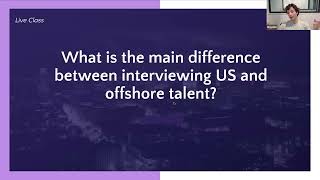
100%. Well, and our, our partner in Near, to show you how high the talent could go, our partner in Near is Argentinian. Like, he's like, he's been great. So he went from employee to a co-owner. So great guy. There's a Franco. Okay, let's keep moving. Okay, so like, if I'm gonna interview in the US and like, I get to, I get to take certain things for granted, like What is, what are the main differences as you see between interviewing a US person who's in the US as a US citizen, all that kind of stuff, and somebody who is in Argentina or Mexico or Canada or India? Like, what are the main differences you coach like your clients on to understand, uh, between the two?
Yeah. So typically I'd start with this and I'll, I'll ask you like in a couple of sentences, like, could you describe your typical interview process for, for someone based in the States? Maybe, maybe not like an executive hire, but. An IC or a manager, how would you go about that?
Like me?
Yeah.
Why? I haven't hired many individual contributors in a while. You guys don't care.
Yeah. Okay.
But, but say it's an executive level hire, which I'm running a process for that right now. You know, we have a— we've— we're working with a recruiting firm. It's not Near. It's a different one. That recruiting firm is giving us resumes. We take a look at the resumes to see if we think it's worth having a a, you know, an introductory chat with them. So we'll have a 45-minute chat with them. And basically that 45-minute intro chat is designed to do two things. One is kind of sell them a little bit on the job. This is an executive hire, so I kind of have to sell people on the job. But then number two, kind of qualify them to see if we want to do a more in-depth interview with them. And then after that, if those two things happen, they want to keep pursuing it and we think there's a fit worth interviewing, then we'll go and basically have a conversation around, you know, money and all that kind of stuff and make sure, like, you know, we're not going to run into any landmines with that later on. And then we'll do an in-depth kind of 2 to 2.5 hour interview with them where we really understand their background, top grading style, and then we'll check references, then we make an offer, and then they join the company. So that's basically like if I'm hiring an executive in the US, that's the high level of what we'll do.
Got it. So when I hear that, I'm basically thinking you have a checklist of things you're looking for, for that person that you probably decided on before you went out to hire them. And then you use interviews and maybe other steps in your process to basically like confirm or, you know, deny whether they fit that attribute and then you decide whether to hire them.
Yeah, I think that step there's in this, for this particular job, you know, we have a job description. Uh, but then from that we've carved out like, here are the 5 things we really want this person to be able to accomplish on the job. And we're going to interview around those 5 things.
Got it. So, yeah, so I'm hearing you do, you, you, you have those criteria, you do a resume screen, and then you have a variety of interviews, uh, that you use to check culture fit, whether they can do the job, whether they're like the right person for this particular role that might be a little more nuanced for an executive hire, but it's effectively the same. Across the board. So I'd say all of that, as long as you have a good hiring process, you can probably do it with offshore talent. But there's a few things to think about that companies, like it doesn't necessarily come like right top of mind. So I'll talk about LATAM specifically, but I mean, this ends up being similar kind of everywhere. But first off, people in Latin America, when you're nearshoring, English, 99% of the time is not their first language. So something you wouldn't think about in the States is like verifying their English level. And it's not just understanding whether they can speak it, but do they have strong written English? Like, will they integrate well into the company just from like basic standpoint? And we do this for all of our customers. We have our recruiting team speak with every candidate before they get presented to make sure that they speak English well. And we kind of check it with their emails and their resumes and writing samples and stuff like that. Second thing is when you do a resume screen, what are you looking for? Like you're probably looking for what school they went to and how they did there, their job experience. And maybe if you recognize a company depending on the job, you might be impressed, company and role. So if they work at Google or they work at EY and or they work at a startup that you recognize, that's kind of like social proof that they might be a good fit for this particular role. But sometimes in Latin, you might not recognize the companies, even the large ones like Mercado Libre is like the Amazon equivalent. And a lot of US-based people might not be aware of that. And so you want to make sure that you understand whether their resumes are strong from school grades and professional experience standpoint. And then for the rest of the process, it's pretty similar, right? Like if you want to treat them, these candidates when you hire them the same way you would as their US counterparts or the people from the US on your team, why treat the interview process any differently? And so it's kind of like those filter steps at the beginning and then at the end, obviously running reference checks and background checks. Like, do you have a service provider? Do you know how to do that? To get their background checks? Can you run their reference checks in the native language that you might have to depending on their previous employers? Oftentimes they're all going to be in Spanish or Portuguese in Latin America. So I'd say it's kind of on the bookend. The bookends are where the differences really come into play for the interview process. Okay.
This is maybe advice from you. One of the things I catch myself doing, So like there's this, like you and I are speaking in English and like a super high level fluency assumed US, like American English right now. And like, it works great 'cause we're both hyper fluent native speakers, but these people that are fluent but not native speakers, like I actually find myself in the interviews, like actually, and even in working with folks who are not native speakers, like I find myself actually kind of simplifying my English a bit and speaking more slowly and more clearly. Because I don't count on them to catch the nuance that you're going to catch, right, as a native speaker when I go full speed. So like, what do you advise people? Like, is that a mistake? Or like, and I just, I caught myself doing it. I caught myself doing it without even really thinking about it, just trying to optimize for communicating as best I could. But I looked up after 6 months and realized I was actually simplifying and slowing down my English for these non-native speakers. Like, is Is that a mistake to do that during the interview process?
It's a great question. I'm not sure whether it's a mistake, but if someone asked me like you're asking right now whether you should or shouldn't, I'd say you should default to just treating them just like you would any person in the US hiring process, right? For the same reason I said before, because they should integrate into your team just as well. And I find, so I used to do the same and I no longer do it. I kind of like, coach myself before any calls with new candidates that are going in interview processes for Near that we're going to hire for our internal team. I try to not curtail how I speak anyway at all. But it's funny you mentioned that, like another bias or another kind of nuance that there is in an interview process is like, assuming a level of either disinterest or a lack of really strong communication ability. Michael mentioned Frank, our partner in Near. When I first interviewed him after, because you interviewed him and then you sent him over to me, you're like, oh, I met this guy. He seems intelligent. Let me know what you think. And we chatted and he was smart and said all the right things. And in terms of what we were looking for, for that particular role, it was like a financial analyst type hire. But he was monotone the entire time. And I think he was just a little nervous for, you know, like it was his first job that was gonna be only in English and the entire interview process in English with people that he met basically online during COVID on Twitter. And I think it was good that we gave him the benefit of the doubt because obviously now having worked with him for 3 years and him becoming one of my best friends, it's like very obvious that he's not a very nervous person or not animated at all. It's just during the interview process, people might get a little nervous. And because, you know, it's not their native language, they may speak in, you know, a less animated or enthusiastic way. And I think there are like biases and stuff that definitely come up that you can kind of not ignore, but just be aware of during interview processes with, with nearshore talent that, you know, maybe if you were hiring someone in the States, you hold it against them. But in these particular cases, it might not be as important.
Yeah. If you're hiring somebody in the States that should be a native speaker but can't like use like, you know, polysyllabic words, you know, look at me using a big college word, then, you know, then you kind of assume that says something about their capabilities. But that's not, you know, I've learned not to use like, is it native speaking or perfect English against somebody overseas to understand like, are they really smart and capable or not?
So I think that's the takeaway. Obviously, like if you're hiring someone to be a blog writer, right? Like you need to hold them to a certain standard on their writing ability, or if they're going to be a client-facing account executive, you know, maybe they, they, they need a different level of spoken English, but outside of specific roles where it really matters, then yeah, 100%. Let it go.
At some point I'll, I'll tell people my, my Canada secret. We should stick around for that one in terms of wanting to, wanting to hire people for certain roles.
All right.
But we'll, we'll keep on doing that. Okay. Uh, how do I assess their skills remotely? Is it different from screening a US candidate? So we talked before a lot about kind of culture fit and like general mental aptitude. Assessment? Like, let's say I want to hire an accountant or I want to hire somebody to be a financial analyst or an HR person for my company or a marketing person. Like, how do I assess their skills remotely and how is that different from the US?
Yeah, so I'd say from like a starting point, if you have a hiring process, in for the roles you're hiring for that have some sort of case study component, replicating that with nearshore offshore talent is definitely a good idea because that's the easiest way for you to understand whether someone's skills or work product is gonna match up to the level that you're looking for. And To be honest, like overall, I don't think it's that different. I think that if you're assessing skills with people in the States using case studies or work samples, or you're using aptitude tests like we do, or personality assessments like Culture Index that you talk about on Twitter that we use for all of our roles, you should 100% basically replicate those processes when hiring folks nearshore. That's my honest opinion on this, that really it's not very different. What I will say is there are some nuances. So for example, you hire a financial analyst in the US depending on what level of talent you're looking for. You might want someone who is really, really strong, more high finance minded that can do three statement models and forecasts and things like that. And those roles or, you know, talent that is prepared to do that, you know, day one of the job, not that they don't have the potential. In LATAM, it's, you know, it's probably a more refined search. And so you may want to kind of tease that out earlier on in the interview process and then make sure you test for those skills. Like, can you produce, you know, a 3-statement model? And then for accountants, you might want to make sure that they can understand the nuanced processes in your company or has US GAAP skills. But really those are kind of nuanced and with the right recruiting partner or the experience that you have, you'll kind of figure that out over time for certain jobs. But overall, I don't find it to be particularly different. The one thing I will say, obviously, like I mentioned before, is you need to make sure you verify that their English level is good enough, but I wouldn't really call it a skill. It's just kind of like a baseline requirement in order to, to hire.
We did have a question that kind of was going to ask you to go a little deeper on that, Hayden. It's like, what's, what's the best method you should use to verify specific skills? Do y'all have any type of tests that you suggest people use when their example was like an Excel macro skill, um, level? But like, do y'all have specifics that you walk clients through on that front?
Yeah, so it comes, we bring it up every time. So when we get a new role with a customer or a potential new customer, and we go, we have a big requirements call with them where we really nail down the job description, but also the nice to haves, the must haves. And then we review resumes to make sure that, you know, hey, is this kind of like a bullet on the resume that you like? What do you not like about this? And we kind of build basically like the ideal profile. And out of that, we figure out which skills are really, really important to kind of verify that candidates have. Oftentimes, honestly, more often than not, companies have, if they'd hired for the role before, some semblance of a test or a case study. That they want candidates to take and we basically help them administer it. So that kind of covers half the companies, let's say. The other half, there are test banks that we use and we provide access to. So we've used Test Gorilla and Criteria Corp to do Excel tests and QuickBooks tests and things like that that test like for specific product knowledge. I'm a bigger fan of tests pretty specific to the job because the truth is if you're not kind of administering like the case study thing, oftentimes these tests are like multiple choice or, you know, short answer, like where you enter a number and there's like nuance and they like grade you wrong and candidates might fail. Really, if you look at the answers they provided, they shouldn't fail those tests. But for some So, you know, for some companies it makes a lot of sense and that I wouldn't say that about every test. And then it's especially important if you're hiring for several slots for the same position. So if you need to hire like several accounts that have like a very specific, you have a need for a certain kind of module in QuickBooks and we have a test for that, which we do have access to, that's a really good use case for that. But when it's like a one-off hire, I think, I think case studies are, are pretty good.
Great. There was one other interesting question that came through that I think we should go ahead and cover. It was, how do you deal with the expectation that many US companies often work longer hours or even some weekends, whereas that may not be the usual thing in LATAM?
The, the, the question kind of broke up for me, but you were saying, I think, when roles require kind of non-standard hours or potential weekend hours.
Yeah. Well, it was— go ahead, Michael. Sorry.
I was going to say the way I actually read this question is the US is, you know, in the top tier one of countries that work the most hours per year, work, you know, and so like longer hours and even some weekends, like we have a more work-hard culture in the US. And that may not be the usual thing in many Latin American countries where they work fewer hours. There's more work-life balance. That's the, that's the way I read this, Ty. Like, how do you deal with the difference in culture there and what's the best practice? Kind of like, should they be working US hours? Should they be working US holidays? Like, how, how do people think about that?
Agreed.
Yeah. So that's a great question. Um, the. The standard mindset for folks in Latin America is basically they'll work 8 hours a day and they'll have a lunch break in between that's like outside of those 8 hours. And a lot of the people on our team, and I found it kind of interesting when I first started working with a lot of people from Latin America, is they'll like actually schedule their lunch hour and be kind of like strict about their work schedule. In that capacity. So I think that's kind of like what you should basically expect as a baseline. There are people that will work, you know, like with a startup mindset where they'll just like get their job done and not stress about hours too much. But in terms of non-standard work hours and weekend work, we have clients that have hired for roles with, with those requirements, like potentially people that need to be available for West Coast hours or weekends because they're a real estate agency. That is all very possible. And the solve for that is making sure those expectations are laid out when you're creating the requirements for your role and then going over that with candidates during the screening call and basically putting it in the job description or using it as a criteria for, for, for sourcing. So 100% possible. Same way, like, a lot of people in the US aren't going to necessarily want to work weird hours or weekends. You just, you find the people that, that, uh, that are open to it.
All right, I think this ties into the next question we just got, which is like, how do you thoroughly vet someone though? Which is, how can I verify their qualifications and work experience? It's like, I know how to do that if it's a US employee, like, you know, and we talk about—
How do you, how do you do it? How do you do it as a US employee then? Uh, for, for US employees.
Well, there's number one, it's like, uh, all the online kind of breadcrumbs. Like I know how to read, like if things are real. Number two, um, so that's just a data point. And then number two is like the way the candidate talks about their qualifications and work experience. Like I listen very closely during the interview process. And then the last one is just, uh, reference checking, like, and so there's kind of the basic reference checking where you call and be like, hey, this person said they graduated from wherever. Uh, then there's kind of the, the second and, and more valuable reference checking where it's like you have real conversations with, you know, folks in the person's past to verify they truly are, you know, saying what they done, done what they've said they did. And then so that's kind of just like the work experience thing. How do you validate that? And then, and then in terms of qualifications, like I look for proof points depending upon the role. So if like somebody was a CEO of a company or something like that, like I would love to see some work product of something they've done in the past that shows they're able to do the thing. And that can be kind of something's happened. They produce some outcome that's easily verifiable, like they sold the company Uh, or it's like something that they produce, like a work product, like a, uh, a strategy document for a company, right? That has all the numbers removed. Um, so those are how I deal with those two things, uh, here in the US.
Yeah. So a lot of the stuff that you said, like, what, what, what do you, what do you think would be difficult of that list? And because you can get work samples from people, you can, you can run Google searches and you can kind of tease out, you know, how they're answering questions and whether they sound like they actually understand what they're talking about. During an interview. You can also, like we talked about, run kind of case studies and aptitude tests and stuff like that. And it's effectively the exact same thing. I think the big difference is verifying it with legit sources. So they're running reference checks and background screenings to make sure that they're not a criminal or they didn't lie about where they went to school and stuff like that. And all those things are obviously very possible to do. You have to make sure that you have a partner like Near or your own access to background screening products that are definitely available for countries outside of the States to run background screenings. And then in terms of reference checks, the difficulty there for most companies is that, like I said before, they're in a different language. So it, you know, maybe the people you're speaking to might speak English. If they do, it's probably not super strong, especially because like English levels amongst folks in Latin America is obviously greater the younger they are. Well, maybe that's not so obvious, but that is the case. And if you, you know, you could potentially do it over email or text, but you're not getting like the, you know, the live Inform— like when you, when you run a reference check with someone, you, you, you probably have like questions that you're— that are kind of direct where you want a direct answer to. And then you ask a question that you want, you want to see like how they— what information they provide that you're trying to answer, maybe like, you know, the unspoken question. And so if you can't get that nuance in a conver— you can really only get that nuance in a live conversation. And so you want to make sure that you have someone, you know, speaking the native language to, to their, to their reference checks to kind of get more information about the person. But those are— I would say those are the two main things that you want to be able to reproduce that aren't as simple to reproduce as all the other stuff like case studies and Google.
And I think kind of a case in point as to why a lot of people work with staffing agencies for overseas folks, right? Like it's just like, I think I recall when you and I interviewed Franco, you know, who's the third partner in Near, like he told us he worked at this bank and you and I were just like, what's the deal with this bank? And he's like, is the most famous bank in Argentina. How do you not know what that is? And I literally didn't know, you know, I know what Citibank is in the US. I had no idea what, what it is, you know, in Argentina.
So yeah. And like about working with, with an agency, like Franco talks about this, like it's like kind of paying for insurance or, you know, like almost like a likelihood guarantee that this person's going to work out. Because if you run those things well with a partner that knows how to do them, it's just like the likelihood of that person being successful, staying at your company for the long term and not having to like rerun the search or like waste several months of not finding the right person or training someone for them only to leave or find out that they're not good, right? You're effectively making it more likely that you're going to have a good experience and the right hire. Yeah, because you've done all these things with a partner that knows what they're doing. Yeah.
Um, all right. Uh, so I mean, a lot of people, including myself, are hiring folks that are like kind of higher-level folks. So, um, that means a lot of problem-solving kind of knowledge worker stuff. Like, how, how do I screen for problem-solving and critical thinking with somebody who's in Argentina or China or or whatever, like I know how to do it in the US. How do I do it with these folks overseas?
I've done it twice. I'm not going to push it back to you again, but the screening for problem-solving, critical thinking skills, the way we do it, and I learned it from you honestly, was through assessments and for basically listening intently during the interview process and then verifying that with reference checks. After the fact. And so at the beginning, we kind of look for certain kind of like culture/work style profiles with Culture Index assessment. But then in terms of like problem solving, critical thinking, that really comes from the aptitude assessment that we use that basically gives people a score on their numerical and verbal reasoning skills and critical thinking skills. So that's like kind of the baseline and we have effectively like a floor number that we look for, for different hires. But then during the interview process, it's the same thing. It's looking for behaviors or traits in what that person is, how that person is acting or performing during the interview and how they speak about their previous experiences. So for example, if you're looking to hire an account executive, whether they're in the States or the US, at least if I'm doing it, I want to see what kind of questions are they asking? Are they saying, hey, like, what's, you know, do you have any questions at the end of the interview? Oh, could we talk about the comp package again? Like, that's, you know, one question. And then maybe they say, hey, you know, I've heard us talk about these two different product lines. Like, do you see, you know, a difference in which companies go for which product based on the headcount range? Because I was thinking X, Y, and Z, and I wanted to hear how you thought about that. So that, you know, that's a very thoughtful question very related to their role that shows that they actually spent some time during the interview and before it thinking, you know, more intently about that job and your firm. And I think that you're looking for the exact same traits and behaviors to test for those problem-solving, critical thinking skills, case studies, and then verifying that stuff after the fact with reference calls. So I don't find it to be all that different.
Yeah, that's great. We've gotten a few questions around this, so it's probably time to answer it. People are wanting to know, how do you handle payroll with offshore employees? Are they paid in— like, for employees in LATAM specifically, are they paid in US dollars, US bank accounts? Is it done through PayPal or wire transfer? Any tax considerations? It just feels like people would kind of largely want to understand that side of the process.
Yeah, for sure. So the vast majority of cases, folks that you hire in LATAM are hired as contractors and some companies pay them directly using PayPal or Payoneer. We work with Deal, which is a company that kind of facilitates global payroll. There's a lot of competition in this space and then you know, it's kind of like on a— depending on the job that you're hiring for and what the requirements are and the years of experience and the compensation, you may want to hire that person as an employee. And there's employers of record which effectively hire that person on your behalf inside of that country, and then you pay a fee and they cover the taxes for you. Um, if they're hired as contractors, the contractor themselves is responsible for taxes in their home country, and then you don't have any tax implications as long as their income is not US source, which means that effectively that it was performed on US soil. In that case, you need to withhold, but that's kind of getting into some nuance that doesn't really happen. You know, we, for example, specifically with our customers, all the work is being performed remotely at home. And so that is not a tax consideration. And then if you work with a partner, like an agency like Near, you know, they should be able to guide you on a case-by-case basis with how to hire the person and how to pay them.
Cool.
There's a few more questions. How many slides do we have right now left?
A lot. A lot.
Okay, let's power through some more slides and then we'll try to reserve the last 10 to 15 minutes for some more questions.
I think we've done this one kind of already. This comes up in just your normal interviewing things. Um, let's see here. Oh, this is kind of leading into what are some mistakes that people make. Um, maybe that's a good question, Hayden. Like, what are the mistakes that you see people make in, uh, in nearshore hiring?
Yeah, that is a, that is a great question. I think the The biggest mistake tends to come out of maybe an error in how they're thinking, how someone might be thinking about starting to do this for their business or why they need to do it for their business. So I think a lot of companies, when they first start learning about offshoring, at least if it's in the Twitter world, and obviously that's where we've promoted this webinar the most, is that you hire virtual assistants remotely who kind of do rote-level work, data entry, very basic stuff. And while that's 100% possible and really valuable and really important for a lot of companies, it does miss the point because I think that the opportunity with nearshore talent is that you are opening your available pool of candidates to the entire world and therefore making it cheaper, faster, and easier to hire really great talent for your company while saving money and basically allowing yourself to grow in other ways. And so companies with that mindset that aren't looking for only cost savings, not trying to find the cheapest channel, have the most success with this because they understand that it's like a strategy to— it's a strategy that they layer on with everything else they're doing at, you know, in their day to day. So I think, you know, it's more of looking at it, not looking at it as a super cheap way to hire people looking for bottom dollar talent. I think that's the biggest mistake. Yeah.
So there's a question here, Hayden, that caught my eye. A number of people are asking candidates to submit like a 1-minute video or a 2-minute introductory video with their application for jobs. A, how do you feel about that tactic? I know you have thoughts because you and I talked about it the other day, uh, but B, if they do do that tactic, like, what is the best kind of like technology thing to tell them to do, how to do that? So A, how do you feel about the requesting the intro video from candidates? And number 2, like, what's the best tactic?
Yeah, so there are— okay, so I'll start with how I feel about it. I mean, I think it's a— it's, it's, it's great. We do it for for all of our customers. So when you get candidates from Near, you'll get video, like introducing who they are, answering questions that are part of our standard process, and then any custom questions that you want to have candidates answer. And then our team will obviously review and filter them. So you're not seeing hundreds of them. You'll see a few of the best. And the reason it's good is because it allows you to screen people and get to know them really quickly. Second, it kind of helps with that English verification piece that I've talked about a number of times. So yeah, I think it's great. It helps you get to know people at scale and helps you verify their English. In terms of the actual tooling, there's a million ways to do this. If you're hiring for a one-off role, I mean, using Loom or something like a video screen recording software, super easy. And then if you're operating at scale, there's a number of tools. Like if you type in like interview video tools, there's tons and tons of them and then you just find, find the one that works for you. Yeah, we've used VideoAsk in the past, which is a product by Typeform, and then there's tons of them for the, for kind of basically really recruiting firms or recruiting departments at companies. To filter quickly through candidate videos.
This is a pretty good question and specific. Other than time zone, what are the major differences between talent pools when looking at LATAM versus the Philippines?
Yeah, it's a great question. So time zone piece is like super important, clearly. I mean, people that are working in the Philippines for US-based companies almost exclusively are working overnight. And I mean, that over time can result in burnout and being tired and just kind of like not a super healthy lifestyle, which is really unfortunate, but it is the case. But in terms of differences, I think the way that I kind of describe it and experience it is that there is kind of cultural professional behaviors in talent in Latin America that's much more comparable to what we're used to in the States. Kind of a desire to grow and progress careers kind of through the ranks at companies, wanting to be entrepreneurial or looking for solutions and even potentially questioning authority, like giving feedback, managing up, pushing back on things. Whereas my experience, and I think a lot of the experience that our customers have with talent in Philippines specifically, is that the culture, you know, there's less questioning authority, there's more like following instructions and directions for tasks to a tee. That is really good for certain roles, but for the majority of roles, we find that basically the culture fit professionally, especially in big cities in Latin America. I think Buenos Aires, São Paulo, Mexico City is really similar to that of the States. And like, it makes sense. Like the Big Four accounting firms and large companies have presence in these countries and, you know, they have employees working there and they're working remotely with their US counterparts all the time. And so That's just, you know, like one manifestation of it.
But yeah, the next— that's great. The next question, and it's been asked a few times, is like, what are the common challenges you've encountered going into an offshore market and how do you typically identify and handle red flags when evaluating candidates?
So Well, I see that this question is specifically asking about, you know, Pakistan, India, and the Philippines. So Near is 100% focused on LATAM. So like we, when customers come to us, like they know or quickly find out that we will help them source and hire and build teams in Latin America. So I answered, you know, one part of that before. In terms of like for specific roles, LATAM makes a lot of sense. So cultural similarity, strong English proficiency for, you know, for the people that do speak English and time zone. Like those are 3 huge things. I'll speak to the English proficiency in LATAM as well. A reason I think it's a really good thing to talk about is because if you think about it, people are not learning English at home in Latin America. Like, you know, they're for like the vast majority of cases, the folks who— I think about the percentage more or less is like 10% of people in Latin America speak fluent English. And I find that that's a proxy for high agency, being really motivated and just like being intelligent overall, like learning English opens the horizon for people in Latin America to accelerate their careers significantly and make a ton more money than they would in their home market. They're getting in, like, especially in countries in Argentina where they're facing, you know, like a rapidly inflating currency, learning English to the point where you can integrate yourself into a US-based company and then earning in dollars. So you're earning like more in absolute value and then in an inflation-protected currency, having the wherewithal to learn English to that point is impressive. And so yeah, basically I find that the opposite side of those things maybe are red flags and why we don't focus our searches in other areas of the world.
I'm actually, I'm a big fan, having watched your business grow, our business grow, is in, in choosing a vendor that specializes in a geography. Because I've just seen how different it is in LATAM versus Philippines versus other places. And I would really question vendors that try to do all-in-one. Like, I would actually choose probably multiple vendors. Like, to the question that's in here, if I want to do Philippines and LATAM, like, I would try to find a specialist vendor that just does those things. And like, like our partner, like Hayden is fluent in Spanish, like he's lived in Argentina, like our other partner is Argentinian, like that helps with sourcing LATAM. And like the reason like Near doesn't do Philippines or South America or Eastern Europe is like there's, we have no competitive advantage there to do better for the customers. So anyway, that's my two cents. Like I wouldn't do an all-in-one vendor at all. I would choose a vendor based on a specialist in your region and really leverage that to have a lot of success.
Yeah, good answer there. There's a question about like, I'll just read it verbatim. Our business operates in a very specialized industry. Have you had experience finding offshore or nearshore talent with expertise in a niche field, or should we expect to do heavy training?
Yeah, I wish I could provide a yes or no answer there, but like the truth is that it depends. So we have, so what we, when we have a company come to us with a very specific need in terms of skills or maybe in terms of like contract length or whatever, we will run a kind of a search in our internal database and then online sources, LinkedIn, et cetera, to be, and then we'll provide an honest answer as to whether or not we can fulfill that role. So we've had like aero tech companies come to us with a specific need and we, you know, for that particular role, not necessarily any role in that industry, but for that specific role, we couldn't take it. But recently we had some pretty niche, basically education-focused roles, and we felt super comfortable that maybe we didn't find someone who was a perfect fit for it, but they had like other skills and qualifications that like ran in parallel that would make it so the training wasn't insane. And then that company could take advantage of hiring for that particular role. So it totally depends. So it's possible and it's worth discussing. 100%. Super niche roles that are more, that are regulated, right? Like you're not gonna hire, maybe like a nurse remotely in Latin America, right? So that kind of stuff, no. But if you think it could be done, it's worth chatting about.
You know, there's been a few questions now around just like data protection and how that works in LATAM and then like how to handle if there is a data breach. How do you kind of approach the security side of things with clients?
Yeah, that's a great, that's a great question. And I know we're wrapping up soon, so I'll go quick. So basic standpoint, whatever you would do in the States, do the same thing in terms of actually protecting your data with remote employee or contractor in Latin America. So a lot of our clients will provision certain software, make sure that the permissions that people have, like, for example, if they're hiring accountants remotely, make sure that, like, certain client data might not be available to that particular person offshore and kind of, like, create silos of data. And then there's also data protection laws and stuff. But in the same way that you can't prevent someone in the US from stealing from you if you aren't careful with, like, the access they get, That's obviously possible, but it's not something we run into and it's, or have run into yet. And the reason is because we're really careful with like basically the security and permissions that our customers are providing to people. But for specific kind of cases, you can totally reach out. We'll be able to walk you through what that looks like more specifically.
Amazing. Well, I think we're at time. Any closing thoughts, Hayden or Michael?
Yes, please come to my conference. So Ty told me I had to smile and then ask you guys to come to my conference. So if you're interested in what I do, which is holdco entrepreneurship, which is being involved in multiple businesses as an owner and supporting them, and you want to learn more about it, check out our conference about that, the Holdco Conference. And it's going to be in a place that I'm super excited about, which is Sundance in Utah. And hey, and Ty, I think we're about halfway sold out so far, even though it's next April. So hope, hope more folks show up. If you're interested in a different way of doing entrepreneurship, tell your friends, we'd love to have you. We have some great speakers lined up and stuff like that. So, and then Hayden, do you wanna talk about Near real fast?
Yeah, so sounds super exciting. And then yeah, on our side, if this interests you at all, if you have hired remotely and you're interested in potentially working with a vendor you're working with a vendor and you want to see how we could help you, or if you've never done it before and you're interested in learning more, uh, or whatever other reason and you want to speak to someone, uh, smarter than me on our team, go to hirewithneer.com/girdley, fill out the form, and you'll get 5% off your first hire.
All right, everybody, uh, we will post, uh, this video on YouTube, uh, and we will share a copy of it with everyone. And, uh, yeah, thanks for being here. Hopefully this will help you with your global hiring. So, uh, it's been a great journey for me, and it's exciting to see other people get to do that as well. So Hayden, thanks for being here, and Ty, thanks for all your hard work.
Yeah, thanks guys.










