NBA's Phoenix Suns Price all Concessions at $2
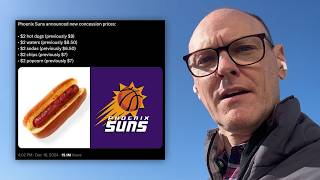
The Phoenix Suns priced all arena concessions at $2, a move the narrator argues is less about profit and more about fixing fan sentiment. NBA viewership dropped 20% year-over-year, and game-day costs have risen 130% in a decade. Concessions are tiny revenue compared to TV and tickets, so the discount is a visible gesture to boost attendance and protect bigger money streams.
Chapters
So the Phoenix Suns just did something kind of crazy. They went through and they lowered all of their concession prices. So hot dogs, popcorn, all that kind of stuff, water. They lowered it down to $2 for everything. And something interesting happened. Here's this post. I'll put it up here on X. The crowd went wild. 15 million views on this post of people excited about this change. And who, who could blame them, right? When hot dogs used to cost $10 or water $9 and us all feeling like we constantly get screwed at the concession stand at events, right? These guys go and basically cut them down to nothing. Two bucks. Well, to explain why this is interesting and how we got here, we kind of have to go back and tell the story of how professional sports became so lucrative and such a big deal. It all starts back in the 1970s and '80s, and back then, big money hadn't really become attracted to professional sports. It was something realistically that kind of your neighborhood rich guy would do for fun so he could tell his friends you know, he owned a sports team. And we also hadn't gotten to a point where there were crazy salaries being paid to people. But look, this is America, and America's gonna America. And if you know one thing that's true, rich guys eventually decide if they're going to be rich, they want to be even richer. So the era of luxury boxes and maximizing profits came in. And what better way to do that than to go to something everybody absolutely wants when they go to a concert, or in the case of the Phoenix Suns, an NBA game. And that's when you start to see captive pricing, really high prices for the things that we all buy, like hot dogs and waters. And if you look at the way some of this stuff is priced, $10 for a hot dog, for example, it might cost the stadium or the team running that kind of sale a buck or two to, to provide you that hot dog and water. Don't get me started. $10 water might cost them $0.25 to sell you. Like, kind of crazy when you're at that level of profit. And look, once teams got addicted to that kind of revenue and that kind of profit, they just kept going and it just kept continuing. Starting in the 2000s and working into the 2010s, we saw the cost to attend games and attend these events like even way overshoot inflation. As an example, one of the studies I read, the LA Raiders, they raised their ticket prices and the cost to attend a game over 130% in the decade from 2013 to 2023. The equivalent of what happened just to the currency in general. So with inflation, where prices went up just about 30% during that time, so they outstripped the costs by, by 3 times, right, what normally would be 300%. So yeah, not a good time to be a fan from 2013 to 2023. And look, this kind of price increase can all work when you have a product that's highly in demand, right? The price just people will pay whatever it is if they really want it. But the reality is that the NBA and the NFL and all this kind of stuff has started to have a lot of competition. And you can see it kind of in the results. For the NBA, for example, back in the late '90s, that's when kind of viewership peaked. And then what we saw was it started to stagnate over the coming decades. And that stagnation is okay if you're slowly declining. But then something bad has happened in 2023, 2024. So this year that we're in right now, which is basically viewership of the NBA has dropped off a cliff. The viewership numbers are down nearly 20% year over year. That's not sustainable. I don't care what kind of business you're in. And look, there's lots of debate right now about why NBA viewership or professional basketball viewership is declining. It is interesting to note that this is mostly a US phenomenon. Globally, The NBA is actually doing really well. But in terms of what we're seeing here domestically, things are not good. And there's lots of explanations that people are putting forward. There's no kind of heir to LeBron James in the US, kind of American stars, like all of our stars are foreign-born. And whether we like it or not, us Americans tend to like American heroes more than we like foreign heroes. Yay, Michael Jordan and Kobe Bryant. There's also just talks about how the game has been solved. Too many 3-pointers, boringness, all that kind of stuff. And I don't know the right answer to it. And frankly, I don't really care. I'm more of a business nerd. I can speak from personal experience as a season ticket holder for a while of an NBA franchise that happened to be located here in San Antonio and rhymes with the phrase MERS. I used to get season ticket packages and I stopped. And I can recall when I first started doing it 6 or 7 years ago, at least here in San Antonio, uh, the arena was a place to see and be seen, uh, where people, rich people went and wanted to show off how fancy they were and all that kind of stuff. Uh, and in the past couple years, especially post-COVID, uh, a lot of that fanciness has turned into now a deal where corporations buy the tickets and they give them out to their employees, and you never see the elite, and you never see kind of that social scene happening. So not that that's a bad thing, but realistically, like, it's indicative to me of a change in how people view the NBA and how special it is or isn't. And with most stuff, if I'm seeing a potential change or I'm seeing a feeling about something, it's pretty likely a lot of people are feeling the same thing. So while not always, it's a good idea to extrapolate what I'm seeing or what you're seeing as a consumer to assume other people are seeing the same. And look, if the demand for the NBA is going down, the games are boring, the viewership's down, uh, the owner of the Phoenix Suns— well, let's tie that back— is a pretty smart guy, right? And he probably didn't get rich by being dumb. And he's done the math and realized, oh, if the perceived value of what we're doing here in the NBA is going down, I got to do something to get the customers and the butts back in the seats. And the second thing, this reduction in crises do besides change the perception of value, it sends an emotional message to your customers, which is a good thing, right? Customers can tell if you really care about them and care about wanting their business. So yeah, a good thing if you're a rich guy wanting to tell people to come back. Well, let's, let's send them a message that says precisely that. But hey, let's talk about what this is in reality. So most people don't know this, but if you go look at what percentage of revenue comes into the NBA, so let's say for example, the Phoenix Suns, actually comes from concessions. That is a very visible source of revenue to you and me who's in there shopping, right? Nothing feels more painful than getting charged $10 for a 90-cent hot dog. But in reality, the real revenue for the NBA doesn't come from these concessions. It's immaterial. It comes from TV, it comes from jersey sales, it comes from licensing, it comes from seat sales. And look, yeah, it's a pretty smart move if 1% of your total revenue comes from concessions to make a very visible discount on that stuff, when in reality, it still costs a couple thousand bucks to go get a premium seat at an NBA game. And so if you start selling hot dogs and waters at cost in order to hype up the fans and sell a few more season ticket packages and get more people watching the games on TV, it's dang sure worth it for these rich guys. And so that's a lesson for us in all of this, which is sometimes you can go and look through your offering and you can look through how you're approaching customers and you can make something that looks like a sacrifice and a big outreach to folks, but in reality it doesn't affect your core business meaningful at all, meaningfully at all. And that's what these rich guys are doing. And the Phoenix Suns owner is pretty, you know, pretty darn smart to do it. And as for the future of the NBA, I watched some stuff where Bill Simmons, who's a longtime commentator on NBA, talked about it. He noted in a, in a video I watched that the NBA has almost died about a dozen times, everything from the ABA to the drug scandals to the lockouts to COVID, and it's bounced back stronger every time. So I'm not worried. It'll continue to be here for a while, and I bet a few years from now we'll be looking back on this time and thinking that they really turned it all around. So that's Cool. If you like business stuff like this, uh, definitely check out link in bio, my link in bio, and sub to our newsletter. We send it out twice a week. See ya.










