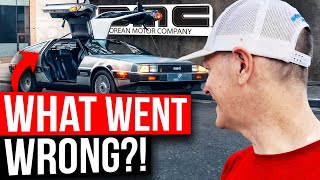
The video chronicles the meteoric rise and dramatic collapse of John DeLorean’s DeLorean Motor Company (DMC). It begins with DeLorean’s early fame at General Motors, where he designed the Pontiac GTO and became head of Chevrolet, before leaving GM in 1973 to pursue his own vision of an "ethical" sports car. The documentary details the conception of the DMC‑12 – a stainless‑steel, gull‑wing‑door vehicle – and DeLorean’s skill at generating media buzz, securing celebrity investors, and obtaining a £100 million‑plus subsidy from the British government to build a factory in Belfast during the Troubles. The narrative then shifts to the operational missteps: DeLorean’s remote, hands‑off management, unrealistic deadlines, custom‑made parts, reliance on inexperienced Northern Irish workers, and costly engineering choices that drove the car’s price from the intended $12,000 to $25‑$34 k, far above comparable sports cars. Technical shortcomings (a 2.8 L Renault V6 with 130 hp, heavy stainless‑steel body) resulted in poor performance and reliability issues. Economic headwinds – a U.S. recession and soaring interest rates – compounded the financial strain, while a missing £23 million from a Panamanian subsidiary and a failed appeal for further government aid led DMC to declare bankruptcy in 1982 after only ~9,000 cars were built. The film then recounts DeLorean’s 1982 cocaine‑trafficking sting, his arrest, and 1984 acquittal on entrapment grounds, after which he never built another car. Finally, the documentary notes the DMC‑12’s cultural resurrection via the 1985 film Back to the Future and its status as a collector’s item, using the story as a cautionary lesson for CEOs about hands‑on leadership and realistic execution.
Chapters
The DeLorean DMC-12 was a revolutionary car design and perhaps the most innovative and unique one of the 1980s, but the entire company failed after making just 9,000 cars. This video is the wild and crazy story of the DeLorean Motor Company.
Thank you to Zapier for partnering with us on this video. More on them later.
John DeLorean was perhaps the biggest rising star at General Motors in the 1960s, back in the days when car guys were rock stars. and he came to fame amongst a number of accomplishments. But one of them was designing the original Pontiac GTO. By just age 40, he'd made a huge name for himself. He had engineering acumen, marketing chops, and a sense of style. People expected him to be president of General Motors someday, running the whole show. By 1972, he'd risen through the ranks and he was named head of Chevrolet. But there was a problem. He felt constrained by GM's conservative and kind of stodgy corporate culture. So in 1973, he shocked the world and he left General Motors to found his own car company, uh, using his own sense of style, flair, vision, and considerable ego. 1975, he founded the DeLorean Motor Company with the vision of building a quote-unquote ethical sports car, one that would be durable, safer, and utterly unique. His initial idea was an all-stainless steel body— stainless steel DeLorean— with, at the time, relatively radical gull-wing doors. Gull-wing doors rise effortlessly, beckoning you inside. The media ate up the whole proposition. Here was aspiring young, brash, and loud young car entrepreneur taking on Detroit on its own home turf. John had a talent for publicity. He loved to court the press, he loved to court publicity, and he loved to create buzz. And it worked. He got the press talking. And John DeLorean's persona was as nearly as, uh, ambitious as his car. He loved the flamboyant side of things, and he loved hobnobbing with Hollywood stars. Business moguls. He wanted to be a big shit. And, well, he acted that way. At one point, Johnny Carson and Sammy Davis Jr., big stars at the time, were investors in his car company. In fact, Johnny Carson reportedly put in $500,000. Big money at the time. John married model Christina Ferrari, a fashion model, and they lived it up in a 15-story duplex on Fifth Avenue in Manhattan. John then leveraged all of this rock stardom and cachet to go to the British government and get them to give him a $100 million-plus government infusion of funds and subsidies to start the car company. The idea for DeLorean was to build a state-of-the-art factory in Northern Ireland, in Belfast to be particular, and partner with Lotus Corporation to do a lot of the engineering. And both of these would prove to be a fateful decision for the company. At the time, Ireland was going through a thing called the Troubles. Unemployment was over 20%. There was sectarian violence. Just overall bad time in the country. Thinking by the British was that the new factory would create over 2,000 jobs, give hope to the people in Belfast, and hopefully help calm the situation. But John's next decision was not to move to Belfast or in fact anywhere near the plant. He kept living in New York City. He continued to enjoy a lavish lifestyle in his Manhattan penthouse or his 430-acre New Jersey estate. You know, big timer. And though he bought a home near the plant in Belfast, DeLorean famously never spent a single night in it. His wife Christina's one visit ended abruptly when she was unsettled by the gritty conditions in Belfast and the protests going on. So John tried to do everything remotely from DeLorean's headquarters in New York City. He set unrealistic deadlines and totally unrealistic engineering expectations. And all the while, John was acting like he was still working at a big, established, well-capitalized company like General Motors. And instead, what this really was was an upstart company that was going to be struggling to get its very first car out the door. DeLorean prematurely opened offices in New York, California, and even the UK. The first DeLorean DMC-12 finally rolled off the Belfast assembly line in early 1981, 6 years after the founding of the car company, and it looked like nothing else on the road. Stainless steel skin, gull-wing doors, Italian styling. It was pretty cool. The doors themselves were set by cryogenically sealed torsion bars, which is a technology developed by Grumman Aerospace, who normally makes fighter jets, showing the kind of crazy engineering requirements that had been thrown on top of the DMC-12. In a flashing marketing stunt consistent with his personality, DeLorean offered the option to buy one of a handful of limited edition 24-karat gold-plated DeLoreans. I mean, all this in partnership with American Express. And at this moment, it seemed like everything was poised for DeLorean to change the world. But that's when things started to change.
We have a secret weapon for producing all of these videos that are coming out on my channel, and my team uses a tool called Zapier that connects it all together. And we do that— that helps us produce with just a handful of people over 12 videos every single week across my channel and everybody else's. Zapier is a tool that connects all the tools you already use and turns scattered workflows into one automated system. There's no engineering required, no programming, and no delays. You build the workflow by choosing the trigger, the action, and the output. Your sales team can stop copy-pasting data. Support will stop chasing tickets around. Your video producer will stop updating readiness inside of different stuff when they finish their job. And operations stops patching manual steps. Every tool involved will automatically update. Most companies lose accuracy because all the information sits in all these different siloed systems that we're running, and Zapier closes that gap. Your data syncs in real time, tasks execute on schedule, and processes stop needing human follow-through. You get reliability without extra headcount and scale without added complexity. So use Zapier to connect your CRM, spreadsheets, video editing platform, workflow, email platform, project tracker, AI tools, and anything else your team relies upon. Thanks to Zapier for sponsoring today's video.
But the first thing to become clear from these early DMC-12s that John's perfectionism and remoteness had driven costs through the roof. Basically every part of the DeLorean had been custom created just for this car. That was great for the wow factor, but it meant that all of that engineering overhead and extra time had pushed costs through the roof. And engineers with Johnaway in New York had done the best they could. They had actually used some off-the-shelf components like the engineering, transmission, steering wheel, and stuff like that. But a lot of the other stuff, man, it was custom made. And I know this is the case because I used to own a DeLorean myself. I bought one to help promote a business I was involved in. And it turned out the only stuff that had worked really well was all this off-the-shelf stuff they had gotten from another manufacturer, which was Renault. All the stuff they'd made in Northern Ireland, it was junk. And I was routinely sending it to the shop to get the car fixed when it was running because of all this custom stuff I had seen John do. And remember how the car was called a DMC-12? Well, that 12, it stood for what they had intended to originally sell it for, which was $12,000. In 1981, when the car launched, it came out at $25,000, which is famously more expensive than a Porsche 911. Or a Corvette was sold for at that time. That might have been fine if the car delivered Ferrari-level performance, but it didn't. Under the hood, the engineers had put in a 2.8-liter V6 engine they had bought from Renault-Peugeot-Volvo Corporation, and that put out a measly 130 horsepower. Perfect if you want to have good emissions, terrible if you want to go fast. To make things worse, the stainless steel body made the thing ridiculously heavy. Meaning it was sluggish off the line. 0 to 60 was a not-rapid 10.5 seconds, and that was made worse because the car weighed 2,800 pounds. Very heavy at the time. And remember how the British government had invested because they wanted to create jobs? Well, it turned out that the factory in Belfast had hired a bunch of inexperienced workers, people that had never done car manufacturing before. Early car versions had panel fit issues, other teething issues, door seal problems, leaks. You name it, the stuff you didn't want to see in a $25,000 car. So as they started to ship the first cars in 1981, DMC was struggling to get all of these repairs fixed and they kept shipping more cars to dealers. Not a good situation to be in if you're trying to make a good first impression. Then they got a bit unlucky in 1981 and 1982. The United States economy hit a recession. Interest rates soared above 20%. That was a bad thing if you were somebody trying to sell an ultra-luxury automobile. From 1981 to 1983, in order to deal with all the costs, DeLorean kept raising the prices of the car. It went from $25,000 to $29,000 to $34,000 in 1980 dollars. That's the equivalent of $107,000 in 2024 dollars, showing how much the company was trying to overcome increasing losses and increasing costs. By 1981, the company was way behind projections. John had famously predicted that they would sell 10,000 cars per year. They were nowhere near close. Then a betrayal struck the company. £23 million, close to $30 million in money at the time, went missing via Panamanian subsidiary. And remember how they had partnered closely with Lotus to get the cars out the door? Well, later investigations showed that suspiciously, they expected John DeLorean and Lotus founder, a man named Chapman, had stolen the money. And in bad news for John DeLorean, Mr. Chapman of Lotus died before he could be prosecuted. With too much spending and too little cash coming in, it was clear that DeLorean was in trouble. In 1982, DeLorean and his team went back to the UK government asking for more. But the UK government wasn't doing well at this time either, and Margaret Thatcher's government famously said they weren't going to put any more money in. In 1982, unable to secure any more funds and really with no hope to get out of the whole thing, the DeLorean Motor Company declared bankruptcy just a year or so after the first cars had left the manufacturing line, and only 9,000 of them had been made. With that door closed, John grew desperate to save the company. John took a meeting with a distant acquaintance, and this guy had a proposition— a quick way for DeLorean to make millions and potentially keep the company alive. In October 1982, DeLorean found himself in a hotel room in Los Angeles, uh, with 55 lbs of cocaine sitting in front of him. Better gold. Gold weighs more than that, for God's sake.
A few minutes later, the FBI arrived, and John And DeLorean was put under arrest.
Meanwhile, somebody had been filming the whole thing. John was recorded as saying, "The cocaine is better than gold and safer than the stock market." This man who once ran the Pontiac division for GM was seen as the next president of the company. He was now doing a drug deal in a hotel room. But it turns out the man who had approached him with the scheme to help him save the company, well, that guy was an FBI informant. and the FBI was recording the whole thing. A few days later, John, who had been somebody who hung out with Hollywood stars and business moguls in tailored suits in his Fifth Avenue apartment, well, he was being walked out of a government building in handcuffs with a perp walk. After that arrest, there was no saving DeLorean Motors. Nobody would step in to save it, and the company went on to be liquidated. The saga didn't end there for John while the company was dead. Uh, he actually went on to argue in his defense. That he deserved to be acquitted. And in 1984, he actually was, arguing entrapment by the police.
As John DeLorean left court this afternoon, a free man acquitted on all charges of cocaine conspiracy.
And truth be told, DeLorean had a point. I mean, he wasn't out looking for drug deals. And this guy, James Hoffman, who had been previously trying to get out of his own charges with the FBI, was looking for a way to get his own charges dismissed. So arguably he came in and set up John DeLorean. And even though John got off, he would never build another car. His reputation had been, well, forever ruined. And ironically, the car itself would be saved by a little movie called Back to the Future that released in 1985. That movie cemented the DeLorean as an iconic car for an entire generation. Mine, Gen X, who saw that car in the movie when we were teenagers.
Are you telling me that you built a time machine? Kind of a DeLorean? The way I see it, if you're gonna build a time machine into a car, why not do it with some style?
And great versions of the DMC-12 can sell for over $100,000.
Great Scott!
And are coveted by collectors these days. This story is a great example of you as an owner or you as a CEO having to do the right stuff for when the company needs it. And in this case, you're never going to get a company or an initiative or hard anything off the ground being hands-off. And if you look back in time, John was never going to create a great car sitting in his ivory tower on Fifth Avenue and expecting things to go well. There was only one person who was going to make it really great and make this whole thing work, and he needed to be on the ground in Belfast making that happen. That doesn't mean you shouldn't delegate. It just means sometimes you can't. And in this case, John definitely couldn't, and the results showed it. All right, that's it for this video. Let me know what you think in the comments below. I read them all. Catch you later.