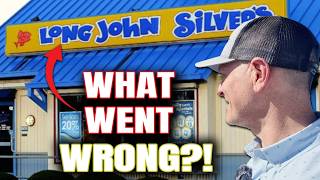
In this business‑focused video, Michael Girdley chronicles the trajectory of Long John Silver’s from its 1969 founding as a niche fish‑and‑chips fast‑food concept to its peak in the 1980s, when it commanded roughly 65% of the U.S. seafood‑fast‑food market and operated about 1,500 locations. He explains how the chain’s early success stemmed from a clear niche focus, but later missteps—management panic, leveraged‑buyout debt, and attempts to chase health trends—eroded that advantage. Girdley then highlights a deeper structural issue: over the past 25 years fish has become three to four times more expensive than chicken, making fish‑based fast‑food uneconomical compared to chicken‑based rivals like Raising Cane’s and Chick‑fil‑A. The combination of financial over‑leverage, shifting consumer tastes, and rising commodity costs led to a dramatic contraction to under 400 stores. The video concludes with a cautionary lesson for business owners about avoiding shiny‑object syndrome, staying true to core competencies, and monitoring commodity‑price dynamics.
Chapters
So I'm someplace pretty fascinating if you're a business nerd. Behind me is the site of the very last standalone Long John Silver's restaurant here in San Antonio. If you're not familiar with Long John Silver's, it was the category killer in terms of seafood as fast food. Crispy fish, golden fries. So if you wanted fish and chips, any of that kind of stuff, like you went to Long John Silver's and the restaurant got incredibly popular, peaking at nearly 1,500 locations just 30 years ago. In 1995. Well, today the chain has basically shrunk to a shadow of its former size. It has just under 400 locations. So what caused this failure actually dates back from the very beginning of the chain and the decisions that were made around then. And they started with this guy, Jim Patterson, who started the very first Long John Silver's back in 1969 in Lexington, Kentucky. And the idea was pretty straightforward. Uh, you would bring this idea of like a Boston or a Maine-style fish and chip shop to rural flyover America. And well, back in 1969, it wasn't flyover America yet. It was driveover America. And back then there was an explosion of fast food concepts. I mean, fast food was still kind of a new thing back in the '60s. And in a sea of me too burger chains where everybody seemed to be doing some version of McDonald's, you had this kind of beacon of uniqueness, which was Long John Silver's. Fish fast food. Pretty cool. And they rode this kind of unique market position the wave of it to a pretty incredible level of growth. By the 1980s, through franchising and corporate growth, the chain was over 1,000 stores. Just pretty, pretty astonishing. And it rode this wave to where by the 1980s, the chain at its peak had 65% of the market for seafood out of the home consumed in the United States and nearly $500 million in sales. Kind of unbelievable. And this is something that's really never been repeated in the history of restauranting. When does, when does a single chain own this much of a percentage of a single, like, like niche? It still tends to happen in American industry. You'll see it happen in, however, in things like software, pharmaceuticals, sometimes business services, but never in restaurants. Nobody has 65% of the burger market. Just insane level of domination by Long John Silver's. And if you look at what got them there, picking a niche and just being really, really good at that niche and dominating it, well, it was the key to success. And there's a lesson there for business owners. And I see it a lot of times, and look, I've done it too. You can really be attracted to shiny objects and wanting to offer new things as opposed to just being really good at what your business is meant to do. And this can happen to small businesses, but it also happens to chains the size of Long John Silver's, where people start to get shiny object syndrome and they start to panic a little bit instead of really focusing on what makes their business really good. And in this case, ownership started to panic. By this time, the company had been falling prey to a lot of the things that were going wrong in American business back in the '80s and '90s, which was, you know, financial engineering and shifting ownership and that sort of thing. And so ownership started to panic a bit, and what they did was not good at this point, which was start to, well, basically make changes that went against the core business. And by this time in the late '80s, there were things that were chipping away at this market dominance for Long John Silver's. You were seeing everything from, you know, at the top end, chains like Red Lobster coming in, other folks getting into seafood from the top end, and then from the bottom up, you were seeing grocery stores and folks come in with things like, you know, ready-to-eat, whatever, those fish sticks. I used to eat, love those things as a kid. They were delicious. And people were microwaving those things at home and that didn't help. So the first kind of thing that sowed the demise here was this management panic that I talked about before. They went through and did financial engineering and like a lot of companies in the late '80s, they did a leveraged buyout and put a bunch of debt on the company. And in retrospect, it's not a good move. You end up with a company that has a lot of debt on it and it's in a declining market and losing market share. It's a recipe for disaster. And well, that was what happened. And this leveraged buyout ran into something else that was really problematic for the chain, which was consumer tastes were changing. People in the late '80s and early '90s were starting to feel like high-fat fried food, which Long John Silver's specialized in, that wasn't the healthiest thing for them. And even then, the chain tried to respond to that stuff. They brought in healthier options. But like many companies, you know, we've seen on this channel, sometimes your customer base starts to bifurcate on you. And while some people want healthier options, other people still want the old unhealthy stuff that you're offering. And in the end, you end up with a chain that doesn't serve either master very well. But there was a third thing I hinted about that is why ultimately, above all the other reasons, the missteps, the turnover of management, the stupidity with the debt and the financial engineering, the one decision that they made back in 1969 when they started the concept, which was to bet on fish, that ultimately proved to be what is the thing that's killed the entire chain. And I'll show you how this is by taking my next stop at a chicken restaurant. When places like this Raising Cane's here have exploded in popularity, This chain alone, Raising Cane's, in the same period has gone from 200 to over 800 stores just in the past decade alone. Well, something structurally has to have caused all this. Like, why are chicken-based restaurants going crazy? Why is Chick-fil-A, Raising Cane's, and all this stuff basically exploding? And then you have places like Long John Silver's around the seafood market that just aren't working anymore. Well, there's an interesting answer to all that. So this restaurant here actually answers this mystery for us. And to explain where I am, So this is a fast food place, but it's not on the, well, super wealthy side of town. Here, people need to get everything they can for their dollar in terms of basically, well, make their dollar go as far as it can. And over here, they've shown us precisely the difference between making fast food out of fish and making fast food out of chicken. And look, in fast food, what matters almost more than anything, it's got to be fast and it's got to be cheap. And structurally, fish has a huge problem, which is over the past 25 years, it has gotten incredibly expensive to buy, while chicken, on the other hand, the price has gone down radically. And so ultimately restaurants like Long John Silver's or even like the Filet-O-Fish at McDonald's, they're not competitive anymore. And the reason is it's 3 to 4 times more expensive just to make a fast food dish with fish than it is to make it with chicken. And if you can't bring food and fast food that's affordable and economical for people, well, you're in trouble. And ultimately that's what's killed Long John Silver's and why they've gone from 1,400 stores to just a few hundred. All right. My name's Michael. I make videos like this that explain the world, especially from the lens of business. And it's for business owners. If you like that stuff, give me a follow, comment below, and, uh, subscribe to my newsletter. Catch you next time.