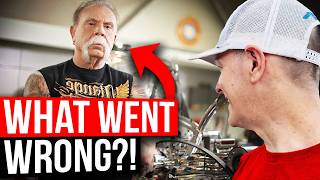
In this video essay Michael Girdley chronicles the trajectory of Orange County Choppers (OCC) and its founder Paul Teutul Sr., illustrating how a blend of entrepreneurial ambition, reality‑TV fame, and family drama propelled the company to a $40 million annual revenue peak before a cascade of missteps led to its collapse. The narrative begins with Paul Sr.’s humble origins, his early welding business, and the 1999 launch of a custom motorcycle shop in Rock Tavern, NY. A breakthrough came in 2002 when Discovery Channel green‑lit American Choppers, turning the shop’s production process and the Teutul family’s volatile relationships into a hit reality series that drew 3.4 million viewers per episode and helped OCC expand into merchandising, high‑priced custom builds, and a $13 million, 61,000‑sq‑ft headquarters opened in April 2008—just before the Great Recession. The infamous 2009 chair‑throwing incident, later turned into an internet meme, symbolized the underlying father‑son conflict that culminated in Paul Jr.’s 2008 firing, lawsuits, and a split that the network exploited as a rivalry storyline. As viewership waned, the show was cancelled in 2012, revenue plummeted, and the costly headquarters became a financial burden. OCC’s merchandising arm filed Chapter 7 bankruptcy in 2013, and by 2018 Paul Sr. filed personal bankruptcy, listing OCC’s value at zero. The company’s assets were sold at a steep loss, the headquarters was repurposed as a storage facility, and OCC relocated to a modest 11,000‑sq‑ft compound in Florida. Paul Jr. continues his own design firm, and the Teutuls have reconciled but no longer work together. Girdley uses the story to draw broader lessons about the dangers of building a business on a media‑driven fad, the importance of sustainable revenue models, and the perils of letting personal drama fuel a brand.
Chapters
In 2009, a reality TV star threw a chair at his own son on national television. Paul Tootle Sr., covered in tattoos, 250 pounds of muscle, was totally angry at his son, Junior Paul, for showing up at a quarter to 8:00 AM rather than the appointed 7:00 AM time. His son, Paul Jr., listened to his dad scream, and his dad said, "You work for me, show up on time." His son threw a chair, the dad threw a chair, and that moment, which was watched over 100 million times online, became not only a famous part of reality television, but a meme on the internet. But what that meme doesn't show was that that particular fight was the core reason of why a huge business empire, Orange County Choppers, ended up failing. Orange County Choppers at its peak was doing $40 million a year in revenue. They built a $13 million headquarters out in the middle of nowhere in upstate New York, and they were bringing in 3.4 million viewers per episode. But this meme moment, it actually only became famous on the internet over a decade later after it happened. In 2018, and by then Paul Sr., the majority owner of the business, he'd filed for bankruptcy, and that $13 million headquarters was sold for pennies on the dollar. This video is the rise and fall of Orange County Choppers. The story starts with Paul Tootle Jr., who was born in 1949 in Yonkers, New York. He started like a lot of entrepreneurs did in the United States, coming from a rough background. He beat drug addiction, and in the early 1970s, he started his own business. His business in Orange County, New York, was based around welding, something he'd started from scratch with a single truck. But by the 1990s, he was kind of bored with his tattoos. You can imagine, he'd loved motorcycles ever since the '60s and '70s eras of Choppers, The Wild Ones, uh, Easy Rider. That was his culture. So in 1999, late into his career and 50 years old, he started a motorcycle business to make motorcycles in, uh, Orange County in New York, uh, and it was in a little town called Rock Tavern, New York. But Paul Sr., he was a kind of a business savant. He didn't want to just build motorcycles. He wanted to build a brand. Remember, this is the peak era of motorcycle culture. And if you watch my video on this channel about Harley-Davidsons, this is the time when the baby boomers were in their 40s, 50s, and 60s, and they loved motorcycles. They also loved watching TV. And in 2002, Paul Sr. caught a lucky break. The Discovery Channel came calling. It turned out the custom motorcycle making process was perfect for reality TV. It was episodic, meaning they'd make a bike and they'd hit their deadlines or not. And then in the case of the, uh, Tootle family, they were purpose-built for drama. Paul Sr. had two sons, Paul Jr. and Mikey. On September 29th, 2002, the show titled American Choppers debuted on the Discovery Channel. The show was an instant hit, bringing in viewers from all over the spectrum. By By 2004, they were bringing in 3.4 million viewers per episode. It was such a hit that it was frequently the number one viewed show in the male 18 to 49 demographic whenever it aired, excluding sports, of course. Here's the thing about reality TV. It turns out reality is actually pretty boring. And the same thing held true for American Choppers. As they got to what they were doing, turned out that it was more about the drama and less about the motorcycles. The real draw was the dysfunction. Uh, father screaming at son, people throwing snacks at each other. And along the way, you had the third son, Mikey, who just kind of hung out in the middle and like a judge at a tennis match, watching craziness happen. By 2004, Orange County Choppers hit $40 million a year in revenue. Employees went from just a couple to nearly 60. Uh, they were receiving dozens of web orders, uh, for new motorcycles and gear, well, per minute. T-shirts, posters, diecast models, Orange County branded stuff, it was flying off the shelves. Unlike a normal business, the fights weren't hurting business. I mean, if you go look at real successful business, it looks pretty freaking boring. Boring is not good for reality TV. And in the case of the dysfunction of the Teutel family, well, their fights made for great TV. It's one of the crazy things you'll see oftentimes in business. People who have normal businesses like making motorcycles, a lot of times they start getting in the media business. They realize real quickly how great of a business media is. Unlike, say, making motorcycles, media is infinitely scalable. Heck, look at this YouTube channel. I can make one video walking around this stupid park in San Antonio, Texas, and a couple hundred thousand people are going to watch it. And you know what? I get paid every time somebody does. Uh, it's called AdSense from YouTube, and, uh, thank you very much. I appreciate each and every one of you. But back to our story. By 2007, Paul Sr. decided that Orange County Choppers needed a headquarters that was reflective of the, uh, brand that he had built. This would not just be a shop or a headquarters or distribution center. No, it's going to be a virtual Disneyland. Of things that were a testament to the business. They would have a movie theater in there, a visitor center, a museum, 61,000 square feet of pure Orange County paradise. They put it next door to a Target on Route 17K. The idea was to turn the whole thing into a tourist destination. If you were a fan, you'd come to the Mecca. Be like Graceland, but for motorcycles. The grand opening was going to happen in April 2008. If you know much about the Great Recession, this is a pretty auspicious time. The price tag? A cool $13 million. April 2008 is an important date because it was 5 months before the Lehman Brothers collapse and the Great Recession began. But timing here was not the craziest part. The craziest part was what these guys were leveraging their brand to be able to sell motorcycles for. A single custom bike bought through Orange County Choppers might run $50,000, $100,000, or even $150,000. Corporations came and paid up big money. They did one modeled after an F-22 Raptor, uh, fighter, basically fighter jet, uh, and those corporations would pay $150,000 or more for one. And this becomes important when, uh, leading into the Great Recession, you're building an entire business like these guys were for Orange County Choppers based on selling toys to rich people. So while outside the four walls a time bomb was quietly ticking, uh, aka the, uh, coming economic collapse, uh, inside, uh, there was about to be a bunch of drama, and this was going to be real drama.
But before we get into that, I want to let you know that I put every single one of these video stories that I do into a one-page summary cheat sheet. It's a great way for you to remember the key beats of the story and take away all the great lessons that come from it. And maybe you could be the cool guy at the party who is telling interesting business nerd stories like I do. Join the club. Anyway, you can get all these cheat sheets totally for free at girdley.com/youtube. Just put your email in and you'll get this video's cheat sheet automatically, plus all the other ones I've done. Now let's get back to the video.
By 2008, 4 years into the show plus or minus, the arguments between Paul Jr. and his father, they became basically unbearable. Paul Jr. wanted creative control. His father, he wanted to control everything. He wanted obedience. In September 2008, Paul Sr., he did the unthinkable. He fired his own son from the company. Paul Jr. left to start his own company, Paul Jr. Designs, I think it was called. Paul Sr. got mad about all that. Son sued father, father sued son. The whole chair-throwing incident, that was just a prelude of what was about to happen in the courtroom. And it got so bad, the two didn't talk to each other for nearly 10 years. But look, it turns out that drama is really good if you're making reality TV show drama. And Discovery Channel went along with it. They rebranded the whole show, basically following both independent companies and positioning them as rivals against each other. But there was a problem. Viewers were getting tired. Turns out the same old stuff of drama with the same people rehashing the same thing just wasn't interesting anymore, and, uh, ratings started to go down. And by 2012, Discovery canceled the shows. With the show over, Orange County Choppers' struggles accelerated. That $13 million headquarters— suddenly there was no real reason for people to come visit it. And in fact, revenue dropped so much that eventually the thing was handed over to the lenders, GE Finance, in order to avoid foreclosure. Paul Sr., he negotiated a lease to stay in his own building. By 2016, the lender had had enough and put the building up for auction. It sold for $2.3 million, 88% off what it cost to build back in the day. Paul Sr. tried to pivot. He opened a bar and grill inside of the building called Orange County Choppers Roadhouse. And ended up losing over $10 million of investor money. People were not happy. In 2013, Orange County Choppers merchandising division, it filed Chapter 7 bankruptcy. Remember, once the eyeballs were gone and the attention was gone, there was no way to go back and monetize it by selling those people t-shirts. Then in 2018, desperate for content, the Discovery Channel called father and son asking them to consider reconciling on camera and bringing American Choppers back to TV. But the day before the premiere, February 27th, 2018, Paul Sr. filed for personal bankruptcy. He owed over $1 million to over 50 creditors. His home was in foreclosure, and he listed the value of Orange County Choppers at $0 in the bankruptcy filing. And that's crazy because that was the week their chair-throwing meme hit the internet and suddenly went viral and suddenly reminded people that Orange County Choppers was still a thing. The crazy thing was It happened 10 years after it actually happened. By that time, the business was already dead. Paul Sr. sold off his 38-acre estate in upstate New York for about $1.5 million, less than half of what he'd been asking. In 2020, he abandoned the headquarters that he had built entirely and relocated to Florida. Today, Orange County Choppers actually operates out of a Florida compound, an 11,000-square-foot one down near Clearwater. And the old headquarters that Paul Sr. had built kind of at the peak of hubris and confidence, uh, today it's been converted to a mini storage. Paul Jr. still runs his own company called Paul Jr. Designs. He's still making motorcycles. And while father and son have reconciled, they'll never work together again. And the custom chopper industry, well, it turned out American Choppers was the peak of that moment. And since then, the motorcycle business has never really recovered. They've lost that cachet. People aren't buying them like they once did. And you can see this. I did a video on Harley-Davidson on this channel as well. There are so many headwinds against the motorcycle business, and it's made worse that social media has totally turned against the motorcycle industry. Heck, I watched a Jay Leno thing the other day where he had an Orange County Chopper and just talked about how terrible of a motorcycle it was. And frankly, I've watched some of the other videos about them too. These things are art pieces. They weren't meant to be ridden. Between 2006 and 2010, The US motorcycle market dropped 41% in annual sales, from just shy of 700,000 to a little under 400,000. And the market for over $50,000 hyper-custom motorcycles, well, it cratered during the 2008 Great Recession, and it's never recovered. When you look at this story, the important lesson is to understand whether your business is sustainable and durable, or whether it's just a fad. Are you making, uh, basically electricity or selling food to people, or are you the next Beanie Baby? And like every other TV show, it had a shelf life. American Choppers did. And at some point, the music was going to stop. And the mistake was not recognizing that ultimately the whole business existed because of this chopper fad made bigger by television, and eventually the music was going to stop. And in the end, Paul Sr., who should have walked away from this whole thing, a deca-millionaire if not more. Well, just because he didn't recognize the business for what it was, ended up bankrupt and having to restart his whole life as a man in his early 70s down in Florida. All right, that's the story of Orange County Choppers. Let me know what you think. I've had this one requested a bunch, uh, so if you enjoyed it, let me know in the comments below. Otherwise, tell me what you think about why it all happened, and I try to read everything you write below. See you next time.