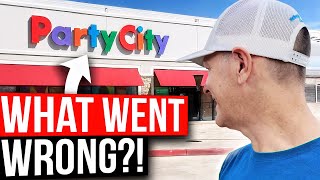
The video, presented by Michael Girdley, chronicles the lifecycle of Party City, a U.S. party‑supply retailer that grew from a single 4,000‑sq‑ft store in 1986 to a $2.4 billion public company with 900 locations and a 20 % market share by 2009. The founder, Steve Mandell, built the chain by mimicking the "category‑killer" model, stacking deep inventory, pricing low, and capitalising on the Halloween boom. Rapid expansion led to operational strain; inventory mis‑management in 1998‑99 caused covenant breaches and the board’s ouster of Mandell. Demographic shifts—declining birth rates and millennial parents’ reduced appetite for lavish parties—cut core demand. Simultaneously, e‑commerce giants (Amazon) and big‑box discounters (Target, Walmart) eroded Party City’s market share. In 2012 the company was taken private in a leveraged buyout by Thomas H. Lee Partners, loading it with billions of dollars of debt and $115 million annual interest obligations. This debt limited reinvestment, leaving the firm vulnerable to external shocks. A 2018 global helium shortage eliminated a 20 % revenue stream (balloons). The COVID‑19 pandemic in 2020 further crippled sales, amplified by Party City’s weak online presence, and a post‑pandemic bullwhip effect left the chain with excess inventory and tied‑up cash. The company lost $500 million, closed 80 stores, and filed for bankruptcy in 2023 and again in 2024, resulting in 12,000 job losses. A few franchised locations, such as three in San Antonio, survived because they were independently owned. Michael concludes with a key lesson: excessive leverage can cripple a business, and he offers a free one‑page summary of lessons for entrepreneurs.
Chapters
In 2018, Party City had 20% of the U.S. party supplies market, 900 stores and billions of dollars of sales. It was an absolute dominant player. But by 2024, it had declared bankruptcy twice and it closed its doors forever. And over 12,000 people lost their jobs. So this video is about the rise, the fall, and what went right and what went wrong at Party City.
Hi, my name's Michael. I explain business by making videos about the rise and fall of companies. And explain the lessons from them so we can all get better at owning or running our own businesses. If you like that kind of stuff, I have taken the key lessons from all these videos and put them into a one-page document that you can download for free. It's in the pinned link below. Go into the comments, you can download it and we'll give it to you. So thanks for being here. Oh, and given it's too hot for me today in Texas to record this whole video in the parking lot of a Party City, I'm going to record it elsewhere for the rest of it. But one of the things you may be wondering is if Party City declared bankruptcy and closed down forever, how am I standing in front of one that's still in operation? Well, that's a great question. And if you stick around towards the end of the video, I'll explain how that all goes down and how one here in San Antonio is still open and doing business.
Party City started at the perfect time. An entrepreneur back in 1986, a guy named Steve Mandell, he saw what was happening back then in retail, which was the rise of the category killers, things like Home Depot for home supplies or Barnes Noble or Borders for books. He wanted I could do the same thing, but for party supplies. So with $125,000, he went and opened the very first Party City in a 4,000-square-foot rented space. And he stacked them deep and priced them cheap, as kind of the retail phrase goes. Uh, he went hard into a bunch of different stuff: party supplies, plates, napkins, balloons, which remained a huge part of the business for Party City. And he rode the Halloween wave, which eventually comprised 25% of the sales and floor space for the city, for the Party City stores.
And the chain quickly grew to 58 stores riding these waves. And then something even better happened, which was peak party, as they call it, which was one of the natures of baby boomer parents was that they loved to throw big lavish parties with lots of gifts and lots of things for their kids. And there were a lot of kids back then. We talk on this channel a lot about how birth rates have declined. Well, back then there were kids everywhere and baby boomers, well, they loved to spend money on extravagant big parties for kids. Every parent trying to outdo the next one, and they shopped at Party City.
In the early days of Party City reflected kind of the personality of Steve.
He raised money to grow faster, he bought up competitors, he even vertically integrated by creating his own manufacturing, you know, thing to create, uh, to create party supplies that he would sell in the stores.
He was a hustler.
The wave riding worked.
By 2009, they had opened 900 stores. They were a public company. They're sales had reached $2.4 billion. When you find a good opportunity like this with a growing market and huge amounts of customer demand, the perfect person to go after it is somebody like Steve. And the chain got really big. But moving too fast for businesses can pose a lot of risk. You do things like Party City did, which was move so quickly that in 1998, 1999, they struggled to do inventory. And when they struggled to do inventory, it put them in violation of debt covenants and it risked them being delisted from the stock market. It was bad times. And that and a bunch of other kind of overaggressive, poor operational errors led the board and the people kind of overseeing the company to oust Steve, and he exited stage left. And the downside is quick growth can leave a business really fragile, as evidenced by this 1999 episode. And that was bad timing to have a fragile business for Party City because the— basically the trends started to turn against the chain.
The first thing that started to go wrong for Party City was the change in children, basically, in the United States. You see, the birth rate here had peaked in the '70s, and it's been declining ever since. Women just are having fewer children. Uh, if you've followed some of the stats I've talked about on this channel, the birth rate is down nearly 20% since 2005. Uh, people just aren't having kids. The other thing that's changing is baby boomers are turning into grandparents now, and parents these days are Gen X and millennials. You know what those parents don't do? Well, by and large, they don't throw huge, lavish, over-the-top birthday parties with tons of gifts, balloons, and all that kind of stuff like the baby boomer parents did. So a double whammy came for Party City, which was fewer kids, and the parents that were parents of those kids, well, they didn't see much value in spending a bunch of money to throw a big extravagant over-the-top party for the kid. The second thing that started to go bad for Party City was the rise of e-commerce. Talked about what happened with Toys R Us, right, when Amazon came for their business.
Well, guess how—
what else Amazon came for?
Amazon came for the party supply business too. I asked my wife about, uh, Party City this morning when I was planning to do this video, and she said, why would I go there? I just click on Amazon. And I saw the same thing. I was in the Halloween business, uh, doing temp stores back in the early 2000s. We had a couple good years, but then I started to see customers coming into our store clicking a button and buying the costumes that we had for $2 cheaper on Amazon and having it delivered to their house. Uh, it was just a non-starter. And the same thing happened to Party City. They've got— started to get gutted by the rise of e-commerce and Amazon coming for them in their business.
The third thing to go wrong for Party City during the early 2000s was the increased dominance of the big box discounters Target and Walmart. You see, since the '90s, those two chains had gone through and doubled the size of their stores on average. And what this allowed them to do was to reach into a bunch of other categories that they hadn't been able to sell in before. And Target and Walmart branched out into toys and home goods and all that kind of stuff. And they also branched out into party supplies and Halloween costumes and sometimes even balloons. And so if a busy mom was driving to one store and she could get everything she needed all at the Walmart or the Target at a really good price, why would she drive an extra couple miles unload the kids and haul them into a Party City. She wouldn't.
Then in 2012, something happened to the chain that put a ticking time bomb on the entire capitalization table and the business, which was they were taken private by a company called Thomas H. Lee Partners. And you know what they do? They're a private equity firm, and they were taken private in what's called an LBO, a leveraged buyout, meaning some debt was used to buy the business. And while Thomas H. Lee put up some money, the rest came from debtors, people who loan business money. So in the grand scheme of things, it created kind of a ticking time bomb for the business. Suddenly they had multiple billions of dollars of debt put on the business, and they had $115 million in annual cash had to go out the door just to pay the interest on that debt.
And so now at this point in the early 2010s, you have a business that is facing all these headwinds fierce competitors in Amazon, Walmart, and Target, uh, and you have a situation where the business can't reinvest in itself because it's stuck paying a whole bunch of debt. And that created just a ticking time bomb that eventually would explode in the next few years. Businesses in this situation, they don't tend to die overnight. It takes time for things to unravel, and it usually is external factors that come in and eventually start to kill the business. And the first one was in the late 2018s, a surprise that nobody saw coming, which was a global helium shortage. And by this time, one of the areas that Party City could really compete in well was the balloon market. You need a lot of space for it. You need expertise. Your employees need to be basically trained to do it.
And so they were doing well, and balloons are great.
You make a lot of profit on them, and it comprised 20% of the chain sales during this era.
So when the helium shortage happened, that meant a core part of the Party City business just evaporated overnight.
And they had stores that just basically lost 15, 20, 25% of sales because they couldn't sell balloons anymore. Uh, and it's just not good for the chain at the end of the 2010s.
And the chain limped along for the next couple years until the next thing came along that nobody was expecting, and that's the 2020 COVID pandemic. And if you remember that time, basically it shut down everything that would have been tied to Party City. Uh, nobody was having parties, people weren't going out of their house. The idea of having 50 kids over for a birthday or a graduation party Like, not going to happen.
So while Amazon and other folks, they were ready for the pandemic because they were doing e-commerce models with delivery, Party City was kept flat-footed. They weren't ready for it because of the high debt load. They hadn't been investing well in their e-commerce operation and it really kind of sucked. Customers were 4.5 times more likely to go to Amazon or Spirit Halloween for party supplies than they were to go to a Party City website and buy it there. It wasn't good. And Party City felt the burn in 2020 financially.
Uh, they lost $500 million, just an incredible amount of money. Uh, sales decreased 21% and they closed 80 stores. It was a bloodbath for them. Not good. And when it seemed like things couldn't even get worse for Party City as a chain, uh, the next thing was the bullwhip effect. And the bullwhip effect is this idea that in supply chains and tightly connected systems like that, where something's produced way off and something changes, and then that creates all kinds of massive ripples down the end of the bullwhip until at the end you see these huge impacts. Well, the same thing happened for Party City with their inventory, which was during COVID the Chinese and places, people who are typically making Party City's merchandise, they weren't producing anything. So when they started to go back to production, everybody ordered a bunch of— a whole bunch of stuff to try to get it delivered. And the next thing you know, you look up in your Party Party City, and you have way too much inventory because you didn't have any inventory before. It's the bullwhip effect. And in the case of Party City, suddenly all their cash was tied up in inventory and, uh, nobody was buying it.
And what COVID did was accelerate a lot of the headwinds and the trends that were happening before against Party City. More and more people were buying e-commerce and that sort of thing. Uh, it was also a situation where people expected post-COVID that people would go back to their behavior as they did pre-COVID. Like, we're gonna have parties again and all that kind of stuff. But they didn't. While many things went back to normal, some of the things didn't. The average American now is spending 70 minutes more in their house per day than they did pre-pandemic. And big parties and gatherings, they're a thing of the past. People aren't doing them like they used to. So you've got all this stuff going wrong for Party City. Differences in birth rates, differences in parental activity and how they think about stuff. We haven't even talked about how the millennials are a very environmentally conscious gene. Generation, and the last thing they want to do is buy a bunch of plastic balloons that are going to kill a dolphin. Then you got Amazon, Walmart, all this stuff that's just going wrong, bullwhip effect. And suddenly what was once a beautiful business like Party City is mortally wounded. And the lenders were not stupid. They recognized this. And these are people that Party City owed money to. And as usually is the case, when you need money the most as a business from your lenders especially, or from your investors, that's when it's least available to you. And that's what's happened to Party City right around this time in the early 2020s, sitting under this enormous debt load with stores that generally weren't profitable, with a chain that in general, even if you factor out the debt, wasn't making money. Party City went and filed for bankruptcy the first time in 2023 and then again in 2024. Nobody was willing to step up, put more money in, lend more money to it. Because in reality, everybody saw the model was cooked and the era of the Party City and the party store category killer was done. And the sad part is, of course, 12,000 people lost their jobs. And as a business nerd, what was kind of a beautiful business faded away into the sunset. And Party City, as the chain it once was, was no more. There's a lot of big lessons from this story. For me, I think the biggest one is how much debt, if done poorly, can hamstring an operation.
I mean, just imagine what could have happened with Party City if instead of paying that much debt, they were spending $110 million a year on making their stores better and cooler and more of an experience and having a good e-commerce website, which they were unable to do because, well, the banks had to get paid. Oh, and I promised to tell you why the Party City that I was in front of was still open when the chain is bankrupt. Well, One of the ways they grew early on was by franchising some of the locations. So the ones that you saw there in San Antonio, and I'll put up some of the pictures, there's 3 of them still here in San Antonio. They were franchisees, so they're still operating independent of the mothership. They weren't part of the company-owned stores. So that's how— well, how Party City is gone. It's not really gone here in San Antonio, but those are independently owned franchisees who have those.
That's right there. So that's it from Party City. Thanks for being here. Let me know what you think of the story. What did you learn from it? Write it in the comments below. I read them all, believe it or not, and I appreciate you putting them there. Catch you next time.