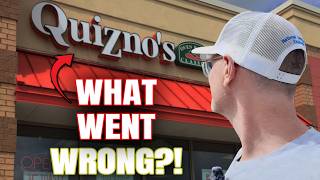
The video chronicles the rapid ascent and dramatic decline of Quiznos, a toasted‑sub franchise that peaked at 5,000 locations in 2007 before collapsing to a few hundred stores and filing for bankruptcy by 2018. Michael explains how Quiznos’ unique franchising strategy—creating a captive food distributor (American Food Distributors) that shifted most corporate revenue from traditional royalties to markup on food supplies—inflated franchisee food costs by about 10 percentage points, misaligning incentives between the franchisor and its operators. The chain then pursued hyper‑aggressive store expansion, opening new locations directly beside existing franchisees, which eroded franchisee profitability and even contributed to a tragic suicide. Franchisees sued, resulting in a $206 million judgment and over $300 million in settlements, destroying trust in the system. The 2008 Great Recession further strained the already thin margins, triggering a death‑spiral as shrinking franchise fees reduced national advertising, making the brand increasingly invisible. Compounding these problems, private‑equity‑driven debt ballooned to roughly $900 million, becoming unsustainable as revenues fell, ultimately forcing Quiznos into bankruptcy. The video concludes with a clear lesson: sustainable franchise partnerships require aligned incentives that create win‑win outcomes for both franchisor and franchisee.
Chapters
Today I'm in front of the very last Quiznos here in San Antonio, Texas. And if you're not familiar with the story of Quiznos, it's a fascinating one of the rise and then a drastic fall of a business. You see, back in 2007, Quiznos was close to being the king of the world, rivaling supergiant Subway for sandwich domination. And in 2007, they had 5,000 stores. But just a few years later, in 2017, they were down to just a couple hundred and the chain was declaring bankruptcy. So it's a fascinating story about what can go right and then what can go wrong in business. And this video is about that story and what we can all learn from it as business owners. So if you're new here, my name is Michael. I make videos about business and recently I've been making a lot of videos about the rise and fall of businesses and the lessons we can learn from each of those. So if you like that kind of stuff, I'm your guy. And I've actually built a guide that's free that you can find in the links below in the comments. That will take all of the main lessons from these videos and give them to you all in one document. Of course, you don't get my good stories to go with it, but it is a way of getting the CliffsNotes of the things you should know when you have your own business and you want to make good decisions. So download that below. Quiznos was actually around as early as the 1980s, and the whole shtick was to be an alternative to Subway. Basically, they would create these sandwiches, they would toast them, they would run them through like a little oven, and you as a consumer got this cool kind of shtick with it. You got melted cheese and toasty bread, and it just was kind of a cut above love your typical Subway or regular sandwich shop. I liked it. It's tasty. And eventually the chain was pretty popular, so they grew away a lot of chains too, including Subway, McDonald's, and others. And that was through the concepts of franchising. And they went hard into franchising to build the business up to be a pretty big— well, pretty big chain. And they rode this wave pretty hard of franchising, and it was perfect time for it. People were loving the sandwich kind of easy trend. People weren't doing a lot of sit-down restaurants kind of into the late '90s and early 2000s, and they were doing kind of quick growth the way like Subway and other franchise concepts had done. But when they put together the franchise system, they did something pretty interesting with Quiznos, which was they took an alternative path to how they, the franchisor, in other words, the corporation that owned the chain, was going to make money. And the way they did this was by putting together a food distributor company called American Food Distributors. And the idea of American Food Distributors was that the customers, i.e., the franchisees who ran these different locations of Quiznos, would buy all their food from this distributorship. And you see, the way a normal franchise system like a McDonald's or a Subway's— the way those guys tend to make most of their money is through what are called royalties. And royalties are where a percentage of revenue gets taken off the top and that gets paid back to the mothership, the franchisor corporation that owns the brand and kind of promotes the franchise. And so a typical restaurant franchise system like a McDonald's, they might charge 5% or 7% or 8%, depending upon the type of franchise it was. As a royalty, and that's where they made most of their money. And they would make a little bit of money other ways. But by and large, that created a situation that was pretty standard between the franchisees, the people who owned and operated the individual restaurants, and the big corporation that owned the brand. So look up a few years in and Quiznos is making most of its money not from royalties. It's making most of its money from operating this food distributorship. And one particular year, Quiznos made over $200 million from their food distributorship business where they were selling food to their franchisees. And only made $70 million from the royalties. And this creates a problem. So typically in a franchise situation, the franchisor who owns the brand and everything, they make a royalty from the revenue. And so if they do that, they're highly incentivized to basically help the franchisees grow. And on the other end, the franchisees, the people who run the restaurants and own them, their job is to keep costs low. And so they're highly motivated to maximize profit by keeping their costs low. And that becomes a win-win. Interests are aligned. The mothership, wants the restaurants to sell more food and do more revenue, and the owners want to make more profit. And potentially in those scenarios, like a McDonald's, hopefully everybody wins. But when Quiznos decided they were going to try to make most of their money by selling food to their franchisees, it created imbalance. It created basically a situation where there wasn't that level of aligned interest. The franchisees suddenly were getting stuck with costs that they didn't necessarily want. And if you look back then at a typical Quiznos food cost, it was a third higher than what you would see another sub shop. So typically, say, a Subway might run at 30% total, you know, cost of goods, like how much their food costs of their revenue. A Quiznos would run at nearly 40%. They were spending almost 10% more of revenue each year just in food. Just crazy. And by setting stuff up this way, Quiznos in effect misaligned incentives. Suddenly they were— didn't really care if the franchisees were making much money. In fact, they were just totally motivated to sell the franchisees as much food as possible. And when you have that kind of setup, In a low margin business like food, and especially a very low margin business like the sandwich food business, you're in a situation where like it's razor thin for the franchisees. Like it's already hard for them to make money as is. And then you slap on high food costs. It's not good. But by itself, this probably would have been okay. The chain could have survived and done well. And in fact, look, I just ate a sandwich at the last Quiznos here in San Antonio. It was pretty good. I really liked it. I liked the toasty bread and the cheese and other people did too. When we talked about how Quiznos misaligned incentives with the franchisees, well, they did something else. They started to make a lot of money from franchise fees. And these are fees that the franchisees, the people that own the restaurants in the chain, they pay to the headquarters when they sign up. And Quiznos went hypergrowth in terms of aggression. They would go start to build new locations right around the corner from their existing franchisees, in effect competing with the very people they were supposed to be supporting as the franchisees. And so Quiznos gets more money from selling more stores, and the existing franchisees are the ones that get hurt when their established businesses are suddenly competing with a new franchise restaurant, Quiznos, that opens up around the corner. And things got really bad to the extent that in 2004, a man named Bhupinder Bhattar in Southern California had a new Quiznos opened up by the franchisor around the corner from his existing restaurant. And headquarters had promised Bhupinder that they wouldn't do this, that they would protect his market and keep him safe from having another too many Quiznos around the corner. But they didn't. They opened up one anyway, and it really put Bhupinder in a place where he couldn't make money anymore. And eventually the dude got so distraught that he committed suicide. And in the suicide note, he listed what Quiznos had done to them, done to him and his family, and asked that it be examined by the authorities. Not good. And other franchisees were starting to feel the same pain. And eventually into the late 2000s, they got together and they started to revolt. In fact, a lot of them got together and started to sue Quiznos Corporation for basically all these things that they had decided to do years before. This food stuff, the overaggressive expansion, just the total kind of disrespect for the franchisees, the entrepreneurs that were running these stores. And they got together and sued, the franchisees did. And in 2010, Quiznos lost a $206 million lawsuit that the franchisees had sued them for kind of these practices. And at this point, the total trust between the franchisees and the franchise system is totally gone. It eroded. These people were not happy and many of them decided not to stick around. And by the end of 2013, the chain had paid over $300 million in penalties and settlements in what they had lost in lawsuits to these disgruntled franchisees that they had screwed over. And it didn't help that a lot of the lawsuits brought light a lot of the practices of Quiznos. In fact, one document came out where the staff had had been figuring out how they were going to, quote unquote, steal as much money as possible from the franchisees. Like, talk about a way to, to erode trust. That's the perfect way to do it. And so competitors pounced on this weakness. Uh, in as early as 2004, Subway had started to experiment with doing its own version of toasted subs. I remember buying those 10 years ago. They were somewhat tasty. And then the Great Recession came, and in 2008, suddenly consumers didn't have money. And you have a situation where Quiznos was a slightly upmarket version of Subway. People had to pay a bit more for slightly more quality and slightly more care in terms of all of this toastiness. And because of the way the food distribution stuff was set up and these Quiznos folks already operating at razor-thin margin, during the Great Recession, hundreds of them went out of business. And for the years that came after that, more and more kept giving up and closing down entirely. And this puts a chain like Quiznos into what could be considered kind of a death spiral. You see, in a situation with franchises, the franchises themselves also pay fees where national marketing can happen on behalf of the chain. So when you see like those national Subway advertisements and stuff like that, that's money that came out of the franchisees into a national fund. And then the corporation itself, Subway, is turning around and buying those Super Bowl ads. But for a chain like Quiznos, which is shrinking, suddenly that means their total fund to do that kind of advertising is shrinking itself, right? Fewer franchisees, fewer restaurants means there's less money to go spend on big ads. And that means you get into a death spiral where your brand becomes more and more irrelevant. And today, like, I told my wife I was going to get a sandwich Quiznos? She said, man, I hadn't thought about that brand in 15 years. Yeah, I'll tell you why you haven't thought about it. They haven't advertised in 15 years because they have no money to do so. And by 2012, the chain had lost over 2,000 restaurants from this death spiral. And then the final death blow came a few years later, and that was the one that always comes for shrinking troubled companies. And that one was debt. You see, as early as 2006, Quiznos had put debt on the business, and that was done by private equity and the different owners that were overseeing the business. And by the year 2014, by many reports, the had nearly $900 million worth of debt on the books. And debt is one of those things that gets magnified and worse for a company as it shrinks, right? You think about it, when a company is growing and getting more revenue, it's easier to find cash to pay interest and pay down your debt. But as a company like Quiznos shrinks and less dollars are coming in, it becomes tougher and tougher to service that debt and stay current with it. And so when that debt caught up to them by 2018, Quiznos threw in the towel and the last hanging-on franchisees, most of them had gone by then or were on their way out the door. And fast forward to today, a few years later, they're left with just a few hundred locations nationwide. And they're a brand that, well, really had a chance to be something special, but totally blew it by making some fundamental errors along the way. There's a lot of lessons from this story around Quiznos. To me, the absolute biggest one is this alignment of incentives. You have to have a situation where if you're going to be in a partnership with somebody, the only sustainable way is for it to be a win-win. In the case of Quiznos, they created a win-lose. They won and the franchisees lost. And that worked for a while until it didn't. And that's the way these one-sided agreements always go. Eventually somebody realizes what's happening and it stops working. And in the case of Quiznos, it's a perfect example of that. All right. That's the story of Quiznos. Let me know what you think. Do you miss Quiznos? I just ate one. It was actually pretty delicious. I'm going to have to go back if I can ever find a parking space in that lot. So let me know what you think in the comments below and, uh, we'll see you next time. Bye.