The rise and fall of Sunnova. Is home solar dying?
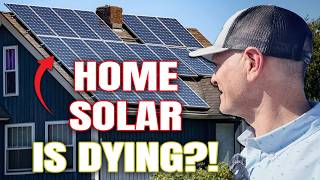
Michael Girdley traces Sunnova's collapse from a $3 billion company to Chapter 11 bankruptcy in 2025 with $10.7 billion in debt. The solar financier thrived on cheap capital and a compelling story but never made money. When interest rates rose and California's NEM 3.0 policy cut solar compensation by 87%, the company couldn't survive.
Chapters
Solar company Sunnova was an absolute rocket ship. It was a solar company with zero-down financing, a big growth story, and a $3 billion market cap. And when it got started, it was riding massive tailwinds—cheap capital, government incentives, and investor hype. But by June 2025, Sunnova filed for bankruptcy, $10 billion in debt, and it was game over. Today we're breaking down how it happened and what business owners can learn from the story of Sunnova and the solar industry in general. Hi, my name is Michael Girdley. I'm a 25-year entrepreneur and I love making content for people who are business owners or aspire to be business owners someday, especially those of you who want to own businesses but not necessarily work in them. In other words, be passive owners. If you enjoy this kind of stuff, please check out my newsletter. I send it out weekly and here's a link here. It's totally free. And oh, by the way, more people see this if you interact with the video, so do me a favor and like, like or comment or something. It'll make me happy.
To explain the story of what happened and what we can learn, let's rewind back to the beginning. Back in 2012, a Houston entrepreneur named John Berger launched the company called Sunnova, and his idea was simple: let's make solar easy. Homeowners could get rooftop panels with no money down and just a monthly payment that was often cheaper than their utility bill. And John's timing was absolutely perfect.
Solar panel prices were way down, mostly because the Chinese had been flooding the market with them. And the government— well, the U.S. government was offering a 30% tax credit, and cheap interest rates made financing super easy. This was back in the era of really cheap money. And by 2019, Sunnova had over 60,000 customers and went public at a $1.5 billion valuation. And this is the first lesson from the story: when you have the opportunity to either run into headwinds or ride tailwinds like Sunnova did, you want to start a business or be involved in things that are going to have massive tailwinds, because tailwinds make everything easier. And you can see how everything was going right for Sunnova as they got started. It was the perfect time, and investors loved it too. Once Sunnova hit the public markets, Sunnova absolutely took off. Between 2020 and 2021, green energy stocks were the hot thing, and Sunnova's share price shot up to $53, nearly 5 times its IPO level. And so Sunnova, well, they were feeling good, so they expanded fast, and they had over 419,000 customers by 2023.
And they secured a $3 billion loan guarantee from the U.S.
government to fund energy storage as well. And investors loved it, the government loved it, everybody loved it. Sunnova had recurring revenue, long-term contracts, and just a great story. But behind the scenes, there was a problem. Sunnova wasn't actually making any money. It was burning all this cash to grow. And this is lesson number 2 from this story, which is stories are great as a way for startups and new businesses to raise capital.
It can unlock tons of capital based on the vision.
The problem is eventually investors start to expect you to generate real profits and cash. And Synova, well, it was growing so fast it didn't have an opportunity to do that. And ultimately things started to change, and the cracks started to show in 2022. First, the tailwind of interest rates that had been low and easy money, well, Those spiked and they went higher, and that hit Sunnova from both sides. For customers, it made it harder for them to buy solar units. Monthly payments went higher, making them less affordable. And for Sunnova itself, debt got more expensive. And then came the second punch: California. And in 2023, the state of California changed its rules. Under NEM 3.0, homeowners earned way less for selling solar power back to the grid in California. And so what happened? Well, installations collapsed, down 87%. and it turns out California was Sonova's largest market. So now demand was falling, capital was tightening, and Sonova was still unprofitable.
This is lesson number 3: if your business is totally based on policy from government or the idea of cheap money, you have to really stay paranoid because both of those things can change really fast. And if things go really wrong, they can both change at the same time. And that's what happened to Sonova. By early 2025, things got really ugly for Sonova. They couldn't raise any new capital because, well, Story didn't matter anymore. Times had changed and everybody could see that the tailwinds they'd had had turned into headwinds. And so it couldn't pay local installers on time. Projects got delayed, revenues slowed, and costs still stayed high.
Inflation wasn't helping. In March of 2025, the company issued a growing concern warning to the stock market. Translation: we may not be a survivable business and may not even make it through this year. So the stock, it crashed 70% in a single day. They laid off over half their workforce. And founder John Berger, well, he exited stage left. He stepped down. And still there was a problem.
The numbers didn't work. And this is lesson number 4: when financing dries up, the only thing that matters is cash flow. And in the case of Sonova, they weren't generating any cash and people weren't willing to loan them any more money. Uh, that is how you go out of business. And finally, on June 9th, 2025, Sonova filed for Chapter 11 bankruptcy. It listed $10.7 billion in debt. Shareholders, they were wiped out. And Sunnova wasn't alone. SunPower filed for bankruptcy in 2024. Solar loan providers like Sunlight Financial and Mosaic, well, they collapsed as well. And one by one, the dominoes fell in the solar industry, and the solar boom had suddenly turned from a big boom to a total bust. This is lesson number 5: when you ride the booms, you have to expect that there will always be an end time where things stop and it becomes a bust. And I've had friends who've gotten rich during booms, but they didn't realize they were in the middle of a boom that inevitably ends up in a bust. And I would tell them, hey, like, don't forget, someday, someday it's going to rain. Someday all of this good revenue and all the money you're making is going to end, and you need to be ready to survive that when it happens. And in the end, the only— the companies that expect things to get worse someday and for the music to stop are the ones that'll survive and live through the downtime after the big booms. But wait, there's a twist on all this. Solar power itself is still a really good market. In fact, it is growing in the United States. In 2024, United States solar generation jumped by 27%. Clean energy demand, it isn't going anywhere because solar is actually a pretty good source of everything. The sun, it turns out, is free. It shines and nobody has to pay it. But the old business models like Sunnova and the ones that are going out of business, the ones that were built on hype, debt, and hope, those are dying and they're gone. The good news is solar demand's not going anywhere, and what comes next will look very different— hopefully leaner, smarter, and more capital efficient. And that's the final lesson here: If you're in a great market, the product might be great, but you have to make sure you have a sustainable business model around it. Sonova's story is a classic one of riding a big boom cycle only to be killed in the bust, and it shows how fast a rocket ship can crash.
So what do you think? Can residential solar bounce back, or is the end— this the end of the gold rush for good? Let me know what you think in the comments below. I'd love to hear from you. Take care.










