The rise and fall of the Tesla Cybertruck: 1 million preorders to failure?
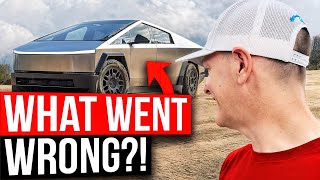
In this video Michael Girdley chronicles the Tesla Cybertruck’s trajectory from its 2019 launch hype—where a futuristic design, sub‑$40k pricing promise, and 500‑mile range claim generated over a million pre‑orders—to its 2025 reality of low sales, quality recalls, price hikes, and brand perception issues. He explains how Musk’s early‑announcement strategy created massive mindshare but also gave competitors a head‑start, how the radical stainless‑steel design forced Tesla to reinvent manufacturing processes, and how post‑COVID macro‑economic conditions (inflation, higher interest rates) reduced consumer willingness to pay premium prices. The video details recurring quality and safety problems, the impact of Elon Musk’s political alignment on Tesla’s brand, and the fierce competition from Rivian, Ford, and GMC EV trucks that outperformed the Cybertruck. Girdley extracts business lessons, emphasizing the need to build what customers want rather than what founders find cool, and proposes retooling the platform into a third‑row SUV to capture a larger market. The narrative is framed as a cautionary case study for entrepreneurs.
Chapters
At its launch in 2019, the Cybertruck was a smash, literally and figuratively. Uh, customers piled up wanting to buy the truck. In fact, 200,000 people put in pre-orders within the first 48 hours, and that number swelled to over a million people putting down deposits within the next couple of years. People were in love with the idea of a full-sized EV truck that looked like it was from the future, was priced under $40,000, and had 500 miles of range. Just incredible. But fast forward to today, and this truck's basically in trouble. They're only selling 1,400 units a month. They've gone through multiple quality recalls, and people, well, they just aren't buying it. So what was the rise and the fall of the Tesla Cybertruck, and what can we as business owners learn from the story? That's what this video is about. If you're new here, my name is Michael. I make videos about the rise and fall of businesses, especially iconic American brands, and I turn those into lessons that we as business owners would find fascinating and helpful. So if you like that kind of stuff, do me a favor. I have a link below that is a guide that takes all the lessons that are the most important ones from this series of videos, puts them into a one-page document, and you can download it there. So check the link below. Oh, and if you stick around to the end of the video, I will tell you how I would fix the Cybertruck and make it popular. So stay tuned for that. So back in 2019, Tesla was virtually on top of the world. They had 78% of the North American EV market. They had just come through as a team having survived what was described as manufacturing hell, trying to get the Model 3 out the door, and it had been a huge hit. And next out the door was going to be the Model Y, which became the most popular car in North America since then. Like, they were on an incredible high and an incredible run. And I wasn't in the building then, so I can't speak about what was going on, but I can tell you I've been in situations like that. You have a couple wins in a row and suddenly you feel like you can't lose. and, uh, that can impact your decision-making, which we'll see a bit later on in the story. But the second thing is in 2019, uh, the world was still a different place economically. This was before a lot of the turmoil that's happened that you're seeing now. It was before COVID and all the money printing that came from that. Uh, it was before all the inflation that everybody's dealing with, all the supply chain, all that stuff. It was just a different era. And having lived in that time, I can tell you money was just easier to come by. It just seemed to flow a lot more than it does today when things have really tightened up as they've tried to inflation in a post-COVID era. And at this time, there was one segment of the passenger vehicle market that the Tesla Corporation had not managed to get into. They were in the sedans, they had small SUVs coming, they had big sedans as well, big SUVs in the Model X, but they had not entered the pickup market. And the pickup market, if you don't know it, is absolutely huge in North America. We are 64% in North America of global sales of pickups, and it's something like $238 billion in sales of pickups. Crazy. And according to the recent Walter Isaacson biography, Musk and his team saw the pickup truck as something that really needed to be rethought. It was a design that nobody had fixed or changed in over 100 years. It felt stale, so they wanted to rethink it. And if you've ever worked with engineers, this sort of challenge is like catnip or manna from heaven for them. Suddenly they were given the opportunity to rethink the pickup truck from an entirely new perspective. What's embrace brand new materials. Let's do an entirely ground up new way of thinking about pickups. And so they dove in. And according to Isaacson, the idea was to let engineering drive the product, right? Let's figure out how to use new materials. Let's have a space age look. Let's try things that haven't been tried before to hopefully revolutionize this category. And Musk famously said at the time, as reported by Isaacson, that he didn't care if anybody bought it. He wanted to build the Cybertruck because it was cool and it pushed the envelope. Just told people not to fight him. They were going to do this revolutionary design and go that way. And Tesla under Musk does something really, really smart. They go out and they announce their products way, way, way before they actually are going to ship. And they've done this time and again. And there's actually a strategic intelligence to do this. When you go out and you announce something super early, it creates mindshare amongst your potential customers. It creates hype. Potentially you get some money from things like preorders, and that all works really well. The problem is that eventually have to deliver that thing that you announce. And so in November 2019, they held a launch event for the Cybertruck, and it went down in history as one of the most kind of fascinating and exciting product launches ever because it was highlighted by a scene where supposedly the unbreakable glass of the Cybertruck was broken by a bowling ball or whatever on a string. And Musk famously looked at the audience and said, "Oops." Not since Steve Jobs had announced the iPhone had a product launch gotten this kind of reception and buzz. Whether it was intentional or not, which they say it wasn't, it was freaking genius. And the hype worked. Like, people put down $200,000 deposits, paid for $200,000 deposits within the first 48 hours. You know who else put one down? I did. I thought it was cool. I wanted to buy a truck that looked like Blade Runner. And it eventually did look like Blade Runner. I just didn't buy one. And then in this launch event, Musk promised deliveries in 2021, an entry price point below $40,000, a standard range of 500 miles, and the thing would be out and available to customers. And this launch event was actually a pretty amazing leadership move by Musk. Uh, it's what I call his man on Mars technique, where you set this incredibly ambitious, almost impossible goal for your team. Then you rally yourself and them all around trying to hit that thing. And you know, even if you only get partially the way there or you slip, it's still such an ambitious goal that you've achieved greatness. And that's what this moment was. The Cybertruck design was incredibly polarizing. You either had people that absolutely loved it. I did. I thought it was pretty awesome to see, at least on stage. And then you had people that hated it. And people basically were polarized on either side of the thing, which I guess is sometimes a hallmark of a great product. People either feel strongly about it one way or another rather than just kind of being like there, right? That's not what you don't want in your new product. But everybody from journalists to consumers, they either loved it or hated it. But one constituency was really important, which was, according to reports inside of Tesla, a number of the engineers thought the design was just too radical. And a lot of them were so worried about how radical the design was that they actually skunkworks created an alternative version of a pickup that would be easier to manufacture and get out to market, and reportedly showed it to Elon. And Elon said, "Nah, we're gonna keep doing my vision. We'll just build it." So they did. So I talked about this genius of the launch first strategy and getting your thing out there way before you deliver it. It has a lot of benefits. There's a side effect and a negative to it. It is a sign to your competitors of exactly what you're gonna be doing. So it gives them information about your plans, activities, and all that kind of stuff that they wouldn't have normally had. And it turned out Ford and Rivian and some others beat Tesla to market with EV trucks by, in some cases, over 18 months. And Rivian got to market in 2021, Ford got to market in 2022 by their, just frankly, more conventional designs. They weren't having to recreate 100+ years of car design to get a car out the door. And meanwhile, the engineers at Tesla were back in manufacturing hell where they'd been during the Model 3. They were having to recreate entire fundamentals of how automobiles are made from scratch. If you just look at the Cybertruck, things like the material used in terms of the stainless steel and then the size of the sheets and how it's not bent and all this kind of stuff. Well, you know, we've spent 100 years as an industry in the car world figuring out how to do some of that stuff really, really well. And if you change everything about how we're going to do it, it suddenly creates an order of magnitude more things that you as an engineering team have to recreate. And that takes time and it takes money. And so nearly 2 years after launch, the 2021 date, that was history. Wasn't going to happen. Uh, early prototypes of the Cybertruck were showing surprising levels of defects, lacks of stiffness, leaks in the cabin, all kinds of stuff that by the time you get to the prototype stage shouldn't be happening for a car manufacturer. Well, it was because the design was just that radical. And so finally, in early 2023, the first Cybertrucks start to show up to customers. And the initial thing they start doing is finding a lot of problems that weren't very good. Things like panel gaps, of which Tesla is pretty famous for in terms of their quality of stuff. But even other things around stuff like getting the giant, never-seen-before windshield wipers that are the size of a semi-truck to work on a vehicle of this size. Like, there was just problem after problem. And that probably would have been okay, except something else had changed. All this engineering had changed the price point of where the truck was entering the market. And at launch, Elon had promised a sub-$40,000 base model, but now a base model was 50% higher than that around launch time, in the low $60s. And that's just unequipped. When I went and looked today, the Cybertrucks are selling just for the base models at low $60s, plus that's without Full Self-Driving and all that other kind of stuff. And a decently equipped one is in the $80s. And when you start to price up at that level, customers have a luxury mindset. They're expecting high quality and good stuff. And that makes it tough when your vehicles come out with some problems. And the Cybertruck also launched into a market and a world that was radically different from when it was announced and when it was conceived back in the pre-COVID era. See, in 2023, you know, the world is radically different. Uh, people are not feeling as wealthy anymore. Money's harder to come by. Times are tough. Inflation is hitting lots of people, and that does a lot of different things. And one of those, in my opinion, was changing in customer attitudes and what's cool and what's not cool. Back before COVID I think it was easier as a consumer to feel okay driving a flashy, really expensive-looking, ostentatious truck. Now, if you drove a Cybertruck, you were flaunting your wealth. That's a tough thing to do when a lot of people in the world are out there hurting. And at least with a Tundra or Ford F-150, somebody kind of has to know what they're looking at to know if you spent $50,000 on that truck or $150,000 on that truck. Just my opinion. And financially, the world had also changed. Pre-COVID, interest rates had been low. We'd been in the greatest boom time in the history of the United States without a recession from 2008 until 2020. And one of the things that helped do that was super low interest rates. And interest rates are a huge driver of how cars get bought in the United States. 80% of cars and trucks are bought in the United States with financing. And what drives how big your monthly payment is for buying a truck or a car is interest rates. And post-COVID, after all the money printing, interest rates are much higher. So if you go look at something like a Cybertruck, what in the low interest rate times might have been a $1,000 monthly payment now would be a $1,500 monthly payment. And so when prices go up like that, it means fewer people can afford to buy what is a high-priced and luxury truck. And in late 2023, things got worse. There was a massive set of recalls for the Cybertruck, two of them that I remember. One was panels would fall off the side of the truck, which— have you ever heard of a Toyota doing that? Like, they don't. And then the second thing, which was even more serious, was supposedly the accelerator pedals would get stuck. If I'm going to pay $80,000 for a truck, I want it to be safe. And, you know, the other byproduct of doing a big launch and being really out there is the news loves to cover it when you stumble. And I remember seeing all the news stories around these particular stumbles with the Cybertruck. It was just not good for consumers. And so besides this changing sentiment and bad perception about the quality and the safety of the truck, uh, other things were happening as well. And people started to do studies to figure out why customers who had been so interested in buying the Cybertruck were now suddenly passing. And the studies came back. Why are you passing on the Cybertruck? Number one was price. Number two was questions about reliability and safety. So some of the stuff that we talked about just a segment ago. Number 3 was the difference between the specs as promised and what they actually got. Suddenly a 320-mile range Tesla Cybertruck isn't as useful as the originally promised 500-mile range, especially when you're going to be expecting to do real work with the thing. And the 4th problem, and this is mostly my theory, but it's part of why I have a problem with the Cybertruck personally, is the idea of utility is lacking. If you think about the mindset of somebody that buys a pickup truck, they buy it not because it can do everyday work. Your typical consumer buying one is buying them because they want to be ready for anything. Your buddy calls you and says, hey, I need to tow the boat. You want to tow the boat. Hey, your buddy calls you and says, I want to— you need to help me move and help me do all this stuff. Like, you want to put a bed frame in the back of the truck? Well, let's do it, right? And your typical truck design enables all that to happen. You have a mindset that you can make anything happen. It's not so much doing it every day. It's having the ability to do that every day. And for designs like a Ford F-150 or Toyota Tundra, I still have that. Like, I feel like I can always help a buddy move if they need me to, or I could tow a tractor tire if I need to in the bed. But the challenge with the Tesla is you look at how the shape is done, how the bed works, how the whole thing is— happens there. Like, it's actually not that practical if I really need it in a pinch. And if the utility is not there and I'm spending all this money Like, it just doesn't make much sense. Like, why would I go over the top and, uh, buy a utility truck that's actually not that useful? And next, when it seemed like things couldn't get any worse for the Cybertruck— it was out the gate super slow, uh, people were not buying it, customers were turning up their nose, people were not converting from pre-sales— things got worse. And in the fall of 2004, in the peak of the Harris and Trump campaign, Elon Musk very publicly came out and joined the Trump campaign. And joining the Trump campaign, or whether you join the Harris campaign or whatever, like, that was all fine. Uh, it's his choice to do what he wants to do, but it did something very quickly to the Tesla brand in general, which is it associated the Tesla brand with politics. And shortly after all that happened, a survey went and looked at the Tesla brand amongst consumers, and now 60% of the people responded said they were avoiding buying Teslas because it was now irreversibly tainted by being part of politics. In other words, they felt like if they bought a Tesla, they were advertising a particular brand or side of politics. And in an era where, like, your car can tell people a lot about what you believe, it's a really bad thing. In this case, there is no Model. So this move into politics, while not good for Tesla, was especially bad for the Cybertruck. And so fast forward to closer to today, in Q2 2025, They're selling about 4,200 units a quarter, which you're like, okay, 4,200 cars, 4,200 Cybertrucks, not the worst thing ever. Well, here's the kicker. Both the Hummer models from GMC and the Ford F-150s, their EVs are both outselling the Cybertruck, like in some cases by over 50%. And while Tesla had projected 250,000 annual Cybertruck sales per year, by the way, they have delivered a grand total of less than 50,000. And there are reports of unsold vehicles everywhere. Heck, I saw it yesterday when I visited their local showroom here in San Antonio. The parking lot was just filled with Cybertrucks. And fast forward today, I think objectively you can say that the Cybertruck has missed expectations. The expectations, albeit, were very high. But what they wanted to prove and they wanted to do, clearly the Cybertruck is not doing well and has missed the mark completely. There's a lot of lessons from the story. I highlighted some of them as we went along and some genius things that Musk and Tesla does. In the end, I think the biggest lesson for me and takeaway from the story is it is important to build what customers want. You need to build what they want, not what you want to build. In this case, if I could go back in history and be in that room, I would say, hey guys, like we need to listen to the customer and figure out what they want and not just build what we think is cool. If you look at all of the mistakes and all the ways it's gone wrong, that's the fundamental core and the explanation for the whole thing. Oh, and I promised to tell you what I would do to fix the Cybertruck. Pretty straightforward. I would convert it as quickly as possible into a third-row SUV model. I think that the target market and people who would buy a full-size or a large SUV based on the Cybertruck platform— like, I think there's tons of parents around the world that are dying for something like that, and that's a much bigger market than the novelty truck buyer market that it's currently going after. So that's what I do. The good news is most of the big third-row SUVs are based on truck platforms anyway, so it's not that big of a stretch, and it won't surprise me if we see Tesla doing it in the next couple years anyway. Let me know what you think in the comments below. I try to read all of them. Is the Cybertruck a flop? What would you have done differently? What did I get wrong? I'm sure there's going to be some Tesla fans that will tell me errors that I had. So let me know in the comments below, or if you like the video, just tell me you like the video. It encourages me to make more. All right, catch you next time. Bye!










