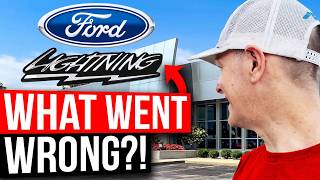
In this on‑camera explainer, Michael Girdley chronicles the entire lifecycle of Ford’s electric pickup, the F‑150 Lightning, from its 2021 debut to its 2025 cancellation. He begins by framing the market pressure from Tesla’s soaring valuation and the looming threat of new electric trucks (Rivian R1T, Tesla Cybertruck, GM Hummer EV) to Ford’s flagship F‑150, which generates over $40 billion in annual profit and accounts for the bulk of Ford’s earnings. To protect this core business, Ford announced the Lightning at the 2019 Detroit Auto Show, promising high performance (560 hp, 775 ft‑lb, 0‑60 ≈ 4 s, 300‑mile range) and a sub‑$40 k price, sparking massive reservation numbers (200 k deposits, 44 k in 48 h, 120 k shortly after). The video then details the rollout: a $750 M plant, 950 dedicated staff, and ambitious production targets (15 k in year 1, up to 150 k later). Girdley outlines the cascade of problems that followed – supply‑chain disruptions, soaring lithium‑battery costs, and successive price hikes that pushed the base price from $40 k to $61 k within six months, with dealer mark‑ups inflating it to $70‑90 k. He highlights the financial drain on Ford’s EV division (losses of $2.1 B in 2022, $4.7 B in 2023, $1.3 B Q1 2024) and the mismatch between truck‑buyer expectations and the Lightning’s real‑world performance: heavy weight (≈ 6 500 lb), limited range when towing, poor cold‑weather performance, and numerous quality defects. Sales peaked at ~15 k in 2022 and 24 k in 2023, far below the projected 150 k, leading to production cuts, layoffs, and ultimately a $19.5 B write‑down and program cancellation in December 2025. Girdley compares the Lightning’s fate to that of rival electric trucks (Cybertruck, Rivian, Hummer) and notes the shift back to gasoline and hybrid powertrains, with hybrid F‑150s outselling the Lightning 10‑to‑1. He concludes with lessons about “revealed preference” – the danger of equating reservation numbers with true purchase intent – and hints at Ford’s future plans for a cheaper, range‑extended electric pickup and repurposing of its Kentucky battery plant for AI data‑center hardware. The video blends data, market analysis, and personal anecdotes, ending with a call to action for viewers.
Chapters
Today I'm at this ginormous Ford dealer here in San Antonio where I live. And today I'm going to make a video about the rise and the fall of the Ford Lightning. And along the way, I'm going to walk around here, see if I can find one, and we'll see if they still have any. The Lightning is a crazy story. In 2021, over 200,000 people put down deposits when it was first announced. Deliveries started happening in spring of 2022. But then just 2.5 years later, in December 2025, Ford canceled the entire project, taking a $19.5 billion write-down. This is the rise and fall of the Ford Lightning. Let's go see if we can find one. The Ford Lightning is actually an interesting product of Tesla becoming a thing. By early 2020, Tesla had a market cap of over $700 billion. That made it more valuable than the next 9 automakers combined, including Ford. And if you're on the board of Ford at that point, that scares you. Wall Street was basically saying, we don't care that you sell only a small fraction of what Ford does, Tesla. That means you're the future and these other guys of the past. Crap, look at the size of this thing. Like, who needs that? It's a big truck. And at that moment in 2020, it seemed like everybody was going to come for the crown jewel of Ford's lineup, the pickup truck. I'm getting kicked out because there's an alarm going off. We'll go to the park. It's where I asked ChatGPT if you're allowed to walk around dealerships when they're closed. Evidently not. All right, go to the park. See you later, Ford. Get out of here before the cops show up. If you guys still want us to buy the cars, why leave them out front? That's all I have to say, Mr. Ford dealer. All right, so I got kicked out of the dealership and we're here at the park. So to catch up on the story, in 2018, Rivian announced that they were bringing out the R1T, which is an all-electric truck designed to come after the Ford F-150. And then in 2019, our buddy Elon Musk announced the Cybertruck to great fanfare. And it— if you're sitting in the boardroom at Ford, so then it looks like your crown jewel, the Ford F-150, is going to be under attack and potentially disrupted entirely. And remember, at this time it looked like the Cybertruck was going to be unstoppable. Musk got 250,000 pre-orders within the first few days, and GM followed suit shortly thereafter with the Hummer EV that they were going to come out with in the truck market as well. So Ford's board at the time said, look, we can either be the next Kodak or Xerox, or we can fight back. Against the disruptor and try to lead in that new market. And people don't realize the importance of the F-150 to the Ford business. It's been the best-selling truck in America for 47 years and the best-selling vehicle of any kind for over 40. It generates $41.5 billion a year for Ford. That's more than Starbucks, Visa, Microsoft. Just crazy size. And while Ford doesn't break it out independently, one analyst basically speculates that Ford makes $10,000 per truck in profit for Ford, and that accounts for over 90% of the entire company's profit. So while Ford is basically a Ford F-150 company with other pickup trucks and cars involved, you basically are sitting in the boardroom at this moment in 2018, 2019, and realizing, oh, if, if the Cybertruck, if Rivian, if all these guys disrupted the Ford F-150, we could lose everything. The standard playbook when a disruptive innovation comes in like this is try to beat the innovators at their own game. You try to innovate better than they would rather than pretending it's not happening. You can beat right back. So that's what Ford decided to do. They'd come out with the Lightning and try to beat Rivian and Cybertruck at their own game. In January 2019 at the Detroit Auto Show, which is kind of like the Super Bowl of auto shows— I hear crazy things, I want to go someday— uh, Ford announced that the F-150 Lightning would be coming out in 2021. At the time, the skeptics kind of laughed at the idea of the Lightning. I mean, are truck buyers going to want something that's all electric? We'd later find out the answer to that, and I'll tell you more about it later in the video. But in order to allay people's concerns and shut up the critics, Ford put on some marketing stunt with their demo version of Lightning. They wanted to prove that the Lightning could be tough, so they took their, uh, basically prototype model, uh, they attached it to 1.25 million pounds of stuff on rails and they towed it with their electric vehicle with the idea of proving that electric cars and trucks could be just as tough as the gasoline-powered brothers. May 2021, Ford CEO Jim Farley unveiled the very first Lightning. It was ready for the market. The specs were impressive for any truck. Well, one that wasn't souped up in the aftermarket. It had over 560 horsepower, 775 ft-lbs of torque, and 0 to 60 in just over 4 seconds. Motors, all-wheel drive, and a promised 300 miles of range. Which proved to be pretty interesting later on in the story. The Lightning could do things that regular trucks couldn't do because you didn't have a big engine under the bonnet. They incorporated a thing called the frunk, which is a trunk in the front, which I like that. It's very cute, very punny. And then the other thing you could do because it was all electrical, like it had a ton of power to be able to do things like power your home in emergencies. Kind of crazy. And what really got people excited was they came out and said that the base model was going to be under $40,000. Which, by the way, was pretty close to what the Cybertruck was promised to as well. And these guys, well, they get optimistic about the prices at the beginning. Within 48 hours, Ford had 44,000 reservations. Within a few months, they had 120,000 of them. And a couple of months after that, they had to stop taking reservations entirely. CEO Farley at the time said something crazy was happening. 75% of the reservation holders were people who had never owned a Ford before. They were coming from brands like Tesla, Audi and others. And one thing CEOs look for is market signal. And this was a market signal that people wanted to buy a thing. So Ford went all in. They hired 950 people to work specifically on the Lightning project, and they built a new manufacturing plant for $750 million that would focus on EVs. The plan was to start with 15,000 vehicles in year one, scale to 80,000 in year two, maybe get to 150,000 or 160,000 beyond that. Serious ambition. And that moment, it looked like everything was going to go impossibly well for the Lightning. Customers were demanding it, uh, people were wowed by the specs and the price. At that moment, that's when things started to go wrong. But before I tell you how that all happened, here's a quick word from our sponsor. A ton of these rise and fall stories come down to the same factors over and over again, so I put them all in a new ebook on why businesses win and why they lose. You can download it for free at girdley.com/why-they-win. Link in the description below. Now back to the show. The first thing to go wrong was that in August 2022, Ford reopened the order banks for the Ford F-150 Lightning, uh, and they got greeted with a nasty surprise. Gone was the sub-$40,000 price point. Now the entry price point was going to be $47,000. COVID had wrecked the supply chain during this time. Uh, they'd basically been unable to ship stuff. Shipping costs were up over 10x. Cost of lithium batteries, after going down for over a decade, suddenly were up 400%. In one year alone. But that wasn't it for the price hikes. In October, they moved it up to $52,000 for the base model. Then a few months later, they went up to $57,000. By March 2023, the entry-level price for a Ford F-150 Lightning was $61,000. The price had gone up over 50% in just 6 months. But Ford wasn't the only one raising prices. These dealers that sell Fords, they're not dumb, and they have the ability to raise prices if they want to. So a lot of them were marking them up even further, $10,000 or $30,000 over MSRP. Suddenly you were looking at paying $70,000 or $90,000 for an entry-level Ford F-150 Lightning. Ford threatened to basically cut allocations to dealers who were doing these kind of games and taking advantage of the shortages, but it didn't do much good. The damage was done. Ford would later slash prices to move inventory. Early customers felt totally burned, first by the initial price hikes and then later on by the rapid depreciation because suddenly the market was flooded with new cars selling for a lot cheaper. Than what they pay for theirs. The backdrop for all this was that Ford's entire EV effort was burning cash and losing money like crazy. In 2022, the division called Model E lost $2.1 billion. In 2023, they lost $4.7 billion on their EV initiatives. And in the first quarter alone of 2024, they lost nearly $1.3 billion. They were losing a staggering $132,000 per vehicle. Turns out businesses like Ford and most businesses in that matter are judged by two things: algebra and physics. And in this case, the math and the physics weren't working. Batteries were getting more and more expensive, so the math didn't work. And they were getting heavier and heavier in order to meet these outrageous demands on specs, which meant that, well, they needed more batteries to be fast enough to meet the specs. The math just wasn't mathing and the physics wasn't physicking. Here's the deal about truck buyers. They are a special type of buyer. They do not buy it for what they do every single day. They buy the truck for what it might do. It might be able to go off-road. It might be able to move a couch. It might be able to tow a camper. And if you're going to build Ford F-150 Lightning, you need to make sure it can do all those things really well, especially at that price point. And in their world where suddenly entry-level pickup trucks are $70,000, even Ford CEO Farley admitted, well, these just don't make much sense. So while the number one punch were these price increases, the number two punch was a lot of bad press. Suddenly, as people got their hands on these Ford F-150 Lightnings and tried to use them in the real world, they discovered they just weren't as practical as the gasoline versions. And while you might get a few hundred miles towing nothing, once you tow something like a camper or trailer, suddenly your mileage could dip below 100 on just a single charge. It's not going to get you very far. Motor Trend, YouTubers like Hoovie's Garage, they did videos around these things. They went viral. Heck, I'm not a car guy and I saw them, and that scared me off the Lightning for good. The Lightning's 131 kWh batteries holds about as much energy as 4 gallons of gas. Try towing something across country or going camping on that. It ain't happening. And good luck finding a charger along the way that can help you when you have a trailer on the back. Most of those places are pull-in, back-out kind of spots. The physics were brutal. Your typical Ford F-150 Lightning weighed nearly 6,500 pounds, over a ton more than a gasoline-powered entry-level model of the Ford F-150. And because of all the extra weight from batteries, suddenly you had Fords that weighed more than their siblings, the Lightning's dead, but could tow less than their gasoline-powered brethren. But Ford in its rush had also not dealt with something else, which was batteries do poorly in cold weather. And owners started to report, and I saw YouTube videos on this as well, some of that purported 300 to 320-mile range would drop in half if it got too cold outside. And precisely in the type of market where people want something where they can go on a bit of an adventure in a pickup truck and rely upon it, suddenly the Ford was getting a reputation Lightning of not being very reliable at all. My cousin had one at this time, and I remember sitting down with him over the holidays and asking him how the Ford F-150 Lightning was going. You know what he told me? He sat down for 20 minutes and told me about all the quality defects that he'd seen. This was very clearly a first effort out of Ford, and it wasn't ready to be out there. Multi-heaters, software glitches, different types of stuff falling off the truck— it was a mess. And on top of all this, people started to look at the specs and performance in the real world. It I realized a lot of what Ford F-150s get used for is light-duty outside field work, and you can't even use a Lightning for that. Like, how are you going to keep somebody on the road all day when you only have 150 or 200 miles of range? In practice, in 2022, Ford sold 15,000 or so Lightnings. That number went up actually in 2023, they sold about 24,000, but it was nowhere the 150,000 or 160,000 car a year dream that they had had. And what was going on was that the early adopters had bought in And the mainstream folks like me, they were scared. Q3 2023 sales were down 46% over the same quarter the year before. Ford responded by slashing prices. They first took $7,500 off the sticker price, and with the $7,500 federal vehicle credit, you could be getting $15,000 off before you even negotiate. By December 2023, Ford was seeing what was happening and they told folks to prepare for a production cut. They basically moved from 3,200 vehicles per week to 1,600 in December 2023. By early 2024, the writing on the wall was pretty clear. Ford moved the vast majority of the Lightning staff over to work on gasoline engines and gasoline-driven trucks. In November 2024, just 9 months later, Ford furloughed 730 workers and paused production of the Lightning for 51 days. At this time, more competition came to market. In 2023, Tesla launched the Cybertruck, and in the first couple quarters, they outperformed, uh, the Ford F-150 Lightning, selling 39,000 cars in the first year over 33,000 for the Lightning. But eventually the Cybertruck kind of failed as well, which is people aren't buying it as much as they'd expected. And by Q1 2025, the Cybertruck was passed by the Lightning, uh, in sales again. And it wasn't just those two trucks. The Rivians, the Hummers, they were all failing. Consumers said they wanted electric trucks, got hyped about them, but then in practice they didn't buy them. And on December 15th, 2025, Ford announced that they were cutting the program entirely, taking a $19.5 billion write-down. The truck that had been named kind of Truck of the Year by all the different publications and people gotten really stoked about and all these pre-orders, it was effectively dead on arrival. They weren't the only one. Hummer from GM, Stellantis, they all have reduced or canceled their programs entirely. Turned out everybody had heard from the market. Yeah, electric trucks sound cool, but we don't want one. Ford and most of these folks are doing what a lot of vendors are doing, which is pivoting back to gasoline or even better, hybrid electric vehicles that give you hopefully the best of both worlds. And proof of that is that the hybrid F-150s are outselling in some situations 10 to 1 over the Lightnings. The V8 version of the hybrid F-150 offers 700+ miles of range, uh, tons of power, and all the upside of the— and the fancy gadgets that you got with the Lightning. And Ford has recognized what truck buyers really want. The next version of Lightning will come out with an engine included in it, a range-extended, uh, EV in fact. And Ford's entire electric vehicle initiative, they've now pushed back the expected first date of profitability to 2029. And sometimes, you know, it's better to be lucky than good. And in Ford's case, they had spent all this money on this Kentucky battery plant to do it for all electric vehicles. And, well, because of this AI boom, they've now repurposed a lot of the production from that plant to service the new AI data centers that are coming up. Still, it does look like Ford believes in cheap electric pickups of the future. In 2027, they're expected to release a competitor to the Maverick. At under $30,000. It will be simple, basic, and all electric. The story of Ford is really an illustration around the idea of a thing economists call revealed preference, which is you can't trust so much what consumers tell you they will do. You have to look at what they actually do in order to understand their true needs. And if you look at the reservation system for Cybertruck or the Ford Lightning, typically these reservations are like $100, not much money at all. And what the mistake was that Ford made was assuming those meant true intent to purchase. In the long term, especially when things were going to change in terms of price and capability. And in this situation, you can't trust that little stuff. You got to see what customers are really going to do, and that's how you know for sure what the market wants. So that's why the great entrepreneurs, they guess about what the market wants, but they're always running experiments to see what happens in practice, because believe it or not, usually surprises you. All right, if you like this video, check out this one I did right here on the Cybertruck and how that's, uh, well, not as good as people had hoped. And if you like this video, let me know in the comments below. It'll encourage me to make some more. Catch you soon.