The rise and fall of Toys "R" Us: From $13B to bankrupcty
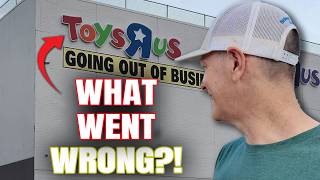
In this video, Michael Girdley narrates the complete lifecycle of Toys "R" Us, tracing its origins from Charles Lazarus' 1948 children's furniture store to the 1957 launch of the first Toys "R" Us as a category‑killer big‑box retailer. He details the company's meteoric rise to 1,600 stores, $13 billion in sales and 25 % of the U.S. toy market, driven by high brand recognition and the ability to make or break toy launches. The story then shifts to the mounting external pressures of the 1990s‑2000s: discounters like Walmart and Target expanding their toy assortments, declining birth rates, and the advent of e‑commerce. Girdley critiques the disastrous Amazon partnership that handed online toy sales to a future competitor. He explains the 2005 leveraged buyout by private‑equity firms, which loaded the chain with over $5 billion of debt, creating a financial stranglehold that forced the business to allocate $400 million annually to interest payments. Despite later leadership efforts—store‑experience upgrades, loyalty programs, and digital initiatives—the company faced new headwinds from tablet adoption, further eroding demand for traditional toys. In 2017, rumors of bankruptcy caused suppliers to halt shipments just before the crucial holiday season, leading to a $2 billion loan that could not sustain the business. The company filed for Chapter 11 in September 2017, liquidated in March 2018, and eliminated 33,000 jobs, with founder Charles Lazarus passing away shortly after. Girdley concludes with a cautionary lesson about the double‑edged nature of debt and the importance of strategic agility for business owners.
Chapters
Today I'm in front of a pretty incredible place if you're a business nerd. Behind me, this Dick's Sporting Goods is the former site of the very last Toys R Us here in San Antonio, Texas. And if you're not familiar with the story of Toys R Us, it's a crazy one of the rise and fall of an iconic American business. At its very peak, Toys R Us had 1,600 stores, $13 billion in sales, and an astounding 25% of the US toy market. But just 20 years later in 2018, the chain filed for bankruptcy and 33,000 people lost their jobs. It's an incredible story about business, and I'm going to tell you the rise and fall of it in this here video. Hi, my name is Michael. I record videos for people that are business owners telling the rise and fall of different businesses. If you like that kind of stuff, I have taken all the lessons from the videos that I've recorded and put them into one document you can download. There's a link to it below in the comments. Check it out and also give me a follow and a comment. It'll make me feel better about my life. So in 1948, young Charles Lazarus was 25 years old and he saw something happen in the United States, which was people were having a lot of kids in the postwar baby boom. So he did what any good entrepreneur would do, which was to go and open up a store to sell those people some stuff. And his first business was actually selling children's furniture to the folks who were having a lot of kids. But something really interesting happened as he did that. People would come in to buy the furniture and they were okay with that. But what they really kept asking for was to be able to buy toys for the kids that they were having. And Charles, well, at that time when you're starting a business from scratch, you do everything. You're doing the bookkeeping, you're selling everything, you're talking to every single customer. So you learn a lot about your market. And hearing that over and over again, he saw an opportunity. And so in 1957, he opened the very first Toys "R" Us. And it was one of the original category killer stores. You come in and it's a huge selection. Tons of toys everywhere, supermarket style. Basically, if there was a toy in the world, you could find it at Toys "R" Us. And people absolutely love the concept. And see, 1960s, '70s, and '80s America was a perfect time for these kind of big box stores to come in. And Toys "R" Us was no exception. It rode this wave to over 1,100 stores globally in just over 20 years. And these big box stores, they won because there was no competition. There was no e-commerce, there was no TV, heck, there was even no internet to compete for your attention. If you're looking for an experience, you need to get out of the house, or you wanted to buy something, you went to one of these stores like Toys R Us where toy shopping or shopping in general was just a total experience. And I remember being a kid in the '80s and '90s, and when I got bored, you know what I did? I asked my mom to go drop me off at the bookstore, and I would hang out with Borders or Barnes Noble and read books for an afternoon because it was air-conditioned and there was nothing else to do. Uh, it was kind of great. And the other thing that helped Toys R Us was people back then were still having a lot of kids. Today the birth rate is about 20 to 25% lower per woman than it was back in the 1980s. Compared to today, there were just a ton of kids everywhere back in the 1980s and '90s. I don't wanna grow up. I don't wanna grow up. I don't wanna grow up. TV advertising was also king. I can remember being and watching Saturday morning cartoons and there would be a Toys R Us jingle. I'm a Toys R Us kid, I never wanna grow up. Every single person knew it and they rode this wave to, believe it or not, Toys R Us had 98% brand recognition. Like 98% of Americans knew what Toys R where Toys 'R' Us was, and if you showed them the logo, they could tell you exactly what the store did. Insane levels of penetration. And Toys 'R' Us got so powerful, you know, owning 25% plus of the market share for toys, they could make or break a launch of a toy. Cabbage Patch Kids, Tickle Me Elmo. If you got good in with Toys 'R' Us and they promoted you to their business and to their customers, it could make or break your toy. And this gave them enormous power to be able to go and push down on suppliers, get the best toys, and get all the supply that they possibly wanted. And in 1994, when Charles Lazarus retired, the company was at the peak of its game. And this was also the peak time for all the other kind of category killers. If you remember Borders and Barnes Noble and the early emergence of folks like Home Depot and stuff like that, like it was the perfect time to be a big box store and to be a category killer. And well, if you try to compete with them, you're going to get killed because they had so many advantages. Big scale, able to drive pricing lower or do things like they would do with Cabbage Patch Kids or Tickle Me Elmo, just create a market for themselves Go win it and make a bunch of money. And if you were a little guy, you couldn't compete. But as is usually the case with companies in these videos, right about the time it seems you can't lose, that's when things start to change. And the first thing that started to change in America was the rise of the discounters. And one of the things people don't realize is back in the '80s and '90s, your typical Target or Walmart store was half the size that it is today. And when those discounters like Walmart and Target doubled the size of their stores, suddenly they had room to put in big selections of toys when they didn't have those before. And this created a real problem for Toys R Us because mom, who was doing a lot of the shopping back then, would take the kids with her and it's a hassle for her to make a stop. And so to talk her into going beyond Walmart or Target to go make another stop at Toys R Us, dragging a bunch of kids in tow, like that's not fun. And so Toys R Us was suddenly getting competed by these big box discounters. Walmart and Target with lower priced items where Walmart and Target would take Toys R Us, say, top 70% selling items, just stock those and then sell them dirt cheap. And on top of it, because mom was already there shopping at those big box stores, they, uh, made it much more convenient for her to shop there than to go do a separate trip over to Toys R Us. So suddenly Toys R Us was at a significant disadvantage. And Toys "R" Us, like, wasn't stupid. Like, they saw this happening. They started to try to make their stores even more of an experience, do more draws, have bigger kind of promotions, have bigger displays and that sort of thing. Like, make the kids scream to want to go to the store. And that helped. But an even bigger threat was coming. And in the late '90s, that was the rise of the internet. And e-commerce was coming for folks like Toys "R" Us and the booksellers as another great example. And Toys R Us saw that coming too. But unfortunately, they reacted in basically the dumbest way possible. They went and did a deal with Amazon where Amazon paid them $50 million a year to be the exclusive provider of online toys for Toys R Us. They basically helped Amazon expand out of their book category into becoming a dominant player in toys. And then Amazon did kind of what Amazon did. They played with bare knuckles fighting. They went in and had told Toys R Us they weren't going to supply toys from other folks. And then they precisely went and did that. So basically Toys R Us in this situation basically did a deal with the devil. And, uh, look, I can't blame them that much. I remember being around in that time back in the early 2000s. People were still trying to figure out what the internet was going to look like and how e-commerce was going to work. Were you going to have one big superstore like an Amazon, or were you going to have multiple little stores, or was it going to be a combination of both? And for folks like Toys R Us who grew up in physical presence and retail that was in your face, like, I can't blame them for being a bit confused. But whatever the cause, they made the absolute worst decision possible because e-commerce and online shopping further made it even more convenient for mom to just click a button and have the high-in-demand toy show up in the house a couple hours later. Not good for Toys R Us. And this is a pretty common theme you'll see in the fall of these companies facing disruption. Almost every single company does something to respond to it. The problem is a lot of times they're not set up to be able to make the right response. In the case of Toys R Us, kind of going out on a limb and making a bet about all this would have put a lot of jobs at risk, or potentially had a CEO stand up and say, this is the way I think it's going to be, let's bet the company on it. And it's hard for, at the time since Mr. Lazarus had retired, a hired gun CEO to step up and say, let's bet the company on this, uh, because in the end they're trying to keep their job. So fast forward to 2005 and private equity enters the picture. And, you know, they did it because growth and profits were stalling. Shareholders were getting antsy and people were seeing these headwinds from e-commerce and also from the big box discounters. So a trio of private equity firms stepped in and bought the chain for $6.6 billion, and they put in a little over $1 billion in equity. In other words, cash in the deal from the private equity firms. But then they saddled the company with a huge swath of debt, which was a bit over $5 billion in debt. which is a crazy amount. And the thing about a debt stack like this, when you put a lot of debt on a business, puts a lot of pressure on that business to keep performing. And it's a relatively safe bet to do when the company is growing. But when you have a company facing headwinds like Toys R Us was, well, it could be pretty darn dangerous because suddenly you have a big set of debtors who want to get paid and they want their interest. And one of the crazy aspects of the Toys R Us story is that the company actually was run pretty well. In 2006, they hired a man named Gerald Storch. He was a former Target executive. He came in, he started to cut underperforming stores, he started to run good promotions, he started to do things right for the business. It was actually running pretty darn well. The problem was the business was running well, but in a face of headwinds where you have all these challengers coming in, people not having kids, e-commerce, all these problems. But in the background, because of the debt and the cap stack that private equity had put on the business, you suddenly have $400 million a year that has to go just to pay the interest on the debt. And for a business like that, it's basically like running a business with handcuffs on. You're not doing— it's not easy because you got to pay that debt no matter what happens. And to put this debt level in perspective, basically they would have to open 40 new stores a year just to keep up with the increasing debt load. And so you look at a business like Toys R Us, which clearly is under threat, and you're wanting to reinvest in that business, update stores, build loyalty programs, do better e-commerce, basically be able to invest in your business. And with that amount of debt, a company like Toys R Us can't do it. And that's a really scary thing when folks like Target or Walmart or Amazon, who have a better kind of financial situation, are able to reinvest in their business, keep innovating, and make even happier customers. And Toys R Us, well, you can't. And in many cases, when you have this level of debt, the way to deal with it as a business CEO is to try to grow the company. But you have this hamstring of you're paying $400 million in interest and you're going into these headwinds. And when you have a shrinking market that you're trying to go after, Like, it's hard to grow your business. And they tried and, well, they did the best they could. And so after Mr. Stortz left the business after a few years doing what appears to be a good job from everything I've read, a new CEO was brought in from Domino's, a man named Dave Brandon. And he started to do really good stuff. He like, he digitized the business, started to bring in loyalty programs. At one point I read that they reached nearly 30% of their traffic was generated using loyalty programs. Like, good stuff to make customers feel appreciated and bring them back. And at this point, Toys "R" Us probably would've been okay, right? They're facing headwinds, but fundamentally they still have a pretty good business. You're selling toys, you're doing it at scale, and there's people who have kids and they want to buy toys for those kids. America's getting richer. Like, this is the right way to do it. But another headwind showed up, which was the rise of the tablet. And if you think about a tablet, it's an iPad or something similar like that. Basically, a tablet can become a multipurpose super toy for parents. You can spend $200 on a tablet and have an infinite number of games and toys and videos for your kid to watch. And suddenly the idea of buying a $50 LEGO set from Toys R Us that the kid might play with for a few hours doesn't make a ton of sense when you can spend $200 once and there's an infinite number of games for your kid to play in front of tablets. And most people don't realize the stats on how prevalent tablets have become as an entertainment device for kids. Basically every kid has one now. If you want to see it, just go to a typical family restaurant and see how many families are surviving dinner with their 2-year-old by putting them on an iPad. It's a lot of people. So at this point, come 2017, Toys "R" Us has a lot of stuff not going for it. First of all, it has the rise of e-commerce, which is basically terrible for the business. Uh, you have the decrease in the number of people having kids, down 20% in the last 15 years alone. You have the discounters who are coming for the core of your best sellers. And then you have parents basically getting disrupted by technology, buying iPads. And then on top of that, we have the biggest problem for the business and what ultimately kills it, which is this huge amount of debt load. And what happened was kind of a predictable event given the way the business was capitalized with this amount of debt. Investors, they were noticing how much free cash flow this is requiring from the business come 2017. And at a critical time during the year, in September of 2017, news leaked that Toys R Us may be considering filing bankruptcy. And if you know how retail works, especially in the US around holiday seasons, September is peak stocking up season. That is when folks like Toys R Us are getting all their Christmas goods that they plan to sell into their stores, and they're depending upon their suppliers to be shipping them that stuff. And when news got out about the potential bankruptcy, the suppliers, they all freaked out. They stopped shipping merchandise to Toys R Us, and suddenly Toys R Us was in a big pickle. And the reason is You know, Black Friday, the day after Thanksgiving, is called Black Friday because that's the day retailers typically get into the black. They become profitable for the year. And if you don't have anything to sell leading up to Black Friday and into Christmas, it's very unlikely you're going to be a profitable, cash-flowing retailer. And the news of this potential bankruptcy pushed them into filing bankruptcy later in the month of September. And suppliers got spooked. They stopped shipping stuff, which makes sense. If they don't think they're ever going to get paid, why would I ship toys to Toys R Us post-bankruptcy filing? And while Toys R Us did manage to get a $2 billion loan to push them through the holidays and survive, the holiday season for them was basically going to be a bust. They didn't have stuff to sell. They didn't get merchandise in. And while they limped through and sold some stuff, the suppliers were spooked, consumers were spooked, and investors were spooked. And the company was headed for the end. And so early in 2018, in the month of March, the Toys R Us Corporation closed doors for good, announced that they were liquidating the assets of the business, giving up all their leases and properties, selling off what they had, and 33,000 people lost their jobs. And in kind of a fitting moment that shows how much some of these iconic companies are really products of the people, uh, that create them, Charles Lazarus, our founder who started the company back in the 1940s, He passed away a week after the chain liquidated. And the crazy thing about Toys R Us is the business would probably be still here today in face of all those headwinds. The business would be good. I mean, it was fundamentally a good business. People have kids and kids need toys. Like, it would have been done right and still be around. But looking back on it, the thing that put the nail in the coffin and ultimately killed it was this debt load. In, in a shrinking business, one that's running thinly, and you have a huge amount of debt, like, eventually it gets untenable and nobody else will put up cash to keep the thing alive. And, uh, that's what happened here. And so I think in the end, we talk about on this channel a lot, debt is a two-edged sword. It's something that's really good and can be a good tool in the right circumstances, but it's also something that can come back and kill you. And you just have to be super duper careful about how you use it. And, uh, Otherwise, it can wipe out everything in the moment when you need it the most. So, all right, that's the story of Toys "R" Us. Thanks for being here as I go through it. It was too hot to tell the story in that park or in that parking lot. I just couldn't do it. I had to go get in the shade. So much for Texas summers. So let me know what you think of this below. Do you think it's right or wrong what happened? Would you have done anything differently? And curious your thoughts on Toys "R" Us. Frankly, I kind of miss it. I wish I was able to take my kids there. It was an experience I had in the '80s that kind of miss. All right, let me know in the comments below. Interested in what you think. I read them all. Talk to you soon.










