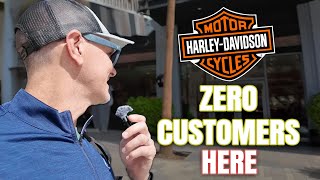
In this on‑location video filmed in Las Vegas, the presenter walks past an empty Harley‑Davidson apparel store and uses the scene to illustrate the brand’s rapid decline. He argues that Harley‑Davidson’s core market has aged past 50, with dealers and buyers now largely baby boomers, leading to a shift toward tricycles for riders who can no longer handle traditional bikes. Attempts to modernize—most notably electric motorcycles—were poorly executed and failed to attract new customers. The presenter frames the situation as an instance of the innovator’s dilemma: catering to an affluent, detail‑obsessed core audience caused product complexity and higher prices, making the brand vulnerable to simpler, cheaper alternatives. He also notes frequent management turnover and inconsistent strategic direction, which have alienated both long‑time enthusiasts and potential younger buyers. The brand’s historic image of rebellious counter‑culture now feels inauthentic to Millennials and especially Gen Z, who view Harley‑Davidson as an “anti‑brand.” The video cites turnarounds at Reebok, Skechers, and Cadillac as precedents, suggesting Harley‑Davidson could recover if it re‑positions itself around authenticity, community, and values that resonate with younger generations. The presenter ends with a call for comments and a link to his newsletter.
Chapters
I have walked past this Harley-Davidson store behind me like 6 or 7 times here in Vegas. It was a Saturday that I was walking by, and now it's a Sunday morning, and literally I have seen zero customers inside of this place in the entire time that I've walked through. And this isn't a dealership, it's one of their clothing and apparel outlets, but it's a total different story compared to where, you know, that kind of brand stuff from Harley-Davidson was just like 10 years ago. Uh, you could not walk 5 feet in a place like Las Vegas without seeing somebody in in a Harley-Davidson t-shirt. Like, the brand has gone from basically everything to nothing amongst this target's market. Walking around here 10, 15 years ago, like, it seemed like every suburban dentist was wearing a Harley-Davidson t-shirt, and the ideas of being kind of a rebel and all that kind of stuff and what that represented, and holding on to the youth and the counterculture spirit of the '60s, like, it was a big deal, and people really embraced it. And now, like, it's gone. The number one thing killing Harley is they super popular amongst suddenly wealthy baby boomers and their customers. Unfortunately, they're getting old. And if you look at the average age of a Harley dealer or Harley buyer these days is over 50. And the number one growing category for Harley-Davidson in terms of the types of bikes they're selling are tricycles because their customers are getting so old they can't hold up the bikes anymore. Look, it's not like Harley didn't see this coming. They saw that their customers were getting older and they started to try to build out these other brands, even having electric bikes. The problem was they just executed on it horribly to the point that the bikes, well, they just kind of sucked and nobody wanted to buy them. Gen X folks like myself who have kids, and there's no way you catch me on a motorcycle these days. It's just too dangerous. It's 200 times more dangerous than riding in a car. Like, why am I going to sign up for that? My wife would kill me. And in the end, Harley has fallen prey to something in the technology space we call the innovator's dilemma. Which basically is what happens when an established mature company like them listens to your core customer really closely. And in those scenarios, what your core customer does is act like aficionados. They start to tell you, "Hey, we want all these bells and whistles. We want these high-end features. We love your product really well. Build all this stuff out for us." And what happens over time is your product gets more complex, more expensive, and eventually becomes pretty ripe for disruption from a cheaper, simpler, and probably more appealing to most alternative. And so you you look at the Harley-Davidson website now, which I did a few weeks ago, like, they were just a cornucopia of different options and all this kind of stuff. Uh, like, basically I had no idea which one of these motorcycles might be for me or which one was potentially my option. They all frankly look like the same bike with just a bunch of different crap on them. And a lot of this just comes back to probably what is the saddest part of the Harley-Davidson story. Which is that so many of the failures are just self-inflicted. It didn't necessarily need to be this way. Just by pure executional mistakes, they've gone through and alienated a lot of their core customers. I put a tweet up yesterday that got a lot of traction. I asked, is there any brand, consumer brand, that has fallen further from grace— and here's the tweet— than the Harley-Davidson brand? And people came out and they're really mad about it. Like they, by trying to appeal to the younger consumer and understand that this disruption was coming and the transition to their customers getting old and dying out, like they hurt a lot of people's feelings along the way. And it sounds like they really didn't need to do that. Similarly, there's been a ton of management transition and folks just not staying the course. And that's one of the things that I think is the lesson from Harley-Davidson here is, you know, if you're picking a direction, Heading that way and doing it well and staying consistent over years, it's what's required, especially when problems like what's happened with Harley are not overnight problems. They've been coming for a long time. Perhaps the toughest thing about making on-the-scene videos in Las Vegas is there is not a quiet place in this whole town. Everything's loud. So where does Harley go from here? Well, I have good news and I have bad news. The good news The good news is there are countless brands in the United States and beyond that have gone through similar trajectories where the brand gets tarnished, out of favor, and then comes back to win. And it's everything from Reebok to Skechers to, heck, Cadillac. And Cadillac is a car brand from GM that went through a similar struggle. At one point, they realized all their customers were getting too old to keep buying Cadillacs. They were all dying. In fact, the last Cadillac I know that was bought out of my demographic was by my grandmother. She was 91. If you're trying to build a sustainable, durable business in the future, Obviously, 91-year-olds are not a sustainable, durable customer base, obviously, for obvious reasons. But in the end, the common thing amongst all those brands that did those turnarounds is they fell pretty far and there's a lot of pain to get through it. And I think that's the same thing Harley-Davidson is going to have to go through to be in a position to be able to resuscitate itself. In the end, I think the future is if the brand can figure out how to speak to what the younger generations actually give a crap about. Whereas baby boomers loved the kind of machismo and counterculture of the '60s and wanting to exemplify that with their brands and, you know, motorcycle purchases. Millennials, they want to be spending time socially with their friends, not being lone wolves. And Gen Z, man, they want the opposite of what is the Harley-Davidson brand, which feels fake and contrived when you're a dentist buying fancy motorcycles and wearing leather chaps on the side of the road. And for Gen Z, the Harley brand is basically an anti- brand for them. They're a generation that's grown up on fake and seeing things that, well, just the internet was pummeling with falsities all the time. So they want authenticity. And when you see some dentist drive up in a $40,000 Harley-Davidson looking all tough with his Harley shirt on, that's the exact opposite of what they want. So I think the brand has a chance. It's just gonna have to figure out how to speak to these folks, and there's gonna be a lot of pain to get there. So, alright. That's my report from Vegas. Let me know what you think in the comments below, and we'll see you next time. Oh, and if you like this kind of stuff, here's a link to my newsletter. I send out weekly emails that are not as loud as casinos, evidently. Catch you later.