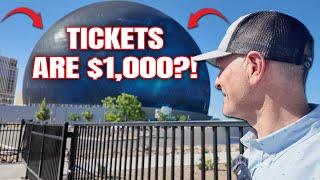
In this commentary, the speaker explains why the Las Vegas Sphere, a $2.3 billion, 17,000‑seat, high‑tech venue attached to the Venetian Resort, lost over $100 million in its first year despite selling hundreds‑of‑dollars tickets. The original construction budget of $1.3 billion ballooned to $2.3 billion because of COVID‑related delays and inflation. The venue’s massive, immersive screen and audio‑visual system creates a high barrier for performers, limiting viable acts to residency‑capable artists such as the Eagles, Dead & Company, or U2. Consequently, the Sphere can only host a few high‑margin shows per week; weekdays are largely empty because residencies rely on out‑of‑state fans. This limited utilization, combined with the venue’s need to share revenue with the few acts that can perform, means the Sphere captures a smaller slice of ticket revenue than a conventional arena would. The speaker argues that the fundamental problem is a mismatch between the enormous capital outlay and the modest cash‑flow generated, making it unlikely the venue will become profitable without a dramatic shift in its business model.
Chapters
So behind me is the Las Vegas Sphere. It's a one-of-a-kind event venue here in Nevada. Well, tonight I'm going to be going to a show here, and I'm going to join about 17,000 other people who have paid hundreds of dollars for the privilege to come and watch a one-of-a-kind concert, well, inside this sphere. And the people that are coming tonight are like me. They've paid hundreds of dollars and some thousands of dollars— not me, but them— uh, to come see the show here. And if you do the math there, 17,000 people times that amount of money per ticket, that adds up pretty fast. It's a shit ton of money. And the problem is the Sphere isn't making any money. In fact, in its first year of operation, it lost over $100 million. Not good. The story to explain why all this revenue is coming in, but these guys aren't profitable running this venue dates back to 2018 when the Madison Square Garden Corporation decided that it wanted to open a one-of-a-kind venue out here attached to basically the Venetian Resort. And that all was great. They had created this concept. It was going to be a one-of-a-kind thing, a destination for folks coming to Vegas. And the original budget to create this was $1.3 billion. Well, then COVID came along and inflation hit, and the budget ballooned from $1.3 billion to $2.3 billion. Actually, those price increases ran into another problem, which is the dynamics of the Sphere. You see, the way the product works inside the Sphere is there's a massive set of screens that make doing a concert here actually a pretty big hurdle. So that means the number of bands that can actually work and be profitable and fill an arena like this is pretty limited because the only things that can make it work are bands that can do residencies, folks like the Eagles, Dead Company, or U2. So you basically have very few bands that can be good tenants for a venue like this. So that creates a problem. If there's very few bands that can fill a place like this, then that means they have a lot of pricing power on a venue like the Sphere. They can cut really good deals such that the venue doesn't take home as much money, say, as a normal venue would in your town or my hometown. The Sphere only works with bands that can do these residencies because of all the AV setup required. That means that there's just, well, not that many nights a week you can fill this place. See, residencies don't work on Monday, Tuesday, Wednesdays because they require people like me to fly in from other states or drive in from California to basically attend those things. So the venue here, the Sphere, it only operates a few nights a week with high-volume, high-margin kind of stuff like the concert I'm going to. A normal arena in, say, in your hometown or my hometown might be busy on Mondays or Tuesdays and making revenue. This bad boy, man, it's pretty much empty or just running kind of B-level kind of stuff that doesn't make it much money at all. Sphere is just a byproduct of the concept of return on investment. In the end, it doesn't matter how much revenue you bring in for your business or for a venue like this. What matters is basically how much of a return you're getting on the amount of capital required. And the fate of this place was pretty much sealed back in 2018. And then by COVID, when the price went from $1.3 billion to $2.3 billion. And today, man, it's tough to see it getting out of, out of being underwater. If you like this kind of stuff, I'll put a link to my newsletter below. I send emails every week. I would love to, well, basically share more stuff like this with you. Subscribe here and talk soon.