Why The Masters Doesn’t Want Your Money
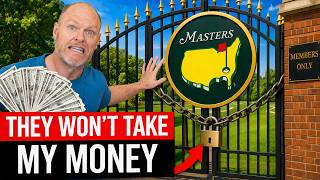
Augusta National built the Masters into golf's most prestigious event by refusing broadcast fees and controlling every detail, from camera angles to concessions. The club admitted its first female members in 2012 and first Black member in 1980. By keeping prices low and merchandise exclusive to the grounds, Augusta generates hundreds of millions in ancillary revenue while appearing above commercial interest.
Chapters
In 2002, a women's rights activist named Martha Burke sent a very polite letter to the Augusta National Golf Club. She had one request: please consider admitting a female member. The chairman at the time was a man named Hootie Johnson, not of Hootie and the Blowfish, but Hootie Johnson was the guy's name. He basically said, someday we may admit a female member, but until then, we will not do it under the point of a bayonet. Then he did something nobody expected. He called the 3 biggest sponsors for the Masters, IBM, Coca-Cola, and Citigroup, and told them not to come back. They were going to run that year's TV broadcast with no ads. For 2 years, they would run the Masters on TV, leaving $20 million in annual advertising fee on the table and making it perhaps one of the craziest businesses in the world. The Masters leaves an estimated $250 million in revenue on the table each and every year. And they do crazy things like sell pimento cheese sandwiches for $1.50 and broadcast their entire event with no commercials whatsoever. And even by doing all this crazy stuff, it is still perhaps the most prestigious elite sporting event in the United States each and every year. So imagine what would make somebody create such a crazy business. Is it greed, elitism, or is it just being incredibly smart and wily? Well, hold that thought. This video is the rise of the Masters.
Oh, and by the way, thanks to Delete.me for sponsoring this video. More on them later.
Back in 1930, a 28-year-old amateur named Bobby Jones did something that nobody else had ever done before, and that was to win all 4 major golf tournaments in one year. A Grand Slam, so to speak. Then he walked away at his peak and retired from professional golf. Jones decided to do something else ambitious. In 1932, he partnered with a Wall Street financier, and for the cool price of $70,000, the pair went and bought a closed-up plant nursery in Augusta, Georgia, with the idea of building a world-class golf club. They recruited a world-class course designer, a man named Alistair McKenzie, and they opened up in the middle of the Great Depression in 1933. And, well, that was the Augusta National Golf Club. The guy from Wall Street, his name was Clifford Roberts, and he was the business end of this whole deal. And the club struggled so bad that they couldn't pay early debts. In fact, their debts at the early days had over 2.5 pages single written, and they had to send letters out. Roberts did, apologizing for being unable to pay their bills. To drum up interest, in 1934, Jones hosted an invitational golf tournament. Roberts, he wanted to call it the Masters, but Jones thought that was too pretentious, and it wouldn't be called the Masters until 1939. The winner of that first tournament was a guy named Horton Smith. He won $1,500 and took home the tournament crown. Outside of the world of golf, nobody cared. Then in 1935, something would happen that would put the entire tournament on the map, perhaps for good. But all of that didn't matter because in just a few years, the Augusta National Course almost ceased to exist entirely. That thing was World War II. The club shut down and was converted during 1942 through 1945 to support the war effort. Same for the tournament. And things got so crazy that livestock was grown on the grounds to support food for soldiers and for the war. In fact, cattle ate some of the famous azaleas that now line the ground. And when the time came to restore the course, when the war was over, German prisoners of war, famously soldiers that had served under Erwin Rommel, were brought in to restore the grounds. In other words, the world's most famous golf course, or at least the most famous one in the USA, was restored by guys who had served in the Afrika Korps under Rommel during World War II. You can't make this stuff up. But back to that 1935 moment that changed everything. A golfer named Gene Saracen was down by 4 strokes with 3 holes to go, basically, well, without much hope. From 235 yards out, Saracen pulled out a 4-wood and hit a shot that went 235 yards and it went straight in the hole. It was a double eagle, one of the rarest shots in golf. Golf fans at the time referred to it as the shot heard round the world. The next day, Saracen beat Wood in a 36-hole playoff. And that amount of drama famously put the course and the tournament on the map. The Squire hit the infamous shot heard round the world at the 1935 Masters Tournament. Crazily enough, national newspapers carried it. And look, if you look at all sports and heck, even this channel, the core of it all is drama and story, rises and falls in tension. And that's what's going on. And exactly at this moment, the world started to see that golf could provide that level of intrigue for viewers, well, around the world.
But before we get into that, I want to talk about today's video sponsor, DeleteMe. Most people don't realize how much of their personal information is floating around on the internet. There are hundreds of data broker websites that collect and sell things like your name, phone number, home address, email, and even information about your relatives. That data gets packaged and sold, which means strangers, marketers, or scammers can sometimes find way more about you than you would expect. And that is where DeleteMe comes in. DeleteMe is a service that finds and removes your personal information from hundreds of these data broker sites. Instead of spending hours trying to track them down one by one, their team handles the removal requests for you and continues monitoring those sites to make sure your information stays off the web. They also send you regular privacy reports that show you exactly where your information was found and what has been removed, so you can actually see the progress that's being made. If you want to take more control over your personal data and reduce your digital footprint, DeleteMe makes the process much easier. Get 20% off DeleteMe consumer plans when you go to joindelete.me.com/girdley and use promo code GIRDLEY at checkout, or use the QR code on screen. That's joindelete.me.com/girdley, code GIRDLEY.
But look, all the story in the world is not going to help you if you don't have a good business. And that's where Roberts, our, uh, investment maker Wall Streeter who was the business mind behind the whole thing, that's where he comes in the picture. And like many CEOs, uh, he was around for a long time. 40 years he ran Augusta National. He was the dictator, CEO, chairman, uh, the ultimate authority on everything Augusta. And like a lot of famous CEOs, Steve Jobs being one, He was totally consumed with every single detail, and he worried about it. What the plants looked like, what advertisers CBS could show, what camera angles they had, what the food was like. He worried about all of it. It had to be perfect. Famously, in 1966, he banned a commentator, uh, named Jack Walker from covering the event for a number of years because he referred to the crowd at the event as a mob. The only phrase he would allow was "Patriots." That behavior set the tone for the decades that would come. In 1994, the club famously banned another commentator for referring to the greens as quote unquote "bikini waxed." Yeah, it was a different world back then. Even today, the announcers can't refer to sand traps as anything except for the appropriate language. And you don't even get to talk about the logos on people's shirts or the prize money. Those things, not kooth at the Masters. So the downside of having these ultimate control of everything dictators like Roberts was, is sometimes they can have some bad ideas and nobody can fight them on it. In fact, as an example, the club didn't allow its first Black golfer to compete until 1975. They didn't admit their first Black member until 1980. And that's the crazy thing about basically extreme personalities. Sometimes they end up in bizarre places. Roberts, at age 83, actually killed himself on the grounds of the Masters in 1977. And Roberts' personality translated into the crazy business model for the Masters. His craziness and obsession about every detail and sense of how things should be— that culture didn't die with him. It continued on. CBS has broadcast the Masters every year since 1956. But here is something that is totally unique in all of elite sports. CBS has never paid a single cent for the broadcast rights. The first CBS broadcast in 1956 had 6 cameras covering only holes 15 through 18. Today it is a virtual technology village doing all kinds of crazy stuff. 120-foot tunnels, all these different platforms and stuff. But the fee is still the same. $0. The US Open gets famously $93 million a year from NBC, and that's not even taking into account some of the crazy stuff like the NBA getting $5 billion a year, the NFL getting tens of billions. There's tons of money out there. Just the Masters doesn't want any of it. Bizarrely, there is no contract. Each year is year to year, all done via handshake with CBS and Augusta. And you would say, well, why wouldn't the Masters sign up for something longer term? You'd have a contract to protect yourself and you wouldn't have to worry about your broadcast rights going to somebody else or disappearing or whatever. But in reality, the Masters does this because they want to maintain absolute control over everything. CBS knows they have to bring their A-game each and every year. The Masters leaves an estimated $125 million a year in broadcast rights on the table. But if they did that, they would give away all the control that they have. As is, they can dictate whatever they want. And today there are just 4 advertisers that typically run each and every year. And those commercials, there's only 4 per hour. Whereas a typical broadcast, when you're sitting through a boring NFL game or NBA game, might have 12 to 18 per hour. Totally changes the experience. And because they have this leverage, it means Augusta gets to do everything their way. The cost is they're leaving a quarter billion dollars a year on the table. In 1997, Tiger Woods became the first person of color to win the tournament at the Masters. He won it by almost a dozen strokes, and the broadcast was so popular. Heck, I remember this time. It was so cool to watch that I was even a golf fan. Got a 14.1 rating, which was like 40-something million people watching the show. It was insane. To put that in perspective, it elevated golf at the time to being up there with like an NBA Finals game. It became the highest-rated broadcast in the history of anything for golf. Nuts. And if you think about it, part of what propelled Tiger to these great heights, besides being one of the greatest golfers, if not the greatest golfer of all time, was this $0 thing that the Masters was doing. Because of that type of thing and CBS feeling like they had to respect the culture of the Masters, they treated it all like a prestige project. And in the end, it turned out to just be a commercial for Tiger Woods. Hard to go against that. 4 left! Think about how differently we would all look at Michael Jordan or Tom Brady if their broadcast was basically like a coronation, like it was for Tiger Woods during those eras. and it just created a sport and something that people couldn't ignore. Which just brings us back to the anecdote that started this whole video, which is Martha Burke asking Hootie Johnson in 2002 when they were gonna admit their first female members. And that's when Hootie said, we're not gonna be changing our ways at the threat of a bayonet. Uh, and then telling all the advertisers, we don't need your money for the next couple years, giving up $20 million a year. They basically, by saying that, was we don't care about any of this stuff. We're gonna be untouchable. And we're going to be the type of tournament and club that we want to be. Then on their own timetable in 2012, they admitted their first two female members, Darla Moore and Condoleezza Rice. If you remember Condoleezza Rice, she's a big deal. She was in the U.S. government, Stanford professor. They made a statement about the type of environment they wanted to have and the type of people that were part of the Masters. And here you have a brand going out saying, we are not beholden to anybody. This is an independent thing, and our brand is we get to be the club that we want to be. The business numbers behind the Masters are absolutely astounding. $150 million approximately in merchandise revenue just in the week that the Masters goes on. Things like private jet slots sell for tens of thousands of dollars around it. And here's the crazy thing. You can't get Masters gear anywhere but on site at the Masters Tournament. Either you buy that Masters gear in person or you don't buy it at all. Heck, they were supreme at inventing merchandise drops before those youngsters even thought about it. The merchandise is one thing, but the food is another. The concessions are crazy. Pimento cheese sandwich, $1.50. Egg salad sandwich, $1.50. Beer, $6. Nothing on the menu over $9. Heck, you can't even get the air to breathe at an NFL game for $9. $10! 10 bucks! Yeah, buddy! You know, if you went to a normal sporting event, This would be $10. Former chairman Billy Payne said, "We take certain things very seriously, like the quality and the price of those concessions. We take that stuff just as seriously as the cut of the grass." And this is smart business. And Costco does this too. Famous for their $1.50 hot dogs. It generates goodwill and helps them make money on the back end. If you feel like they did you a favor only charging you $25 for lunch for 4 people, Well, you're going to turn around and spend $500 on merch in the concession stands without any second thought. And everything about the brand is a throwback to the way things used to be. The top amateur invitees, they sleep in a 30 to 40 foot dormitory room called the Crow's Nest. And the top pros, well, they sleep in rented mansions nearby that cost tens of thousands of dollars a night. Even the trophies reinforce this idea. Of the brand. You get your green jacket for winning. Well, here's the deal.
You don't get to keep it.
You only get to wear it when you come to the club. And here's the thing about Augusta. They go all in. They've spent hundreds of millions of dollars buying all the land around the club itself, doing it under shell companies with NDAs. They want to control each and every detail of the grounds and the experience. One family nearby on Stanley Road refused to sell to the club. Today, their property is entirely surrounded by Augusta National-owned real estate. And all this turns around and attracts the very most elite from around the world. As an example of that is what happens with private jets. They land approximately every 5 minutes at the little regional airport nearby. And if you want to park that airplane on the ground, it can cost you tens of thousands of dollars a night for a parking space. April 2025, Rory McIlroy completed a career Grand Slam. By winning the tournament. The prize? $4.1 million. The total purse that year was $21 million, which has nearly doubled since 2021. You want to attract the best golfers in the world? You got to give them the best reward possible. Viewership that year was up 35% to 19.9 million people. And heck, I said it before, I'm not a golf fan, and even I watched this thing. It was great TV. It was the biggest golf broadcast since the Tiger Woods era. And the most watched non-NFL broadcast in history. Well, second most watched, but you get the idea. So if you do all the math, something crazy is going on with the Masters. They're making a lot of money, but they're leaving a lot of money on the table. Free broadcast rights, doing crazy stuff with the cheapness of the food. All that is just things that you wouldn't normally do. And here's the Masters made it work. So what's going on? What the geniuses behind the Masters have realized is it's all about the brand. And this level of exclusivity, this control that they have over everything, is something that great businesses throughout history have developed, nurtured, and created. You can go back and look at the great entrepreneurs of history who've gotten this right. Uh, Sam Walton, who understood with Walmart that it was about cheap, low prices, and the entire brand and culture built around that. You have Steve Jobs controlling every detail of the early Macintoshes until the iPhone. All that leading back to a certain very important insight, which is that customers are wired to trust in great brands. And once you build that up, it can be an amazingly profitable and sustainable thing for the very long term. And the Masters totally gets that idea. And look, the other side of this argument is that people say the Masters can afford this stuff because they attract really rich people willing to drop a lot of money. But in the end, the reason they want to do that is because the brand is the brand. The Masters is untouchable. All right. Let me know what you think about the business of the Masters and their decisions in the comments below. I try to read them all. Which side do you take on this argument? I'm curious. Catch you next time.










