Working in Startups Vs. Established Companies - Pros and Cons
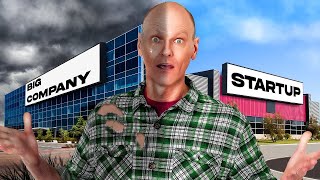
In this talk, Michael Girdley argues that the most effective route to becoming an entrepreneur is to work at a small, early‑stage company rather than a large corporation. He weaves personal anecdotes—from a windowless internship at a big nonprofit institute, to graduating from a small liberal‑arts college, to co‑founding Dura Software—with data from a 2015 New York Times article and Bloomberg Beta’s Future Founders study. The data show that founders are typically older, well‑educated, and most importantly have prior experience at venture‑backed or small companies. Girdley critiques traditional entrepreneurship education that treats startup creation like a recipe, highlighting a hands‑on program at Trinity University as a better model. He outlines three practical benefits of small‑company work: immersion in the startup mindset, close apprenticeship with founders, and networking with like‑minded peers. While acknowledging that big‑company experience can work for a few, he maintains that, for most aspiring founders, small‑company roles provide the breadth of responsibilities, rapid decision‑making exposure, and entrepreneurial network needed to increase the odds of future success.
Chapters
If you're young, my thesis is that one path for you to get into entrepreneurship is to go work at a small company. And when I say small company, I'm very specific about that because I think you shouldn't go work at a big company. And so this whole video will explain why, make the case for it. So let's dig in. Okay, so a lot of why I think about this, well, it's based on some data that I'm going to show you in a bit. There's studies and that sort of thing, but it's also my personal experience. So when I had my first internship in college, I went and worked at this like like very big institute here in San Antonio. And it was full of what was a nonprofit, actually. So it was like big corporation that made money but kind of didn't want to make a profit. What I discovered was those types of places, the bigger the organizations get, the less they feel like startups, the less they feel like entrepreneurship, and they more feel like you're part of a big machine. And so I spent a summer there and basically I don't remember exactly what I did. I sat in a windowless office the whole time and like 4 or 5 days a week my officemate would come in and there was no windows in this office and he had a haircut like Friar Tuck. We didn't do anything important. So that was experience data point number 1 about a path to entrepreneurship. So that was age 19. Fast forward to me turning 21. I've gone to college at a small liberal arts college that is not well known for entrepreneurship, and I'm graduating from the computer science program with a computer science degree. And we have a big luncheon for me and all the other graduates, and they go around the table and they ask everybody, what are you going to do after graduation? And go from guy number 1, okay, I'm going to go work for Andersen Consulting. Oh, I'm going to work for a finance company in New York. And they got around to me and I was like, I have no idea. I think I'm just going to go try figure it out and not rush to get a job. And at that moment, I knew that I had just spent the past 4 years of my life in a computer science program full of people that weren't like me. And some of that is because, again, I was taught this lesson of entrepreneurs and entrepreneurship and the people that are wired to do this type of life, you don't find them oftentimes in big institutions. So fast forward to my late 30s, I'd had a little bit of business success and I started to invest in companies, angel investing, which I later decided I really hate. I'll do some videos on that as to why I hate angel investing. So I'm investing these companies and I would see two types of founders walk in the door and I'd see people that were founding companies that were coming from a huge organization. And what I saw was they had no clue how small company stuff worked. Like they just thought the magic, like, sales fairy would just show up with like some customers. And on the other side, I would meet with people and I would talk to them who had run small businesses. And I saw that these people, like, they actually had the ability to do all the things that happen when you start a business and when you become an entrepreneur. And that really changed my mind about this idea of like, okay, getting a job can help you learn a lot of skills in life and help you learn things towards being an entrepreneur. But potentially you learn different things when you're working at a big company versus a small company. And I've seen the same thing prove out in companies I've started. So, uh, for example, I co-founded a company here in San Antonio. It's called Dura Software. We have 250-something employees now. It's 6 years old, biggest software company in San Antonio. And it was co-founded with me by a guy who came from a big company environment. His name's Paul. He's terrific. And he's been the CEO of the business since we started. When I got to know Paul, one of the things I realized was really special about him is unlike big company people, he shared with me that he had owned and run a restaurant at one point in his career. And I was like, oh, okay. Like, I'm not worried about this guy because he's figured out and survived like the hardest business in the whole world, which is to run like a non-branded, non-franchise, non-chain restaurant here in the United States. It's long hours, tough employees, margins that are tough. And then, of course, that all caps off with like somebody stopping up your toilet right before close and the thing flooding everywhere, and you have to deal with that. And being in a small company teaches you all these lessons that, well, you just can't get anywhere else. So this is my experience, but actually the data really backs this up. So I'm gonna pull up here this New York Times article, and it's titled from 2015 by this— by Claire Cain Miller: The Next Mark Zuckerberg Is Not Who You Might Think. Many people think they know that the founder of a tech startup looks like a 20-something man who spent his childhood playing on computers in his basement and who later dropped out of college to become a billionaire entrepreneur. That's Mark Zuckerberg. But number one, most tech tech startup founders and people who build these like high-growth startups, they have unusual resumes. I definitely have one as well. The average age of a founder is 38 years old, and most of them have a master's degree and have worked for 16 years. So here's where it gets interesting. So Bloomberg Beta took a different approach and teamed up with the Haas researchers to use data about successful founders to try to predict who in the tech industry might someday start companies before they had even begun the process. Then the investors contacted those people and asked to meet. The aim of the program, called Future Founders, was to find a broader group of people who might someday have a billion-dollar idea since venture capital is so heavily revised on referrals. They did things to try to make the sample size more diverse and all that kind of stuff. And so they got to this single thing from their study. There was number one factor that determined whether they were going to be successful at getting funding for their business and whether they ended up starting a company at all. And the number one factor that it was was whether they had worked for a venture-backed company in the past. In other words, the people who are most likely to start a company that got investment were the ones who had spent time working at one of those companies in the past, and they found that people who stayed at the same job for a long time were unlikely to start companies, while people who had tried and failed to start one were more likely to succeed in venture capital on another try. And look, there is nothing wrong with somebody going to work at a big company. And that's one of the things that drives me nuts about commentary on entrepreneurship, especially like influencer types. Like, I guess I'm one too. Like, they want to tell you that, that's— there's only one way you should start a business and that's the best lifestyle. And I think that's crazy. There is nothing wrong with most people wanting to have a job. Like, you look at the average lawyer who lives on my street, a lot of years they make more money than I do. So that's just how that works with a lot lower risk. And so there is nothing wrong with that kind of choice. But ultimately, like, what we see here is there's a high predictive rate of your ability to start a business if you've worked at a business that is early stage or it looks like one that is entrepreneurial. And to me, a lot of this stems from the fact that learning how to be an entrepreneur is totally about something you have to learn on the job. It's not something you learn in the classroom. And that's one of those things that, like, colleges have decided they're going to teach entrepreneurship. And the problem is that most of these programs, they do it totally wrong. They want to teach people that you can learn entrepreneurship by just reading a book or just studying how the steps can work. And I think I'll pull up here on the screen, MIT has this set of steps that they walk somebody through, a 26-step way to start a startup. And it's just like, oh my God, like, that doesn't work. Because like, it assumes that this is like starting a business is like a chemistry experiment. And there are just too many factors that you have to deal with and too many moving parts for there to be a recipe to follow. Sure, there's some principles. And I've talked about that in some of my other videos, like the effectuation videos. And look, there's some schools that do an entirely great in terms of teaching entrepreneurship. Trinity University, located here in San Antonio, with the entrepreneurship program, is run by my friend Luis Martinez. Like, they would basically just give the kids some money at the beginning of each semester, give them some rules, and tell them to go run a business and try to make some money. So that leads to thesis number 1: don't go to the big company if you think you want to be an entrepreneur. Instead, like, because it's a practical field, you want to go find a place where you can join a small company and go learn from the founders who are doing it well, right? And the things you'll have happen in a small company— so I made myself notes here. Number 1, you'll understand and be inside of a small company. You'll work there, you understand how kind of how it feels, right? The routine and the mindset and all that stuff is different when you're in a small company, right? The good ones especially, like, they move so much faster than the big corporations, and the breadth of what each person does is so much broader. Like, when you're working in a big company, you just have your narrow thing and you do that really well. Like, you're an accountant for software in this division in this country, like, you just do that. In a small business, like, you're doing a million things at once when you're a controller or an accountant, right? Just totally different thing. You get a feel for what a small company feels like, and then you're able to translate that when you start your own business. Number 2, this is a practical field, right? Learning entrepreneurship, like, the way to do it is kind of like a blacksmith apprentice, right? You're hanging around the blacksmith. The blacksmith's in there, like, hammering on and making things out of iron or whatever blacksmiths do. I'm definitely not one. Like, you're able to be in a situation here where working in a small company, you're close to the leaders who are doing all the things and making the types of decisions you'll be making when you run your own business in future. So you get to see them, you get to spend time, and you get to understand how they're thinking. And one of the cool things I've seen is you get to learn what they do well, and you also get to watch what they do poorly. And you can try not to do the stuff they suck at or do poorly when you run your own business. And the number 3 thing, which I think is really cool about working in a small business or in a startup for that matter, you get to network with other people who are like you, right? When I was in a big company and I was working there, I tried to do startups. I tried to like moonlight and try to create businesses on the side. And there was a slight problem. I was like the black sheep inside of our company. Everybody else was a big company person, and I was the guy who wanted to go start businesses and hustle and make stuff happen. And when you're in a small company, you can start to network those people and get to know them, and they'll hopefully be more like you as an entrepreneur or an aspiring entrepreneur than somebody who's a big company person. You think about it, these things all are like the exact opposite of what happens for you in a big corporation. The feel of a big corporation is different. You get really far from the leaders, right? The guys who are, and gals who are the CEOs and chiefs of staffs and senior VPs and CFOs. Like when you're in a big company, you never even meet those people. They may not even know your name. The network of folks that you're going to get in a big company, they're not startup people. They're not going to be entrepreneurial and be people you want to do stuff with. Look, there are big company exceptions. I've met these people. Paul, I talked about, spent most of his career at big companies and that's taught him a ton of skills and you can entirely be successful at it. I think people like him are more the exception than the norm. So, and ideally, look, if you're a young person, you're graduating college, you're in your 20s or whatever, like you would just go start a company. But by and large, most young people don't feel like they have the skill set to get there. But a good learning ground is the core thesis here, which is like, go work in a small business, go work close to entrepreneurs that are doing it, see what they're doing, and develop and build those skills. And ideally, you get paid to do it. And then when you go to start your own business or you go to become entrepreneurial, like you suddenly have a set of skills, mindset, and connections that will make the whole thing much more in your favor than if you tried to do it when you first got started. So, and again, look, this is all your life. You can do whatever you want. You just gotta give it a try. But I do think this is a very appealing path. If you wanna become an entrepreneur someday, go work at a small business.










