#142 Career, AI, education, retraining, talent, K-12, higher ed with author/professor Michael Horn
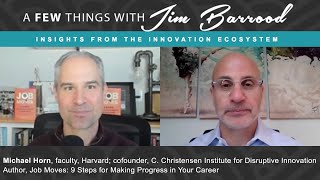
Michael Horn, Harvard professor and co-founder of the Clayton Christensen Institute, discusses how COVID reshaped education toward non-linear schooling and online learning, then shifts to AI tools in classrooms and his new book Job Moves, which applies Jobs-to-Be-Done theory to career changes using a nine-step framework and 15 years of job-switcher data.
Chapters
Hey, friends, thanks for joining me. Jim Barood to hear a few insights from leaders who represent our innovation ecosystem. Today's chat is with Michael Horn, the co founder of the Clayton Christensen Institute for Disruptive Innovation and a professor at Harvard. He's also the author of several books, including the national bestseller job 9 Steps for Making progress in your career by.
Writing books, doing a lot of podcasts, advising universities and companies as they chart their course in the education world, and then teach a class at the Harvard Graduate School of Education on innovation in education.
Fantastic. And you've done so much over the years. Walk us through your career because it's like no other. Why don't we start with high school?
Wow. Okay. Well, so went to a public high school, was super into a bunch of things and really spirited around newspaper, music and tennis were the big three. Went on to college at Yale, loved the experience there. And while there, I really got to know the administration through the Yale Daily News, which, you know, you, you say I was a history major, but I really majored in the Yale Daily News and ended up through that and, and making the most of connections, ended up working for David Gergen after I graduated college, the, you know, political advisor to four U.S. presidents. And then he co founded the center for Public Leadership at the Harvard Kennedy School. And now my neighbor in Lexington, which is kind of fun, but so worked for him for a couple years, went to the Harvard Business School intending to be on the business side of media and as you know, while there, took Clay Christensen's class on innovation, disruptive innovation, and just completely changed my mind about how I viewed every part of the world. And he had this opportunity to co author a book with him on public K12 education, which certainly was not why I went to business school, but it was like, okay, you know, use ideas that I really believe can make a difference in a public interested way. Let's do it right. And so we co authored Disrupting Class. We co founded the Clayton Christensen Institute for Disruptive Innovation, where I'm still the board chair and a distinguished fellow and basically, you know, started it's a nonprofit think tank. And so I led that team for about a decade, focusing on cranking out white papers, testifying in state houses, trying to inspire entrepreneurs and venture capitalists and others to bring about a student centered revolution in the education world in K12 higher education and so forth, which was really fun. Left in 2015. I should say we met probably early in that chapter because I think I was speaking with Clay or, or maybe I was filling in for him when he couldn't make it or something like that. It's something you. You were hosting, which is just funny because I always made the joke, you know, half. Half the height, half the brains, far less than half the cost of whatever Clay was. But. And so there I showed up and. But in any event, when I left the Christensen Institute, it was because my girls had just been born a short time earlier, twin girls. And I wanted a more flexible lifestyle and to be able to work across a lot of different spheres and be conflicted and not worry about some of these things. And so helped an education venture studio, helped stand up an education philanthropy out of the Robin Hood foundation. And then, you know, sort of wound my way. We got acquired by Guild Education. That brought me into workforce learning, really became me, helped me become aware of the world of careers in connection with higher ed. And then, you know, back into the gig economy in 2022 and here I am today. So that was a whirlwind, but. But hopefully gave some sense of it.
No, that's. That's amazing. I know you have a new book. How many books have you written so far?
Good question. I think the number seven, but I'm not 100% sure. You stop. You stop keeping track of after your third? I think so, yeah.
Wonderful. Well, we're going to get to that. But let's talk first about education, since you, you've seen so much and know so much and have really great insights. So we've just gone through, well, now the pandemic is in the rearview mirror, but the effects of it have been substantial. Right. And give us sort of a broad brush of how, you see how that has changed the, you know, the educational system from K12 to university, and then we can dive deep, deeper into it.
Yeah. So what I would say is I had high hopes that it would change it much more than it in fact has. But I think if you're looking for the changes, there are a few. Number one, I think the common thing across all part of Our society, education, K12 education, college and university, frankly, our careers as well, is that everything is less linear. We far more students are dancing in and out of home school to micro school to their neighborhood, public school to a charter school to an independent school and back again. Like it's just winding in ways that I think historically we didn't think that's how schooling worked. And that's also true, I think in college and university and the need to constantly be reskilling and upskilling and our careers are less linear as well, so that's one big change that I think seems durable and lasting. A second one is sort of a corollary of that, which is we've seen a number of states create education savings accounts, which people love to label as vouchers, but they're not really that. They're really accounts filled with money that you can spend on education items. And what's important about that is, you know, you can spend it on tutoring, you can spend it on school tuition, you can spend it on, you know, classes. Right. For, for music or something like that. And what I think is interesting about that is that's helping fuel the equity piece of this, if you will. Right. Which is people who maybe couldn't afford a private school or micro school experience all of a sudden have a range of choices in an unbundled way. Often that that was not true before. And so I think what's important about that is that's contributing to the lack of linearity. It's creating a lot more choices for individuals. I also think it's putting a lot more pressure on the public school districts that I had hoped would transform out of COVID that maybe have been more intransigent in their ways. I think for them to be able to recapture some of those students, they're going to have to break out of their own one size fits all mindsets and start to innovate much more than maybe they've been willing to do. So I think those are two enduring things. And the third one I would just name is in the college university space. The number of individuals enrolled in online university obviously spiked hugely during the pandemic. And yes, it's retreated some, but it's been far more enduring than I think people maybe thought it would be. And I think the reason for that is, yeah, a lot of people who had like zoom School, you know, in a traditional university hated it. But a lot of people found their way to the southern New Hampshire universities or Western governor universities of the world, which, as you know, like, they know how to do online education well. And so if you had that experience, word of mouth referral has just caused those experiences, Arizona State University, et cetera, to really grow, I think, much faster than maybe they would have. And hold on to a lot of those students they started to serve during the pandemic. And what's really interesting is like just give you a little bit of a fact on this, Western Governors University at any given point in time now serving somewhere like 180,000 students. And whereas before the pandemic, you Know, most of these were mid-30s, right. They had a job, they were looking to take the next step in their careers. Now I think it's Almost a quarter, 20% or so are in that 18 to 24 year old demographic. So that's a real sea change I think in who is taking online courses or on, you know, thinking about the online experience now.
Now that is a remarkable fact. I mean that is 5x from before, after. Now let's just dive into the K12 first. You mentioned things haven't changed for most schools. But are there any model schools or model school systems that you point to that have, you know, really changed, progressed, transformed to be a model for others?
Yeah, well, I think some of these micro schools have been pretty exciting, right? As, as exciting proof points out there. I look at like Alpha schools out of Austin, Texas or the Acton academies. There's some 300 plus of them I think worldwide now what Kpod Learning is doing. So I mean here's the other trend. A lot of educators said, I'm done with this sort of compliance mindset. I'm going to create my own school. So these are like, this is very education educator driven movement. They wanted to become, you know, your area, your specialty entrepreneurs. And so I think some of those models, Kai Pod Learning, my tech high rebranded as Open Ed, Prenda Learning, Wildflower, Montessori schools, those are some pretty big standouts that I think are showcasing that there are different ways to do schooling and, and people seem to be gravitating toward them.
Got it. And then on the, the college level, you mentioned a few of the, you know, online strong universities. Are there any examples there besides the, the typical suspects you mentioned that have sort of again leveraged the pandemic to transform into, into a model that's sort of.
Yeah.
Replicable. Because as you know, most universities, change takes forever.
Yes. Yeah. Well, so let's, let's do the pessimistic side first, then we'll do the optimistic side. The pessimistic side I think is frankly we see presidencies 10 years even shorter than ever and a lot of boards quite frankly seem hesitant to appoint the full time president and going to this sort of interim model. And to your point, because change within these institutions takes a long time, I just, I, I don't think you can have a three year presidency and do meaningful change and innovation. Like the presidents who affect this sort of change, their tenures are measured in 10 year plus increments. Right. You know, Michael Crowe is what, 23 years or something like that? Now Paul LeBlanc was 20 or 21 when he stepped down at Southern New Hampshire University. Rick Levin, even at Yale was a couple decades. Right. So, so it takes time to make these big changes. I think what, you know, I'll name a different one, which is Northeastern University coming out of this. So this is the optimistic side again. Obviously their sea change started in 1996. The current president, Joseph A. Has been there since 2006. I believe that co op model, that work, you know, workforce based, integrated learning element of what they're doing, it's a different part of innovation, but I think it's hugely important as the world of work is changing so rapidly and people realize that the need to integrate experiential learning into what they're doing is really increasing. And so I think they're getting a lot of attention and interest of people saying, hey, can we copy pieces of what they're doing? Number one. But number two, as you know, a lot of colleges and universities are financially struggling at the moment, going out of business and so forth. Northeastern has taken this as an opportunity to strategically expand. And so now you can be a Northeastern student in London, in Maine, in Seattle, potentially New York very soon. Right. All over the United States and the globe over time. And so both the global nature, the work based learning I think is really interesting in a place like that.
Yeah, for sure. I mean that model is so impactful. Right. And so successful. However, it takes a long time to build it and that's for other universities.
Employer relationships are not just sitting there and up. Right. Like it is a lot of work. Which I think is why it's a good point because I actually think people like me often say, like, why aren't more people copying it? And the answer is just that it takes a real investment in your communities and employers and helping them learn how to integrate these individuals and integrate them back into the, into the learning and the like. Right. It's not a small logistical feat.
Yeah, for sure. So you mentioned sort of the strain, the challenges of universities. Let's just go at the macro level, because this is a reality, right. The demographic cliff is almost upon us. And the reality is that a quarter of universities may not be around in five years. Depending on that may vary by a few percentage points. But what's your take on. Clearly that's a challenge. Are there solutions? Is there any, Are there any approaches or. I know there's no silver bullets, but anything that you advise, I know you advise university presence all the time. What might, besides consolidation? I mean, what are Some formulas that might work well.
So first to say, I think some consolidation, net net will probably be healthy for the sector because there's too many seats for 18 year olds. Right. To your point, it will be brutal for some communities. And so I think that's where the solutions start is can they innovate into say apprenticeship based degrees? Reach University is a really promising new university that works particularly well in rural communities to educate teachers. And they take paraprofessionals who are on the job, they give them an online course or so, you know, during the week. And then the homework, if you will, is the actual work you're doing in the school. So you're getting a paycheck. They're able to braid workforce funding with education funding to make it free. You're not getting loans and you come out the other side a fully certified teacher and you get that pay bump then and great skills because it's all been practical. Right. And so I think models like that, that really lean into integration with work, models that really lean into improving or showcasing the return on investment for individuals, I think are really important right now. Those are things that can bring in revenue, can create different programs and incredibly important. The third one that I would mention that I think universities ought to be at least thinking about is how do we serve adult learners in our, in our midst? You know, a lot of them are built for that 18 to 24 year old demographic that's shrinking to your point. But actually the demand for upskilling and reskilling in the economy is increasing arguably faster than ever before as the nature of work changes thanks to technology and more. And so are there ways for universities to expand into or, or create partnerships in, to really help upskill and reskill adults who need more and more education at different unpredictable times in their lives. And that's an exciting thing. I think if more people need more education, that should be on mission.
Yeah, for sure, for sure. It might not be as profitable, but it will be certainly on mission.
Yeah, no, I think that's. I mean, look, the trick then becomes cost of acquisition of the students. In some ways they have more disposable income, so it could be more profitable. But it's. To your point, the cost side of it may be you got to work that out and figure out what's our engine to keep them coming in the door. And part of that is, I think again, western governors, Southern New Hampshire give a clue to that. Which is the best businesses. Clay taught us this years ago, which is they nailed the job to be done they don't need advertising to grow because it's a lot of word of mouth referral.
Yeah, for sure. All right, let's talk about AI. You've talked about this, you've studied it, we're all trying to figure it out. But let's talk about those challenges. Let's first talk K12. How are you viewing it? What have you learned?
Yeah. So still more questions than answers and I remain pretty malleable. But what I'll say is I see a lot of entrepreneurship in the K12 sector in specific around AI. A lot of educators trying to play with it, do interesting things. There seems to be two camps, if you will, broadly speaking, one of creating AI tools that are teacher facing. So helping them do their job better, more efficiently able to better connect with students, things like that, or student facing. So helping students, you know, have a tutor beside them or have an AI agent that allows them to do much deeper work perhaps than they otherwise would have been able to do. And I think the, you know, everyone can argue on different sides of this. The people who are building for the teachers first, I think they would say like, hey, AI tutors sound great in theory, but there's a lot of hallucinations, there's a lot of mistakes, we can really damage kids and so forth. I kind of think, yeah, that, that you know, AI is best when paired with an expert because the expert can sort of know when it's going off course. Right. But it can be a force multiplier for that expert. So, so there's a lot to think, you know, that logic makes a lot of sense if it can help me as a teacher better reach myriad of students who are in different places more rapidly. Lesson planned, help me with some of my administrative tasks, maybe help me grade certain components of deeper, richer work projects and written work and things of the nature that gets pretty exciting. And I think there's a place for those AI tutors and those AI agents that maybe help the students do deeper work as well in the sense of like, you know, the not classic non consumption, the disruptive innovation where the alternative is nothing at all. No one's saying it's as good as, you know, Jim sitting beside me, getting to know me on a deep personal basis and tutoring me and us having, you know, that understanding of what really lights my fire and where I am at any given point in time. But for certain use cases, I think it could be better than the alternative. Nothing at all. And, and ideally it will improve to be able to serve more and more students in different in different cases. I think regardless, it is going to be a staple of how we do work. And so there's been this huge fight of oh my God, they're using AI to cheat. Guess what? We're all using AI to do better work in the workforce. Right. And there's a lot of research that shows it can really uplevel work from people who are maybe not as strong on the job. I think teaching us to use it as a productive part of what we do is really important. And I'll tell you in my class that I teach at Harvard, so I'm jumping out of K12 right now, but into higher ed. I tell my students, I expect you to use the AI to do your papers. But I will tell you right now, if you think the AI is going to write your papers, I'm going to see right through it in a moment's notice. Because the content, right, like it's, it's not going to be able to do the analysis. But I hope it sharpens your argument. I hope you use it as a coach to improve your writing and editor to. So that I'm not sitting there waiting through your argumentation trying to figure out what the heck is, you know, what the heck are you actually saying? But it really up levels the whole product. I think we should start expecting that so that people can become even better creators with AI as a tool.
Yeah, I'm glad you mentioned that about integrating it into the classroom. That's the whole key. I guess what I'm seeing is that change management issue where only 5% of the teachers are going to be using it. And you really need a much larger percentage if everyone's going to be on the same plane and there's going to be in the same boat and at the same level of integration because then you have competing forces. One doesn't want any tries to ban it, which, you know, no detectors are good enough these days. So it's a, it's a real dilemma. And are you seeing any universities that are sort of ahead of the curve here? If that's, if that. I know that's impossible to be but. Or close to, you know, the edge here that they're really doing some good pedagogy.
Yeah. So on the pedagogy point, you know, I know the western governors in southern New Hampshires are using AI, right, to harness data, insights and improve the instructional materials and things of that nature. I know Arizona State has a really cool set of supports for faculty members where they will support innovative ideas to develop them. Whether that's for research or teaching. So that's been pretty interesting to see. The Quantic School of Business and Technology that offers executive MBAs and MBAs, they use it in really cool ways to both improve the, the, the quality of the instructional materials that they're putting out and figure out differences, but also, frankly, starting to teach. Like, what do you need to know with AI? What can you do for it, for data analysis, things of that nature. So I think there are schools that are staying on the bleeding edge of it. And there are a lot of schools, to your point, that are sort of like the K12 teachers you just described, which is there's some early adopters, they're super in it, there's a bunch who are laggards, but it's very much grassroots, not sort of a well thought out strategy or, or, or set of plans or models.
Yeah, yeah. I mean, to your point, I think the prospect of an AI tutor, right, has a lot of potential. On the other hand, they're still looking at the screen and maybe with close, you know, in person or personal supervision that might, you know, there might be a formula there that sort of has the best of both worlds.
Well, I think that's the bigger thing, right, which is in that sense, AI is just one more tool, right, in a series of tools. And what I think we've keep getting taught over and over and over again, it was the thesis of disrupting class was if you're just layering technology on the existing classroom, you're just, you know, marginally making it more efficient and so forth. What we really need to do is change the model of learning itself and then use technology in that. And, you know, the, the simple analogy you've seen a lot, I think, is when electricity first came about in the Industrial Revolution, people thought it had to, you know, be central and that everyone was just working at the same clock speed regardless. And then they realized, oh, we can distribute it and build factories that looked, you know, very, very different, right, and enabled very different workflows. And that's when the efficiency and sort of breakthrough gains came online, if you will. I think AI is probably the same thing in education, which is to say, if I have a model that sets me up so that that teacher is not delivering one size fits all instruction, but is instead roaming around the classroom or learning environment or learning studio, you know, working one on one small groups like teeing up big ideas and projects that you're delving into. And then AI is a tool by which I'm learning knowledge or Sort of honing my ideas and the teachers, you know, able to say, hey, Jim, what if you prompted it this way? Or, you know, there's a really cool tool that'll help you accelerate that portion so you can go deeper on this thing that you seem to be interested in. That's a very different learning model. It's much closer to, you know, sort of back to the early 1900s of Montessori. But instead of building blocks and things of that nature, we're using AI, Right. As one of those key tools that I think is when this gets really interesting, which is, I think, your bigger point. Right. This is why we need to think about the model and then how do we use the technology and service of that as opposed to be like, okay, the model's fixed, we're just layering technology.
Over it, you know, and time will tell and the models are getting all, are getting better all the time. But I guess at the end of the day, it really could be the realization of personalized learning, which you've spoken about for a couple decades now.
Long time now.
Long time.
I have much more gray hair and less of it than when we first met.
Yeah, for sure, for sure. All right, so let's move on to the book. Tell us about your book and sort of the thesis of it, how it came about, and then talk us through.
Yeah, absolutely. So Job Moves nine steps for making progress in your career, co authored with Ethan Bernstein, who's a professor at the Harvard Business School, and Bob Mesta, who is the founder with Clay Christensen of the Jobs to be Done theory. And essentially the three of us teamed up basically to understand first, like, what motivates people to switch jobs, what causes them to say, today's the day I'm going to switch jobs. And we did a Jobs to be Done study on that. And, and over time, Ethan and Bob were working together on this much longer than when I was a part of it, but over 15 years, essentially built up a huge data set of thousands of individuals as they actually switched jobs. And to understand what were the root causes of driving those switch. The big idea of the book then is yes, companies hire you, but you also hire your next job. You get to choose where you work for the benefits, salary, et cetera, et cetera, and what trade offs you'll make to do that work and if it's the right fit for you or not. And what I would say is that a lot of individuals, they are, you know, switching jobs more frequently than ever. So they are making progress in some sense through job switches, but they have not internalized this notion that you get to hire your next job. And if that is true, we have built a nine step process to really help you understand what does progress look like for you right now in this circumstance? What's the struggling moments that you're facing that you're trying to solve for, and then really understand what drives your energy, what drains it, what are the trade offs you're willing to make there so you can get the things that are most important. Same thing on your capabilities and assets and skills that you bring to the job. And then we take you through a series of prototyping exercises to really come up with different ways you could get that next job, help you make trade offs in the real job market, understand what they really look like. And, and you know, one of the other big arguments of the book is what you do on a day to day and week to week basis is far more important than what you'll be the title and its benefits and salary and things of that nature. And I think a lot of the advice we give people is out of step with that. We tell them to focus on follow your boss's path or don't settle for anything less than a 10% raise or make sure you get that promotion. The reality is it's inconsistent with the progress that at least 75% of us are trying to make as we switch jobs, which is pretty daunting when you think about it. But it's an opportunity to help a lot of people make more progress, for sure.
I mean, that makes a lot of sense, especially in this disruptive time. Right? That's technology fueled. So a new paradigm, I guess, has to be there. And this obviously, I think, addresses that. Now, is it for younger people, older people, or is there any sweet spot?
Yeah, great question. So the book is written for anyone, I would say, who has had at least one job. So I think there is a very cool adaptation and I've done a couple podcasts and conversations with people who work in the K12 area and people have created companies that are starting to adapt it for the K12 environment. There's some very easy translations to do for the college and university environment, but the book itself is written for anyone who has had one job and then on up. And so we got entrepreneurs, we got blue collar, we got white collar, we got, you know, all sorts of circumstances, demographics, people all over the world in it. But I do think it helps to have had one job so you can start to understand what do I bring into the working world? What really drives my energy and things of that nature. There are proxies for that in the K12 and higher ed world that, like I said, easy to make the crosswalk. But that's not how the book is written.
Yeah. So is there an assessment part of it?
There is. You guessed it. So if you jump on job moves.com and click on Resources, there's a free assessment. It helps you diagnose why, what's the root causes of what's driving me to switch jobs both in the past and in the future. And that's a key part of it that's available for free that I think will help people realize, oh my gosh, the forces that are driving me or have driven me are not the ones that I had sort of thought about or the common advice that you often get when, when, when you say I'm, I'm ready to look for a new job.
That's great. And we'll, we'll put that link in the, in the show notes. So are there any sort of trends you saw as you researched the book?
Yeah, it's interesting. 25 years ago, McKinsey came out with this article, the War for Talent and they had a playbook of what it meant to help retain and keep people, which was largely based on one of the jobs to be done in our book, which is these take the next steppers, we call them quests for progress in the book. And the take the next steppers are not perfectly aligned but pretty closely aligned with sort of our organizational notice notion of climbing the ladder or career progress or you know, taking the next step right in your career. But that means that three out of four of the quests for progress we found so get out, regain control, regain alignment, have almost orthogonal to the career ladder. And the reason I bring that up is what we saw as we were writing the book is the great resignation happened. Millions and millions and millions of people leaving their jobs and then millions and millions and millions of those people who took new jobs regretting almost instantly the new jobs that they had taken. And our sense for that is that they were seeking progression, but what they were really trying to make is progress and they didn't understand what progress meant in their lives. And, and so we hope that the assessment in steps two and three of the book specifically really help people unpack what is progress for you and how do you make a decision that's consistent with that as opposed to sort of what the market is telling you you should do?
Yeah, that makes a lot of sense. That's really forward Thinking what about technology? How does technology play into as people think, you know, what's next or what's best for them? I mean that must have been an important thing to consider for sure.
And it shows up in a couple places. So number one, we know that the half life of technical skills is shrinking dramatically every single year. AI is probably thrown some fuel on that fire, so to speak. And that's changing the nature of work. What that means is when we have step three is people do a career balance sheet where they understand what are my assets, what are the liabilities I need to invest in to keep my assets current and what are the assets I'd like to develop in the future and what's it going to take to develop them. But we don't ask you just to have your a view of your assets and these are your capabilities, your skills, experiences, network, so forth. We want you to also estimate what's the useful life of them. Because what we know from accounting is assets depreciate over time, so too do your skills. And frankly in this technology driven world, they're depreciating faster than ever before. And so understanding with like a cold hearted reality. Take how you know, how long is this going to be useful? What do I have to invest in to keep it useful is really important. I'll tell you a story. One individual we were coaching, she had been an individual contributor, just like awesome coder, great technical chops, started moving into a managerial role, started to be asked to do things cross functionally, cross departmentally in the company. And she feels this real tug of like oh my God, my, the people I'm managing, they value me for my technical chops. And the people who are sort of above me or working with me at my peer level now as a manager, they want me to be leaning into these managerial skills, you know, developing, you know, right, the, the durable skills developing across departments and things like that. And she feels this real conflict and like, so we walked it through right with her. What's the real useful life of these technical skills that have been so valuable into your, in your career so far? She, you know, she labels them their matter much lower frankly than some of these more durable skills in terms of their shelf life. And then we're like, okay, what's it going to take to keep those up to speed? And she starts naming, you know, the investment in terms of programs and education and things, you know, in time that she's going to have to invest to keep them up to speed. And we're like okay, can you do that and invest in these managerial skills that are so important to you and maintain, you know, she had just gotten married, maintain this relationship and so forth. And she's like, oh my God, something's got to give. And so this is where you have to make hard choices and trade offs in our career. And I think this is a big piece of it. The second place, I'll say it comes up big time, Jim, is that people are switching jobs on average every four years in the United States. Among younger generations, it's even quicker than that. And I think a big part of it is like, we love to talk about how Gen Z and millennials are super impatient. They want the world yesterday. But I think, like, wouldn't you also, if you were constantly being yelled at and told your skill set is depreciating faster than ever before, you're going to be completely out of date in a moment. Like, of course they want more responsibility and so forth. So I think that's the second way it's playing into sort of the freneticism, if you will, and the churn in the job market. And then the third one, I will say people are using AI increasingly to apply to jobs, to have their resumes. I won't say doctored, but, but improved to improve open positions. They're trying to make themselves look like superheroes to match these posts that increasingly are asking for crazy laundry lists of skills like the, you know, the entry level role that asks for five years of prior experience. And so we're seeking unicorns and people are presenting themselves as superheroes. This ain't working in my judgment. And so I think AI is actually breaking the online job market even more. And I think we have some ways that you can use AI in the book to help you to, you know, help you prototype different jobs, to help you better tell your career story, things of that nature. But the popular uses of it, I think are actually going to be destructive in the, in the short run at the very least.
Yeah, that makes sense. One last thing related to the book, Michael. Side Hustles. Right. You know, I was just speaking to a university audience the other day and I said, every one of you is going to have a side hustle. It's just. Or many throughout your career. And I'm just curious how you see that in the context of the research you've done, if that's sort of on target. Is that just something that is in the air in recent years?
I'm so glad you asked that question. It is a big part of the book in, in a couple ways. Number one, it's a great way to prototype so you can learn before you make a switch in your career. Because that, that's another thing, right? We're trying to help people learn before they switch, not after they switch and realize, oh my God, that was a terrible move. Number two, it's a great way to help you when you're making trade offs. So what I would say is there's no, this is not a book about the dream job. We do not believe that the perfect job along every single dimension exists, every job you do is going to have some element of suck in it, right? Things you do that you don't love, whatever it is, but can you complement it with these side hustles so that when you look at your overall life, you're actually getting to scratch the different itches you want. You know, easy example of this. One of the guys in our, in our data set, he was looking to take the next step in his career. It was sort of a grow up moment as he moved, followed his, his, his girlfriend who became his wife to a new city. He's like, I gotta have a stable job. He had been a women's basketball coach in college, not, not like a particularly well paying program. And he, so he, he switches into a steady state, you know, government job, like, knows it's going to be there, pays pretty well in a, in a city and he starts refereeing basketball games on the side as a side hustle. Like he gets to scratch that itch, right? He gets to still be part of the players, part of the environment, part of a sport he loves. And he also takes that next step that he needs to right in his career so that he, he's able to round it out. And so you know that this plays itself out, I would say in numerous ways. But side hustles are one great ways to again, prototype, learn before switching to round out the portfolio of what you're doing so that you're not just defined by the job title, but you're instead defined by all the different things you get to do inside. Hustles, I think are an incredibly important part of it.
Yeah, for sure. This has been a great conversation, Michael. We usually talk about or give tips, so we call it just one thing. So what's one tip for parents to help their kids thrive in school and prepare for college or their career?
I would say most kids are limited in their vision of what they can do after school by what their parents do, what the immediate people around them do, what their first responders teachers and so forth do. So how do you combat them? Get a lot of career exploration, get them out there talking to different people, meeting people in different careers, get them in different internships or projects or camps just to learn about what's out there, what are the pathways to get there, and what's the relevance of what they're actually learning in school.
Great tip. Here's another one. One tip for professionals looking to move to a new job or new career.
The biggest myth I think, that people hold about switching jobs or changing careers is that it's this isolated process where I sit in my room, I update my resume, I blitz it out to lots and lots of online postings, and I sit there and pray. In reality, job switching is social. It's done through networks. Largely 70% of jobs are filled by someone in network. And so if you're switching jobs, careers, whatever it is, you've got to get out there and actually meeting with people and talking with them. And I think the best way to do that is, frankly, through informational interviews where you're not yet asking for the job, but you're learning about how the capabilities you already have can map on to that career job you're hoping to have. See where that overlap is. Learn what that day to day and week to week is. Through these interviews, you'll be much more articulate about how you can add value and how you could get hired into that job so you can help them make progress as well.
That's great, great, great way to conclude this. But before we conclude, as you know, I want you to share a poem or a quote or something that's meaningful to you. Michael.
So the one I'm thinking about, Jim, is we're recording this the day after I finished teaching my class at Hugsey, and I do this sort of modified. How will you measure your life.
With.
The kids or not the kids, they're much older than that. They're graduate students, but with the students in front of me. And the quote that was at the heart of where I choked up yesterday with them was that your actual strategy is the product of the thousands of little decisions you make. So I'll say it again and I'll tell the meaning. Your actual strategy, it's not what you say it is. It's the product of the thousands of little decisions you make. And the reason I think that's important is as you think about how you interact with your kids or the, you know, choices you make in your career, it's easy to say, I'm a this I'm a that kind of parent I'm going to be this but the day to day micro things you do define what that your actual strategy is and you so you have to sweat those small details and make sure you don't get veered off course course I love that.
That's a great way to end. Michael, thanks so much. Good luck with the book. Thanks for joining us. I hope you enjoyed the show. Please like it, leave a review and subscribe. See you soon.










