A Generation of Education Innovation Seen Through the Eyes of an Online Education Visionary
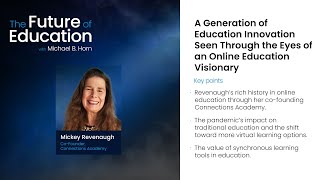
In this interview, host Michael Horn talks with Mickey Revenaugh, founder of Connections Academy and former Pearson executive, about her 40‑year journey in education technology. Revenaugh recounts her early work editing computer magazines for teachers in the 1980s, her role in the federal E‑Rate program, and the founding of Connections Academy in 2001—a venture sparked by post‑9/11 urgency and a desire to connect teachers and learners online. She describes how the company built a vertically‑integrated K‑8 virtual school, the 2011 Pearson acquisition, and subsequent expansion into international curricula (UK, global schools) and experimental technologies (VR, AI, blended learning). The conversation shifts to the COVID‑19 pandemic, where Connections Academy’s existing platform enabled rapid scaling (30‑40 % enrollment surge) and emphasized social‑emotional support, which helped retain the “COVID cohort” and mitigate learning loss. Revenaugh reflects on the differing philosophies of US and UK assessment systems, the evolving role of synchronous instruction, and the importance of data‑driven personalization balanced with teacher‑student “magic.” Looking forward, she highlights two emerging trends: (1) parent‑driven, permissionless aggregation of educational resources (disaggregation of curriculum, instruction, assessment) and the risk of further cultural polarization, and (2) the rise of artisanal, hybrid career pathways—apprenticeships, micro‑schools, and lifelong learning coaches—that blend local, hands‑on work with global, digital collaboration. She concludes with optimism that technology will knit together diverse collectives, offering equitable, flexible learning experiences that reshape K‑12, higher education, and the future of work.
Chapters
Welcome to the Future of Education. And now here's your host, Michael Horne.
Welcome, welcome, welcome to the Future of Education, where we are obsessed with helping all individuals build their passions and fulfill their human potential. And today's guest I know is someone who's maybe even more obsessed with that question than I am, because I get, I'm lucky enough to counter as a friend, Mickey Revanaugh, and she's one of the founders of Connections Academy, which we'll hear about, has been working at Pearson for many years. And then, Mickey, you've recently allegedly retired, but I think you're now part of the hashtag am writing, 5am writing club, or something like that. So, first, it is great to see you. How are you? And how are these first few months of, of not fading quite into the sunset?
It's been wonderful. I would highly recommend retiring to anybody who can, like, live long enough to get there. And I was really fortunate to kind of work with a retirement coach for about a year before I made this move. And her message was, find something that gives you joy to do every single day and stay active, basically. And so I've been able to do that in the 5am writing club. I was keeping UK hours for the last couple of years. So this feels like sleeping in because I am actually getting up at a little bit before five as opposed to a little bit before three. So it's all good. It's very relaxing.
I was gonna say that sounds like a big improvement, relatively speaking, but it's still 5am it's still dark.
It's still 5am there's still a few hours before the sun rises. But I have learned the hard way that early morning is my good creative time and the time when my brain actually functions relatively well. And then it goes way, way downhill as the rest of the day goes by.
I find the same thing. The best writing occurs in the morning when you're fresh and coming out of a dream state. But let's first, before we get into the here and now, and of Mickey's predictions on the future of education and all that, I, I actually think folks would really benefit from hearing your story and how you came together with a couple others to found Connections Academy, I think that was 2001, if I, if, if my memory is correct. So it was certainly before I was in the education space, as you know, because you met me just after my first book was published. No embarrassing me yet, but. But the. I'd love to hear your own founding story and how you came to, with that team, create Connections and you can tell people what connections is, of course, as well.
Sure. So. And I'd like to kind of reel back even about a decade and a half before that, because I got. I first got involved with education technology right around the time when they were rolling out Commodore 64s and the first Apple. Apple computers into classrooms in the mid-80s. So I had been a journalist and, you know, working in writing and editing for what was then my whole life, which seems like, you know, a little sliver at this point. But I got hired at Scholastic actually to edit a couple of computer magazines for classroom teachers, which was a pretty revolutionary concept in, like, 1986. Right. And the thing that really struck me then was that a, the educators that were embracing this were not the young hotshots just out of education school, but instead it was elementary teachers of a certain age who kind of saw this box, this machine, as something that would allow them to do what they always thought they should be doing in their classrooms, which is personalized learning for kids. Energize it, bring excitement in, but also allow students to go down pathways that are unique to them, as opposed to everybody doing the same thing. And, you know, back then, it was not such an easy thing to pull off. I mean, this was even before most shrink wrap software was available. So we had teachers, we would run basic programs in the magazine. You could type it in and a tree would grow on the screen. It's like, oh, wow, a tree growing on the screen. But, you know, pretty quickly, local area networks came along. And then by the mid-90s, of course, you know, the Internet. And I was still, you know, in educational publishing at the time, thinking about what does this Internet thing mean for teaching and learning? And only had a brief time to think about that because I then went to work on the founding of the E Rate program, which was really the federal government's effort to make sure that every school and library in the country, public, private, small, large, you know, poor, rich, could benefit from this thing called the Internet. So it was wiring every school and library for access to the Internet and then internal connections within school buildings. And then, you know, it's evolved ever since then. And I'm thrilled to see that the E Rate is still going along. It's very institutionalized then, but in those early days, it's like, oh, we have $3.2 billion that we're going to have to get into the hands of schools somehow and make sure that it's used really well. So that was sort of my early introduction to the very emerging possibility of what online learning could be because at that point folks were really using it more for going and finding stuff on the Internet and bringing it back into classrooms as opposed to connecting with each other via the technology.
Yeah, I mean that, that was my recollection certainly was. It became a research tool in effect. Right. And I remember in the new school newspaper wiring up the computer so that they could talk to each other, forget about, forget about, you know, pulling something in to collaborate to someone in another school. But that's sort of where you started to go, is to allow people to collaborate over time and space, in effect.
Yeah. And it was the really right around 2000 or so that, you know, I had changed. I did a little startup thing. Right. So one startup and another startup and another startup and all of them were really focused on harnessing the technology to allow equity of access for students, no matter where they were, to really high quality education. And yeah, then connecting people. And so the, the origin story, Connections Academy per se started with actually I call it a cabal of consultants, you know, a bunch of folks that it wasn't a company yet, but I was sort of loaned from one of the startups I was working on to this little effort to figure out how do we use the Internet to connect teachers and learners across space and time and yet make the experience really intimate and high quality. And so the actual birth of Connections Academy was driven quite a bit actually by 9 11. I mean I'm a New Yorker. I was sort of around in those early days after 911 and we were filing our first charter application for this online school and didn't have a name for it. And so I was actually walking along streets in lower Manhattan watching the emergency vehicles speed by and looking at all those posters up on the wal looking for missing people. This sense of both being under siege, but also really needing to find a new way to be in the world. And the idea of connections kind of kept coming back to me again and again. So we said, why don't we call it Connections Academy? And that was all the market research we did to figure out the name.
Of the company are the most authentic. Right.
So that was fall of 2001. The first online schools that we were supporting open in fall of 2002. And so connections Academy, all props to our big competitor in the field. K12.com now call Stride. I like to joke that we are the Coke and Pepsi or the Lyft and Uber of the online learning world. But, but we really wanted to figure out a way to bring super High quality curriculum and content and really high quality teachers into this emerging space of online schools, of virtual charter schools is what they were back at that point. And we tackled it from the hardest place possible, which is K through 8, and did crazy things like built a platform and stuff that I would never advise anybody to do now if they were starting an online school. But back then, what were you going to do? What were you going to do? Put a kindergarten on blackboard? I don't think so. So we really kind of rolled up sleeves and made it all.
Yeah. Which I mean is the founding, I think of most new industries is the first companies are vertically integrated. You got to do it all. Because the parts just don't exist as standalone or if they do, they're not built for your context and use case to your point. So you, you build Connections Academy, you grow it quite a bit. A lot of virtual charters, a lot of students, you start branching into different parts of serving school districts, even with it in a variety of ways. And then obviously it gets bought by P.E. pearson in a pretty big transaction. And you go there and then you have this whole other career of international schools and innovation there. Tell us a little bit about that.
It was really exciting. So you know, the, the development of virtual schools in the US really tracked pretty carefully along the expansion and evolution of charter schools per se and school choice and then the ever refines availability of technology. So you know, back in the day it's like how do we get teachers and students to talk to each other in real time? And then you know, not too long down the line, like Adobe Connect comes along, you go oh, we could use that. But by 2011, which is when Pearson acquired Connections, which was a pretty spicy transaction actually. I think the Pearson powers that be saw it as the future. But a lot of Pearson colleagues thought oh my God, God, what have we done? This crazy like out on the edge, going to piss school districts off in a really big way company that we're bringing in. Is this a smart thing for Pearson to do? And in the end it turned out to be yes. In fact, this really was where everything was going in terms of use of technology. And we'll come to the pandemic in a second. But yeah. And that few years in between there, from 2011 to the time of the pandemic, I was incredibly fortunate to work on a few even more cutting edge things. Like what might this look like if you were serving students around the globe and not just within a state in America? How do you deal with time zones? How do you help students feel engaged and connected with each other if they're from really, really different cultures and really different ways of learning? Then we made it even more complicated by launching a UK curriculum version of the same thing, which I learned so much about. The differences in curriculum approaches that a nation or a collection of nations might take and what that says about what they think education should be. And the UK system is really different than the US system. And. But we found a way to make that work for online as well. And then a little forays into blended learning with some site based implementations and then finding ways into things like a little bit of virtual reality, a little bit of AI and figuring out how all those things fit together as well.
Stay on this for one moment because you just mentioned something very tantalizing about how a country thinks about the purpose of education. What's the lesson that you learned from there? And how would you describe maybe the difference for a US audience versus a UK audience?
So the thing that struck me first and foremost is that in the UK curriculum, and this is true in what is now called the Commonwealth, I guess, but it was really where the Empire was, or everybody who had embraced the UK approach is very much of a sorting hat approach that kicks in really in a definitive way around age 14 and then age 16 and then beyond that, where students, based on really high stakes exams, their future gets determined. Are they going to be university bound or are they going to be vocationally bound? And so much is freighted on the GCSE exam when you're 16 and then the A levels when you're finishing up our equivalent of high school, that the pressure on young people to perform on those things and do it really well has been a defining characteristic, I think, of the British education system for better or for worse. I mean, the good news is that those exams are, I like to call them like the AP exams on steroids. They're very deep, very higher order thinking skills. They're not a bunch of multiple choice questions. They're tough exams. And to prepare for them, you work for a couple of years going deep on subjects. The bad news is that if you're not a great test taker, if you screw it up, you know, it could mean that you're, you know, kind of tracked into becoming a hairdresser or an H Vac technician, which could be wonderful things for you, but it might be that you have then closed off the opportunity for further education and higher education. The US system kind of goes the opposite direction. Right? You know, it's like everybody is supposed to go to college. You know, more and more our high schools are stepping away from a standardized exam as being the key to entry to those things, and much more, hopefully moving away from just seat time and more towards experience and competencies. But those experience and competency things are still pretty cutting edge in the world. I don't, at least in what has traditionally been the British system, those things are just now beginning to be considered. And the anxiety about letting go of them is as much on the part of students and parents as it is on the part of educators. There's a sense that the A level is the great leveler. No matter if you went to a really poor and crappy state school in some bad neighborhood in London or a fancy private school, when you sit for the A level, it's a leveling experience. Yeah. Doesn't always work out that way. It very much tracks socioeconomics the way it does in the US but there is perception. So anyway, very long rambling answer to.
Your very no, it's a super no, it's super. It's just interesting, I think. And, and it's also interesting because I think from a US perspective, I would say, oh, we have a very sorting system. But you're right, relative to a system that was much earlier, it's nothing even close to it. Right. And so there's a lot of just interesting things to unpack there, I think. Let's fast forward then into the pandemic, sort of the capstone, if you will, of your career with connections in Pearson. And what was that experience like? What were you working on? Because all of a sudden, as you said, the world was going digital, in many cases, full time virtual, but not always. And what were you doing there and what'd you learn?
So our first impulse was a little bit of like, you know, man the sandbags with the Red Cross. It's like, we know how to do online learning suddenly every kid in America and really around the world. I mean, I think the UN statistics that we looked at is that 9 out of 10 students were suddenly overnight in an online or emergency remote learning situation, and nobody really knew how to do that except folks like us. Right? And so we sort of jumped in with both feet to advising districts about how to set up and operate online schools, in some cases using our curriculum and platform, in other cases not, but really just trying to bring the benefit of our experience to what was happening in those schools. And then, I mean, the inflow of students to both our US public schools, virtual schools, and to our private schools that serve the globe was pretty astonishing. I mean, you know, 30, 40% increase in enrollment like within a month or two. And that, that was sweaty as you might imagine. It's sort of like because it was, it was a combination of just, you know, capacity, but then also serving what I've been calling the COVID cohort of families and students who didn't necessarily choose that weren't kind of coming to this with a well thought out plan for I really want to be in online learning, but needing to be served well nonetheless. The proudest thing that I kind of came out of the pandemic with is that of that Covid cohort of families that came in, we actually retained the majority of them in persistent engagement with either our managed online schools, the district schools that we help set up, or even our virtual schools around the world. And I think it's because we tried to really hard to pay attention to the soft part of learning, the social emotional part of learning and the engagement between teachers and students and between students and each other in a way that we could do because we already have curriculum and platform. We didn't have to spend all of our time spinning up lessons and just.
Trying to get the best results. That's interesting. It's super interesting. I actually saw some data yesterday from another in person school setting, but during COVID around academic achievement. But it correlated almost 100% to did they feel taken care of socially and emotionally. And they were really, as it was described to me, in a ready state to learn. Well, then they continued to have academic growth. And for those that didn't, you didn't see much growth.
Yeah, yeah, yeah. And our, our virtual public schools, I mean this whole learning loss thing, which you know, I know is a term I kind of hate and I think that's shared. We didn't see an erosion of students academic performance if they were in a full time virtual school and especially if they had been there before, but even if they'd come in since then because the routines and rituals of being in an online school were there already and served that purpose well. And then what's exciting to me is to see the spin off things that are happening from there like micro schools and pods and so on that, that I think a lot of people thought those are not going to last any longer than the pandemic does. And in fact a lot of families are saying, you know, actually that combination of in person custodial care and guidance and tutorial with a really high quality online school is the ticket for my kid. I see Them thriving in that.
Yeah, yeah. So I want to get there in the moment because that's sort of the forward looking thing. I want to come back a little bit to not oral history so much, but more lessons learned. Right?
Yeah.
And for those that don't know, I got to travel around a lot with you on the road in state capitals and stuff and hearing pearls of wisdom that you would drop here and there, but you, you got to see a lot. You got to have a sense of where things should go and we're not going in. In many cases, you made that allusion to the fact that there was this, which I didn't know, actually, this internal sort of angst in Pearson around, hey, is this really a good thing? Is, is digital that important? And. And it was. What, what are some big lessons learned that you take from, you know, these few decades in education?
So I will confess that I was probably not as big of a believer in the, the personal magic that happens between a great teacher and students and that that often that magic is delivered in real time in a synchronous kind of setting. And it's partly because, you know, I spent a lot of time watching teachers do stuff in classrooms that either wasn't a good use of their time or wasn't a good use of their kids time. Right. You know, a lot of classroom management, a lot of boring routine stuff, a lot of things that were frustrating to educators and saw that what the educators that came to work at Connections Academy really loved was the ability to use data and really understand in a sort of scientific and quantitative way how the kids were doing and what to do next. If you go a little bit too far down that path, you forget about the art of teaching. I think that is less about being a great performer and more about tuning into what makes a kid tick. I don't believe that that always has to happen literally in person, but I do believe it is facilitated by careful and intentional use of synchronous instruction. Hard to do in a synchronous classroom with one teacher and 30 kids all on at the same time. Much easier to do in small group. Very easy to do one on one. And so one of the lessons I feel like I've learned is that and just in time for the synchronous tools to get better, by the way, and for kids to be learning living in a synchronous way online outside of school too, is that the use of video, audio and real time instructional tools is really valuable and important and continues to be valuable no matter how good we make the content and curriculum and how engaging that is on its own as the students are interacting with that directly. That combination of things, I think is. Will always be a work in progress and will need to continue to be really calibrated for individual students learning preferences and individual teacher strengths. But we'll never. I don't believe that all one or all the other will ever be effective or as effective as it could be. So that's a big lesson learned. And if you'd asked me, you know, 10 years ago whether how important synchronous was, I go, come on, that's just replicating what we do in the classroom online. It's not. It's not a good use of the technology at the time. And I'm disagreeing with myself now.
Super interesting. That's super interesting. Evolution. One other question on that, because that relates to the international work that you did where you're trying to stitch together and we hear, you know, con World School, we hear, you know, I'm on the board of Minerva University that has a global campus, right? Or global campuses, I guess is the better way to say it. How have you, like, what are the lessons you've learned about the ability to stitch together students from very different time zones, countries, cultures and systems of education, or beliefs about the purpose of education?
I think the. The most striking examples that I saw were actually in the Monday assemblies at Pearson Online Academy, UK Global and Harrow School Online, which were the opportunities for students and all of the teachers and staff to kind of engage with each other in a way that was a little bit informal. And what I saw with my own eyes was that students who had common interests with each other would find a way, even if it meant somebody logging on at 10 at night and somebody else logging on at 6 in the morning to be synchronous with each other and work and collaborate, and that there was almost unlimited joy in that experience for them. Now, I think these international online schools are attracting students who either aren't finding their peeps in their local setting, they're people who are either already globally focused or learn a little bit differently or are training for the Olympics and therefore have their eye on something else. And just being in a collection of other kids like that was, like, such a relief and so thrilling that they were sort of willing to do whatever it took. We also worked really hard to, like, cluster kids together in at least adjacent time zones so that, you know, you didn't have to be on at midnight in order to get the best of your chemistry teacher. And it Worked generally well enough. But I think educators have a inclination to over engineer those things when, if we let ourselves be led by the students a little bit more, we often end up in a really good spot because they know what they need. You know, they know when they need a hug, when they need a push. They know when having two or three, you know, buddies helps and when it is a distraction. And paying attention to that sort of like superstructure of their learning is where I think teachers and school leaders can start calibrating and making it make sense for everybody.
It's very wisdom of Maria Montessori for you. Observe the child and follow and follow them.
Go figure.
Let's turn to predictions in the future of what's going to come because you've always been someone who has bold ideas about what should be there and, but also like really thoughtful reflections of like, are we going to get there? How are we going to get there? Trends to watch and things of that nature. And you tend to see things before others do. So what's on your radar of what's coming down? And let's start there. What's on your radar of what we should expect?
So I am really a little fixated right now on these kind of two sides of the same coin around sort of parent choice and the ability for families to access that idea of permissionless combinations of education resources that make sense for their kid. On the one hand, I think that's incredibly thrilling because I think going even back to disrupting class and thinking about the disaggregation of things that we think of having to be hardwired together and in the education system you see it happening all the time. Young people on their own go out and hunt and pack and find the stuff that makes sense for them and weave it together themselves. Doing that with some really expert guidance and with an eye on the ultimate prize of where do you want to go with your life? I think is a trend that we're going to see continue into the future. And parents are starting to get, I think, a little bit more comfortable with the idea that that could turn out to be a good thing and not not a disaster for their kids. You know, school doesn't have to be a place where you put your kid and then on the other end they'll come out formed that, you know, it's a daily process really. The flip side of that that worries me a little bit is this opportunity to further polarize what is a really polarized culture at this moment. And that's in the US but beyond the US as well. So people being drawn to those resources and those ways of education that reflect how they think already and not being open to other ideas, other influences, other cultures, other ways of thinking about things. And I'm not quite sure what the reconciliation of those two sides will be ultimately. I, I would hate to think that it has to be, you know, sort of the education system insisting on things being done a certain way in order to address the common good. But I'm also. Most parents that I see have that kind of in mind, but quite a few of them don't, don't. And so that worries me a bit. And, and you know, I'm intrigued to hear because you see even more of this than I do. I'm really intrigued to see, hear what you think about that as well.
So I think it's a great question. And I, as you know, in the new book From Reopen to Reinvent, concluded that the only way forward, frankly, was to follow this more pluralistic tendency that I think parents have and not try to force the. Into the one size fits all. Because I think it's just creating a lot of friction and inability to progress. And I'm worried about the same thing. You are on the other side of it as well, that there is a subset certainly that are picking the experiences that they are for fully values aligned reasons on both sides of the spectrum. Right. And so, and frankly, it's probably more of a360 of a view of that than like a left right thing. And I don't know how we get out of that. I think my hope is that by being better educated and creating more ways to connect with others through interests that you share, that you wouldn't have picked through where you moved, that we sort of rebuild the fabric in an under, you know, in, in another way. But I don't know that it turns out inherently that way. I was having this discussion with my father the other day because he said, well, you've pulled your kids into the private school and, and you know, you sort of write like I was like, dad, it's on any dimension you pick. It is more diverse than the public school district we chose to move to and then ironically don't send to. So I, I confess I have a similar worry. But I think the only way through it is not to fight more because I think the friction is so unhealthy right now of pitting people against each other. I don't know though. It's a very good question. I think.
Well, and I think the friction and the digging in of Heels makes me concerned that more families will just exit the system altogether and won't want to take advantage of the guidance or the resources that could make this an experience beyond what you as a parent could figure out on your own. You know, that there's other parents and other resources and this emerging, you know, career path that I see as of success coaches, you know, or learning coaches that can help a family, you know, figure out, like, what is the next best thing learning experience for their student to tackle, either based on where that student ultimately wants to go, you know, for lifelong career, or just based on what they're interested in right now. It's like when you stop being interested in dinosaurs and suddenly get interested in space. Trav, where's the pivot that you can take your kids so that you're building on that and keeping them excited about learning?
Yeah, I think that's a good point. And I, and I guess that's my hope, right, is that if we create more pathways for that, that I'm going to stereotype for a moment. But the person in Vermont and the person in Utah. Right. Who see the world very differently, but they both end up in the space travel unit together as a cohort. Because I do agree. I've come, you know, to believe that these synchronous cohort based experiences are extremely important as well. And all of a sudden you find commonality and maybe tear down visions of what quote unquote, the other is, I hope that's a healthy thing that allows us to progress. And I guess the point being if we hold it back, I just think people are going to continue to exit. And so I don't think you can. I think that's where it's going anyway. So how can we embrace the most positive vision of it to create choice and access for families and kids, including.
Figuring out a way to truly embrace access and equity by having public funding that follows what is now very much of a privately funded experience for an awful lot of kids.
Yeah. And I'm intrigued by the education savings accounts toward the end. And we'll see. And it really does unbundle things in some neat ways. But what else is on your radar?
Oh, so I'm really interested in the pivots that students make over the course of a K through 12 and beyond K through 12 career. And we're probably getting close to a point where we have some longitudinal data around students who have gone through, for example, virtual public school and graduated from that for high school long term. How do they do, you know, what is Their university experiences, like if they go that direction, are they all going to coding boot camp and becoming like tech moguls overnight? Are people floundering because their experience was so different from what is still the mainstream then? My glass half full, rose colored glasses view of that is, how does that then impact universities and work? I think it's in some ways tragically lucky break that the pandemic really interrupted the traditional trajectory of higher ed and the traditional trajectory of work. So as these young people are coming into higher ed, they're encountering the ability to be more hybrid, to have more diverse experiences to pull together university experience that makes sense for them, that doesn't include just going to one institution. And then when they get to the world of work, unless, unless all the CEOs that really want everybody to come back face to face have their way and are like leading companies that are not populated with very many people. Work is going to be a really interesting hybrid experience that involves a lot of twists and turns over a person's career, just as we predicted it would, but in a way that is way more extreme than I think we expected. I believe that young people who have gone through a diverse learning experience on the way there are better suited and better prepared for what that economy is going to be like when they get to it. But I think we're just now getting to a place where we can prove that or disprove it in any kind of structured sort of way.
Be super interesting to watch that. I actually want to try this idea out on you, which is, I've wondered in the same way that we've envisioned some of schooling going back to the one room schoolhouse, more personalization, etc. The good sides of it. Right. And tutoring and things of that nature, maybe a return to apprenticeships as part of that, obviously. But also frankly, I think, you know, the world of work where we went to a central place where we interacted with colleagues is a 1900s creation. Right. Like, or you know, 1800s, I suppose as well, with factories and Lowell and things like that. But you know, for a large part of the history, you worked on the farm, you had your, you know, you had your shop, you had your blocks, right?
Yeah.
And you went next door and like, you're, you weren't that far away. And by the way, your kids maybe apprenticed with you. And in today's world it'd be both the girls and the boys. It wouldn't just. Right. It wouldn't be gendered on that. But I guess, I wonder, is there some of that return to the. To the past, but hopefully a more egalitarian version of it.
I actually think the answer to that is yes. And one of the things that keeps occurring to me around about, like, what is the impact of technology? The impact of technology really is the knitting together of individuals into collectives and a shifting array of collectives that are often driven by the choice of the person, but in some cases may be driven by the institutions they serve, whether that's work or church or university, whatever it might be. And whereas if you were the blacksmith stuck way out in the country, your circle of people that you could interact with was really limited by what you could get to geographically. Now that's not the case. Right. And so I'm really intrigued by the idea of kind of the return of the artisan, you know, someone who is, you know, creating and making things, whether those are made out of, you know, ones and zeros or made out of wax or made out of whatever, and then being able to serve the entire world because of the Internet, you know, and groups of colleagues that come together around projects, you know, around common purpose that, you know, absolutely do not have to be in proximity to each other to get the best out of what it is. And, you know, we've seen a bunch of that happen already, but it's always been sort of on the margins as opposed to the enterprise itself. And I think that genie is out of the bottle. I think we're definitely headed in that direction and hopefully in a way that those artisanal, individually shaped careers are family supporting that you're not off of a safety net that allows you to have health care, still a problem in the U.S. as we know, or interact as a citizen to help drive your community. But I'm optimistic about that. I think people like local. They like local things. They like going down to the farmer's market, and they also like having friends on the other side of the world that they can play games with. And those two things are not counter to each other. They're all part of our experience now.
Love it. And it's about connections at the end of the day.
So there you go.
I think it's a perfect place to end it. Mickey, thank you for your continued thought leadership, your continued bias toward action and all that you've created. And just appreciate your father friendship and you joining us today.
It's been a thrill.
Yeah. And we'll be back. Next time on the Future of Education.










