Anti-semitism in K–12 Schools
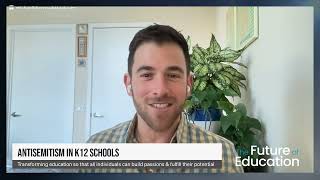
Tyler Gregory, CEO of the Jewish Community Relations Council, discusses the rise of antisemitism in California K-12 schools since October 2023. A Bay Area poll found only 28% of Jewish respondents think schools are handling it well, with one-third witnessing incidents. Gregory calls for better teacher training and integrating Jewish history into ethnic-studies curriculum.
Chapters
Welcome to the Future of Education. And now, here's your host, Michael Horne.
Welcome to the Future of Education, where we are dedicated to building a world in which all individuals can build their passions, fulfill their potential, and live a life of purpose. Since October 7, 2023, in this country, we've seen an outpouring of hate, and specifically anti Semitism, across schools. The story has been well known and well told in higher education and our colleges and universities. It's also occurred in our K12 schools and districts, and we haven't covered that nearly as much on this particular podcast. And so I'm excited to delve into that today. But before we do so, I just want to address what some folks have asked, like, why are we covering this as a topic for the future of education? And I think the reason fundamentally, is that hate, antisemitism, so forth, raises big questions about the discourse and behaviors in our schools in the future. It raises big questions around free speech in our schools and to the point of the work here, it raises big questions around how we support each and every single individual in realizing their full human potential, regardless of their race, creed, beliefs, on and on. And so I'll also admit as. As this has begun over the past now, year and a half, this is personal as well for me as a Jew. But I think it raises larger questions and to help us think through them, I'm delighted that Tyler Gregory is joining us because, Tyler, you actually know something about this much deeper than do I. You've been on the front lines of this as the CEO of the Jewish Community Relations Council, the largest collective voice of Bay Area Jews in California. Under your leadership, JCRC pushes for a just world where Jewish identity is embraced and all people can thrive. And I think it's important to note before you jump in, you all have mobilized multi ethnic, multi faith coalitions to fight back not just against antisemitism, but to show up for lots of groups who have felt marginalized or experienced discrimination from black communities. The Asian Pacific, Asian American Pacific groups, obviously, anti lgbtq. Sorry, I cannot talk today. Anti LGBTQ groups and so on and on. And so this is an incredibly important set of topics, not just on the narrow prism of anti Semitism, but much more broadly, of course. So, Tyler, welcome to the show. Thanks so much for being here.
It's my pleasure. Thanks so much for having me, Michael.
Yeah, you bet. And I'll do my best to talk a little bit better as we get going on, but you get to do most of the talking, fortunately, so.
Sure.
I just want to have you give us the ground state of things. If we go back to October 6, 2023, what was the state of antisemitism in California K through 12 schools specifically? There was a lot of conversation, I will say, around a proposed ethnic studies piece of the curriculum that some people felt had anti Semitic efforts. So I'd love you to sort of give us what was the state of play prior to Hamas's attacks and maybe how that's been similar or different from other states in the US that you've observed.
So thanks so much, Michael. I would say that the October 7 attacks accelerated a trend that we had previously been seeing, which is an increasing amount of antisemitism in K12 schools, both environmental as well as in curriculum. You mentioned the ethnic studies course that is now going to be mandated in California schools, and other states are following suit. We had a wake up call almost five years ago when the proposed state model curriculum included anti Semitic rap lyrics that were references to the Israeli Palestinian conflict. It was our community's wake up call. And this discipline historically has not included Jewish Americans. Jewish studies departments in higher ed have been separate from ethnic studies departments. Asian Pacific Islander, Latino, African American, Indigenous communities in ethnic studies. But they started writing about us in derogatory ways, and they decided that the Middle east would be a disciplinary area that should be included in ethnic studies. And so that experience was a wake up call for us that we needed to play catch up and also figure out how we wanted to fit into the story of ethnic studies. And so that's been a hotspot for us. But so too has been casual antisemitism on the playground, in the classroom, and often more of dog whistles than overt forms of antisemitism that maybe your or my parents, Michael, might have experienced as kids. And so we have a lot of work to do to help teachers and administrators recognize those dog whistles and how that leads to exclusion for Jewish students today.
So then, I mean, that's obviously a disturbing state of affairs that had been escalating. I assume it goes into overdrive, sadly, starting October 7th.
But.
But just talk to us about what the last school year looked like before we get into this school year, just, you know, in the, in the schools themselves. I suspect you have stories of parents and students who've reached out to you and told you, give us a sense of the state of play, whether that's through stats or the stories to really help us understand what was going on.
Yeah, the challenges have evolved. So in the days after the horrific attacks the main issues that we saw were from parents that felt the response from school districts to their communities were either inadequate, non existent, had implicit biases, or there were other problems with the way they were communicating. And you talk about belonging on your show. This is really a moment for Jewish students, parents, families, teachers to feel like they belong as part of that district. And I think a lot of folks listening might not understand how these terrorist attacks impact Jews in America. This was the single deadliest day for the Jewish community since the end of World War II, since the end of the Holocaust. And that collective trauma, that generational trauma, was felt across the Jewish world whether we had direct connections to Israel or not. And so for a kid to show up on October 8th after that, whether they had a direct or indirect relationship to what happened, that was a traumatic event for all of us. And that was a time for them to be seen, felt heard in the same way, the response from school districts that we saw after the murder of George Floyd with Black Lives Matter, after a wave of Asian hate, particularly here in San Francisco, where one out of three residents are Asian Pacific Islander, we saw the response from school districts to those acute moments for those communities. And we had the same expectation that school districts would hold our community in the same way. And sometimes there were insensitivities, sometimes Muslim and Jewish students felt pitted against each other in these communications. And so that led to a lot of concern, if not disturbance, depending on the communication. In terms of how administrators were communicating to their constituents about the issue, did.
You see like in the classrooms themselves, teachers lash out in different ways and districts, how did they respond if that happened? What was sort of. Because, I mean, right. On higher ed campuses, I think a lot of people saw the protests, right? They saw the sit ins and this, you know, basically encampments in many cases, and then the administration saying, yeah, it violates a policy, but we're going to sort of look the other way. What was going on in K 12 school districts themselves, in the classrooms, on the playgrounds around this, outside of the district. Initial response.
So as you can imagine, things got more complicated as Israel responded to the attacks and went after Hamas in Gaza, which is a incredibly challenging condition to conduct a war. You go after terrorists that are hiding under civilian populations. Gaza is one of the most dense places in the world and, and a debate, and I don't think this is the place to give my personal opinion on what's happening, but there is a robust debate and differences of opinion. And no matter what school district setting you're entering you're going to have a multitude of opinions about what's taking place for the war. So once Israel's response started, it got much, much harder for administrators to figure out how to hold everybody, including places where you had Israeli and Palestinian families both in that district. And you saw activism, much like on higher ed campuses. We saw Gaza walkouts in Oakland and San Francisco Unified School Districts. And most administrators were woefully unprepared on how to handle that because you'd have a set of activist students and in some cases teachers, which in our mind crosses the line, call for their fellow students to walk out. So what happens if you're a Jewish student that's sitting there and you're not participating? You feel vulnerable, you see that you are being judged by your peers. There is not a good way for the teacher to address the situation in the moment. I would say there are some bad actors and we can talk about that. But for the most part, what we're seeing is a lack of competency on how to hold Jewish and Muslim students through this traumatic time.
So maybe. Actually, let's jump into that because I'm super curious. It sounds like it's more of a story of we just don't know what to do to handle these challenges. How do you like. Obviously, JCRC has been providing resources, I imagine, to help educate district leaders, school principals, etc. About what the proper response is. How have you all thought about how to hold these two? You know, divergent. Two is actually probably the wrong word, right? To Jews, three opinions. So it's probably multiple. Multiple opinions and divergences in a community. How all. How have you recommended people start to respond or lead their schools and districts given those conditions you just described?
Well, one thing we quickly discovered is that in diversity equity inclusion programs or in diversity trainings, the Jewish American experience is lacking. And you could say the same thing about Muslim Americans. And so the first thing that we worked on was retooling our anti Semitism and Jewish identity training to support administrators and teachers to make sure that they had the core competency to understand what a Jew is. And Michael, you know this as well as I do. Judaism is our religion. Jews are a people. We have peoplehood. But in many places. And this is not something to criticize if you're not fully versed in this. People conflate our religion with the rest of our identities, our culture, our nationhood, our relationship to Israel, or our secular nature. You can be an atheist Jew, right? And I think that our identities have been flattened in this Christian country such that teachers and administrators don't quite know how to put us in a box. And that's a very complicated thing to work through. So if you don't know who we are, how are you going to hear the dog whistles that weaponize various parts of our identity? And that's the way that we try to educate K to 12 leaders to make sure that they understand and can better listen for the ways in which our religious, cultural, political connection to Israel is weaponized in ways that echo forms of anti Semitism that, that have existed long before the modern state of Israel, for example.
Yeah, it's super interesting as you get into that because Rabbi Wolpe, he's long made the point, right, that Jewish as a construct predates the Western constructs around race, religion and so forth. It was sort of an amalgamation of a lot of these things and you just described them. Even if you go to Israel now, you'll see secular atheist Jews, deeply religious Orthodox Jews, right. And everything in between traditionalist and so forth. Get, you know, that doesn't even get into the divisions we think about popularly in this country around Reform, conservative and so forth. It's much, much deeper and multifaceted. So the training, as it sounds like, is actually fundamental ground level education of just even understanding what is going on and what you're seeing in your context. I'm curious, that sounds like it would not provoke maybe the backlashes that some of the DEI trainings we know historically have, have done. But I'm sort of curious about the effectiveness maybe more to the point, because we also know DEI trainings, but also frankly, Holocaust trainings have not been super effective often in protecting the populations that they're intended to. How, how do you all think about, you know, measuring that or protecting against it?
Well, what I would say is too often when we think about longitudinal a student's experience with, with Jewish identity and antisemitism, when they have a ancient world history course, they learn maybe there's a couple lines about ancient Israel and the Israeli kingdoms when we're talking about the Roman Empire. And then maybe we talk about the Jewish American experience after the Holocaust. And there's certainly a Holocaust education component that is from 1933 to 1945. Right. But Jewish history spans 3,000 years. And so that's why we think that Jewish identity should be a part of ethnic studies and that we do need to educate people about the multiple elements of our identities and talk about not only the bad things that happened to us, but to celebrate what we have contributed to this country. Jewish sports heroes, Jewish elected officials. Ruth Bader Ginsburg People should understand how we celebrate being Americans as the Jewish community and the ways in which we've contributed to this country. And without ethnic studies, really, we're only talking about bad things that have happened throughout their history. And Michael, you know that most of our Jewish holidays are about overcoming the bad things that happen to us. And, and at the end of our holiday, whether it's our Passover Seder, we usually say, and let's eat, let's celebrate l'. Chaim. Right? But we can't just be in this victimhood mentality. We have to talk about who we are, what we believe in, talk about Jewish joy and what we mean to this country. And that's why I think whether we're newcomers or not to ethnic studies, there is a meaningful place for us in this story about what it means to, to be Jews in this country. And that's something that I don't think takes away for those that don't want Jewish Americans to be a part of ethnic studies. We're not trying to take away any other experience from being a part of this. We just think that the Jewish kid in the classroom that's going through an ethnic studies course could equally benefit by being seen through this discipline in the same way that we touch on Holocaust studies or helping kids understand what antisemitism is.
Super interesting. It's a very similar answer to the one Dara Horn gave me when I asked a similar question. I'm just curious and I'd love to dig one level deeper, as I did with her actually on this, which is how do you make sure, frankly for ethnic studies in general, but also the Jewish component of it. It's not just one more thing on a long list of items that schools should do because there's limited time, there's lots of competing interests trying to get their segment in. Why does this rise to the top in your view or inclusion? Or are there other way ways to go about this, maybe that get the principles across but create more freedom for. Okay, what's the precise knowledge or specific standards we're going to study as we learn about principles of frankly not dipping into anti Semitism, but hate more broadly?
I think you got to tackle both layers, Michael. We as a community are often the canary in the coal mine of a health, of a democracy of society as the Jewish community. And so to help students understand that a multiracial, multi ethnic democracy, when one community is targeted, it often leads to other communities being targeted. And if you look historically to Jewish communities around the world, 1920s Germany was a golden era for Jews in Germany. In that democracy. I'm a gay Jew. There were gay clubs in Germany. And we saw how the Jewish community was a canary in the coal mine for what was happening and the steady march to fascism in that country. And so we don't think anti Semitism is only a Jewish problem. But if you, if you zoom out and you look globally, oftentimes we're a scapegoat that is a harbinger of things to come and a measurement of the health of the society that we're living in. And so we think that we can talk about this in a much broader lens where we're helping people understand historically what some of the consequences can be when the Jewish community is targeted. I also think there's not a one shot to this. I don't see a silver bullet. The more ways we can integrate our very small minority in the Context of America, 2 to 2.5%, depending on the day, the better chance we have of reinforcing what our community means.
Super is super helpful and interesting. Let me ask you this, because one of the contours of debate that have has come up in the higher ed context, right? So we lay the education piece. People still have different viewpoints. How do we think about the line between free speech, you know, students expressing viewpoints about Israel or say, you know, maybe less savory ones, around support for hamas, even Tinker vs. Des Moines stuff, right? Supreme Court case of the. The ability to express your views freely. You don't lose those when you enter the school doors, but how do you think about that tenant, if you will, of the American experience? And when this crosses the line into blatant discrimination, bullying and stuff, that is not okay. How do you think about that? I guess in general.
So for better or worse, anti Semitic speech is free speech. I think when universities uphold free speech as their gold standard, we ask them, okay, if you're going to allow this kind of hate speech, where Israel is the scourge of the earth and responsible for all these ills that extend beyond what a tiny economy in the scope of global affairs could possibly achieve, we ask, where are you exercising free speech? If this is such an important value to you, why are you staying silent? When Jews are not allowed to go to the library because they're being blocked? When are you staying silent? When terrorism is being glorified by certain campus groups, we can respect their value, but where we lose faith in their abilities is when they don't practice what they preach. And too many universities, and since we're talking About K to 12, unfortunately, too many districts are staying silent in the face of these discriminatory acts. And so that's where we would like to see education leaders step up right now.
Do you think there's a different line from K12 to higher ed in terms of how teachers, you know, you mentioned the ethnic studies curriculum, obviously, and getting Jews included in that curriculum and an understanding, frankly, of Judaism more broadly built into it? You know, in higher ed, there's this sort of sense of academic freedom. Right. Professors, they create their own courses. I get to lecture as I, as I view. Do you see that extending into curriculum in K12 as well, or is there a different way we ought to think about academic freedom, slightly different from free speech, but still, you know, related. And these noxious viewpoints that you just talked about that perhaps we're not calling out as clearly as we might?
It's a, it's a tough question. And I think teachers have a right to bring their own lived experiences into the classroom so long as it does not target the experiences of other students. And unfortunately, we're seeing too much of that. We're seeing, and this is a tough issue to talk through, but we're seeing Palestinian flags. If a teacher is a Palestinian American into the classroom and there's a Jewish student sitting there not knowing how to feel, are they going to be graded poorly? Are they safe being in that environment? And that gets really tricky because we don't want to deny a Palestinian their identity. But these symbols that for some people are personal are otherwise political. So I think we have a lot of work to do to figure out how to massage those issues. But we also don't want to deny the lived experience of teachers, which can be so rich for students to learn about. So I think it's a balancing act. And I wish I had a clearer answer for you.
No, no, this is good. I mean, I frankly, I think delving into the shades of gray is what's going to make us stronger over time. And as you said, you know, your mission has really been these trainings around the education to get awareness into the schools. I'm curious what you're starting to see, the fruits of that. What does the school year look like? You say, you said some of the anti Semitism has morphed maybe over time. Where are we now? How are we doing? What else do we need to do as we think about charting a path forward for all students?
Yeah. So we did a Poll a few months ago, Bay Area Jews, a random sample public poll. And we found that only 28% of Bay Area Jews are satisfied with how K12 schools are tackling antisemitism. We also found that one out of three Bay Area Jewish residents have personally experienced or witnessed antisemitism. And then we asked those folks, did that happen? And about 30% of them said that that happened in a school setting second only to social media. So we think that it's a prominent source of the challenge that our communities face. And we have a lot of work to do still. What we're seeing this year is more of the incidents that we're getting calls with are classic anti Semitism rather than weaponization of the war. So classic anti Semitic tropes about Jews having too much power or privilege. And I don't think that we're quite to the bottom as to why that is, but the level at which we're getting those calls is clearly inspired by what happened last year. And so, in the same way, I don't want to get too political on here, but after the initial election of Donald Trump, we saw a Pandora's box open on the far right with anti Semitism. October 7th seems to have led to a Pandora's box opening with far left anti Semitism. They look and feel differently. They're different types of threats, but that permission seems to continue to exist. And our job is to make sure that those forms of hate stay on both extremes and not creep into the mainstream of our society. And unfortunately, it seems like public and private education is one of the most important battlefronts in which we're dealing with this problem?
No, super helpful, Tyler, as we wrap up here, just any other thoughts that we should be thinking about work that you're doing that you want to spotlight or conversations that we ought to be keeping an eye on as we progress through the rest of the school year.
One thing that we think is really important to lift up, but I will not give any illusion. It's easy. It's important for students to see Muslim and Jewish leaders talking to one another. And I think districts see, okay, we got to have our anti Semitism module. We got to have our Islamophobia module. We need to have an assembly dedicated to Jewish Americans and Muslim Americans or Palestinian Americans. That's great. But if there are divisions in a classroom or in a school or even among parents, what better way to get them to change the tone of the conversation and lower the temperature and tensions than to see Muslim and Jewish or Israeli and Palestinian leaders talking to one another with civil discourse. And that's a broader conversation just in the context of this civil discourse. But if they can see role models talking through differences about how, despite the fact that the war is 6,000 miles away, both of our communities are in pain and trauma and that actually we have a lot more in common culturally and as immigrant communities than we do are divides over what's happening there, maybe we can start to build bridges and change the way that we're having this conversation. And so we work with a Muslim organization both to provide joint trainings and to model civil discourse. And. But there are a lot of amazing organizations both in Israel, Palestine, and here that are trying to bring Jews, Muslims, Israelis and Palestinians together. And to model that in front of students goes a very long way. And so that's something that I think we need much, much more of as this issue plays out.
That's a very hopeful note to end on. Let me ask you a final question. How can people find out more about JCRC and follow your work?
You can follow us jcrc.org and learn much more about our education trainings. We'd be delighted to work with you.
Perfect. Tyler, thank you so much for joining us and for all of you, we'll see you next time on the Future of Education.










